Home Blog Page 17

“Nation First”: PM Modi’s 7 Appeals to Indians Amid Global Economic Uncertainty

0

Prime Minister Narendra Modi has urged citizens to adopt a series of lifestyle and economic measures aimed at protecting India from the impact of the ongoing global crisis, particularly rising fuel prices and supply-chain disruptions linked to tensions in West Asia. Speaking at a public gathering in Hyderabad during his visit to Telangana, the Prime Minister said that in difficult global circumstances, “nation first” must take priority over personal convenience.

The appeal comes at a time when global crude oil prices have surged because of the prolonged conflict involving Iran and the United States. India, which imports a major portion of its crude oil and gold, faces pressure on fuel prices, foreign exchange reserves and import bills during such international crises.

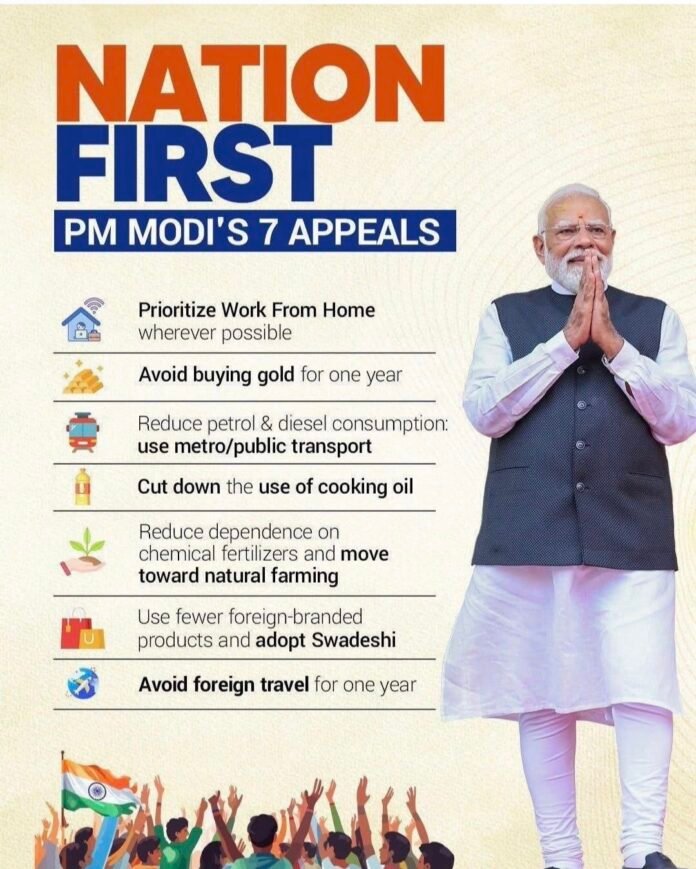
During his address, PM Modi outlined seven major appeals to citizens. One of the most discussed among them was his suggestion to revive Covid-era work habits such as work-from-home, virtual meetings and video conferencing wherever possible. According to the Prime Minister, reducing unnecessary commuting can significantly lower fuel consumption and help conserve foreign exchange reserves.

He also appealed to people to reduce the use of petrol and diesel and prefer public transport systems like metro rail services. He encouraged carpooling and greater adoption of electric vehicles, saying collective small efforts could reduce India’s dependence on imported fuel. Businesses were also advised to shift cargo movement towards railway networks wherever feasible.

Another major appeal was to avoid purchasing gold for one year unless absolutely necessary. India is among the world’s largest gold importers, and high gold imports increase pressure on foreign currency reserves during periods of economic stress. PM Modi said reducing non-essential gold purchases would help the country conserve valuable foreign exchange.

The Prime Minister also urged citizens to postpone non-essential foreign travel, overseas vacations and destination weddings for at least a year. Instead, he encouraged people to support domestic tourism and prioritise spending within the country.

Beyond fuel and imports, PM Modi also spoke about reducing cooking oil consumption for health and economic reasons and encouraged farmers to reduce dependence on chemical fertilisers by moving towards natural farming methods. He further appealed to people to choose more Indian-made products and strengthen the “Swadeshi” spirit to boost self-reliance.

The Prime Minister’s remarks have sparked political debate, with opposition leaders criticising the appeals as a sign of economic strain, while supporters described them as preventive and patriotic measures aimed at protecting the economy during uncertain times.

Whether viewed as economic caution or a call for national discipline, the message reflects growing concern over how global geopolitical conflicts can directly affect everyday life in India. Through these appeals, the government appears to be encouraging citizens to participate collectively in reducing economic pressure and strengthening the country’s resilience during a volatile global period.

National Technology Day 2026: Celebrating India’s Scientific Achievements

0

India celebrates National Technology Day every year on May 11 to honour the country’s achievements in science, technology, and innovation. The day marks a historic moment in India’s scientific journey, the successful nuclear tests conducted at Pokhran in Rajasthan in 1998 under Operation Shakti. These tests established India as a nuclear-capable nation and showcased its growing technological strength before the world.

The significance of the day goes beyond the nuclear tests. On May 11, 1998, India also successfully test-fired the indigenous Trishul missile and conducted the successful test flight of Hansa-3, an indigenously developed aircraft. These achievements highlighted India’s advancements in defence technology and aerospace engineering.

Recognising the importance of these milestones, then Prime Minister Atal Bihari Vajpayee declared May 11 as National Technology Day in 1999. Since then, the day has been observed annually to celebrate India’s scientific progress and encourage innovation and research.

National Technology Day is important because it reminds the nation that science and technology are essential for development, security, and self-reliance. In today’s world, technology plays a major role in almost every field — healthcare, communication, education, agriculture, defence, transportation, and business. The day recognises the contributions of scientists, engineers, researchers, innovators, and startups that are helping India become technologically stronger.

India has made remarkable progress in areas such as space exploration, digital technology, artificial intelligence, renewable energy, biotechnology, and defence manufacturing. Organisations like ISRO , DRDO, and various scientific institutions have played a major role in strengthening India’s global position in technology and innovation.

National Technology Day is celebrated across the country through seminars, exhibitions, workshops, award ceremonies, and educational programmes. Schools, colleges, and scientific institutions organise activities to promote scientific thinking and inspire young minds to pursue careers in science and technology.

The day also reflects the vision of an “Atmanirbhar Bharat” or self-reliant India, where indigenous innovation and research become the foundation of national growth. It serves as a reminder that technological advancement is not only about machines and inventions but also about improving lives and building a stronger future for the nation.

As India continues to emerge as a global technology hub, National Technology Day stands as a tribute to the country’s scientific spirit, innovation, and determination to lead in the modern world.

US Proposes Higher Minimum Wages for H-1B Workers

0

The United States Department of Labor issued a proposed rule on 27 March 2026 to raise minimum salary thresholds for H-1B visa workers. The proposal covers H-1B, H-1B1, E-3, and PERM labour certification programmes in the United States.

H-1B Visa Wage Framework

The H-1B visa is a non-immigrant work visa used by the United States for speciality occupations that require theoretical or technical expertise. The visa is linked to prevailing wage rules, which set minimum pay levels for foreign workers in relation to local labour-market data. The proposed rule is titled Improving Wage Protections for the Temporary and Permanent Employment of Certain Foreign Nationals in the United States. The Department of Labor has stated that the existing wage levels were fixed about 20 years ago.

Proposed Wage Levels

The proposal seeks to raise prevailing wage floors across four experience levels. Level I would move from the 17th percentile to the 34th percentile of wage data, while Level IV would move from the 67th percentile to the 88th percentile. For an entry-level software engineer in San Francisco, the minimum H-1B salary would rise to about 162,000 a year. The proposed minimum salary for similar roles is about 113,000 in Dallas and about $132,000 in New York.

Public Consultation and Policy Background

The proposed changes are open for public comments until 26 May 2026. After the comment period, the Department of Labor will examine responses before issuing the final rule. This proposal follows a presidential proclamation issued on 19 September 2025 that directed the Department of Labor to revise prevailing wage levels under the H-1B programme.

Important Facts

  • The H-1B visa is used in the United States for speciality occupations in fields such as information technology, engineering, and research.
  • Prevailing wage rules are used in the United States to set minimum pay standards for certain foreign workers.
  • The PERM labour certification process is part of the United States employment-based permanent residence system.
  • The H-1B1 visa applies to nationals of Chile and Singapore under separate United States visa arrangements.

Cost Estimate and Labour Impact

Analysts estimate that the proposal could cost employers at least 18 billion in the first 12 months. The estimated annual cost could rise to 43 billion within three years if most existing H-1B visas are renewed at higher wage levels.

Happy Mother’s Day 2026: Top 50 Best Wishes, Messages, Greetings, Images and WhatsApp status to Share With Your Mom

0

Happy Mother’s Day 2026: Celebrate the amazing woman who fills your life with immense love by sharing these heartfelt wishes, beautiful images and messages.

Happy Mother’s Day 2026: Celebrated every year on the second Sunday of May, Mother’s Day in 2026 falls on May 10. It is a special occasion dedicated to honouring the unconditional love, strength and sacrifices of mothers and maternal figures who shape our lives in countless ways. While no single day can truly reflect everything they do, it serves as a meaningful reminder to pause, appreciate and celebrate them with gratitude and love.

To make the occasion even more special, we’ve curated a thoughtful collection of heartfelt wishes, warm greetings, and meaningful images that you can share across WhatsApp, Facebook and other social media platforms to celebrate the incredible women in your life.

Happy Mother’s Day 2026 wishes

1. Happy Mother’s Day to the woman who fills my life with love, warmth and endless care. You are my greatest blessing.

2. Wishing you a beautiful Mother’s Day filled with peace, happiness and all the love you truly deserve.

3. Happy Mother’s Day to my first teacher, best friend and forever guide. Life feels easier because of you.

Happy Mother’s Day 2026: Top 50 Best Wishes, Messages, Greetings, Images and WhatsApp status to Share With Your Mom

4. Thank you for your unconditional love, endless patience and constant support. You mean the world to me

5. To the most special woman in my life, Happy Mother’s Day. Your love is my biggest strength.

6. You are the heart of our family and the reason behind all our smiles. Wishing you a joyful Mother’s Day.

7. Happy Mother’s Day to the woman who always puts everyone before herself. You are truly irreplaceable.

8. No words are enough to express how grateful I am for your love, sacrifices and care.

9. Wishing you a Mother’s Day as wonderful and beautiful as your heart. You deserve all the happiness.

10. Happy Mother’s Day to the one who made my world brighter just by being in it.

Happy Mother’s Day 2026: Top 50 Best Wishes, Messages, Greetings, Images and WhatsApp status to Share With Your Mom

11. Your love has shaped my life in the most beautiful way. Thank you for everything, Mom.

12. To the strongest woman I know, Happy Mother’s Day. Your strength inspires me every day.

13. You are my comfort, my safe place and my biggest support system. Love you always.

14. Happy Mother’s Day to the woman who taught me kindness, patience and strength.

15. Every day I am grateful for your love and care, but today is especially for you.

16. You make life more meaningful with your presence. Wishing you endless happiness.

17. Happy Mother’s Day to my forever inspiration and the reason behind my confidence.

Happy Mother's Day 2024: Mother's Day celebrates our moms and the mother figures in our lives. (HT Photo)
Happy Mother’s Day 2024: Mother’s Day celebrates our moms and the mother figures in our lives.

18. Thank you for guiding me through every step of life with love and wisdom.

19. You are my greatest gift and my biggest blessing. Happy Mother’s Day, Mom.

20. Wishing you joy, love and laughter today and always. You deserve the world.

Mother’s Day 2026 messages and greetings

21. Happy Mother’s Day to the woman who makes every day brighter with her love and care.

22. You are the reason our home feels like the safest place in the world.

23. Wishing you a day full of rest, love and everything that makes you smile.

24. Happy Mother’s Day to my forever comfort and strength.

25. Your love is the foundation of everything good in my life.

26. Thank you for always being my biggest supporter and cheerleader.

Mother’s Day is celebrated every year on the second Sunday of May to honour mothers and maternal figures. (Canva)

27. You are the heart that keeps our family together.

28. Happy Mother’s Day to the woman who does it all with grace and love.

29. Life wouldn’t be the same without your warmth and care.

30. You are my guiding light in every phase of life.

31. Wishing you happiness that lasts not just today, but always.

32. Happy Mother’s Day to the one who understands me without words.

33. Your hugs are my favourite place in the world.

34. Thank you for your endless sacrifices that often go unseen.

35. You are my biggest inspiration every single day.

36. Happy Mother’s Day to the one who loves me unconditionally.

37. Your strength and kindness make you truly special.

38. I am forever grateful to call you my mom.

39. You make life beautiful just by being in it.

40. Wishing you peace, love and endless joy today.

Mother’s Day WhatsApp and Facebook status

41. Happy Mother’s Day to my first home and forever home.

42. You are my greatest blessing and my biggest gift.

43. Thank you for teaching me love, patience and kindness.

It recognises the unconditional love, sacrifices and care that mothers give throughout their lives. (Canva)

44. You are the reason behind my happiest memories.

45. Happy Mother’s Day to my safe space in every storm.

46. Your love is the most precious thing I have ever known.

47. Wishing you a day as beautiful as your heart.

48. You are my constant source of strength and hope.

49. Happy Mother’s Day to the queen of our hearts.

50. I am who I am because of your love and guidance.

Somnath Temple: The Story of India’s Eternal Shrine

0

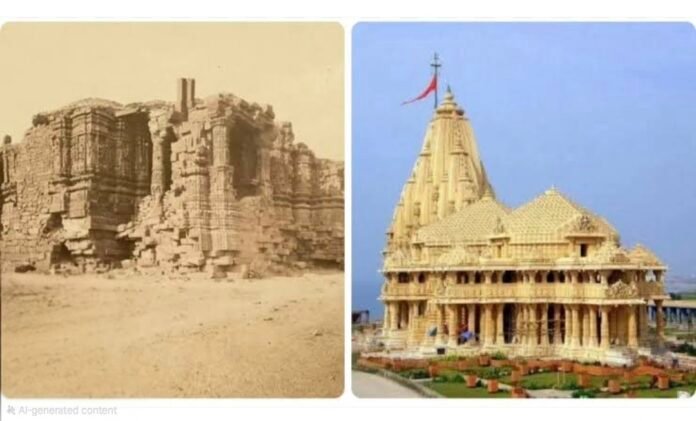
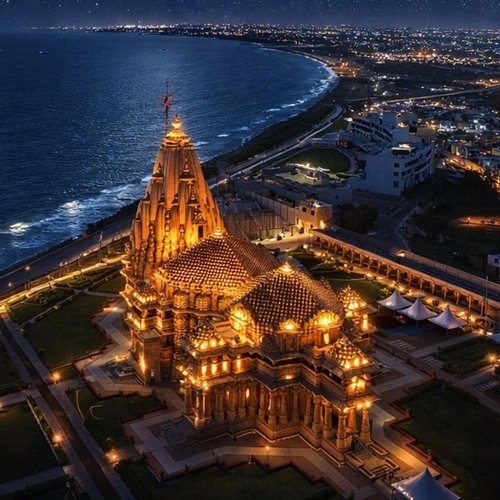
Standing majestically on the shores of the Arabian Sea in Somnath Temple, the Somnath Temple is far more than a place of worship. Revered as the first among the twelve Jyotirlingas of Lord Shiva, Somnath represents faith, resilience and the enduring spirit of Indian civilisation. Over centuries, the temple has been destroyed, rebuilt and revived multiple times, becoming one of the most powerful symbols of cultural continuity in India.

The word “Somnath” means “Lord of the Moon.” According to Hindu mythology, the Moon God, Soma, built the original temple in gold to worship Lord Shiva and seek freedom from a curse. Ancient legends later describe reconstructions in silver by Ravana and in sandalwood by Lord Krishna. While these accounts belong to mythology, they underline the temple’s immense spiritual importance in Hindu tradition.

Historically, Somnath has been an important pilgrimage centre since ancient times. Located at Prabhas Patan in Gujarat’s Saurashtra region, near the confluence of the rivers Kapila, Hiran and the mythical Saraswati, the site was mentioned in several ancient texts and inscriptions.

The temple’s history is deeply tied to repeated invasions and reconstructions. The most famous attack came in 1026 CE when Mahmud of Ghazni invaded the temple, looted its immense wealth and destroyed the shrine. Historical records describe Somnath at the time as one of the richest temples in India. Yet the temple rose again. Kings and rulers from different dynasties, including Bhima I of Gujarat and later Kumarapala, rebuilt and restored it repeatedly.

Over the centuries, the temple continued to face attacks under different invading rulers, including during the Delhi Sultanate and Mughal periods. Emperor Aurangzeb is believed to have ordered its destruction again in the early 18th century. However, despite repeated devastation, Somnath never disappeared from public memory or devotion.

The modern chapter of Somnath began after India’s Independence in 1947. Sardar Vallabhbhai Patel, India’s first Deputy Prime Minister, visited the ruins and resolved to rebuild the temple as a symbol of national pride and cultural restoration. The reconstruction effort, supported by K.M. Munshi and funded through public contributions, became one of independent India’s earliest cultural revival projects.

The present temple, built in the grand Chalukyan or Kailash Mahameru style of architecture, was inaugurated on 11 May 1951 by India’s first President, Dr Rajendra Prasad. Its towering shikhara, intricate carvings and sea-facing location make it one of India’s most iconic temples.

Today, Somnath attracts millions of devotees and tourists every year. But beyond religion, it continues to stand as a symbol of survival and renewal. Its story is not merely about destruction and reconstruction; it is about a civilisation’s ability to preserve faith and identity across centuries of change and conflict.

For many, Somnath is not just a temple — it is a reminder that while structures may fall, cultural memory and belief can endure through time.

Somnath at 75: A Temple, a Civilization and the Story of India’s Resilience

0

As the historic Somnath Temple marks 75 years of its post-Independence reconstruction, India is once again turning its attention to one of the country’s most enduring symbols of faith, resilience and civilisational continuity. Prime Minister Narendra Modi is set to participate in the “Somnath Amritparv 2026” celebrations on May 11, commemorating 75 years since the restored temple was inaugurated by India’s first President, Dr Rajendra Prasad, in 1951.

Located on the western coast of Gujarat at Prabhas Patan, Somnath is revered as the first among the twelve Jyotirlingas of Lord Shiva. But beyond its religious significance, the temple occupies a unique place in India’s historical and cultural consciousness. Over centuries, Somnath became a symbol of repeated destruction and repeated rebuilding — representing what many describe as the unconquerable spirit of Indian civilisation.

The year 2026 carries a double historical significance. It marks not only 75 years since the temple’s reopening after Independence, but also nearly 1,000 years since the first recorded attack on the temple by Mahmud of Ghazni in 1026. In January this year, the country observed the “Somnath Swabhiman Parv,” commemorating a millennium of resistance, survival and revival associated with the temple.

In recent remarks, Prime Minister Modi described Somnath as a “timeless symbol of Bharat’s resilience, unity and civilisational strength.” He noted that despite repeated invasions and destruction over centuries, the temple continued to rise again because of the enduring faith and collective resolve of the people.
The reconstruction of Somnath after Independence holds immense historical significance. Soon after India became free in 1947, Deputy Prime Minister Sardar Vallabhbhai Patel took the initiative to rebuild the temple as a symbol of national restoration and cultural self-confidence. The effort was strongly supported by writer and statesman K.M. Munshi. In May 1951, the rebuilt temple was formally inaugurated in the presence of President Rajendra Prasad.
The ongoing Amritparv celebrations include spiritual gatherings, cultural programmes, chanting ceremonies, exhibitions and events honouring those who defended the temple across centuries. Earlier this year, a grand “Shaurya Yatra” and a large drone show depicting Somnath’s historical journey drew national attention.
Today, Somnath stands not merely as a place of worship but as a powerful historical symbol — one that reflects India’s ability to endure adversity and reclaim its heritage. Its story continues to resonate because it is deeply intertwined with questions of faith, identity, memory and national pride.
From ruins to renewal, Somnath’s journey across centuries mirrors the larger story many associate with India itself — wounded repeatedly, yet never defeated.

World Migratory Bird Day: Celebrating Nature’s Great Travellers and the Need to Protect Them

0

Every year, millions of birds undertake extraordinary journeys across continents, oceans and mountain ranges in search of food, breeding grounds and favourable climates. These remarkable seasonal movements are among nature’s greatest wonders, and World Migratory Bird Day serves as a reminder of the urgent need to protect these avian travellers and the ecosystems they depend on.

Observed twice a year — on the second Saturdays of May and October — World Migratory Bird Day is a global awareness campaign dedicated to the conservation of migratory birds and their habitats. The campaign is organised by international environmental bodies including the United Nations Environment Programme (UNEP)-backed Convention on Migratory Species and aims to highlight the ecological importance of migratory birds as well as the threats they face worldwide.

Migratory birds play a vital role in maintaining ecological balance. They help control pests, pollinate plants, disperse seeds and contribute to healthy ecosystems. Their migration patterns also act as indicators of environmental health, often revealing the impacts of climate change, habitat destruction and pollution.

From the Siberian cranes that visit India’s wetlands to the Arctic terns that travel thousands of kilometres between polar regions, migratory birds cover astonishing distances with incredible precision. India itself is an important stopover and wintering destination along the Central Asian Flyway, hosting hundreds of migratory species every year in wetlands, forests, grasslands and coastal regions.

Places such as Keoladeo National Park, Chilika Lake and Sultanpur National Park become seasonal homes to thousands of migratory birds arriving from distant countries including Russia, Mongolia, Central Asia and Europe.

However, these birds face growing dangers across the globe. Rapid urbanisation, shrinking wetlands, deforestation, illegal hunting, pollution and climate change are severely affecting migratory routes and breeding habitats. Artificial lighting in cities, glass buildings and power lines also contribute to bird deaths during migration.

Climate change has emerged as one of the biggest threats. Rising temperatures and changing weather patterns are altering migration timings and food availability, disrupting delicate ecological cycles that migratory species rely upon for survival.

The theme for World Migratory Bird Day 2026 focuses on creating bird-friendly environments and restoring habitats critical for migratory species. Conservationists emphasise that protecting migratory birds requires international cooperation because these birds cross multiple national borders during their journeys.

Governments, environmental groups, schools and wildlife enthusiasts around the world mark the day through birdwatching events, awareness campaigns, educational programmes and conservation drives. In India, the occasion also highlights the importance of protecting wetlands, which are rapidly disappearing due to encroachment and pollution.

World Migratory Bird Day is not just about birds; it is about preserving biodiversity and maintaining the interconnected balance of nature. The survival of migratory birds reflects the health of ecosystems shared by all living beings.

As flocks continue to soar across skies, crossing countries and continents without boundaries, the day serves as a powerful reminder that environmental protection too must rise above borders. Protecting migratory birds today means safeguarding the planet’s ecological future for generations to come.

Maharana Pratap Jayanti: Remembering the Warrior King Who Refused to Surrender

0

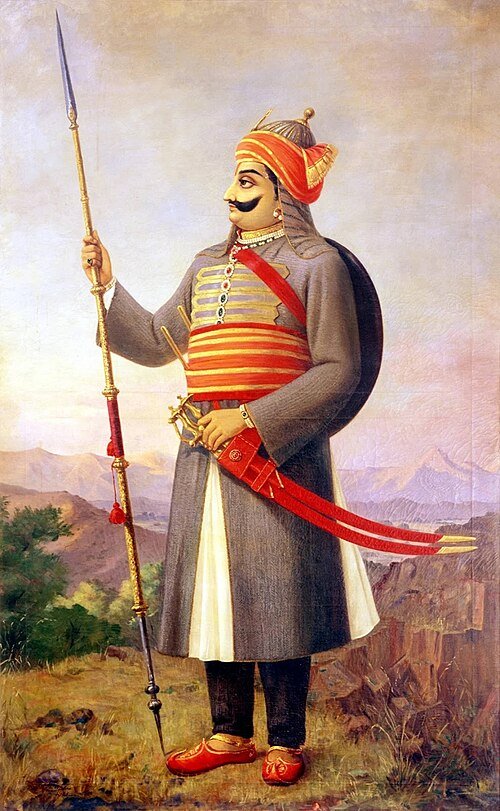
Every year, Maharana Pratap Jayanti is observed with great pride and reverence across India, especially in Rajasthan, to honour the birth anniversary of Maharana Pratap — one of the most celebrated warrior kings in Indian history. Known for his unmatched courage, fierce patriotism, and unwavering resistance against the Mughal Empire, Maharana Pratap remains a timeless symbol of self-respect, independence, and sacrifice.

Born on May 9, 1540, to Rana Udai Singh II and Maharani Jaiwanta Bai, Maharana Pratap belonged to the Sisodia dynasty of Mewar. After the death of his father in 1572, he ascended the throne of Mewar at a time when much of northern India had come under the control of Mughal emperor Akbar. While several Rajput kingdoms accepted Mughal supremacy, Maharana Pratap chose a far more difficult path — resistance.

His refusal to bow before Akbar became the defining chapter of his life and legacy. Akbar reportedly sent several diplomatic missions to persuade him to accept Mughal authority, but Maharana Pratap remained steadfast in protecting the sovereignty of Mewar. His determination eventually led to the historic Battle of Haldighati in 1576, one of the most iconic battles in Indian history.

Fought in the narrow mountain pass of Haldighati in present-day Rajasthan, the battle saw Maharana Pratap’s comparatively smaller army confront the mighty Mughal forces led by Raja Man Singh of Amber. Despite limited resources, the warriors of Mewar fought with extraordinary bravery. Maharana Pratap also received support from Bhil tribal warriors and Afghan commander Hakim Khan Sur, reflecting the broad alliances he built in defence of his kingdom.

Although the battle is often described as a tactical advantage for the Mughals, Maharana Pratap was never captured, nor did he surrender. Instead, he retreated into the Aravalli hills and continued guerrilla warfare for years. Over time, he succeeded in reclaiming much of Mewar, except Chittorgarh. Historians and public discussions continue to debate the exact outcome and interpretation of the Battle of Haldighati, but Maharana Pratap’s resilience and refusal to submit remain central to his enduring legacy.

No account of Maharana Pratap is complete without mentioning Chetak, his loyal horse, whose bravery became legendary in Indian folklore. According to popular accounts, even after being grievously wounded during the battle, Chetak carried Maharana Pratap to safety before collapsing. The story of their bond continues to inspire generations and has become an inseparable part of Rajput history and culture.

Today, Maharana Pratap Jayanti is marked by processions, cultural programmes, tributes, and discussions on his life and ideals. Schools, organisations, and communities remember him not merely as a ruler, but as a symbol of courage, honour, and devotion to one’s land and principles.

More than four centuries after his death, Maharana Pratap continues to occupy a unique place in India’s collective memory. His life story is not just about warfare or kingship; it is about resilience in adversity and the belief that dignity and freedom are worth every sacrifice.

Who is Suvendu Adhikari? The BJP Leader Taking Oath as West Bengal Chief Minister

0

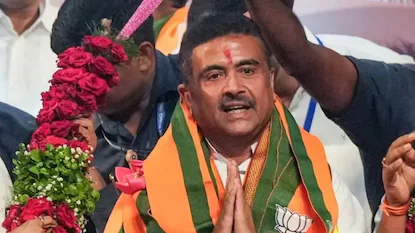
In a historic political shift for West Bengal, senior BJP leader Suvendu Adhikari is set to take oath as the state’s first-ever Bharatiya Janata Party Chief Minister. His swearing-in at Kolkata’s Brigade Parade Ground marks the end of 15 years of Trinamool Congress rule under Mamata Banerjee and signals one of the biggest political transformations in Bengal since Independence.

Suvendu Adhikari’s political journey has been anything but ordinary. Once considered one of Mamata Banerjee’s closest lieutenants and a key architect of the Trinamool Congress’s rise in Bengal, Adhikari eventually emerged as her fiercest political rival and the face of the BJP’s expansion in the state.

Born into a politically influential family in East Midnapore, Suvendu is the son of veteran politician Sisir Adhikari. He began his political career with the Congress before joining the Trinamool Congress during its formative years. Over time, he became one of the party’s most influential grassroots leaders, especially in the politically crucial districts of East Midnapore and South Bengal.

Adhikari played a major role in the anti-land acquisition movements in Nandigram and Singur during the late 2000s — movements that significantly weakened the Left Front government and eventually helped Mamata Banerjee end the Left’s 34-year rule in 2011. His organisational ability and mass connect earned him the reputation of being one of the TMC’s strongest field leaders.

Over the years, he served as Member of Parliament from Tamluk and later held several ministerial portfolios in the Mamata Banerjee government, including transport and irrigation. However, tensions between Adhikari and the TMC leadership gradually intensified over issues related to party functioning and political direction.

In 2020, he dramatically switched to the BJP in one of Bengal politics’ biggest defections. The move altered the state’s political landscape and gave the BJP a powerful Bengali face capable of challenging Mamata Banerjee directly. In the 2021 Assembly elections, Adhikari defeated Mamata Banerjee in Nandigram in a fiercely contested battle that instantly elevated his stature within the BJP.

Since then, he became the BJP’s principal opposition voice in Bengal and served as Leader of the Opposition in the Assembly. Known for his aggressive political style and strong Hindutva positioning, Adhikari emerged as the BJP’s central strategist in the state. In the 2026 Assembly elections, he once again made headlines by contesting from both Nandigram and Bhabanipur — Mamata Banerjee’s traditional stronghold — and winning both seats.

The BJP’s rise in Bengal has been a long and gradual process. For decades, the state was dominated first by the Left Front and later by the Trinamool Congress. The BJP remained politically marginal in Bengal until the late 2010s. However, the party steadily expanded its organisational base by focusing on nationalism, Hindutva politics, welfare outreach and anti-incumbency against the TMC government.

The BJP’s breakthrough came in the 2019 Lok Sabha elections, when it emerged as the principal challenger to the TMC by winning 18 parliamentary seats in the state. Though it failed to win power in the 2021 Assembly elections, the party significantly increased its vote share and strengthened its cadre network across Bengal. Under leaders like Suvendu Adhikari, the BJP continued building momentum, eventually securing a historic majority in the 2026 Assembly polls.

Adhikari’s elevation is being viewed not only as a personal political triumph but also as the culmination of the BJP’s long pursuit to establish itself in a state traditionally resistant to the party’s politics.

Now, as he prepares to take oath as West Bengal’s ninth Chief Minister, Suvendu Adhikari steps into office carrying both immense expectations and formidable challenges. From law and order and industrial revival to political reconciliation in a deeply polarised state, his tenure will likely define the next chapter of Bengal politics.

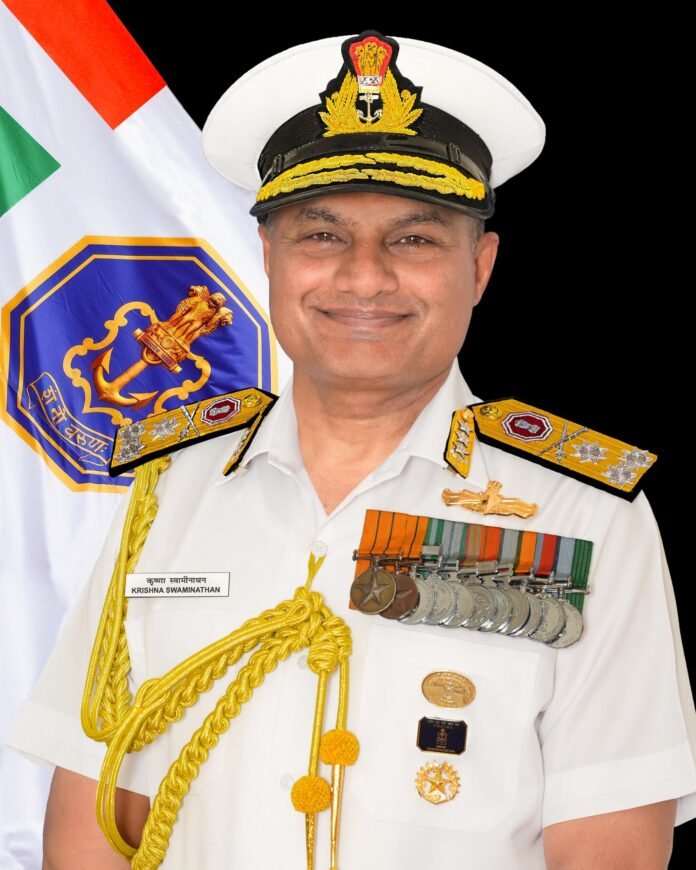
Vice Admiral Krishna Swaminathan to Lead Indian Navy as Next Naval Chief

0

The Government of India has appointed Vice Admiral Krishna Swaminathan as the next Chief of the Naval Staff (CNS), entrusting one of the Indian Navy’s most experienced operational commanders with the leadership of the country’s maritime forces. He will succeed Admiral Dinesh Kumar Tripathi, who is set to retire on 31 May 2026.

Currently serving as Flag Officer Commanding-in-Chief (FOC-in-C) of the Western Naval Command — the Indian Navy’s premier operational command headquartered in Mumbai — Vice Admiral Swaminathan brings nearly four decades of distinguished service marked by frontline operational leadership, strategic planning and personnel management.

A highly decorated officer, he has been awarded the Param Vishisht Seva Medal (PVSM), Ati Vishisht Seva Medal (AVSM) and Vishisht Seva Medal (VSM) for exceptional service to the nation.

Commissioned into the Indian Navy in the late 1980s, Vice Admiral Swaminathan belongs to a generation of naval officers who witnessed the transformation of India’s maritime doctrine from coastal defence to a broader Indo-Pacific strategic vision. Over the years, he has served across a wide range of operational and command appointments, gaining extensive experience in fleet operations, maritime security, personnel administration and strategic affairs.

Throughout his career, he commanded several frontline warships and important naval formations. His operational expertise spans both the Western and Eastern seaboards, with significant involvement in maritime surveillance, combat readiness and naval modernisation efforts. Known within naval circles for his professional acumen and organisational leadership, he also held key staff appointments dealing with human resource management and strategic planning — crucial aspects in today’s technology-driven naval warfare environment.

As head of the Western Naval Command, Vice Admiral Swaminathan oversaw India’s most strategically significant maritime theatre, responsible for safeguarding the Arabian Sea region, critical sea lanes and major naval assets. The command plays a central role in India’s maritime posture amid evolving security challenges in the Indian Ocean Region.

His appointment comes at a time when the Indian Navy is rapidly expanding its operational capabilities through indigenous warship construction, aircraft carrier development, underwater warfare preparedness and enhanced maritime partnerships with global allies. India’s growing focus on the Indo-Pacific, maritime trade security and countering strategic competition in regional waters places enormous importance on naval leadership.

Defence analysts believe Vice Admiral Swaminathan’s blend of operational command experience and strategic understanding makes him well-suited to guide the Navy through this crucial phase of transformation. His tenure is expected to focus on strengthening indigenous naval capability, integrating advanced technologies, enhancing jointness with the Army and Air Force, and expanding India’s maritime influence across the Indo-Pacific.

From commanding warships at sea to leading the Navy’s most critical operational command, Vice Admiral Krishna Swaminathan’s rise to the top reflects a career built on discipline, operational excellence and strategic vision. As he prepares to assume office as the nation’s next Naval Chief, he steps into a role central to safeguarding India’s maritime interests in an increasingly complex global security environment.