

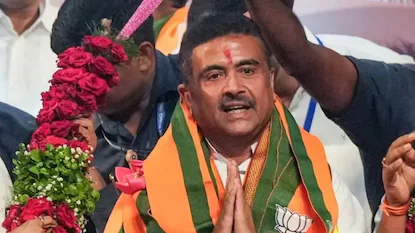
In a historic political shift for West Bengal, senior BJP leader Suvendu Adhikari is set to take oath as the state’s first-ever Bharatiya Janata Party Chief Minister. His swearing-in at Kolkata’s Brigade Parade Ground marks the end of 15 years of Trinamool Congress rule under Mamata Banerjee and signals one of the biggest political transformations in Bengal since Independence.
Suvendu Adhikari’s political journey has been anything but ordinary. Once considered one of Mamata Banerjee’s closest lieutenants and a key architect of the Trinamool Congress’s rise in Bengal, Adhikari eventually emerged as her fiercest political rival and the face of the BJP’s expansion in the state.
Born into a politically influential family in East Midnapore, Suvendu is the son of veteran politician Sisir Adhikari. He began his political career with the Congress before joining the Trinamool Congress during its formative years. Over time, he became one of the party’s most influential grassroots leaders, especially in the politically crucial districts of East Midnapore and South Bengal.
Adhikari played a major role in the anti-land acquisition movements in Nandigram and Singur during the late 2000s — movements that significantly weakened the Left Front government and eventually helped Mamata Banerjee end the Left’s 34-year rule in 2011. His organisational ability and mass connect earned him the reputation of being one of the TMC’s strongest field leaders.
Over the years, he served as Member of Parliament from Tamluk and later held several ministerial portfolios in the Mamata Banerjee government, including transport and irrigation. However, tensions between Adhikari and the TMC leadership gradually intensified over issues related to party functioning and political direction.
In 2020, he dramatically switched to the BJP in one of Bengal politics’ biggest defections. The move altered the state’s political landscape and gave the BJP a powerful Bengali face capable of challenging Mamata Banerjee directly. In the 2021 Assembly elections, Adhikari defeated Mamata Banerjee in Nandigram in a fiercely contested battle that instantly elevated his stature within the BJP.
Since then, he became the BJP’s principal opposition voice in Bengal and served as Leader of the Opposition in the Assembly. Known for his aggressive political style and strong Hindutva positioning, Adhikari emerged as the BJP’s central strategist in the state. In the 2026 Assembly elections, he once again made headlines by contesting from both Nandigram and Bhabanipur — Mamata Banerjee’s traditional stronghold — and winning both seats.
The BJP’s rise in Bengal has been a long and gradual process. For decades, the state was dominated first by the Left Front and later by the Trinamool Congress. The BJP remained politically marginal in Bengal until the late 2010s. However, the party steadily expanded its organisational base by focusing on nationalism, Hindutva politics, welfare outreach and anti-incumbency against the TMC government.
The BJP’s breakthrough came in the 2019 Lok Sabha elections, when it emerged as the principal challenger to the TMC by winning 18 parliamentary seats in the state. Though it failed to win power in the 2021 Assembly elections, the party significantly increased its vote share and strengthened its cadre network across Bengal. Under leaders like Suvendu Adhikari, the BJP continued building momentum, eventually securing a historic majority in the 2026 Assembly polls.
Adhikari’s elevation is being viewed not only as a personal political triumph but also as the culmination of the BJP’s long pursuit to establish itself in a state traditionally resistant to the party’s politics.
Now, as he prepares to take oath as West Bengal’s ninth Chief Minister, Suvendu Adhikari steps into office carrying both immense expectations and formidable challenges. From law and order and industrial revival to political reconciliation in a deeply polarised state, his tenure will likely define the next chapter of Bengal politics.