Home Blog Page 645

Do You Know! Which part of the constitution deals with the panchayats?

0

Panchayats are institutions of self-government in rural areas of India. They are responsible for planning and implementing various development schemes and programs at the local level. The constitution of India provides for the establishment, composition, powers and functions of panchayats in Part IX, which was added by the 73rd amendment in 1992.

According to Article 243B of Part IX, there shall be constituted in every state, panchayats at three levels: village, intermediate and district. However, states with a population not exceeding 20 lakhs may not have panchayats at the intermediate level. The panchayats at each level shall consist of elected representatives from the territorial constituencies in the panchayat area. The ratio between the population of each constituency and the number of seats allotted to it shall be the same throughout the state, as far as practicable.

Article 243C of Part IX specifies the composition of panchayats at each level. It also provides for the representation of the chairpersons of the lower level panchayats, the members of parliament and state legislatures, and the members of the upper houses of parliament and state legislatures in the higher level panchayats. The chairperson of a panchayat at the village level shall be elected by the people, while the chairperson of a panchayat at the intermediate or district level shall be elected by and from among the elected members of that panchayat.

Article 243D of Part IX mandates that not less than one-third of the total number of seats in a panchayat shall be reserved for women, and that not less than one-third of the offices of chairpersons in a panchayat at each level shall be reserved for women. It also provides for reservation of seats and offices for scheduled castes and scheduled tribes in proportion to their population in a panchayat area.

Article 243E of Part IX stipulates that every panchayat shall continue for five years from the date of its first meeting, unless dissolved earlier. It also states that an election to constitute a new panchayat shall be completed before the expiry of its term, or within six months of its dissolution.

Article 243F of Part IX lays down the qualifications and disqualifications for membership in a panchayat. It also empowers the state legislature to make laws regarding these matters.

Article 243G of Part IX empowers the state legislature to endow the panchayats with such powers and authority as may be necessary to enable them to function as institutions of self-government. It also authorizes the state legislature to delegate to the panchayats such functions and responsibilities as may be entrusted to them by law relating to various subjects listed in the Eleventh Schedule.

Article 243H of Part IX authorizes the state legislature to make laws regarding the finances of the panchayats, including their taxation powers, grants-in-aid from the consolidated fund of the state, and allocation of funds from central or state plans.

Article 243I of Part IX provides for the constitution of a State Finance Commission every five years to review the financial position of the panchayats and make recommendations regarding their resources, expenditure and audit.

Article 243J of Part IX obliges every panchayat to maintain accounts and records of its income and expenditure, and submit them for audit by such authority as prescribed by law.

Article 243K of Part IX provides for the constitution of a State Election Commission to conduct elections to the panchayats in accordance with law.

Article 243L of Part IX extends Part IX to union territories subject to such modifications as may be specified by law.

Article 243M of Part IX exempts certain areas from Part IX, such as those under Schedule V (tribal areas), Schedule VI (hill areas), or any other area where local self-government exists under any other law or custom. It also empowers Parliament to make laws regarding these matters.

Article 243N of Part IX states that any law made under Part IX shall not be called in question in any court on any ground.

Article 243O of Part IX bars any court from interfering in any electoral matter relating to a panchayat, except on an election petition presented to such authority as prescribed by law.
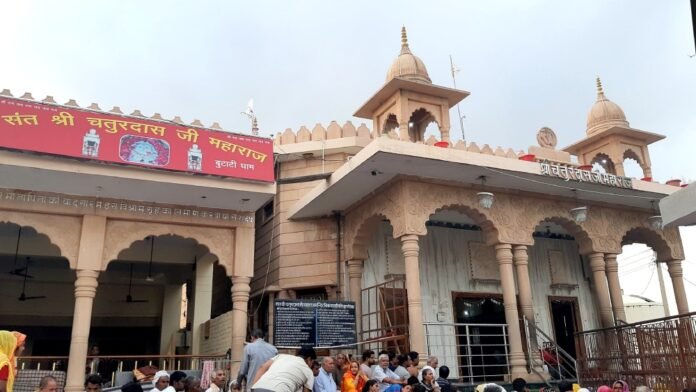
Butati Dham: A Temple of Miracles for Paralysis Patients

0

Butati Dham is a temple located near Kuchera town in Nagaur district of Rajasthan. It is dedicated to Saint Chaturdas Ji Maharaj, who is believed to have miraculous powers to cure paralysis. Every year, lakhs of people from across the country and abroad visit this temple to seek healing from this debilitating condition.

The Legend of Saint Chaturdas Ji

According to the legend, Saint Chaturdas Ji was born in a Charan caste family about 500 years ago. He was a great yogi and a devotee of Lord Shiva. He and his brother, Saint Gangadas Ji, went on a pilgrimage to various holy places. During their journey, they met many sages and saints who blessed them with divine powers.

One day, they reached a place called Butati, where they decided to stay for some time. There, they saw many people suffering from paralysis and other diseases. Saint Chaturdas Ji felt compassion for them and started using his powers to heal them. He would apply ash from the sacred fire (havan kund) on their bodies and make them walk around the temple seven times. Soon, the news of his miracles spread far and wide, and people started flocking to Butati Dham for paralysis cure.

Saint Chaturdas Ji spent the rest of his life in Butati, serving the people and worshipping Lord Shiva. He attained samadhi (final liberation) at the age of 108. His samadhi is now the main shrine of Butati Dham temple, where people pay their respects and seek his blessings.

The Ritual of Sapt Parikrama

The main ritual of Butati Dham temple is the sapt parikrama (seven circumambulations). It is believed that anyone who performs this ritual with faith and devotion can get rid of paralysis or any other disease. The ritual involves walking around the temple seven times in seven days, twice a day: once in the morning after the aarti (worship service) and once in the evening before the aarti.

The temple authorities provide free accommodation, food, water, utensils, firewood and other facilities to the patients and their attendants. They also provide guidance and assistance to perform the ritual properly. The patients are advised to follow a vegetarian diet, abstain from alcohol and tobacco, and maintain cleanliness and hygiene during their stay.

Many patients have reported significant improvement or complete recovery after completing the sapt parikrama. Some have even shared their testimonials on social media platforms like Facebook and YouTube. The temple also organizes special fairs and festivals on auspicious occasions like Ekadashi (eleventh lunar day), Vaishakh (April-May), Bhadon (August-September) and Magh (January-February), when thousands of devotees throng to Butati Dham.

How to Reach Butati Dham

Butati Dham is situated about 52 km away from Nagaur city on the Ajmer-Nagaur road. The nearest airport is Jaipur International Airport, which is about 250 km away. From there, one can take a train, bus or taxi to reach Merta Road Junction railway station, which is about 45 km away from Butati Dham. Alternatively, one can also hire a private car or cab from Jaipur or nearby cities like Pushkar⁵.

From Merta Road Junction, one can take a jeep or taxi to reach Butati Dham temple. The temple is open from 5 am to 10 pm every day. There is no entry fee or donation required to visit the temple or avail its services. However, one can offer voluntary contributions to support the temple’s activities and maintenance.

Butati Dham is a unique place of faith and healing that attracts people from all walks of life. It is a testimony to the power of Saint Chaturdas Ji’s miracles and the devotion of his followers. If you are looking for a spiritual experience or a cure for paralysis, you may want to visit this temple and witness its wonders for yourself.

Barsatein – Mausam Pyaar Ka: A Romantic Drama Set in a Newsroom

0

Sony Entertainment Television is all set to launch a new romantic drama series titled ‘Barsatein – Mausam Pyaar Ka’ on July 10, 2023. The show is produced by Balaji Telefilms and features popular actors Kushal Tandon and Shivangi Joshi in the lead roles.

The Plot

The show revolves around the love story of Reyansh Lamba (Kushal Tandon) and Aradhana (Shivangi Joshi), who work in the same news channel. Reyansh is the owner of the channel, who is ambitious, suave and charming. He is also emotionally unavailable and lacks chivalry towards women. Aradhana is a journalist, who is fearless, honest and passionate. She uncovers several wrongdoings of Reyansh’s business empire, which leads to their clash of wills and ideologies.

However, as they say, there is a thin line between love and hate. Reyansh and Aradhana’s initial hostility gradually transforms into attraction and romance, as they face various challenges and dangers together. But will their love survive the storm of secrets, lies and betrayals? Will they be able to overcome their differences and find their happily ever after?

The Cast

Kushal Tandon, who was last seen in Beyhadh opposite Jennifer Winget, is making his television comeback after six years with this show. He said that he was thrilled to be back with a distinctive role that was tailored for him by Ekta Kapoor. He also said that television has and will always have his heart.

Shivangi Joshi, who rose to fame with Yeh Rishta Kya Kehlata Hai, is playing the role of Aradhana, a female journalist who falls in love with her boss. She said that she was excited to be a part of this show, which is an enticing romance drama with a lot of twists and turns.

The show also stars Saii Ranade, Sameer Malhotra, Preet Kaur Nayak, Vipul Deshpande, Ali Khan, Mishika Mishra, Prarthana Mondal and Arshi Bharti in pivotal roles.

The Promo

The makers of the show have released a teaser promo that shows Kushal Tandon and Shivangi Joshi in a rain sequence. The promo has a tagline that says “Jab baarish mein bheegi hui dhadkanein milengi, tab barsaatein mausam pyaar ka ban jayegi”. The promo has created a lot of buzz among the fans of the actors and the genre.

The Timings

The show will air every Monday to Friday at 8 pm on Sony Entertainment Television from July 10, 2023. The show will also be available for online streaming on SonyLIV app.

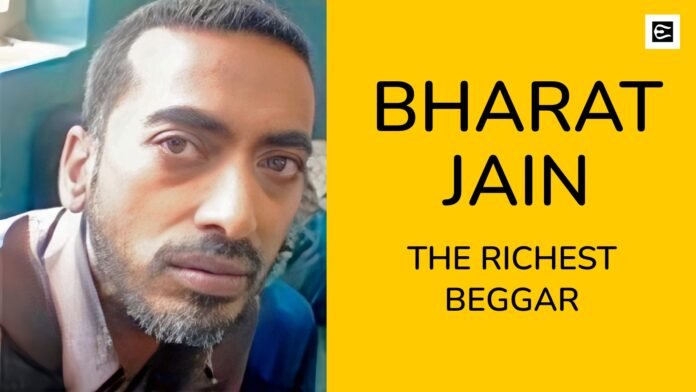
Meet Bharat Jain, the richest beggar in India who owns properties worth crores

0

Bharat Jain is not your ordinary beggar. He is, in fact, the richest beggar in India and probably the world. He can be seen begging on the streets of Mumbai, but he has a net worth of Rs 7.5 crore. He owns a 2BHK flat in Mumbai worth Rs 1.2 crore and two shops in Thane that rent for Rs 30,000 per month. He also has bank deposits and investments worth crores.

Jain, who is 55 years old, has been begging for more than three decades. He started begging after he dropped out of school due to financial problems. He is married and has two sons who are studying in college. He also supports his father and brother who live with him¹. He begs at prime locations like Chhatrapati Shivaji Maharaj Terminus railway station (CSMT) or Azad Maidan, where he earns between Rs 60,000 and 75,000 per month.

Jain says he begs because he likes it and it gives him satisfaction. He says he does not want to stop begging even though he has enough money to live comfortably. He says he does not bother anyone and people give him money willingly. He also claims that he pays income tax on his earnings and does not evade any laws.

Jain’s story is an example of how begging can be a lucrative business in India, where there are millions of beggars living in poverty and destitution. Jain is one of the top five richest beggars in India, who are richer than most of us and are in fact correlates.

UNCTAD’s World Investment Report 2023 Sheds Light on Sustainable Investment Challenges

0

The recently released World Investment Report 2023 by the United Nations Conference on Trade and Development (UNCTAD) offers valuable insights into foreign direct investment (FDI) trends in developing countries. The report emphasizes the pressing need to bridge the investment gaps, particularly in renewable energy, to achieve the Sustainable Development Goals (SDGs) by 2030. Additionally, it highlights the global decline in FDI and calls for support to developing nations in their transition to clean energy. Let’s delve into the key findings of the report.

FDI in Developing Countries in Asia:

In 2022, FDI in developing countries in Asia remained steady at $662 billion, signaling no change compared to the previous year. Although the growth rate was flat, countries in this region, such as India and ASEAN, continued to attract substantial FDI, contributing to their economic buoyancy.

Global FDI Decline:

The report reveals a 12% decline in global FDI, reaching $1.3 trillion in 2022. This decline follows a strong rebound in 2021 after the impact of the COVID-19 pandemic in 2020. Notably, China experienced a 5% increase in FDI, serving as an exception to the global downward trend.

Renewable Energy Investment Gap:

One of the critical concerns emphasized in the report is the significant investment gap in renewable energy within developing countries. While the annual investment required to support clean energy transitions amounts to $1.7 trillion, these nations only attracted $544 billion in FDI for clean energy in 2022. This calls for urgent efforts to bridge the investment gap and attract more sustainable energy investments.

Investment Gaps in Sustainable Development Goals:

The report uncovers a substantial investment gap across all sectors of the Sustainable Development Goals (SDGs), which has risen to over $4 trillion per year from $2.5 trillion in 2015. Sectors such as energy, water, and transport infrastructure face the largest investment gaps. Addressing these gaps is crucial for achieving sustainable development targets and fostering inclusive growth.

Challenges and Opportunities:

Despite a positive trend in sustainability investment in global capital markets, the report highlights the need for increased investments in developing countries. Most of the renewable energy investments have flowed into developed nations, leaving developing countries with a significant deficit. Enhancing exposure to developing nations and addressing concerns of greenwashing are vital priorities for the sustainable finance market.

Investment Policymaking and Reform:

The report sheds light on the surge in investment policymaking activities in 2022, with many countries adopting measures to counter an expected economic downturn. Measures favorable to investment increased to 102, nearly doubling from the previous year. Furthermore, work to reform the international investment agreement (IIA) regime continued, focusing on new types of agreements, termination of existing treaties, and discussions on reforming dispute settlement mechanisms.

Global Action Compact for Investment in Sustainable Energy for All:

To address the challenges highlighted in the report, a Global Action Compact for Investment in Sustainable Energy for All is proposed. This compact encompasses guiding principles covering the objectives of the energy transition, including meeting climate goals, providing affordable energy for all, and ensuring energy security. The compact also outlines six action packages to drive national and international investment policymaking, foster partnerships and cooperation, implement financing mechanisms, and strengthen sustainable finance markets.

UNCTAD’s World Investment Report 2023 underlines the urgency to bridge the investment gaps and promote sustainable investment practices in developing countries. By addressing these gaps and fostering partnerships, nations can work together to achieve the SDGs and ensure a sustainable and inclusive future. The report serves as a call to action for governments, international organizations, and stakeholders to prioritize investment in clean energy, enhance investment policymaking, and reform international investment agreements.

100+ Savage Captions for Instagram

0

Instagram is a great platform to showcase your personality, style and attitude. Sometimes, you need to spice up your posts with some savage captions that show your confidence, sass and wit. Whether you want to throw some shade, clap back at your haters, or just express yourself, here are some savage captions for Instagram that you can use or get inspired by:

Savage Captions for Selfies

  • I’m not here to fit into your world. I’m here to make my own.
  • I’m not bossy. I’m the boss.
  • I’m not rude. I just have the guts to say what everyone else is thinking.
  • I’m not mean. I’m just too honest for your fragile ego.
  • I’m not sorry for being myself. Do you want me to apologize for being awesome too?
  • I’m not here to impress anyone but myself.
  • I’m not looking for trouble. Trouble usually finds me.
  • I’m not always sarcastic. Sometimes I’m sleeping.
  • I’m not a snack. I’m a full course meal.
  • I’m not a princess. I don’t need saving. I’m a queen. I got this handled.

Savage Captions for Haters

  • Haters are my biggest fans.
  • Haters are just confused admirers.
  • Haters don’t really hate you. They hate themselves because you’re a reflection of what they wish to be.
  • Haters gonna hate. And potatoes gonna potate.
  • Haters are like clouds. They disappear when the sun comes out.
  • Haters make me famous.
  • Haters are the best motivators.
  • Haters are proof that you’re doing something right.
  • Haters only hate the things they can’t have and the people they can’t be.
  • Haters are like crickets. They make a lot of noise but you never see them.

Savage Captions for Exes

  • Dear ex, thank you for breaking my heart. It made me stronger, smarter and happier than ever.
  • Dear ex, thank you for showing me what I don’t want in a relationship.
  • Dear ex, thank you for making me realize that you’re not worth my time, energy and love.
  • Dear ex, thank you for being the best example of what not to look for in a partner.
  • Dear ex, thank you for leaving me. You made room for someone better.
  • Dear ex, thank you for teaching me how to be savage.
  • Dear ex, don’t worry about me. I’m doing great without you.
  • Dear ex, don’t check on me. You’ve lost that privilege.
  • Dear ex, don’t text me when you’re bored. I’m not your backup plan.
  • Dear ex, don’t hate me because I moved on. Hate yourself because you let me go.

Savage Captions for Friends

  • Friends don’t let friends do stupid things… alone.
  • Friends are like bras. They support you and keep you up.
  • Friends are like diamonds. They’re precious and rare.
  • Friends are like stars. They shine bright even when you can’t see them.
  • Friends are like wine. They get better with age.
  • Friends are like pizza. You can never have too much of them.
  • Friends are like chocolate. They make everything better.
  • Friends are like books. They have stories to tell and lessons to teach.
  • Friends are like flowers. They brighten up your day and make you smile.
  • Friends are like music. They make your life more beautiful and fun.

100 Best Captions for Instagram Posts in 2023

0

Instagram is one of the most popular social media platforms in the world, with over 1 billion monthly active users. It is a great way to share your photos and videos with your friends, family and followers. However, to make your posts stand out and attract more engagement, you need to add some catchy and creative captions that suit your mood, personality and style.

Here are 100 best captions for Instagram posts in 2023 that you can use or get inspired by:

Captions for Selfies

  • I woke up like this. Literally.
  • Just a girl who loves her coffee and her cat.
  • Don’t let anyone dull your sparkle.
  • Feeling cute, might delete later.
  • Life is too short to be serious all the time.
  • Smile, it’s the best makeup you can wear.
  • Be yourself, everyone else is already taken.
  • Confidence level: selfie with no filter.
  • I’m not perfect, but I’m always me.
  • Live, laugh, love and take selfies.

Captions for Travel

  • Wanderlust: a strong desire to travel and explore the world.
  • I haven’t been everywhere, but it’s on my list.
  • Travel is the only thing you buy that makes you richer.
  • Adventure is out there, go find it.
  • The world is a book and those who do not travel read only one page.
  • Wherever you go, go with all your heart.
  • I’m in love with cities I’ve never been to and people I’ve never met.
  • Work hard, travel harder.
  • Catch flights, not feelings.
  • Travel is my therapy.

Captions for Food

  • You can’t live a full life on an empty stomach.
  • Good food, good mood.
  • Eat well, travel often.
  • There’s no we in fries.
  • I’m on a seafood diet. I see food and I eat it.
  • Happiness is homemade.
  • Life is a combination of magic and pasta.
  • You are what you eat, so eat something sweet.
  • Don’t be upsetti, eat some spaghetti.
  • Pizza is always a good idea.

Captions for Friends

  • Friends are the family we choose for ourselves.
  • A good friend knows all your stories. A best friend helped you write them.
  • Friends don’t let friends do silly things alone.
  • Friendship is not about who you’ve known the longest. It’s about who walked into your life and said “I’m here for you”.
  • Friends are like stars, they come and go, but the ones that stay are the ones that glow.
  • True friends are never apart, maybe in distance but never in heart.
  • Friends are the chocolate chips in the cookie of life.
  • A friend is someone who understands your past, believes in your future and accepts you just the way you are.
  • Friends make good times better and hard times easier.
  • A day spent with friends is always a day well spent.

Captions for Love

  • You are my favorite notification.
  • You are my favorite place to go when my mind searches for peace.
  • You are my favorite hello and my hardest goodbye.
  • You are my today and all of my tomorrows.
  • You are my favorite reason to lose sleep.
  • You are my favorite distraction.
  • You are my favorite adventure.
  • You are my favorite song lyrics

Indore Becomes First Urban Body in India to Receive Extended Producer Responsibility Credit for Recycling Single-Use Plastic Items

0

Indore Municipal Corporation (IMC) in Madhya Pradesh, India, has created history by becoming the first urban body in the country to receive Extended Producer Responsibility (EPR) credit for effectively recycling banned single-use plastic items. The city of Indore has implemented a comprehensive ban on single-use plastics, leading to the recent seizure of approximately eight tonnes of such plastic, preventing its circulation and contributing to a cleaner environment. Furthermore, Indore has earned the prestigious distinction of being recognized as India’s cleanest city for the sixth consecutive year in the central government’s annual cleanliness survey.

The concept of Extended Producer Responsibility (EPR) entails extending a producer’s responsibility for a product to the post-consumer stage of its life cycle. Indore’s commendable efforts in responsible waste management and sustainable practices have earned the city an EPR credit of Rs 8,100. To address the challenge of recycling the seized plastic, the IMC established a recycling plant operating under a public-private partnership (PPP) model. This state-of-the-art facility has played a pivotal role in converting the seized plastic waste into reusable materials, effectively reducing the burden on landfills and promoting a circular economy.

Indore faces the daily challenge of managing a substantial amount of solid waste, with an average of 1,162 tonnes generated each day, including around 164 tonnes of plastic waste. However, the IMC has implemented an efficient waste collection system wherein waste is systematically categorized and collected from every doorstep in the city using civic vehicles. The collected waste is then promptly transported to the recycling plant for proper disposal, ensuring that Indore remains a clean and environmentally sustainable city.

Madhya Pradesh Chief Minister Shivraj Singh Chouhan expressed his heartfelt congratulations to the residents and local administration of Indore for this significant achievement. He emphasized the importance of promoting a circular economy, aligning with the vision of Prime Minister Narendra Modi, and commended the IMC for its tireless efforts in realizing this goal.

Know more about the biggest temple of Krishna in India

0
Credit: Vrindavan Chandrodaya Mandir

One of the sincere love found in this world is the love one has for their idol. Lord Krishna has won hearts with his tales. There is an electrifying energy that surges through the people when they talk about Lord Krishna.

Vrindavan Chandrodaya Mandir aspires to be the latest place for the devotees of Krishna, in the holy land of Vrindavan. It is built through the directions of Srila Prabhupada. The temple will have one grand hall for the devotees, Srila Prabhupada’s museum and expo, a gaushala, and more.

Therefore, the Chairman of the temple, Sri Madhu Pandit Dasa has claimed, “Five thousand years ago, when Lord Krishna appeared on this planet, He brought His divine abode Vrindavan to enact transcendental pastimes. This holy dham is non-different from Krishna and is as worshipable as the Lord Himself. Vrindavan, the heart of Braj Bhoomi, is the most important place of pilgrimage for devotees of Lord Krishna. Scriptures state that visiting Vrindavan is equal to having the darshan of Lord Hari. Hence, this spiritual town of temples experiences an influx of people from across the globe every year.”

Therefore, this temple is still in progress, and there is still construction going on.

Where is Mangrove Forest Mainly Found in India?

0

Mangrove forests are a special type of vegetation that grows in the intertidal regions where freshwater and saltwater intermix, such as in the bays, estuaries, creeks and lagoons. They are salt-tolerant plants that can survive in harsh conditions and provide various ecological and economic benefits. They are also home to a rich diversity of flora and fauna, including some endangered species.

Mangrove Forest Cover in India

India has a mangrove forest cover of 4975 sq. km, occupying 3.6% of the global mangroves and 0.15% of the total geographical area of India. The mangroves are distributed along the coastal states and union territories of India, with the highest concentration in the east coast. The following table shows the state-wise mangrove cover in India as per the State of Forest Report 2019:

State/UTMangrove Cover (sq. km)Percentage of Total Mangrove Cover
West Bengal211442.5
Gujarat118023.7
Andaman & Nicobar Islands61712.4
Maharashtra2224.5
Orissa2314.6
Tamil Nadu470.9
Andhra Pradesh3677.4
Goa310.6
Karnataka70.1
Kerala60.1
Pondicherry80.2
Total4975100

Major Mangrove Forests in India

Some of the major mangrove forests in India are:

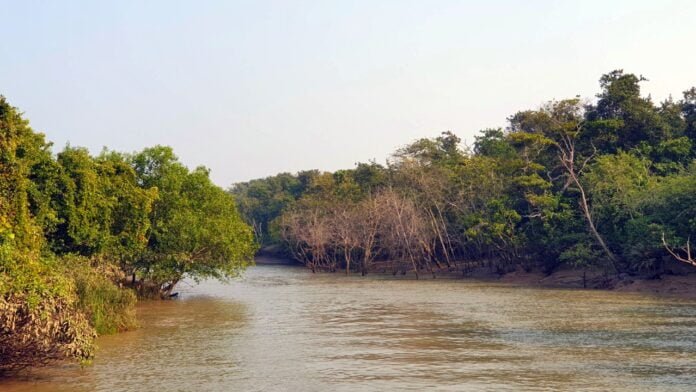
  • The Sundarbans: This is the largest contiguous mangrove forest in the world, covering an area of about 10,000 sq. km in the delta of the Ganges, Brahmaputra and Meghna rivers on the Bay of Bengal. It is shared by India and Bangladesh, with about 60% of the forest lying in Bangladesh and the rest in India. It is a UNESCO World Heritage Site and a Ramsar Site, and is known for its exceptional biodiversity, especially the Royal Bengal Tiger, Ganges and Irawadi dolphins, estuarine crocodiles and the critically endangered endemic river terrapin (Batagur baska).
  • Bhitarkanika: This is the second largest mangrove forest in India, covering an area of about 650 sq. km in the delta of the Brahmani and Baitarani rivers in Odisha. It is a Ramsar Site and a National Park, and is considered a “mangrove genetic paradise” for its high diversity of mangrove species. It is also home to many wildlife species, such as saltwater crocodiles, olive ridley turtles, king cobras, fishing cats and migratory birds.
  • Krishna-Godavari: This is the third largest mangrove forest in India, covering an area of about 367 sq. km along the coast of Andhra Pradesh at the mouth of the Krishna and Godavari rivers. It is also known as Coringa Wildlife Sanctuary, and is a Ramsar Site and an Important Bird Area. It supports a variety of mangrove species, such as Avicennia marina, Rhizophora mucronata, Sonneratia caseolaris and Excoecaria agallocha. It also harbours many wildlife species, such as smooth-coated otters, fishing cats, sea turtles, dolphins and water birds.
  • Pichavaram: This is one of the most scenic mangrove forests in India, covering an area of about 110 sq. km along the coast of Tamil Nadu near Chidambaram town. It is also known as Pichavaram Mangrove Forest Reserve, and is a Ramsar Site and an Important Bird Area. It consists of more than 50 islands separated by narrow water channels that can be explored by boats. It has a high diversity of mangrove species, such as Avicennia officinalis, Rhizophora apiculata, Bruguiera cylindrica and Ceriops tagal. It also hosts many wildlife species, such as water snakes, crabs, prawns, clams and birds.

Importance and Conservation of Mangrove Forests

Mangrove forests are important for various reasons:

  • They protect the coast from erosion, storm surges, tsunamis and cyclones by acting as natural barriers and buffers.
  • They support the livelihoods of millions of people who depend on them for fishing, crabbing, honey collection, tourism and other activities.
  • They sequester and store large amounts of carbon, thus mitigating climate change and its impacts.
  • They provide habitat, food, shelter and breeding grounds for a wide range of terrestrial, aquatic and marine species, many of which are endangered or endemic.
  • They maintain the water quality and nutrient balance of the coastal ecosystems by filtering pollutants and sediments.

However, mangrove forests are also facing many threats, such as:

  • Deforestation and degradation due to urbanization, industrialization, aquaculture, agriculture and other developmental activities.
  • Pollution from domestic, agricultural and industrial sources that affect the health and productivity of the mangroves and their associated fauna.
  • Climate change that causes sea level rise, temperature increase, salinity change, acidification and extreme weather events that affect the survival and distribution of the mangroves.
  • Invasive species that compete with or prey on the native mangrove species and alter the ecosystem functioning.
  • Lack of awareness, appreciation and participation among the local communities and stakeholders regarding the value and conservation of the mangroves.

Therefore, there is a need to conserve and restore the mangrove forests in India by adopting various measures, such as:

  • Implementing legal and policy frameworks that recognize the rights and responsibilities of the local communities and stakeholders in managing the mangroves.
  • Enhancing scientific research and monitoring to assess the status, trends and threats of the mangroves and their biodiversity.
  • Promoting sustainable use and management practices that balance the ecological, economic and social benefits of the mangroves.
  • Restoring degraded or lost mangrove areas by planting suitable native species and removing invasive species.
  • Raising awareness and education among the public, especially the youth, about the importance and conservation of the mangroves.