Home Blog Page 644

Check Here! How to Calculate Total Percentile in CUET

0

CUET stands for Common University Entrance Test, which is a national-level exam conducted by the National Testing Agency (NTA) for admission to various undergraduate programs offered by the participating central universities, institutions, and organizations across India. CUET is conducted in multiple shifts and sessions for different subjects and programs. Therefore, to ensure fairness and transparency in the evaluation process, NTA uses a normalization method to calculate the CUET scores and percentiles of the candidates.

In this blog post, we will explain how to calculate the total percentile in CUET using a simple formula and an example. We will also discuss the normalization process and its significance in CUET.

What is CUET Percentile?

A percentile is a measure of relative position of a candidate in a group of candidates. It indicates the percentage of candidates who have scored equal to or less than a given candidate in an exam. For example, if a candidate has a percentile of 90 in CUET, it means that he/she has scored more than or equal to 90% of the candidates who appeared for the exam.

A percentile is different from a percentage, which is a measure of absolute performance of a candidate in an exam. It indicates the ratio of marks obtained by a candidate to the maximum marks possible in an exam. For example, if a candidate has scored 80 marks out of 100 in an exam, his/her percentage is 80%.

How to Calculate CUET Percentile?

To calculate CUET percentile score, you need to:

  1. Obtain your raw score from the CUET scorecard.
  2. Determine the total number of candidates who appeared in the exam.
  3. Rank the candidates based on their raw scores from the highest to the lowest.
  4. Find your rank in the list of candidates based on your raw score.
  5. Calculate your percentile score by dividing the number of students who scored equal to or below your score by the total number of candidates taking the exam and then multiply it by 100.

The formula for CUET percentile score is:

Percentile Score = (No. of Candidates appeared from the session with raw score EQUAL TO OR LESS than T Score / Total Number of Candidates Appeared in Session) x 100

Let us understand this with an example.

Suppose there are 10 candidates who appeared for CUET in a session for a particular subject. The raw scores and ranks of these candidates are as follows:

CandidateRaw ScoreRank
A901
B852
C803
D754
E705
F656
G607
H558
I509
J4510

To calculate the percentile score of candidate A, we need to find out how many candidates have scored equal to or less than him/her. In this case, only A has scored equal to him/her, so the number is 1. The total number of candidates who appeared in the session is 10. Therefore, using the formula, we get:

Percentile Score of A = (1 / 10) x 100 = 10

Similarly, we can calculate the percentile scores of other candidates as follows:

CandidateRaw ScoreRankPercentile Score
A90110
B85220
C80330
D75440
E70550
F65660
G60770
H55880
I50990
J45

10 |

100 |

What is CUET Normalization?

CUET normalization is a process used by NTA to adjust the raw scores of candidates who appeared for CUET across multiple shifts or sessions for a specific subject. The normalization process is used to ensure that the scores obtained by the candidates are fair and comparable, regardless of the difficulty level of the question papers in different sessions.

The normalization process involves several steps, such as:

  • Determining the overall difficulty level of the exam based on the performance of all the candidates in all the sessions.
  • Evaluating the difficulty level of each session based on the performance of the candidates in that session.
  • Calculating the raw scores, scaled scores, and normalized scores of each candidate in each session based on their responses and the difficulty level of the session.
  • Ranking the candidates based on their normalized scores across all the sessions for a specific subject.

The normalized score is the final score that is used to determine the merit list and cut-off marks for CUET. The normalized score is calculated using a statistical formula that takes into account the raw score, scaled score, and percentile score of each candidate in each session.

The formula for normalized score is:

Normalized Score = (Percentile Score / 100) x (Maximum Marks – Minimum Marks) + Minimum Marks

Why is CUET Normalization Important?

CUET normalization is important because it ensures that:

  • The candidates are not at a disadvantage or advantage due to the variation in the difficulty level of the question papers in different sessions.
  • The candidates are evaluated on a common scale and standard, irrespective of the session they appeared for.
  • The candidates have equal opportunities to get admission to their preferred programs and universities based on their merit and preference.

CUET normalization is a scientific and reliable method that is widely used by various testing agencies and educational institutions to conduct fair and transparent entrance exams.

Conclusion

We hope this blog post has helped you understand how to calculate the total percentile in CUET and why it is important. CUET is a competitive and prestigious exam that can open up many opportunities for you to pursue your higher education in some of the best central universities in India. Therefore, it is essential to prepare well for the exam and aim for a high percentile score. You can also check out our other blog posts on CUET preparation tips, syllabus, pattern, mock tests, etc. to boost your chances of success. We wish you all the best for your CUET exam!

ISRO Launches Chandrayaan-3, India’s Third Moon Mission

0

India’s space agency, ISRO, successfully launched Chandrayaan-3, its third lunar exploration mission, on Friday, July 14, 2023, at 2:35 pm IST (9:05 UTC) from the Satish Dhawan Space Centre in Sriharikota, Andhra Pradesh. The mission aims to demonstrate a soft landing on the lunar surface and deploy a rover to conduct scientific experiments.

Mission Details

Chandrayaan-3 consists of a lander and a rover similar to Chandrayaan-2, but does not have an orbiter. Instead, it has a propulsion module that will act as a communication relay satellite between the lander and the Earth. The propulsion module will carry the lander and rover configuration until the spacecraft is in a 100 km lunar orbit.

The lander, named Vikram after the father of India’s space programme Vikram Sarabhai, is designed to perform a soft landing on a flat plain near the lunar south pole. The landing site is located at 69.367621 S, 32.348126 E, and has been selected based on high-resolution images from Chandrayaan-2 orbiter. The landing is expected to take place on August 23, 2023.

The rover, named Pragyan meaning ‘wisdom’ in Sanskrit, is housed inside the lander and will be deployed after the landing. The rover is powered by solar energy and has a planned mission life of one lunar day (14 Earth days). The rover will move on six wheels and carry two scientific instruments: an Alpha Particle X-Ray Spectrometer (APXS) to measure the elemental composition of the lunar soil, and a Laser Induced Breakdown Spectroscope (LIBS) to identify minerals and detect water ice.

The lander will also carry four scientific payloads: a Radio Anatomy of Moon Bound Hypersensitive ionosphere and Atmosphere (RAMBHA) to study the lunar ionosphere, a Chandra’s Surface Thermo physical Experiment (ChaSTE) to measure the thermal conductivity of the lunar soil, an Instrument for Lunar Seismic Activity (ILSA) to detect moonquakes, and a Laser Retroreflector Array (LRA) to enable accurate measurements of the lunar orbit and distance.

The propulsion module will also carry one payload: a Spectro-polarimetry of HAbitable Planet Earth (SHAPE) to observe the Earth’s atmosphere and polarization.

The total mass of Chandrayaan-3 is 3900 kg, with 2148 kg for the propulsion module and 1752 kg for the lander module including the rover of 26 kg.

Mission Background

Chandrayaan-3 is ISRO’s follow-up attempt after the Chandrayaan-2 mission faced challenges during its soft landing on the lunar surface in September 2019 and was eventually deemed to have failed its core mission objectives. However, Chandrayaan-2 orbiter continues to orbit around the moon and provide valuable data.

Chandrayaan-3 is also a precursor to the Lunar Polar Exploration Mission (LUPEX), a joint mission between India and Japan planned for 2025. LUPEX will aim to land near the lunar south pole and explore its potential for human habitation and resource utilization.

Chandrayaan-3 was launched on board a Launch Vehicle Mark-3 (LVM3 M4), ISRO’s most powerful rocket capable of carrying heavy payloads to geostationary orbit or beyond. The launch was witnessed by thousands of people at the launch site and millions more through live telecast and webcast.

ISRO Chairman Dr. K Sivan congratulated the launch team and said that Chandrayaan-3 was a “very important mission” for India’s space programme. He also thanked the European Space Agency (ESA) for providing tracking support through its European Space Tracking (ESTRACK) network.

Prime Minister Narendra Modi also hailed the launch as a “proud moment” for India and said that Chandrayaan-3 would “enhance our understanding of the moon”. He also praised ISRO for its “remarkable achievements” in space exploration.

Chandrayaan-3 is expected to reach the moon in about six days and perform several orbital maneuvers before attempting the landing. ISRO will provide regular updates on the mission status through its website and social media platforms.

Moti Magri Udaipur: A Tribute to the Lion of Mewar

0

If you are a history buff and a lover of scenic views, then you must visit Moti Magri in Udaipur, Rajasthan. Moti Magri, which means Pearl Hill, is a hilltop that overlooks the Fateh Sagar Lake and offers a panoramic view of the city and the Aravalli hills. But more than its natural beauty, Moti Magri is famous for its majestic bronze statue of Maharana Pratap, the legendary king of Mewar, who fought valiantly against the Mughal emperor Akbar in the Battle of Haldighati in 1575.

The History of Moti Magri

Moti Magri was chosen as the site for the memorial of Maharana Pratap by Maharana Bhagwat Singh Mewar, who initiated the project with the help of a public trust. The statue was built in 1948 and depicts Maharana Pratap riding his loyal horse Chetak, who saved his life during the battle despite being fatally wounded. The statue is 11 feet high and weighs 7 tonnes. It is made of bronze and shines brightly on the hill.

The memorial also has a museum that showcases the history and culture of Mewar through paintings, models, weapons and other artefacts. There is a model of the Chittor Fort, which was the capital of Mewar and the seat of Maharana Pratap’s ancestors. There is also a model of the Battle of Haldighati, which depicts the fierce fight between the Rajput army led by Maharana Pratap and the Mughal army led by Akbar’s general Man Singh. The museum also has portraits of Rani Padmini, the queen of Chittor who committed self-immolation to protect her honour from Alauddin Khilji, and Meera Bai, the saint-poetess who was devoted to Lord Krishna.

Moti Magri also has a Japanese rock garden, which was gifted by the Indo-Japanese Friendship Society. The garden has various types of rocks, plants and water features that create a serene atmosphere. There is also a light and sound show that narrates the 900-year rule of the Mewar dynasty over Rajasthan and their glorious achievements.

The Timings and Entry Fee of Moti Magri

Moti Magri is open for visitors from 9 am to 6 pm every day. The entry fee for Indian adults is Rs 20, for Indian children is Rs 10, and for foreign adults is Rs 50. The light and sound show takes place every evening at 8:15 pm in summer and 7:30 pm in winter. The entry fee for the show is Rs 20 for Indian adults and Rs 10 for Indian children.

How to Reach Moti Magri

Moti Magri is located on Ambamata Road, near Fateh Sagar Lake in Udaipur. It is about 2.4 km from Udaipur Railway Station and 23.3 km from Maharana Pratap Airport. You can take a taxi, auto-rickshaw or bus to reach Moti Magri from any part of the city.

Why Visit Moti Magri

Moti Magri is a must-visit place for anyone who wants to learn more about the rich history and heritage of Mewar and its brave rulers. It is also a great place to enjoy the scenic beauty of Udaipur and its surroundings. You can spend some quality time with your family or friends at Moti Magri and admire the statue of Maharana Pratap, who is an inspiration for many Indians. You can also visit other nearby attractions like Fateh Sagar Lake, Saheliyon Ki Bari, Bagore Ki Haveli and Lake Pichola.

Tea Break in Test Cricket: A Tradition and a Tactic

0

Test cricket is the oldest and the longest format of the game, which spans over five days with two innings per side. It is also the format that tests the skills, stamina and strategy of the players and the teams. In a test match, there are two intervals taken in a day’s play, apart from the drinks breaks. The first interval is the lunch break, which lasts for 40 minutes, and the second interval is the tea break, which lasts for 20 minutes. Here, we have a look at the test match break time and its significance in the test cricket.

The Origin

The origin of the tea break in test cricket is not very clear, but it is believed that it dates back to the late 19th century or the early 20th century. According to some sources, the tea break was introduced by Lord Harris, who was the captain of England and later became the governor of Bombay. He was fond of tea and used to have it during the breaks in play. He also invited the opposing team’s captain to join him for tea, which became a tradition and a gesture of sportsmanship.

Another possible origin of the tea break is that it was influenced by the social customs of the British aristocracy, who used to have afternoon tea as a part of their daily routine. Since cricket was initially played by the upper class, they incorporated their tea habit into the game as well.

The Significance

The tea break in test cricket is not just a time for refreshment and relaxation, but also a time for reflection and planning. The tea break provides an opportunity for the players to regroup, strategise, rest, rehydrate and recharge their batteries before the final session of the day. The tea break can also have an impact on the momentum and outcome of the game, as it can disrupt or enhance the performance of the players.

For example, if a batsman is well set and scoring runs freely before the tea break, he might lose his concentration and rhythm after the break and get out soon. On the other hand, if a bowler is struggling to take wickets before the tea break, he might get some useful tips from his captain or coach during the break and come back with renewed vigour and confidence.

The tea break can also be used as a tactical tool by the captains to influence the game. For instance, if a team is close to taking a new ball or declaring their innings, they might delay or hasten their decision depending on whether they want to take advantage of or avoid the tea break. Similarly, if a team is chasing a target or trying to save a match, they might try to score more runs or play more defensively before or after the tea break.

The Rules

According to law 11.4 of the Marylebone Cricket Club (MCC), which governs the laws of cricket, the pre-decided tea interval can be changed if both captains agree to do so in consultation with the umpires. This usually happens when playing time is lost due to bad weather, poor light or other exceptional circumstances.

Moreover, law 11.6.1 states that “If an innings ends when 30 minutes or less remains before the agreed time for tea, the interval shall be taken immediately. It shall be of the agreed duration and shall be considered to include the 10-minute interval between innings.”

Taliban bans beauty parlor for ladies in Afghanistan

0
Credit: AFP File photo

Taliban has explained the ban on Beauty salons in Afghanistan, they stated, “Salon, beauty parlor offer such services that do not go along with the words of Islam, moreover it causes financial harm in the groom’s families in wedding ceremonies.

Thus, the group gave their statement days after they asked all the beauty salons around Afghanistan to close and wind up in one month. Thus, this has raised concern around the world for women entrepreneurs.

Sadiq Akif Mahjer, The vice president and spokesperson for the Taliban-run Virtue, acclaimed, “Those included eyebrow shaping, the use of other people’s hair to augment a woman’s natural hair and the application of makeup, which would interfere with the ablutions required before offering prayers”

He also added, “In addition, the salons cause economic stress on grooms’ families, who are required by custom to pay for the pre-wedding salon visit by the bride and her close female relatives.”

Woman gave birth to snake in India: News is real or fake?

0
Image: Snake birth image

Recently, several videos have been circulating on social media claiming that a woman in India has given birth to a snake. The videos show different locations for the incident, such as Uttar Pradesh, Bihar, West Bengal and others. Some of them also show an ultrasound scan image that appears to show a snake-like creature inside a woman’s womb. But is this news real or fake?

The verdict: Fake

After doing some research, we can confidently say that this news is fake. It is based on false and misleading information and pictures. There is no evidence or credible source to support this story. It is likely that someone created this story by using different sources and editing them together.

The facts: Why it is impossible

First of all, it is scientifically impossible for humans to give birth to snakes or any other non-human animal. Humans and snakes are different species with different genetic codes, reproductive systems and modes of development. Humans are mammals, giving birth to live young, while snakes are reptiles that mostly lay eggs. The genetic makeup, anatomical structures and reproductive processes of humans and snakes are fundamentally different.

Secondly, there is no evidence that any human woman has ever given birth to a snake or any other species. All the cases that have been reported have been either hoaxes or cases of mistaken identity. For example, in 2015, a woman in Somalia supposedly gave birth to a live snake, but it turned out to be a case of pseudocyesis (a false pregnancy) and a coincidental encounter with a snake³. In 2016, a woman in Philippines allegedly gave birth to a snake-like creature, but it was later identified as an eel common in the area⁴.

The sources: How to spot the hoax

The videos that claim that a woman in India has given birth to a snake are not reliable sources of information. They are based on false and misleading information and pictures. Some of them use manipulated images of ultrasound scans or unrelated footage of doctors in operating theatres¹². They also do not provide any details about the woman, the hospital, the doctors or the snake.

If you encounter such videos or stories on social media, do not believe them or share them. Instead, do some research and check the facts from credible sources. You can also use fact-checking websites like Factly or Hoax or Fact to verify the authenticity of such claims.

The conclusion: Be aware and be critical

The news that a woman in India has given birth to a snake is fake. It is based on false and misleading information and pictures. It is scientifically impossible for humans to give birth to snakes or any other non-human animal. There is no evidence that any human woman has ever given birth to a snake or any other species.

We hope this article has helped you understand why this news is fake and how to spot such hoaxes. Be aware and be critical of what you see and hear on social media. Do not believe everything you see or share without checking the facts first.


References:

¹: Woman Gives Birth to a Snake in India: A Hoax or a Miracle?

²: The Claim that a woman gave birth to a snake in India is a hoax – FACTLY

³: A Woman in Somalia Supposedly Gave Birth to a Live Snake – VICE

⁴: A Woman in Philippines Gave Birth to a Live Snake: Hoax

ISRO’s Chandrayaan 3 mission to be launched on Friday

0

The Indian Space Research Organization has planned to launch the Chandrayaan 3 mission, which will be one of the most worked, lunar exploration missions. This anticipated event will take flight on Friday at 2.35 PM on board LVM3, carrying Chandrayaan 3.

The mission has taken nearly 4 years after the failure of the Chandrayaan 2 soft landing. Thus, this time failure has been used as a lesson to improve the scenarios that can backfire. The first orbit Chandrayaan 3 will be injected on Friday, whereas most of the resolutions are for the last phase.

The chairman of ISRO S Somanath, stated that there are many changes done to the mission of Chandrayaan-3 to offer more stability. The LVM3 will associate Chandrayaan 3 on the apogee, which is the farthest point from earth, of 36, 500Km, against 45, 475 Km which was during Chandrayaan 2.

Witness this space event at the official youtube channel or the website of ISRO.

Aurora Borealis displays in Ladakh

0
Credit to the owner

We all love the northern lights, some due to a celestial projection or some for the beauty of the universe. So, if you are one of the stargazers, Ladakh should be the next stop for you! A region in the western Himalayas at an elevation of 4,500 meters (14,764 ft), has become the stargazer spot in India.

Hanle Observatory, one of the highest-located sites for optical, infrared, and gamma-ray telescopes in the world is situated in the area. According to the reports, The Hanle Observatory is one the highest optical telescopes in the world.

The region has recently become an ultimate destination for stargazers, bloggers, scientists, and influencers as it showcased an astronomical light show, Aurora Borealis. It is one of the results of the solar storm that displays the beauty of cosmic events.

The observatory recently released a time-lapse of this cosmic event which stunned a lot of people.
As we know, the Aurora Borealis is a cosmic event that is usually seen in countries like Finland, Norway, Greenland, and Iceland. However, for some events it is also displayed in the region of Ladakh.

Know more about Instagram, Threads

0

Instagram has been one of the largest used social media in the world. Therefore, Instagram has officially launched the text-based conversation app, known as Threads. It is a new app that helps the creator share ideas and views through words. The app is available for download through the play store for Android, and apple story or iOS. The app is currently available in 100 countries.

Instagram users can easily access the app with a few steps and enjoy the app and its function.

It is also an app that contributes to a chain of communication between the community. In a community, one can raise their voice and let people hear them. It is an app that allows users to discuss many things.
One can follow each other and connect with them.

The features of Threads:
Camera: It can be used to post anything under community guidelines.
Inbox: For the users to connect and know more about each other.
Status screen: It will show the status of the user’s account.

Instagram users can easily share and connect with others while following simple steps of community guidelines.

Udaipur temple imposes dress code

0

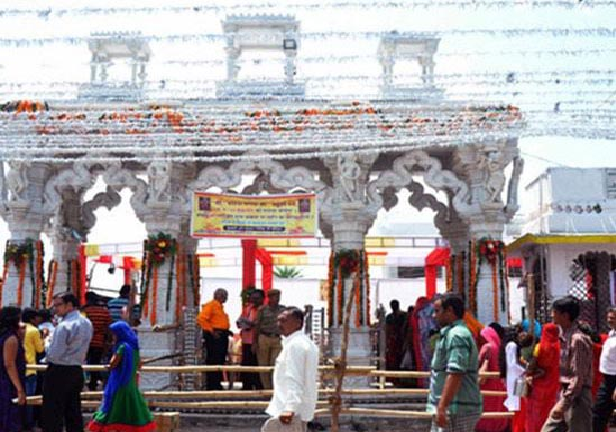
The Bohra Ganesh temple has been one of the significant temples in Udaipur. The temple has been very strict about particular aspects of the dress code.

The history of Bohra Ganesh Temple:

The very old and famous temple of Lord Ganesh, Bohra Ganesh Temple, is situated near Mohanlal Sukhadia University in Udaipur. It is believed that the temple is 350 years old. One can witness an east-facing idol of the lord in a dancing posture, in the center of the temple.

Bohra Ganesh temple has the same prestige as the temple of Moti Dungari. Thousands of devotees visit every week.

The imposed rule

As the temple authorities strictly follow the Hindu religion. Thus, this became the reason for the ban on short clothes in the mandir. The priest has strictly prohibited any devotee from entering the temple wearing short clothes, as they say, it has been imposed to follow the Hindu religion.