Ajmer, one of the holy cities of India, home to the Dargha of saint Khwaja Moinuddin Chishti, witnessed one of the major social horrors in 1992. One of the worst cases humanity has seen, “Ajmer 92” still haunts the people.
Now the case is about to be depicted on the big screen, named Ajmer 92.
About the case:
The case is about a sequence of crimes of rape and sexual abuse, including more than 100 women. Journalist Santosh Gupta reported on the crime in April 1992 and busted many secrets revolving around the case.
In the report it was claimed that the people who were behind it had connections with the higher authorities, such as powerful, politically well-connected individuals, some of whom had ties with the Sufi Dargah in the town.
The report brought the major series of sexual abuse and blackmail to light, where many girls were sexually abused and blackmailed by the guilty. Mostly the women who were targeted were school or college-going girls. They were lured to a remote location and abused there by one or multiple men.
The widespread crime ended in 1992 when Gupta’s story highlighted the abuse in the public domain.
Ajmer 92.
Directed by Pushpendra Singh, Ajmer 92 had already received appreciation. The trailer reflected upon the reality of Society in a short amount of time. The film will be released on 21st July 2023.
Nelson Mandela was a South African anti-apartheid leader, political prisoner, Nobel Peace Prize laureate and the first democratically elected president of a multiracial South Africa. He is widely regarded as one of the greatest statesmen and humanitarians of the 20th century. His life and legacy have inspired millions of people around the world to fight for justice, freedom and dignity.
On the occasion of his 105th birth anniversary, we have compiled a list of some of his most powerful and memorable quotes that reflect his wisdom, courage and compassion. These quotes can motivate us to overcome our challenges, pursue our dreams and make a positive difference in the world.
On Leadership
“Real leaders must be ready to sacrifice all for the freedom of their people.”
“It is better to lead from behind and to put others in front, especially when you celebrate victory when nice things occur. You take the front line when there is danger. Then people will appreciate your leadership.”
“A good leader can engage in a debate frankly and thoroughly, knowing that at the end he and the other side must be closer, and thus emerge stronger. You don’t have that idea when you are arrogant, superficial, and uninformed.”
“A leader. . .is like a shepherd. He stays behind the flock, letting the most nimble go out ahead, whereupon the others follow, not realizing that all along they are being directed from behind.”
On Education
“Education is the most powerful weapon which you can use to change the world.”
“Education is the great engine of personal development. It is through education that the daughter of a peasant can become a doctor, that the son of a mineworker can become the head of the mine, that a child of farm workers can become the president of a great nation. It is what we make out of what we have, not what we are given, that separates one person from another.”
“No country can really develop unless its citizens are educated.”
“Without education, your children can never really meet the challenges they will face. So it’s very important to give children education and explain that they should play a role for their country.”
On Courage
“I learned that courage was not the absence of fear, but the triumph over it. The brave man is not he who does not feel afraid, but he who conquers that fear.”
“The greatest glory in living lies not in never falling, but in rising every time we fall.”
“It always seems impossible until it’s done.”
“Do not judge me by my successes, judge me by how many times I fell down and got back up again.”
On Freedom
“For to be free is not merely to cast off one’s chains, but to live in a way that respects and enhances the freedom of others.”
“There can be no greater gift than that of giving one’s time and energy to help others without expecting anything in return.”
“There is no easy walk to freedom anywhere, and many of us will have to pass through the valley of the shadow of death again and again before we reach the mountaintop of our desires.”
“As I walked out the door toward the gate that would lead to my freedom, I knew if I didn’t leave my bitterness and hatred behind, I’d still be in prison.”
On Humanity
“No one is born hating another person because of the color of his skin, or his background, or his religion. People must learn to hate, and if they can learn to hate, they can be taught to love, for love comes more naturally to the human heart than its opposite.”
“It is in your hands to create a better world for all who live in it.”
“A fundamental concern for others in our individual and community lives would go a long way in making the world the better place we so passionately dreamt of.”
“What counts in life is not the mere fact that we have lived. It is what difference we have made to the lives of others that will determine the significance of the life we lead.”
On Democracy
“It is not our diversity which divides us; it is not our ethnicity, or religion or culture that divides us. Since we have achieved our freedom, there can only be one division amongst us: between those who cherish democracy and those who do not.”
“A critical, independent and investigative press is the lifeblood of any democracy. The press must be free from state interference. It must have the economic strength to stand up to the blandishments of government officials. It must have sufficient independence from vested interests to be bold and inquiring without fear or favour.”
“The people of South Africa have spoken in these elections. They want change! And change is what they will get. Our plan is to create jobs, promote peace and reconciliation, and to guarantee freedom for all South Africans.”
“Never, never and never again shall it be that this beautiful land will again experience the oppression of one by another and suffer the indignity of being the skunk of the world.”
On Wisdom
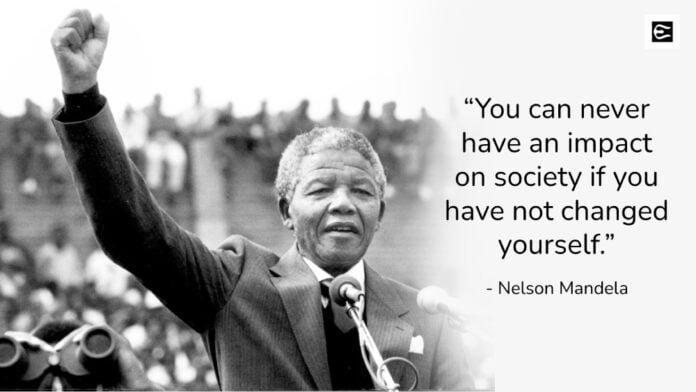
“You can never have an impact on society if you have not changed yourself.”
“Everyone can rise above their circumstances and achieve success if they are dedicated to and passionate about what they do.”
“I like friends who have independent minds because they tend to make you see problems from all angles.”
“Fools multiply when wise men are silent.”
On Humor
“I am not a saint, unless you think of a saint as a sinner who keeps on trying.”
“I never lose. I either win or learn.”
“After climbing a great hill, one only finds that there are many more hills to climb.”
“If you talk to a man in a language he understands, that goes to his head. If you talk to him in his language, that goes to his heart.”
On Legacy
“During my lifetime I have dedicated myself to this struggle of the African people. I have fought against white domination, and I have fought against black domination. I have cherished the ideal of a democratic and free society in which all persons live together in harmony and with equal opportunities. It is an ideal which I hope to live for and to achieve. But if needs be, it is an ideal for which I am prepared to die.”
“Death is something inevitable. When a man has done what he considers to be his duty to his people and his country, he can rest in peace. I believe I have made that effort and that is, therefore, why I will sleep for the eternity.”
“When a man has done what he considers to be his duty to his people and his country, he can rest in peace.”
“I am the product of Africa and her long-cherished view of rebirth that can now be realised so that all of her children may play in the sun.”
We hope you enjoyed reading these inspiring quotes by Nelson Mandela. Which one is your favorite? Let us know in the comments below.
Dalkhai is a folk dance of Odisha, India, that originated in the Sambalpur district. It is performed by the Adivasi communities of Western Odisha, such as the Binjhal, Kuda, Mirdha, Sama and others. The dance is named after the word ‘Dalkhai’, which means ‘lady love’ in Oriya, and is used as an address to a lover at the beginning and end of each stanza sung in the dance.
History and Significance
Dalkhai is a dance that reflects the culture and traditions of the Adivasi people of Odisha. It is based on the themes of love, nature, mythology and social issues. The dance depicts the stories of Radha and Krishna, Ramayana and Mahabharata, as well as the daily life and struggles of the Adivasi people.
Dalkhai is also a festival that is celebrated in the month of October, coinciding with the Dussehra festival. The festival is marked by worshipping Goddess Durga, who is made of sand on the riverbank and placed under a tree. The festival also involves offering sacrifices to the goddess, singing folk songs, playing musical instruments and performing the Dalkhai dance. The festival is a way of expressing gratitude to the goddess for her blessings and protection.
Features and Style
Dalkhai is a dance that involves both male and female dancers, who wear colorful and traditional costumes and ornaments. The women wear printed Sambalpuri sarees, scarves, necklaces, bangles and anklets, while the men wear dhotis, kurtas, turbans and waistbands. The women also tie bells around their ankles to produce rhythmic sounds while dancing.
The dance is accompanied by a rich orchestra of folk music played by instruments such as dhol (a double-sided drum), nisan (a large iron drum), tamki (a small drum), tasa (a brass drum) and mahuri (a double-reed instrument). The dhol player leads the tempo and dances in front of the women. The dance consists of various steps and movements that are synchronized with the music and lyrics. The dance also involves flirting and teasing between the male and female dancers.
Celebration in 2023
The Dalkhai festival in 2023 will be celebrated from October 14 to October 21, coinciding with the Dussehra festival. The festival will be celebrated with great enthusiasm and joy by the Adivasi communities of Western Odisha, as well as by other people who appreciate the folk culture of Odisha. The festival will be an occasion to showcase the rich heritage and diversity of Odisha’s folk dance and music.
The festival will also be an opportunity to promote tourism and cultural exchange in Odisha, as many visitors from other states and countries will be attracted to witness the spectacle of Dalkhai. The festival will also be a platform to encourage young talent and preserve the folk art form for future generations.
Mrinalini Sarabhai, who was born on May 11, 1918, was one of the most celebrated and influential figures in the field of Indian classical dance. She was an expert in Bharatanatyam and Kathakali, two of the most prominent dance forms of South India, and also a choreographer, a teacher, and a social activist. Google Doodle honoured her on her 100th birth anniversary in 2018.
Early Life and Education
Mrinalini Sarabhai was born in Kerala to a distinguished family of lawyers, social workers, and freedom fighters. Her father, Dr. Subbarama Swaminathan, was a renowned barrister at the Madras High Court and principal of the Madras Law College, while her mother, Ammu Swaminathan, was a prominent member of the Indian National Congress and a parliamentarian.
She spent her childhood in Switzerland, where she learned the Dalcroze method, a Western technique of dance movements. She returned to India and joined Shantiniketan, the school founded by Rabindranath Tagore, where she discovered her passion for dance. She later went to the United States and enrolled at the American Academy of Dramatic Arts to train in dance.
She came back to India and learned Bharatanatyam from Meenakshi Sundaram Pillai, Kathakali from Thakazhi Kunchu Kurup, and Mohiniattam from Kalyanikutty Amma. She also studied Manipuri and other folk dances from various regions of India. She developed her own style and technique by blending the classical and folk elements of dance.
Career and Achievements
Mrinalini Sarabhai married Vikram Sarabhai, a renowned physicist and the father of the Indian space program, in 1942. They had two children, Mallika and Kartikeya, who also became eminent dancers and artists.
She founded the Darpana Academy of Performing Arts in Ahmedabad in 1948, which became one of the leading institutions for imparting training in dance, drama, music, and puppetry. She choreographed more than 300 dance dramas on various themes ranging from mythology to social issues. She also performed extensively in India and abroad, earning acclaim and recognition for her artistry and innovation.
She was also a vocal advocate for women’s rights, environmental protection, communal harmony, and cultural diversity. She used her dance as a medium to raise awareness and inspire action on these issues. She also wrote several books on dance, art, and culture.
She received many awards and honours for her contribution to Indian classical dance and culture. Some of them are:
Padma Shri (1965)
Padma Bhushan (1992)
Sangeet Natak Akademi Award (1968)
Sangeet Natak Akademi Fellowship (1994)
Kalidas Samman (2004)
Nishagandhi Puraskaram (2010)
She passed away on January 21, 2016 at the age of 97 in Ahmedabad. She left behind a rich legacy of dance that continues to inspire generations of dancers and artists.
The Indian Space Research Organisation (ISRO) has set its sights on the moon once again with the upcoming launch of Chandrayaan-3, and leading the mission is the renowned scientist Ritu Karidhal Srivastava. Scheduled for launch at 2:35 pm on Friday from the Satish Dhawan Space Centre in Sriharikota, Andhra Pradesh, Chandrayaan-3 aims to explore the uncharted territory of the moon’s south pole.
The mission will be propelled into space by ISRO’s GSLV Mark 3 (LVM 3) heavy-lift launch vehicle, equipped with a composite of propulsion, lander, and rover components. The lander is designed for a soft landing on a designated lunar site and will deploy the rover to conduct in-situ chemical analysis of the moon’s surface. If successful, India will join an elite group of nations, including the United States, Russia, and China, that have achieved a soft landing on the moon.
At the forefront of this crucial lunar mission is Dr. Ritu Karidhal Srivastava, a highly respected senior scientist at ISRO. Dr. Karidhal, affectionately known as India’s “rocket woman,” has an illustrious career that includes serving as the Mission Director for Chandrayaan-2 and the Deputy Operations Director for Mangalyaan, India’s Mars Orbiter Mission.
Hailing from Lucknow, Dr. Ritu Karidhal Srivastava pursued her passion for space by obtaining a master’s degree in Physics from Lucknow University, followed by an MTech in Aerospace Engineering from the prestigious Indian Institute of Science (IISc) in Bengaluru. She joined ISRO in 1997, where she rapidly rose through the ranks and played a crucial role in several significant space missions.
Dr. Karidhal’s accomplishments have earned her numerous accolades, including the ISRO Young Scientist Award presented by former President APJ Abdul Kalam. She was also honored with the ISRO Team Award for her contributions to the Mars Orbiter Mission in 2015 and the Women Achievers in Aerospace award by the Society of Indian Aerospace Technologies & Industries (SIATI).
From a young age, Dr. Ritu Karidhal Srivastava has been captivated by space and diligently collected newspaper clippings on ISRO and NASA’s achievements. Her passion and expertise have resulted in over 20 published papers in esteemed international and national journals.
The launch of Chandrayaan-3 marks another significant milestone in Dr. Karidhal’s remarkable career and further cements her legacy as a trailblazer in the field of space exploration. As the mission lead, she will spearhead the team of dedicated scientists and engineers in their pursuit of scientific knowledge and lunar discovery.
Dr. Ritu Karidhal Srivastava’s contributions to India’s space program extend far beyond her technical expertise. She serves as an inspiration, particularly to young women aspiring to pursue careers in science and engineering. Her achievements exemplify the spirit of perseverance, innovation, and determination that have propelled India’s space exploration endeavors to new heights.
As Chandrayaan-3 prepares for its ambitious mission to the moon, Dr. Ritu Karidhal Srivastava stands as a symbol of India’s scientific excellence and a beacon of inspiration for future generations of scientists and dreamers. Her indomitable spirit and groundbreaking work continue to shape the trajectory of India’s space exploration journey, propelling the nation toward even greater scientific achievements.
In the small town of Larkana, Pakistan, a remarkable family has captured the attention of the world with their extraordinary coincidence. The Mangi family, consisting of Ameer Ali Mangi, his wife Khudeja, and their seven children, has made headlines for setting a Guinness World Record for the most family members born on the same day.
August 1 holds a special significance for the Mangi family. It all started with the arrival of their eldest child, Sindhoo, on August 1, 1992. The surprises continued when twin girls, Sasui and Sapna, joined the family on the same date. As fate would have it, the Mangi family welcomed Aamir and Ambar into the world on August 1 as well. And in later years, the family was blessed with twin brothers, Ammar and Ahmar, completing the incredible coincidence.
What makes their record even more astounding is that all the births happened naturally, without any cesarean sections or premature deliveries. Khudeja didn’t experience early labor, and the synchronicity of their births seemed like a miraculous gift from above.
The Mangi family not only celebrates the birthdays of their seven children on August 1 but also marks it as their wedding anniversary. Ameer and Khudeja tied the knot on August 1, 1991, exactly one year before the birth of their eldest daughter, Sindhoo. This day has become an even more significant occasion for the family, embodying the unity and joy they share.
With their unique story capturing the world’s attention, the Mangi family celebrates August 1 with even more enthusiasm and happiness. They have adopted a tradition of cutting a shared cake, symbolizing their bond and unity. Their extraordinary coincidence has garnered multiple Guinness World Records, adding another layer of recognition to their already remarkable story.
The previous record for siblings with coinciding birthdays was held by the Cummins family from the United States. Five children in their family shared the same birthdate, February 20, between the years 1952 and 1966. The Mangi family’s achievement surpasses this record, making their synchronicity even more exceptional.
Being part of a family with the same surname is not uncommon, but to have multiple family members sharing the exact birthdate is truly remarkable. The Mangi family from Larkana, Pakistan, has not only captured the world’s attention but also inspired awe and wonder with their incredible coincidence.
During his two-day official visit to France, Prime Minister Narendra Modi presented a range of exquisite gifts to the country’s leaders, showcasing the rich cultural heritage of India. These gifts included a sandalwood sitar, silk fabric, a marble table, a silk carpet, and a sandalwood elephant figurine.
One of the highlights among the gifts was a sandalwood sitar presented to French President Emmanuel Macron. This unique replica of the musical instrument, crafted from pure sandalwood, displayed intricate carvings of Goddess Saraswati and Lord Ganesha, representing knowledge, music, wisdom, and the removal of obstacles. The sitar also featured peacock motifs, symbolizing India’s national bird, and elaborate carvings inspired by Indian culture.
Brigitte Macron, the President’s spouse, received a Pochampally Ikat silk fabric presented in a sandalwood box. Pochampally Ikat, known for its vibrant colors and intricate designs, originates from the town of Pochampally in Telangana, India. The fabric exemplifies India’s rich textile heritage and was elegantly showcased in a decorative sandalwood box, highlighting the craftsmanship and aromatic qualities of sandalwood.
Prime Minister Élisabeth Borne of France was presented with a captivating marble table adorned with intricate marble inlay work. This craftsmanship involves cutting and engraving semi-precious stones into high-quality marble sourced from Makrana, Rajasthan. The result is a beautiful and colorful masterpiece showcasing the skilled artistry of marble inlay work.
President of the French National Assembly, Yaël Braun-Pivet, received a hand-knitted silk Kashmiri carpet from Prime Minister Modi. These carpets, known worldwide for their softness, intricate details, and captivating colors, are a testament to the craftsmanship of Kashmiri artisans. The unique feature of these carpets is their ability to display different shades when viewed from various angles, creating an illusion of two carpets instead of one.
Finally, President of the French Senate, Gerard Larcher, was presented with a sandalwood hand-carved elephant figurine, symbolizing wisdom, strength, and good fortune. Meticulously crafted from pure sandalwood, these elephant figurines hold special significance in Indian culture, embodying the harmonious connection between nature, culture, and art.
The gifts presented by Prime Minister Narendra Modi to the leaders of France represent not only the beauty and artistry of Indian craftsmanship but also serve as a gesture of friendship and cultural exchange between the two nations. These gifts reflect India’s diverse cultural heritage and further strengthen the bonds of diplomacy and goodwill between India and France.
Tennis is a sport that has many tournaments and events throughout the year, but there are four that stand out as the most prestigious and important ones. These are the Grand Slam tournaments, also known as the majors, which are the Australian Open, the French Open, Wimbledon, and the US Open. Winning one of these tournaments is a huge achievement for any tennis player, but winning all four in the same year is the ultimate goal and challenge. This is what is known as a Grand Slam in tennis.
The Origin and Meaning of Grand Slam
The term Grand Slam was first used in 1933 by a New York Times writer, John Kieran, who compared the feat of winning all four major tennis tournaments to a bidding convention in the card game bridge. He wrote that if Jack Crawford, an Australian player who had won the first three majors of the year, could also win the US Open, it would be like scoring a Grand Slam in bridge.
Crawford failed to do so, losing in the final to Fred Perry, but the term stuck and became widely used to describe the achievement of winning all four majors in a calendar year. The first player to accomplish this was Don Budge of America in 1938, followed by Maureen Connolly of America in 1953, Rod Laver of Australia in 1962 and 1969, Margaret Court of Australia in 1970, and Steffi Graf of Germany in 1988. Rod Laver is the only player to have done it twice, and also the only one to have done it before and after the start of the Open Era in 1968, when professional players were allowed to compete in the majors.
A Grand Slam can be achieved in singles, doubles, or mixed doubles, and by men or women. However, singles is considered the most prestigious and difficult category. A player can also achieve a Grand Slam by playing with different partners in doubles or mixed doubles.
The Variations of Grand Slam
Besides the calendar year Grand Slam, there are other variations of the term that are used to describe different achievements in tennis. These include:
Non-calendar year Grand Slam: This is when a player wins all four majors consecutively but not within the same calendar year. For example, Serena Williams won the US Open in 2014, followed by the Australian Open, French Open, and Wimbledon in 2015. She completed a non-calendar year Grand Slam but failed to win the US Open in 2015 to complete a calendar year Grand Slam.
Career Grand Slam: This is when a player wins all four majors at any point during their career. For example, Roger Federer won his first major at Wimbledon in 2003, followed by the US Open in 2004, the Australian Open in 2004 and 2006, and finally the French Open in 2009. He completed a career Grand Slam but not a calendar year Grand Slam or a non-calendar year Grand Slam.
Golden Slam: This is when a player wins all four majors and the Olympic gold medal in singles in the same calendar year. This is considered the most difficult and rarest achievement in tennis. Only one player has ever done it: Steffi Graf in 1988. She won all four majors and then defeated Gabriela Sabatini of Argentina in the final of the Seoul Olympics to complete a Golden Slam.
Career Golden Slam: This is when a player wins all four majors and the Olympic gold medal in singles at any point during their career. Only four players have ever done it: Steffi Graf (1988), Andre Agassi (1999), Rafael Nadal (2010), and Serena Williams (2012).
The Grand Slam Tournaments
The four Grand Slam tournaments are:
Australian Open: This is held every year in January at Melbourne Park in Melbourne, Australia. It is played on hard courts and is known for its high temperatures and unpredictable weather. It was first held in 1905 and became part of the Grand Slam circuit in 1924.
French Open: This is held every year from late May to early June at Stade Roland Garros in Paris, France. It is played on clay courts and is known for its long rallies and physical demands. It was first held in 1891 and became part of the Grand Slam circuit in 1925.
Wimbledon: This is held every year from late June to early July at All England Lawn Tennis and Croquet Club in London, England. It is played on grass courts and is known for its tradition and prestige. It was first held in 1877 and is the oldest tennis tournament in the world.
US Open: This is held every year from late August to early September at USTA Billie Jean King National Tennis Center in New York City, USA. It is played on hard courts and is known for its loud crowds and night sessions. It was first held in 1881 and became part of the Grand Slam circuit in 1924.
Each Grand Slam tournament lasts for two weeks and consists of five main events: men’s singles, women’s singles, men’s doubles, women’s doubles, and mixed doubles. There are also junior, wheelchair, and legends events. The tournaments are overseen by the International Tennis Federation (ITF) and award the most ranking points, prize money, and prestige to the players.
The Grand Slam Winners
Here is a list of all the players who have won a Grand Slam in singles, doubles, or mixed doubles in the Open Era (since 1968):
Raksha Bandhan is a Hindu festival that celebrates the bond of love and protection between brothers and sisters. It is also known as Rakhi, which means a sacred thread that sisters tie around their brothers’ wrists on this day. Raksha Bandhan falls on the full moon day of the Hindu month of Shravan, which usually coincides with August in the Gregorian calendar.
Raksha Bandhan 2023 Date and Time
In 2023, Raksha Bandhan will be celebrated on Wednesday, August 30. The auspicious time to tie the rakhi is during the Aparahna period, which is the late afternoon according to the Hindu division of the day. The Aparahna time for Raksha Bandhan 2023 will start from 1:42 pm and end at 4:18 pm. The total duration of the Aparahna time will be 2 hours and 36 minutes.
If the Aparahna time is not available, then the next best time to tie the rakhi is during the Pradosh period, which is the evening twilight. The Pradosh time for Raksha Bandhan 2023 will start from 6:54 pm and end at 8:40 pm. The total duration of the Pradosh time will be 1 hour and 46 minutes.
It is advisable to avoid tying the rakhi during the Bhadra period, which is considered inauspicious for any auspicious work. The Bhadra time for Raksha Bandhan 2023 will start from 10:58 am on August 30 and end at 12:06 pm on the same day. The total duration of the Bhadra time will be 1 hour and 8 minutes.
Raksha Bandhan History and Significance
Raksha Bandhan has a long history and significance in Hindu mythology and culture. There are many legends and stories associated with this festival, which highlight its importance and relevance. Some of the most popular ones are:
Indra and Indrani: According to one legend, when Indra, the king of gods, was fighting a fierce battle against the demon king Bali, he was losing his strength and courage. His wife Indrani, who was also a goddess, tied a sacred thread around his wrist to protect him from harm and grant him victory. This thread was called a raksha sutra, which later came to be known as rakhi.
Krishna and Draupadi: According to another legend, when Krishna injured his finger while flying a kite, Draupadi, the wife of the Pandavas, tore a piece of her saree and wrapped it around his wound to stop the bleeding. Krishna was touched by her gesture and promised to protect her from any danger. He fulfilled his promise by saving her from being disrobed by Duryodhana in the Kaurava court.
Yama and Yamuna: According to yet another legend, Yama, the god of death, had not visited his sister Yamuna, the river goddess, for a long time. Yamuna missed her brother dearly and asked Ganga, another river goddess, to convey her message to him. Yama was pleased to hear from his sister and decided to visit her. Yamuna was overjoyed to see her brother and welcomed him with a grand feast. She also tied a rakhi around his wrist and prayed for his well-being. Yama was moved by her love and affection and granted her immortality. He also declared that whoever celebrates Raksha Bandhan with their sisters will be blessed with a long and happy life.
King Bali and Goddess Lakshmi: According to one more legend, King Bali, a benevolent demon king, had conquered all the three worlds and became the ruler of the universe. Vishnu, the preserver god, wanted to restore the balance of power and decided to test Bali’s generosity. He disguised himself as a dwarf Brahmin named Vamana and asked Bali for three steps of land as a boon. Bali agreed without hesitation, but Vamana revealed his true form and covered the earth and the sky with his two steps. He then asked Bali where he should place his third step. Bali realized his folly and offered his head as the third step. Vishnu was impressed by Bali’s devotion and granted him a boon to rule the netherworld. He also decided to stay with Bali as his guard. However, this meant that Vishnu had to leave his wife Lakshmi behind in Vaikuntha, his abode. Lakshmi missed her husband dearly and decided to go to Bali’s palace as a poor Brahmin woman. She tied a rakhi around Bali’s wrist and asked him to free her husband from his service. Bali was touched by her gesture and realized that she was none other than Lakshmi. He agreed to let Vishnu go back to Vaikuntha with his wife and also requested them to visit him once in a while.
Raksha Bandhan is a festival that celebrates the bond of love and protection between brothers and sisters. It is also a symbol of harmony and unity among different communities and religions. It is a day to express gratitude, affection, and respect for one’s siblings and to pray for their happiness and well-being. It is also a day to exchange gifts, sweets, and blessings with one’s family and friends. Raksha Bandhan is a festival that strengthens the bond of siblinghood and fosters a sense of responsibility and care among brothers and sisters..
India is a vast and diverse country with a population of over 1.3 billion people. It is also a democratic republic with a federal system of government. The Constitution of India, which came into force on 26 January 1950, is the supreme law of the land. It establishes the structure, functions, powers, and duties of the three organs of the state: the executive, the legislature, and the judiciary.
The judiciary is the branch of government that interprets and applies the law in India. It also acts as the guardian of the Constitution and the protector of the rights and liberties of the people. The judiciary consists of a hierarchy of courts that deal with various types of cases, such as civil, criminal, constitutional, administrative, etc.
But how many supreme courts are there in India? The answer is: only one.
The Supreme Court of India
The Supreme Court of India is the highest judicial authority and the final court of appeal in India. It is also known as the apex court or the court of last resort. It has the power to hear and decide cases involving any matter arising under the Constitution or any law made by Parliament or any state legislature. It also has the power to review its own judgments or orders, as well as those of any lower court or tribunal.
The Supreme Court of India is located in New Delhi, the capital city of India. It was established on 26 January 1950, replacing the Federal Court of India, which was set up in 1937 under the Government of India Act 1935. The Supreme Court consists of the Chief Justice of India and a maximum of 33 other judges. The President of India appoints the judges on the recommendation of a collegium, which is a group of senior judges headed by the Chief Justice.
The Supreme Court has original, appellate, and advisory jurisdictions. Under its original jurisdiction, it can hear cases involving disputes between the central government and one or more states, or between two or more states, or cases involving the violation of fundamental rights. Under its appellate jurisdiction, it can hear appeals from any judgment or order of any high court or tribunal in civil, criminal, or constitutional matters. Under its advisory jurisdiction, it can give its opinion on any question of law or fact referred to it by the President of India.
The Supreme Court also has some special powers, such as:
The power to issue writs for the enforcement of fundamental rights or for any other purpose.
The power to transfer cases from one high court to another or from a high court to itself for speedy justice or fair trial.
The power to grant special leave to appeal from any judgment or order of any court or tribunal in any matter.
The power to declare any law made by Parliament or any state legislature as unconstitutional if it violates the basic structure doctrine.
The power to make rules for regulating its own practice and procedure.
The Supreme Court functions with two types of benches: a division bench and a full bench. A division bench consists of two or more judges and hears routine cases. A full bench consists of at least five judges and hears important cases involving constitutional issues or matters of general public importance. Sometimes, a larger bench consisting of seven, nine, eleven, or more judges may be constituted to hear cases involving substantial questions of law.
The Supreme Court is headed by the Chief Justice of India, who is the senior-most judge of the court. He/she is responsible for allocating cases to different benches, appointing acting chief justices for high courts, presiding over full bench hearings, administering oath to new judges and other constitutional functionaries, etc. The Chief Justice also acts as the ex-officio chairman of various bodies, such as:
The National Judicial Academy
The National Legal Services Authority
The General Council of the Bar Council of India
The Supreme Court Legal Services Committee
The Indian Law Institute
The current Chief Justice of India is Justice Dhananjaya Y. Chandrachud, who took office on 9 November 2022. He is the 50th Chief Justice of India.
The High Courts and Subordinate Courts
Below the Supreme Court are the high courts and subordinate courts. There are 25 high courts in India at present (as on December 18, 2020). These are:
S.No
Name
Year Established
Jurisdiction
1
Allahabad High Court
1866
Uttar Pradesh
2
Andhra Pradesh High Court
2019
Andhra Pradesh
3
Bombay High Court
1862
Maharashtra, Goa, Dadra and Nagar Haveli, Daman and Diu
4
Calcutta High Court
1862
West Bengal, Andaman and Nicobar Islands
5
Chhattisgarh High Court
2000
Chhattisgarh
6
Delhi High Court
1966
Delhi
7
Gauhati High Court
1948
Assam, Nagaland, Mizoram, Arunachal Pradesh
8
Gujarat High Court
1960
Gujarat
9
Himachal Pradesh High Court
1971
Himachal Pradesh
10
Jammu and Kashmir High Court
1928
Jammu and Kashmir, Ladakh
11
Jharkhand High Court
2000
Jharkhand
12
Karnataka High Court
1884
Karnataka
13
Kerala High Court
1956
Kerala, Lakshadweep
14
Madhya Pradesh High Court
| 1956 |
Madhya Pradesh |
| 15 |
Madras High Court |
1862 |
Tamil Nadu, Puducherry |
| 16 |
Manipur High Court |
2013 |
Manipur |
| 17 |
Meghalaya High Court |
2013 |
Meghalaya |
| 18 |
Orissa High Court |
1948 |
Odisha |
| 19 |
Patna High Court |
1916 |
Bihar |
| 20 |
Punjab and Haryana High Court |
1947 |
Punjab, Haryana, Chandigarh |
| 21 |
Rajasthan High Court |
1949 |
Rajasthan |
| 22 |
Sikkim High Court |
1975 |
Sikkim |
| 23 |
Telangana High Court |
2019 |
Telangana |
| 24 |
Tripura High Court |
2013 |
Tripura |
| 25 |
Uttarakhand High Court
|
2000
|
Uttarakhand
|
The high courts are the top judicial bodies in the states and union territories. They have original, appellate, and supervisory jurisdictions. Under their original jurisdiction, they can hear cases involving the violation of fundamental rights or any matter of substantial public importance. Under their appellate jurisdiction, they can hear appeals from any judgment or order of any subordinate court or tribunal in civil, criminal, or constitutional matters. Under their supervisory jurisdiction, they can issue directions or orders to any subordinate court or tribunal for the administration of justice.
The high courts are headed by the chief justices, who are appointed by the President of India on the recommendation of a collegium. The chief justices are assisted by other judges, who are also appointed by the President on the recommendation of a collegium. The number of judges in each high court varies depending on the workload and population of the state or union territory.
The high courts also have administrative control over the subordinate courts in their respective jurisdictions. The subordinate courts are also known as district courts or lower courts. They are the courts of first instance for most civil and criminal cases in India. They are divided into two categories: civil courts and criminal courts.
The civil courts deal with cases involving disputes over property, contracts, family matters, etc. They are headed by the district judges, who are appointed by the governor of the state on the recommendation of the high court. The district judges are assisted by other civil judges, who are appointed by the governor after passing a judicial service examination conducted by the high court or the state public service commission.
The criminal courts deal with cases involving offences against the state or society, such as murder, theft, rape, etc. They are headed by the sessions judges, who are appointed by the governor of the state on the recommendation of the high court. The sessions judges are assisted by other judicial magistrates, who are appointed by the governor after passing a judicial service examination conducted by the high court or the state public service commission.
The subordinate courts also include some special courts and tribunals that deal with specific matters, such as family courts, consumer courts, labour courts, tax tribunals, etc. These courts and tribunals are established by various laws made by Parliament or state legislatures.
Conclusion
We hope this blog post has helped you understand how many supreme courts are there in India and what are their roles and functions. The Supreme Court of India is the only supreme court in India that has the final authority to decide any legal dispute in India. The high courts and subordinate courts are the other important components of the Indian judicial system that handle various types of cases at different levels. The Indian judiciary is an independent and impartial institution that upholds the rule of law and protects the rights and interests of the people.
If you want to learn more about the Indian judiciary or prepare for competitive exams like UPSC, SSC, etc., you can check out our other blog posts on Indian polity notes, current