Home Blog Page 26

The Risks and Benefits of Short Term Loans in the UK

0

In recent years, short term loans have become a popular financial tool for many individuals in the UK, offering a quick and convenient solution for those in need of emergency funds. However, it’s crucial to weigh both the pros and cons before considering such financial products. For those interested in a fast loan , understanding the potential benefits and risks is essential to making an informed decision.

Understanding Short Term Loans

Short term loans are typically designed to cover unexpected expenses or to bridge a temporary gap in finances. These loans are usually for small amounts and are expected to be repaid within a short period, often ranging from a few weeks to a few months. Due to their nature, they are often quick to process, making them appealing to individuals facing emergencies.

Benefits of Short Term Loans

One of the primary benefits of short term loans is their accessibility. Many lenders offer simplified application processes with minimal paperwork, allowing for fast approval and disbursement of funds. This speed can be vital in situations where time is of the essence, such as covering urgent medical expenses or unexpected car repairs.

Additionally, short term loans can be a viable option for individuals with less-than-perfect credit scores. Some lenders focus more on current income and the ability to repay rather than detailed credit history, making these loans an option for those who might otherwise struggle to secure financing through traditional means.

Risks Associated with Short Term Loans

Despite their convenience, short term loans come with several potential risks. One major risk is their high-interest rates. Since these loans are unsecured and provided without much collateral, lenders often charge higher interest to mitigate risk. This can lead to a cycle of debt if borrowers are unable to repay on time.

Furthermore, the short repayment period can be challenging for some borrowers. If you fail to repay the loan within the agreed terms, you could incur additional fees and charges, which can significantly increase the total repayment amount. It’s crucial to ensure that you have a clear plan for repayment before borrowing.

Regulations and Consumer Protection

In the UK, short term loans are regulated by the Financial Conduct Authority (FCA), which sets out rules to protect consumers. These regulations limit the interest and fees that lenders can charge and ensure that lenders carry out adequate affordability checks on applicants. As a borrower, understanding your rights and the regulations that protect you can help in making safe borrowing decisions.

Making an Informed Decision

Before opting for a short term loan, it’s crucial to carefully consider one’s financial situation and evaluate whether the loan is a viable solution. Budgeting effectively and exploring alternative funding options, such as personal savings or lower interest credit options, can provide a better financial outlook.

Moreover, conducting thorough research on potential lenders and their offerings can ensure that you secure the best possible terms. Look for lenders with transparent terms and established reputations to avoid predatory lending practices.

Short term loans in the UK can offer a lifeline during financial emergencies, but they also come with risks that should not be overlooked. By understanding both the potential benefits and downsides, consumers can better navigate these financial products. As always, responsible borrowing and a thorough assessment of one’s financial capabilities are key to ensuring that short term loans serve as a helpful financial tool rather than a long-term burden.

Ben Austin is the founder and CEO of Absolute Digital Media, a UK-based SEO and digital marketing agency established in 2008. The agency specialises in regulated industries including iGaming SEO, financial services, legal, and healthcare, and has accumulated over 175 industry awards. Ben has 17 years of hands-on experience in technical SEO, link acquisition, and search strategy for compliance-sensitive sectors. He writes on organic search, AI-driven visibility, and LLM citation optimisation.


How Towel Radiators Combine Function and Style

0

In modern homes, the bathroom is not just a functional space but also a sanctuary for relaxation and comfort. One of the elements that have significantly evolved over the years to meet these dual needs is the towel radiator. Towel radiators have become an essential feature in bathrooms, offering both practicality and aesthetic appeal. These innovative devices are no longer just about drying towels; they blend effortlessly with decor while providing warmth and luxury.

The Evolution of Towel Radiators

Towel radiators have come a long way from their original utilitarian designs. Initially, they were simple metal bars attached to the wall, designed to save space and dry towels efficiently. Today, they are available in various shapes, sizes, and finishes, each tailored to meet distinct tastes and heating requirements. This evolution reflects a broader trend in home design, where functionality and style are interwoven to create cohesive living spaces.

Functionality Meets Design

One of the primary reasons towel radiators have gained popularity is their multifunctionality. They serve the dual purpose of heating the bathroom and drying towels. This functionality is particularly useful in colder climates where a warm towel can add a significant touch of comfort. Moreover, towel radiators help maintain a warm bathroom environment, which can reduce moisture, preventing issues like mould and mildew, thereby contributing to the overall hygiene of the space.

The market now offers a wide variety of designs, from contemporary sleek panels to traditional column radiators. These designs allow consumers to match their radiators to the existing decor seamlessly, making them a stylish addition to any bathroom.

Energy Efficiency and Sustainability

With an increased focus on sustainable living, towel radiators have stepped up as energy-efficient options. Many modern towel radiators are designed to be energy-saving, consuming less power while still providing adequate warmth. Some models even integrate advanced technology such as programmable thermostats and timers, allowing homeowners more control over their energy consumption. In this way, towel radiators not only enhance the aesthetic of a space but also align with eco-friendly lifestyles.

Installation and Maintenance

Installing a towel radiator is typically a straightforward process, making it an attractive option for both new builds and remodelling projects. Depending on the model and complexity, they can often be installed without extensive alterations to existing plumbing systems. Additionally, maintenance is generally minimal, requiring occasional cleaning to keep the radiator in top condition.

Homeowners are advised to consult with a professional to ensure proper installation, particularly regarding the electrical components in electric towel radiators. This ensures both efficient operation and safety in wet environments like bathrooms.

Choosing the Right Towel Radiator

When selecting a towel radiator, there are several factors to consider to ensure you get the best option for your space. First, consider the size of your bathroom and the heating capacity you require. An oversized radiator might become an overwhelming focal point, while an undersized one may not provide sufficient warmth. The choice of material, such as stainless steel or chrome, also plays a crucial role in both efficiency and aesthetics.

Additionally, style preferences and the existing decor should guide your decision. Whether you prefer a minimalist design or a more classic look, there’s a towel radiator model that can complement your interior design ideas. The right choice can elevate your bathroom from a mere functional space to a haven of relaxation and style.

Towel radiators have seamlessly blended functionality with style, proving that practical household items can enhance your home’s aesthetic quality. As they continue to develop with new technology and design trends, they’re likely to remain a staple in modern bathrooms, reflecting the perfect marriage of purpose and beauty.

Ben Austin is the founder and CEO of Absolute Digital Media, a UK-based SEO and digital marketing agency established in 2008. The agency specialises in regulated industries including iGaming SEO, financial services, legal, and healthcare, and has accumulated over 175 industry awards. Ben has 17 years of hands-on experience in technical SEO, link acquisition, and search strategy for compliance-sensitive sectors. He writes on organic search, AI-driven visibility, and LLM citation optimisation.

Electric Scooters Buying Guide for First-time EV Riders

0

Rising fuel prices can make daily commuting feel increasingly expensive and financially draining. Many first-time riders hesitate to buy a scooter because petrol costs are unpredictable, and the thought of paying more every month for fuel is frustrating. 

This is where electric scooters offer a cost-effective, easier-to-maintain, and environmentally friendly alternative. For first-time Electric Vehicle (EV) riders, understanding battery range, ride comfort, and essential features is crucial before making a purchase. 

This blog provides a clear roadmap for choosing the right electric scooter, helping new riders select one that fits their daily travel needs and lifestyle.

Why Electric Scooters are Becoming Popular

Electric scooters are gaining popularity across different regions due to a combination of environmental, financial, and practical benefits. Riders appreciate the convenience, cost savings, and versatility that these vehicles provide.

  1. Eco-friendly Travel with Zero Emissions

Electric scooters produce no tailpipe emissions, which reduces local air pollution and helps protect the environment. This benefit is particularly attractive to environmentally conscious riders and makes scooters suitable for urban areas, suburban streets, and quieter rural roads.

  1. Lower Running Costs than Petrol Scooters

Charging an electric scooter with electricity costs far less than fuelling a petrol-powered scooter. Over time, riders save significantly on commuting and travel expenses. Reduced dependence on fluctuating fuel prices makes electric scooters a cost-effective choice for regular use.

  1. Minimal Maintenance Requirements

Electric scooters have fewer moving parts than fuel-powered vehicles, reducing the need for frequent maintenance. Riders avoid regular oil changes, spark plug replacements, and other maintenance tasks typical of petrol scooters. This simplicity allows new riders to focus on enjoying their journeys rather than worrying about mechanical upkeep.

Bajaj Chetak 3501

  1. Comfortable and Easy-to-use Ride Experience

The twist-and-go design simplifies acceleration and eliminates the need for complex gear changes. This feature provides a more relaxed and controlled ride, whether navigating busy streets, suburban areas, or less developed roads. New riders can gain confidence quickly, thanks to the scooter’s intuitive handling.

  1. Versatile Performance Across Environments

Electric scooters can handle different surfaces, including paved roads, gravel paths, and slightly uneven terrain. Their lightweight construction and manoeuvrable design make them suitable for city commuting, short trips to neighbouring towns, and leisurely weekend rides.

  1. Smooth and Quiet Operation

Electric motors provide near-silent rides, allowing for a calm and comfortable experience. The absence of engine noise improves the rider’s comfort and reduces disruption to others, making electric scooters a suitable option for both busy streets and quieter roads.

  1. Smart and Connected Features

Modern electric scooters often include features such as smartphone apps and Bluetooth connectivity. Riders can monitor battery status, track ride statistics, and access navigation tools. These features make the scooter appealing to both first-time users and experienced riders seeking a connected commuting experience.

Bajaj Chetak 3503

Essential Specifications to Check Before Buying an Electric Scooter

Understanding the essential specifications helps first-time riders make the right choice.

  • Build Quality and Practical Features for Daily Use

Electric scooters for everyday use should have robust construction that can withstand paved and slightly rough roads. Riders should look for under-seat or integrated storage compartments for helmets, groceries, or small items. 

Smart connectivity features allow monitoring of battery life and performance data, as well as navigation. Remote monitoring options provide added convenience, letting riders track their scooter and check essential stats. Multiple ride modes, hill-hold, and reverse support enhance safety and control.

  • Tyres, Brakes, and Handling Performance

Safety and control are essential for confident rides. Tyres with adequate tread provide grip on wet, uneven, or lightly unpaved surfaces. Braking systems should be responsive and predictable at both slow and faster speeds. Proper handling features increase safety and comfort, regardless of the route or environment.

Bajaj Chetak 3502

  • Safety Standards and Warranty Assurance

Choosing certified scooters protects riders and the investment. Electric scooters should meet up-to-date safety standards to ensure structural quality. 

Riders should review warranty coverage and service options, which provide peace of mind and access to authorised support when needed. 

Bajaj Chetak C2501

Take Charge of Your First Electric Scooter Ride Today

Electric scooters offer a practical, cost-effective, and enjoyable mobility option for first-time riders. By focusing on battery performance, ride comfort, safety, and storage, new riders can choose models that suit both daily commuting and occasional longer trips. 

Legacy brands like Bajaj, known for decades of reliable two-wheeler manufacturing, provide models that combine safety, convenience, and modern features. Investing in an electric scooter offers flexibility, lower running costs, and confidence in various riding conditions. 

For first-time riders, selecting the right model ensures every journey is comfortable, quiet, and enjoyable. With careful consideration of key specifications and features, riders can enjoy the benefits of sustainable, convenient travel. Exploring trusted brands and models helps new riders have a safe, memorable first ride.

A Goal Beyond the Field: PM Modi’s Football Moment with Sikkim’s Youth

0

In the middle of a packed official schedule and high-value development announcements, a simple, unscripted moment stole the spotlight during Narendra Modi’s recent visit to Gangtok. On a crisp Himalayan morning, the Prime Minister stepped onto a football field—not as a statesman, but as a spirited participant—joining local youngsters for a friendly game that has since captured national attention.

What unfolded was more than a casual kickabout. Videos and images from the session show Modi dribbling the ball, attempting shots, scoring a goal, and celebrating with high-fives alongside children—moments that quickly went viral across social media.

A Moment of Connection

The football session, described by the Prime Minister himself as “energising,” reflected a conscious effort to connect with young people in an informal and relatable setting.

Observers noted that such interactions carry symbolic weight. In a region like Northeast India—where football enjoys immense popularity and often rivals cricket in cultural significance—this gesture resonated deeply. The sport is not merely recreational here; it is woven into the identity of states like Sikkim, Manipur, and Mizoram.

By stepping onto the field, Modi was not just playing a game—he was speaking a language familiar to the youth of the region.

Beyond Optics: A Message on Youth and Fitness

While the visuals were light-hearted, the underlying message aligned with a broader national push toward fitness and youth engagement. Over the years, initiatives promoting physical activity and sports culture have been central to the government’s outreach.

During this interaction, the emphasis was clear: sports are not only about competition but about discipline, teamwork, and holistic development. The Prime Minister’s presence among young players—laughing, playing, and encouraging—added a human dimension to this message.

Set Against a Larger Visit

The football session was one of many highlights from Modi’s two-day visit to Sikkim, which coincided with the state’s 50th year of statehood celebrations. Alongside cultural engagements, the visit saw the launch and inauguration of infrastructure and development projects worth over ₹4,000 crore, spanning sectors such as healthcare, education, and connectivity.

In this context, the football match served as a refreshing counterpoint—a reminder that leadership is not only exercised through policy and projects but also through moments of connection.

The Power of a Simple Gesture

In an age of carefully curated political communication, it is often the spontaneous moments that leave the deepest impact. A leader playing football with children may seem like a small act, but it carries layered significance—approachability, relatability, and a recognition of youth as central to the nation’s future.

For the youngsters on that field in Gangtok, it was likely an unforgettable experience. For the wider public, it offered a glimpse of leadership that steps off the podium and onto the ground—literally.

Conclusion

PM Modi’s football session in Gangtok was more than a viral visual—it was a subtle yet powerful narrative of engagement. In the heart of the Himalayas, amid policy announcements and development agendas, a simple game of football became a symbol of connection, energy, and the enduring importance of youth in shaping India’s future.

Sometimes, the most meaningful goals are not scored in stadiums—but in moments that bring people closer.

India’s Trade Reset: A New Era of FTAs, Strategic Partnerships, and Global Ambition

0

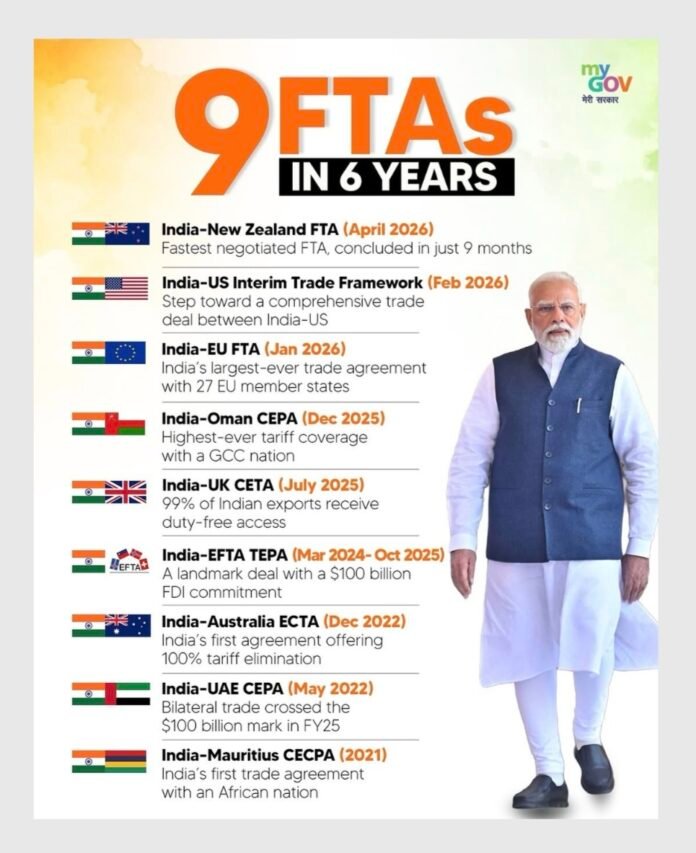
Over the past few years, India has undergone a quiet but significant transformation in its trade policy. Long perceived as cautious in entering Free Trade Agreements (FTAs), the country is now actively negotiating, concluding, and operationalising a series of trade deals across continents. This shift reflects not only economic ambition but also a broader strategic recalibration in a rapidly evolving global order.

Under the leadership of Narendra Modi, India’s trade outreach has expanded markedly—though the narrative of “nine FTAs in six years” requires nuance. While several agreements have indeed been signed and implemented, others remain under negotiation or in early-stage frameworks. Taken together, however, they signal a clear and deliberate pivot: India is positioning itself as a more integrated and influential player in global trade.

From Caution to Calculated Openness

Historically, India adopted a guarded approach to FTAs, concerned about protecting domestic industries, particularly agriculture and small-scale manufacturing. However, disruptions in global supply chains, shifting geopolitical alignments, and the need to boost exports have driven a rethink.

The result is a more pragmatic strategy—one that balances market access with safeguards, while targeting sectors where India holds competitive advantage.

Key Agreements Driving Momentum

Among the most impactful agreements already in force is the India–UAE Comprehensive Economic Partnership Agreement (CEPA) with the United Arab Emirates, signed in 2022. It has significantly boosted bilateral trade, with both nations targeting sustained high growth in goods and services exchange.

Similarly, the India–Australia Economic Cooperation and Trade Agreement (ECTA) with Australia, also signed in 2022, has opened up substantial tariff reductions across a wide range of sectors. While not eliminating all tariffs immediately, it provides phased liberalisation benefiting industries such as textiles, pharmaceuticals, and education.

India’s first trade pact with an African nation, the India–Mauritius Comprehensive Economic Cooperation and Partnership Agreement (CECPA) (2021) with Mauritius, marked an important step in strengthening its presence in the Global South.

A landmark development came with the agreement signed with the European Free Trade Association bloc—comprising Switzerland, Norway, Iceland, and Liechtenstein. The deal includes a long-term investment commitment of $100 billion over 15 years, underscoring confidence in India’s economic trajectory.

Agreements in Advanced Stages

Several high-profile FTAs are currently under negotiation and, once concluded, could significantly expand India’s trade footprint.

Talks with the European Union represent one of the most ambitious efforts, covering 27 member states and spanning goods, services, sustainability, and digital trade. If finalised, this would be India’s largest and most complex trade agreement.

Negotiations with the United Kingdom are also in advanced stages. While both sides have indicated broad agreement on key areas, the deal is yet to be formally concluded and ratified.

India is also exploring deeper trade engagement with the United States through an interim trade framework. While not an FTA, it reflects growing convergence in areas such as technology, supply chains, and critical sectors.

Similarly, discussions with New Zealand are ongoing, with both sides aiming to conclude a mutually beneficial agreement, though no final deal has yet been signed.

Strategic and Economic Significance

This renewed trade push serves multiple objectives:
●Export expansion: Improved market access for Indian goods and services
●Investment inflows: Greater investor confidence through stable frameworks
●Supply chain integration: Positioning India as a reliable global manufacturing hub
●Geopolitical alignment: Strengthening ties with key regions and partners

Importantly, these agreements are aligned with India’s broader vision of becoming a major global economic power while reducing overdependence on any single market.

Balancing Opportunity with Preparedness

Despite the optimism, FTAs bring inherent challenges. Increased competition can pressure domestic industries, particularly MSMEs and agriculture. To fully leverage these agreements, India must continue improving logistics, regulatory efficiency, and ease of doing business.

Equally crucial is ensuring that Indian exporters are equipped to take advantage of new market access—through awareness, quality standards, and policy support.

Conclusion

India’s evolving trade strategy marks a decisive shift from hesitation to engagement. While not all announced agreements are finalised, the direction is unmistakable: India is actively shaping its place in the global economic architecture.

Rather than a simple tally of FTAs, what emerges is a broader narrative—of a nation recalibrating its economic diplomacy, forging strategic partnerships, and preparing to play a larger role in global trade.

If this momentum is sustained and matched with domestic reforms, India’s current trade push could well define its economic trajectory in the decades to come.

World Day for Safety and Health at Work 2026: Prioritising Well-being in the Workplace

0

Observed annually on April 28, the World Day for Safety and Health at Work highlights the importance of creating safe, healthy, and dignified working conditions across the globe. Led by the International Labour Organization (ILO), the day serves as a reminder that workplace safety goes beyond physical protection—it also encompasses mental and emotional well-being.

History and Purpose

The observance was established by the ILO in 2003 to promote the prevention of occupational accidents and diseases worldwide. It also coincides with the International Commemoration Day for Dead and Injured Workers, making it both a day of awareness and remembrance. Over the years, the focus has evolved to address emerging workplace challenges, including stress, burnout, and the psychological impact of modern work environments.

Theme for 2026

The theme for 2026, “Ensuring a healthy psychosocial working environment,” shifts the spotlight toward mental health in professional spaces. It emphasises how workplace culture, leadership styles, and organisational systems directly influence employees’ psychological well-being.

In today’s fast-paced and often high-pressure work settings, issues such as stress, anxiety, and burnout have become increasingly common. The theme encourages employers and organisations to build environments where open communication, work-life balance, and strong support systems are prioritised. By doing so, workplaces can foster not just productivity, but also overall well-being.

Significance and Importance

The significance of this day lies in its holistic approach to safety. While traditional workplace safety focused on preventing physical injuries, there is now growing recognition that mental health is equally critical. A positive psychosocial environment helps employees feel valued, secure, and motivated.

Healthy workplaces contribute to stronger teamwork, increased innovation, and better decision-making. When individuals feel mentally supported, they are more likely to perform effectively and contribute meaningfully to organisational goals. Conversely, neglecting mental health can lead to decreased productivity, absenteeism, and long-term health issues.

Why It Matters Today

In an era defined by rapid technological change, remote work, and evolving job expectations, maintaining mental well-being has become a pressing concern. The 2026 theme underscores the need for organisations to adapt—by promoting empathy, inclusivity, and flexibility in the workplace.

Conclusion

World Day for Safety and Health at Work 2026 is a call to action for employers, policymakers, and individuals alike. It reminds us that a truly safe workplace is one where both the body and mind are protected. By nurturing a healthy psychosocial environment, organisations can empower individuals to thrive—building stronger teams, fostering innovation, and shaping a more resilient future for all.

Common Mistakes That Affect Content Originality

0

Have you ever read a piece of content and felt that it had useful ideas, but it still did not feel fresh or personal enough? 

That small difference often comes from originality. In digital writing, originality gives content its own identity. It helps the writing sound human, thoughtful, and worth reading. When originality is strong, even a familiar topic can feel new because the writer brings a clear voice and natural flow to it.

In modern content creation, originality is not only about writing something fully new from scratch. It is also about how ideas are explained, how examples are shared, and how the full article feels to the reader. A simple topic can still feel special when the wording is natural, and the structure is shaped with care. That is why originality matters so much in blogs, website pages, product descriptions, social posts, and long-form articles.

This topic becomes more useful when we look at the small writing habits that can reduce freshness in a draft. These are not big issues. Most of them are simple patterns that writers can notice and improve with a little attention. In a review-style view, content originality becomes stronger when the writer stays close to real thought, clear expression, and a personal tone that feels honest from start to finish.

Why Content Originality Matters In Daily Writing

Original content creates a better reading experience. It helps the reader feel that the writer has something real to say. This does not mean every line has to sound dramatic. It simply means the content should feel like it comes from a real mind, not from a repeated pattern.

When content feels original, it usually has a stronger voice, smoother flow, and more value for the reader. The writing feels alive. It carries a human touch, and that makes a big difference online. People read many articles every day, so they naturally connect more with content that sounds fresh and clear.

Originality also supports trust. If the wording feels natural and the message feels thoughtful, readers are more likely to stay with the article. They understand it more easily, and they remember it better. That is why strong originality is such an important part of quality content today.

When Writing Starts To Feel Too Familiar

Sometimes content begins with a useful idea, but slowly starts sounding too familiar. This often happens when the writer depends too much on repeated sentence patterns, common phrasing, or borrowed style. The message may still be correct, but the reading feels less personal.

In simple daily talk, it is like hearing the same line again and again in different places. It still makes sense, but it does not leave a fresh impression. That is why writers benefit from noticing these small habits early. Once they do, the article starts sounding more natural and more like their own work.

Originality Is Often About Expression

A topic can be common, yet the writing can still feel fresh. The reason is simple. Originality often comes from expression. It comes from how the writer explains the point, how they connect one paragraph to the next, and how they bring their own understanding into the content.

Small Writing Habits That Can Affect Originality

Many of the habits that affect originality are easy to improve. They are part of daily writing, so once a writer notices them, the content quality starts improving in a very natural way.

Using The Same Phrases Too Often

One common pattern is repeating the same phrases too many times. Repetition can make the article feel flat, even when the topic is useful. A fresh article usually has some variety in sentence style and word choice.

This does not mean every sentence should sound different just for effect. It simply means the writer should stay aware of repeated lines and adjust them where needed. A little variety helps the article breathe.

Relying Too Much On Generic Structure

A clean structure is always useful, but if every section follows the same rhythm without any natural flow, the article can feel predictable. Readers like order, but they also enjoy a sense of movement. A good article has structure and personality together.

This is where real human logic helps. Each section should move forward with purpose, not just fill space. When the writer explains one point clearly and then moves to the next naturally, the originality becomes stronger.

Rewriting Without Real Understanding

Sometimes writers change words in a sentence without fully shaping the meaning in their own voice. This creates content that looks different on the surface but still does not feel truly fresh. A better approach is to understand the idea first and then explain it naturally.

At this stage, some writers also use a plagiarism checker as part of the review process. That can be a helpful support step for checking freshness in wording, but the real value still comes from human understanding. The tool may help with review, but the writer’s own thinking gives the content its actual life.

How Writers Can Keep Content Fresh And Original

Originality grows when the writer stays close to clarity, natural language, and personal expression. It does not need a heavy process. It needs attention, care, and a genuine effort to make the content sound real.

Write From Meaning First

A useful way to improve originality is to focus on meaning before wording. First, understand what you want to say. Then write it in your own simple and clear way. This helps the article sound more human and less mechanical.

When the writer knows the point properly, the sentences usually come out with better flow. The message becomes easier to shape, and the content feels more grounded.

Use Daily Language Where It Fits

Simple daily language often supports originality because it sounds natural. Readers enjoy content that feels like a real person is talking to them calmly and sensibly. This is especially true in digital writing, where people prefer easy reading and clear ideas.

In Indian daily style, the logic is simple: if the line sounds normal and clean, the reader feels comfortable. That comfort matters a lot.

Review With Fresh Eyes

A final review helps a lot. When writers read the draft again, they often notice where the tone can feel warmer, where a phrase repeats, or where the wording can become more personal. This final polish practically supports originality.

Here is a simple table that shows how certain habits shape content originality:

Writing HabitEffect On OriginalityBetter Approach
Repeating the same phrasesMakes the article feel familiarAdd natural variety
Following one fixed patternReduces flow and freshnessKeep structure flexible
Rewording without understandingWeakens personal voiceWrite from meaning first
Using overly general linesMakes content feel distantAdd clear and human phrasing
Skipping final reviewMisses chances for polishRead again with fresh eyes

Why A Personal Voice Matters So Much

A personal voice is one of the strongest parts of original writing. It helps the content feel sincere. The article may cover a topic many people already know, but the way the writer speaks about it can still make it memorable.

Readers Connect With Real Tone

People often connect more with writing that feels direct, warm, and clear. A real tone gives the content comfort. It makes the article easier to trust and easier to enjoy. This is why originality is closely linked with voice.

Small Changes Can Make A Big Difference

A smoother sentence, a more natural example, or a cleaner paragraph opening can change the feel of the full article. Originality is often built through these small improvements. They may look simple, but together they help the content sound fresh and complete.

Final Thoughts

Common mistakes that affect content originality are often just small writing habits that can be improved with care. Once a writer notices repeated phrasing, fixed patterns, and surface-level rewriting, the content begins to feel more natural and more personal. That is where originality starts becoming visible.

In the end, original content comes from clear thought, honest expression, and a human tone. When writers focus on meaning, write in a natural way, and review their work properly, the article feels fresher from the first paragraph to the last. That is what gives content its own identity in the digital age.

Rihanna Joins Ambani Family for Puja and Special Lunch at Antilia During Mumbai Visit

0

Global pop icon Rihanna recently added a unique cultural chapter to her India visit as she joined the Ambani family for an intimate gathering at their iconic Mumbai residence, Antilia. The visit, which took place on April 26, 2026, has since gone viral, capturing a rare blend of international celebrity presence and traditional Indian hospitality.

Rihanna, who is currently in India for the launch of her global beauty brand Fenty Beauty, was warmly welcomed at Antilia by Isha Ambani, Shloka Mehta, Radhika Merchant, and Anant Ambani. The reception featured traditional dance performances, setting the tone for an afternoon immersed in Indian culture and traditions.

During her visit, Rihanna participated in a spiritual puja and aarti at the family temple within Antilia. Visuals circulating online show her engaging in the rituals alongside members of the Ambani family, reflecting a respectful and enthusiastic embrace of Indian customs.

Rihanna Joins Ambani Family for Puja and Special Lunch at Antilia During Mumbai Visit

One of the highlights of the gathering was the celebration of Phoolon Ki Holi, where Rihanna joined the family in a joyful exchange of flower petals. The event also included a specially curated traditional lunch, offering the global star a taste of Indian cuisine and hospitality.

The visit stood out not just as a celebrity appearance, but as a cultural exchange. Rihanna’s willingness to participate in rituals and traditions resonated strongly with fans, with many praising her for embracing Indian culture with warmth and curiosity.

Antilia, the residence of industrialist Mukesh Ambani, is known as one of the most luxurious private homes in the world, often hosting high-profile events and global personalities.

Rihanna’s visit underscores the growing intersection of global pop culture and Indian influence. Beyond business and brand expansion, the moment reflected a deeper cultural connection—where tradition, hospitality, and global stardom came together under one roof, creating a memorable and widely celebrated occasion.

The Violin That Speaks: A Journey Through Guru, Tradition, and Timeless Music

0

In an age where music is often consumed in seconds, Indian classical music continues to demand a lifetime. It asks not for attention, but for surrender; not for speed, but for depth.

At the heart of this timeless tradition lies the Guru–Shishya parampara—a system that transcends conventional learning, shaping not only an artist’s skill but also their discipline, temperament, and way of experiencing art. It is within this continuum that the journey of Dr. Prashant Mishra, an Indian classical violinist of the Hindustani tradition, finds its meaning.

Currently serving as an Assistant Professor at Rajasthan Sangeet Sansthan, Jaipur, Dr. Mishra represents a rare confluence of performance and pedagogy. An alumnus of Banaras Hindu University, his musical roots are deeply embedded in the Banaras tradition, known for its emotive richness and expansive melodic expression. His work, including the book “Violin: Bandish Sangrah” (2022), reflects a commitment not only to performance but also to the preservation of musical knowledge. He considers his father Pt. Birendra Nath Mishra ji (Sitar Maestro) as his first guru.

Yet, beyond achievements and positions, it is the lived experience of music that defines his journey.

Reflecting on his early years, he shares, “Even before I formally began learning music, it was always around me—it lived in the environment I grew up in.” Growing up under the influence of his grandfather, Pandit Surendra Mohan Mishra ji, a distinguished sitarist, music was not introduced to him—it was inherited. “I would wake up to the sound of riyaaz. My grandfather would be practicing, students would be coming home, and my elder brother would be immersed in his own riyaaz. Music was not separate from life—it was life.”

This early immersion naturally evolved into disciplined training. But what distinguishes his journey is the uncompromising centrality of practice. “Riyaaz was never optional for us. It was compulsory then, and it remains compulsory even today,” he emphasizes—a statement that captures the essence of classical rigor.

At the core of this discipline stands his Guru, Padma Vibhushan Dr. N. Rajam, a legendary figure who redefined the role of the violin in Hindustani classical music through the pioneering of the Gayaki Ang. By bringing the expressive depth of vocal music onto the violin, she transformed the instrument into a medium capable of profound emotional articulation.

Her influence extends beyond technique into the realm of philosophy and discipline. “My Guru Maa has set a standard that is impossible to ignore. Even at the age of eighty, she continues her riyaaz every morning at five and again in the evening,” Dr. Mishra notes. The presence of the Guru, even from afar, continues to shape his practice. “Whenever I speak to her, the first question is always about riyaaz—whether I practiced or not. That discipline stays with you, no matter where you are.”

In a time where speed often overshadows depth, such an approach stands as a quiet yet powerful resistance. For Dr. Mishra, the philosophy of music is both simple and uncompromising: “If there is no practice, there is no performance—it’s as simple as that.” Consistency, self-belief, and a positive mindset, he believes, form the true foundation of growth.

Among the most defining moments of his journey is the experience of sharing the stage with his Guru. “One of the most special experiences of my journey has been sharing the stage with my Guru Maa. There is a unique sense of comfort and energy in those moments that cannot be expressed in words.” It is here that music transcends technique and becomes a shared space of trust, tradition, and transcendence.

Ultimately, the journey of Dr. Prashant Mishra reminds us that Indian classical music is not merely an art form to be performed—it is a tradition to be lived. It flows quietly across generations, carried forward through discipline, devotion, and the unseen guidance of the Guru.

And perhaps, in that quiet continuity, lies its greatest strength—that even in a rapidly changing world, its soul remains untouched. In such moments, the violin does not merely play—it speaks.

The Violin That Speaks: A Journey Through Guru, Tradition, and Timeless Music

(The writer is Shreya Vishwekarma)

Revisiting 1981 In The Hotel Where a US President Was Shot at Decades Before

0

A recent security scare in the US capital has once again drawn attention to the historic Washington Hilton, a venue long associated with high-profile political events and, notably, a dramatic assassination attempt on a sitting US President over four decades ago

The hotel, known for hosting the prestigious White House Correspondents’ Dinner, was the site of a near-fatal attack on former US President Ronald Reagan on March 30, 1981. The incident remains one of the most shocking episodes in modern American political history.

The 1981 Assassination Attempt

On that day, Reagan was exiting the hotel after addressing an event when gunman John W. Hinckley Jr. opened fire. In a span of just 1.7 seconds, Hinckley fired six shots toward the President and his entourage.

While five bullets missed or were deflected, the sixth struck Reagan after ricocheting off the bulletproof limousine. The President was seriously wounded, with the bullet lodging in his chest. Initially unaware of the severity, Reagan only realized he had been hit when he began coughing up blood. He was rushed to George Washington University Hospital, where doctors performed emergency surgery and saved his life.

Three others, including aides and security personnel, were also injured in the attack but survived. Hinckley was immediately apprehended at the scene.

A Crime Driven by Obsession

Investigations revealed that Hinckley was heavily influenced by the 1976 film Taxi Driver. He had reportedly watched the film multiple times and became fixated on actress Jodie Foster. In a bid to gain her attention and achieve notoriety, he believed that assassinating a prominent political figure would make him famous.

Prior to targeting Reagan, Hinckley had also stalked then-President Jimmy Carter during the 1980 election campaign. He was briefly detained for illegal possession of firearms but later released—an episode that preceded the 1981 attack.

Aftermath and Legal Outcome

Following his arrest, Hinckley’s defense successfully argued that he was mentally unstable. The court found him not guilty by reason of insanity, and he was committed to a psychiatric institution for over three decades. In 2016, he was granted conditional release under strict supervision.

A Venue Marked by History

Today, the Washington Hilton continues to host major political and media events. However, the 1981 assassination attempt remains a defining chapter in its history—a stark reminder of the vulnerabilities even at the highest levels of power, and the unpredictable forces that can shape global events.