

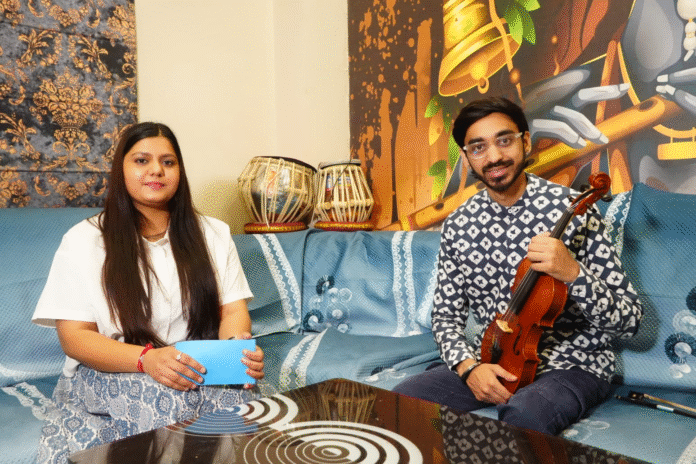
In an age where music is often consumed in seconds, Indian classical music continues to demand a lifetime. It asks not for attention, but for surrender; not for speed, but for depth.
At the heart of this timeless tradition lies the Guru–Shishya parampara—a system that transcends conventional learning, shaping not only an artist’s skill but also their discipline, temperament, and way of experiencing art. It is within this continuum that the journey of Dr. Prashant Mishra, an Indian classical violinist of the Hindustani tradition, finds its meaning.
Currently serving as an Assistant Professor at Rajasthan Sangeet Sansthan, Jaipur, Dr. Mishra represents a rare confluence of performance and pedagogy. An alumnus of Banaras Hindu University, his musical roots are deeply embedded in the Banaras tradition, known for its emotive richness and expansive melodic expression. His work, including the book “Violin: Bandish Sangrah” (2022), reflects a commitment not only to performance but also to the preservation of musical knowledge. He considers his father Pt. Birendra Nath Mishra ji (Sitar Maestro) as his first guru.
Yet, beyond achievements and positions, it is the lived experience of music that defines his journey.
Reflecting on his early years, he shares, “Even before I formally began learning music, it was always around me—it lived in the environment I grew up in.” Growing up under the influence of his grandfather, Pandit Surendra Mohan Mishra ji, a distinguished sitarist, music was not introduced to him—it was inherited. “I would wake up to the sound of riyaaz. My grandfather would be practicing, students would be coming home, and my elder brother would be immersed in his own riyaaz. Music was not separate from life—it was life.”
This early immersion naturally evolved into disciplined training. But what distinguishes his journey is the uncompromising centrality of practice. “Riyaaz was never optional for us. It was compulsory then, and it remains compulsory even today,” he emphasizes—a statement that captures the essence of classical rigor.
At the core of this discipline stands his Guru, Padma Vibhushan Dr. N. Rajam, a legendary figure who redefined the role of the violin in Hindustani classical music through the pioneering of the Gayaki Ang. By bringing the expressive depth of vocal music onto the violin, she transformed the instrument into a medium capable of profound emotional articulation.
Her influence extends beyond technique into the realm of philosophy and discipline. “My Guru Maa has set a standard that is impossible to ignore. Even at the age of eighty, she continues her riyaaz every morning at five and again in the evening,” Dr. Mishra notes. The presence of the Guru, even from afar, continues to shape his practice. “Whenever I speak to her, the first question is always about riyaaz—whether I practiced or not. That discipline stays with you, no matter where you are.”
In a time where speed often overshadows depth, such an approach stands as a quiet yet powerful resistance. For Dr. Mishra, the philosophy of music is both simple and uncompromising: “If there is no practice, there is no performance—it’s as simple as that.” Consistency, self-belief, and a positive mindset, he believes, form the true foundation of growth.
Among the most defining moments of his journey is the experience of sharing the stage with his Guru. “One of the most special experiences of my journey has been sharing the stage with my Guru Maa. There is a unique sense of comfort and energy in those moments that cannot be expressed in words.” It is here that music transcends technique and becomes a shared space of trust, tradition, and transcendence.
Ultimately, the journey of Dr. Prashant Mishra reminds us that Indian classical music is not merely an art form to be performed—it is a tradition to be lived. It flows quietly across generations, carried forward through discipline, devotion, and the unseen guidance of the Guru.
And perhaps, in that quiet continuity, lies its greatest strength—that even in a rapidly changing world, its soul remains untouched. In such moments, the violin does not merely play—it speaks.
(The writer is Shreya Vishwekarma)