

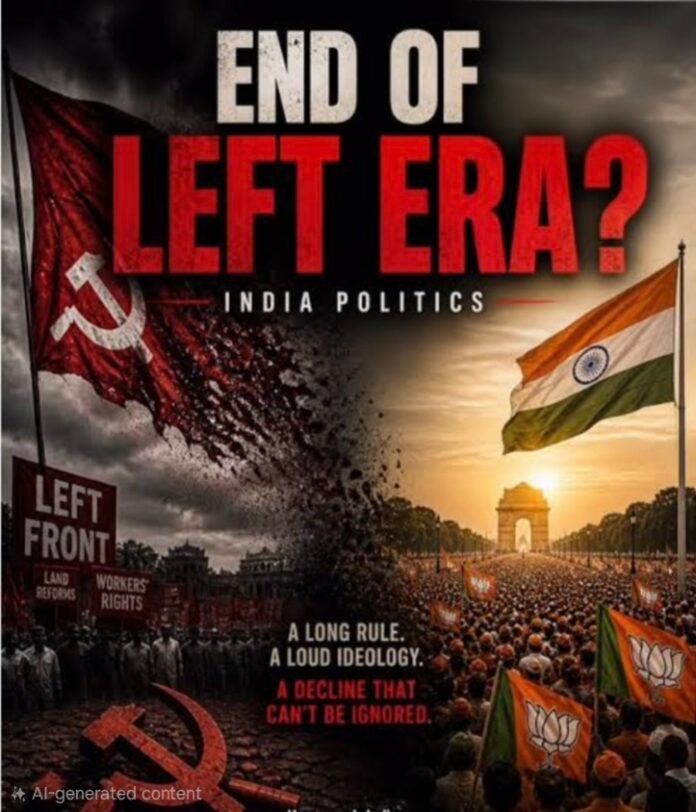
For decades, Left or communist politics occupied a distinct and influential space in India’s democratic landscape. Rooted in the principles of social equality, workers’ rights, land reforms, and state-led welfare, Left politics sought to challenge economic inequality and represent the marginalized. But recent electoral outcomes, especially the loss of its last major stronghold, have triggered a critical question: is this the end of Left politics in India, or merely a phase of transformation?
What is Left Politics in India?
Left politics in India is largely associated with Marxist and socialist ideologies. It emphasizes redistribution of wealth, protection of labor rights, secularism, and opposition to unchecked capitalism. The movement gained momentum in the early decades after independence, particularly among workers, farmers, and intellectuals.
The most prominent parties representing this ideology have been the Communist Party of India Marxist (CPI-M), Communist Party of India(CPI), and their allies under the Left Front umbrella. Leaders like E. M. S. Namboodiripad, Jyoti Basu, and Harkishan Singh Surjeet played pivotal roles in shaping the movement.
Strongholds and Legacy
The Left’s most enduring political success came in states like West Bengal, where it ruled continuously for 34 years (1977–2011), and Kerala, where it alternated in power for decades.Tripura was another key bastion, governed by the Left for over two decades until 2018.
These governments were known for land reforms, decentralization (like Kerala’s local governance model), and high human development indicators. However, over time, cracks began to appear.
What Has Changed?
Recent assembly election results—particularly the loss of the Left in Kerala, long considered its last stronghold—symbolize a dramatic shift. The erosion has been gradual but consistent:
●Declining grassroots connect: The Left struggled to adapt to aspirations of a younger, more urban, and economically ambitious population.
●Rise of alternative forces: Regional parties like All India Trinamool Congress in West Bengal and national players like Bharatiya Janata Party have filled the vacuum.
●Ideological rigidity: Critics argue that the Left failed to modernize its messaging in an era dominated by globalization and digital transformation.
●Organizational fatigue: Long years in power led to complacency, factionalism, and weakening cadre strength.
Is This the End?
Calling it the absolute “end” may be premature. Political ideologies rarely disappear; they evolve. The concerns that the Left historically championed—economic inequality, unemployment, workers’ rights—remain deeply relevant in India today.
However, the current phase does indicate a significant decline in electoral relevance. The Left’s parliamentary presence has shrunk, and its influence on national policy is limited compared to previous decades.
What Lies Ahead?
For the Left to regain relevance, it may need a strategic reinvention:
●Reconnecting with youth and urban voters
●Addressing contemporary issues like gig economy workers, climate change, and digital inequality
●Building broader coalitions without losing ideological core
In a rapidly changing India, political survival depends not just on legacy but adaptability. The Left’s future will depend on whether it can transform itself from a relic of the past into a voice for the emerging challenges of the present.
The story, then, is not simply of an end—but of a crossroads.