

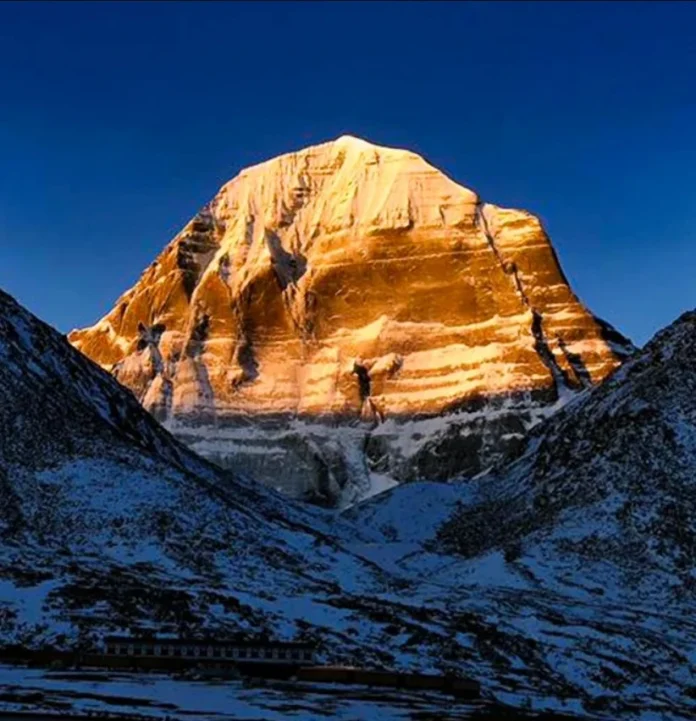
Amid the silent, snow-covered expanses of the Tibetan Himalayas stands Mount Kailash~ mysterious, majestic and deeply sacred. Rising beside the crystal-clear waters of Lake Mansarovar, this remote spiritual landscape has drawn saints, pilgrims and seekers for thousands of years. Revered not by one religion alone but by Hindus, Buddhists, Jains and followers of the ancient Bon faith, Kailash Mansarovar is considered one of the holiest places on Earth, a destination where spirituality, mythology and nature merge into something timeless.
For Hindus, Mount Kailash is believed to be the divine abode of Lord Shiva and Goddess Parvati. Ancient scriptures describe it as the cosmic axis of the universe, the place where Shiva meditates in eternal stillness, beyond worldly attachment. The mountain’s striking pyramid-like form and untouched summit have only deepened its spiritual aura across centuries. Unlike most great peaks of the world, Mount Kailash has never been climbed. Out of reverence, mountaineering on Kailash is prohibited, and devotees believe the sacred mountain is not meant to be conquered by human ambition.
The spiritual significance of Kailash extends beyond Hinduism. Buddhists associate the mountain with Demchok, representing supreme bliss and enlightenment, while Jains believe their first Tirthankara, Rishabhdev, attained liberation near Kailash. Followers of the Bon tradition regard it as the centre of spiritual power and the seat of their sky goddess. Few places in the world hold such profound religious importance for multiple faiths simultaneously.
Equally sacred is Lake Mansarovar, one of the world’s highest freshwater lakes. According to Hindu belief, the lake was first created in the mind of Lord Brahma before manifesting on Earth. Pilgrims consider its waters spiritually purifying, and many undertake ritual baths despite the freezing temperatures, believing the sacred lake washes away sins and brings inner peace.

At the heart of the pilgrimage lies the arduous “Kora” or “Parikrama”, a 52-kilometre circumambulation around Mount Kailash. Performed on foot across rugged terrain and high altitudes, the journey is physically demanding yet spiritually transformative. Many pilgrims describe it not as a trek, but as a deeply emotional experience of surrender, silence and self-discovery.
Mystery also surrounds Kailash. Stories of unusual energy fields, unexplained phenomena and spiritual experiences have long fascinated travellers and devotees alike. Though many such tales remain unverified, they contribute to the mountain’s enduring mystique and reverence.

The Kailash Mansarovar Yatra 2026 is expected to be conducted between June and August through the Lipulekh Pass route in Uttarakhand and the Nathu La route in Sikkim under the supervision of India’s Ministry of External Affairs. The best time to visit is generally from May to September, when weather conditions are comparatively favourable and the mountain is visible in its full grandeur.
Yet, beyond religion and ritual, Kailash Mansarovar represents something deeper, humanity’s eternal search for meaning, peace and connection with the divine. In the silence of the Himalayas, surrounded by towering mountains and sacred waters, pilgrims often say they do not merely visit Kailash; they experience it within themselves.