Home Blog Page 628

Premanand Ji Maharaj speaks the story of spiritual strength via his ‘connect’ with Krishna

0

Premanand Ji Maharaj, a revered spiritual luminary, has left an indelible impression on India’s spiritual landscape through his profound teachings, unwavering devotion, and selfless service. Born on December 30, 1932, in the serene village of Aligarh in Uttar Pradesh, India, Premanand Ji Maharaj dedicated his life to the pursuit of spiritual enlightenment and the welfare of humanity. His teachings and life story continue to kindle the spiritual flame in countless individuals embarking on their own profound journeys.

Early Life and Spiritual Awakening

In his formative years, Premanand Ji Maharaj, born Prem Narayan Tiwari, exhibited a natural proclivity towards spirituality. His family recognized his spiritual potential, introducing him to various spiritual traditions and practices from a tender age. His insatiable thirst for spiritual knowledge led him to seek guidance from a pantheon of gurus and saints.

It was during this quest that he encountered the profound teachings of Lord Krishna and the timeless wisdom of the Bhagavad Gita. These teachings resonated with him at a profound level, catalyzing a transformational journey. Immersing himself in the sacred text, he underwent a metamorphosis, renouncing worldly attachments and dedicating his life to the service of God and humanity.

Teachings and Philosophy

Premanand Ji Maharaj’s teachings centred on the principles of love, devotion, and selflessness. He ardently propagated the path of Bhakti Yoga, emphasizing the cultivation of a deep and affectionate connection with the divine. His discourses and sermons stood out for their simplicity and accessibility, making profound spiritual wisdom accessible to individuals from all walks of life.

One of his seminal teachings underscored the significance of selfless service, or “seva,” as a potent avenue for spiritual growth. According to him, by serving others without expecting anything in return, individuals could cleanse their hearts and draw closer to God. This philosophy of seva resonated deeply with his followers and became a cornerstone of his spiritual community.

Establishing the Prem Mandir

Among Premanand Ji Maharaj’s most remarkable achievements was the establishment of the Prem Mandir in Vrindavan, Uttar Pradesh. The Prem Mandir, also known as the “Temple of Love,” stands as a magnificent tribute to Lord Krishna and Radha. It not only signifies his unwavering devotion to the divine but also embodies his vision of disseminating love and spirituality.

Beyond being a place of worship, the Prem Mandir is an architectural marvel, bedecked with intricate marble carvings that depict the divine love stories of Lord Krishna. It has evolved into a revered pilgrimage site and an emblem of spiritual unity, attracting devotees from across the globe.

Legacy and Influence

The legacy of Premanand Ji Maharaj endures through the multitude of lives he touched with his teachings and selfless service. His followers, affectionately known as “premis,” continue to carry forth his message of love, devotion, and seva. The spiritual organization he founded, the Shri Kripalu Ji Maharaj Mission, plays a pivotal role in disseminating his teachings and supporting charitable endeavours.

Premanand Ji Maharaj’s life serves as a perennial wellspring of inspiration for all those embarking on the quest for spiritual enlightenment and a deeper connection with the divine. His unwavering commitment to selfless service, his devotion to Lord Krishna, and the majestic Prem Mandir stand as testaments to his profound influence on India’s spiritual tapestry. As his teachings resonate with seekers and devotees, Premanand Ji Maharaj’s legacy remains an enduring beacon of light for those traversing the path of spirituality and love.

Soak the serene beauty of Sajjangarh Fort in Udaipur

0

Priyanshi Pareek reports on the Sajjangarh Fort..

Perched majestically on the Aravalli Hills, Sajjangarh Fort, often referred to as The Monsoon Palace, stands as a testament to architectural splendor and offers visitors awe-inspiring vistas of Udaipur’s lakes and palaces. Situated at an elevation of 3100 feet above sea level, this hilltop residence resembles a tiara adorning the rocky landscape, providing a panoramic spectacle of lakes, hills, and the distant Chittorgarh.

Historical Significance

The inception of The Monsoon Palace can be traced back to 1884 when Maharana Sajjan Singh, the 72nd ruler of the Mewar Dynasty, ordered its construction. Originally intended as a nine-story astronomical center, Maharana Sajjan Singh’s untimely demise led to its transformation into the iconic Monsoon Palace. The strategic hilltop location was chosen to offer a sweeping view of his ancestral home in Chittorgarh. Interestingly, the palace also found its way into pop culture when it served as the residence of Kamal Khan, an exiled Afghan Prince, in the 1983 James Bond film “Octopussy.”

Architectural Marvel

Set atop the Bansdara peak of the Aravalli Hills, Sajjangarh Fort is a breathtaking sight itself. The fort’s construction predominantly employs white marble, creating a stunning contrast against the rugged terrain. The foundation rests on marble pillars adorned with intricate floral and leaf motifs, showcasing the exquisite craftsmanship of Rajasthan. The walls are adorned with lime mortar, and the palace boasts Rajasthani architectural marvels such as domes, fountains, and jharokhas.

The heart of the palace features a grand central courtyard with a majestic staircase leading to various rooms and quarters. While it was once owned by the Mewar Royal Family, it now falls under the jurisdiction of the Forest Department of the Rajasthan Government, allowing public access to this architectural gem.

A Must-Visit Destination

Sajjangarh Fort, The Monsoon Palace, is not just a historical relic but also a testament to the opulence and grandeur of Rajasthan’s past. Its regal architecture, coupled with the breathtaking views it offers, makes it a must-visit destination for tourists and history enthusiasts alike. As the palace stands proudly atop the Aravalli Hills, it continues to remind visitors of the rich history and architectural prowess that define Udaipur and the surrounding region.

Tea sellers, comedians, bus drivers and painters driving world economies…watch out the list here…

0

World leaders often seem like they were born into positions of power and prestige, but a closer look at their backgrounds reveals that many of them embarked on unique and unexpected paths to leadership. From tea sellers to comedians, bus drivers to painters, these leaders’ stories serve as a testament to the diverse and unconventional routes that can lead to the highest echelons of political power. In this article, we’ll delve into the fascinating journeys of some of the world’s most influential leaders.

Narendra Modi: From Tea Seller to India’s Prime Minister

Narendra Modi, the Prime Minister of India, started his life as a humble tea seller at a railway station. His rise to power is a testament to his determination and leadership skills. From serving chai to leading the world’s largest democracy, Modi’s story is one of grit and ambition.

Volodymyr Zelensky: A Comedian Turned President

Ukraine’s President Volodymyr Zelensky made his name in the comedy world before entering politics. His TV show “Servant of the People,” where he played the role of an ordinary teacher who becomes president, foreshadowed his own surprising political journey.

Edi Rama: From Painter to Albanian Prime Minister

Edi Rama, the Prime Minister of Albania, had a career as an artist before entering politics. Known for his colorful artwork, Rama has brought his creative vision to the world of politics, striving to transform his country’s future.

Tony Abbott: Trainee Priest to Australian Prime Minister

Before becoming the Prime Minister of Australia, Tony Abbott considered becoming a Catholic priest. His background in theology and philosophy has undoubtedly influenced his political career and leadership style.

Boiko Borisov: Bodyguard Turned Bulgarian Leader

Boiko Borisov, Bulgaria’s former Prime Minister, started his career as a bodyguard. His path to political leadership showcases his commitment to protecting his country, albeit in a different capacity.

Justin Trudeau: Bouncer to Canadian Prime Minister

Canada’s charismatic leader, Justin Trudeau, worked as a bouncer before entering politics. His journey from nightclub security to the highest office in the country is a testament to his resilience and adaptability.

Ivo Josipovic: Music Composer to Croatian President

Croatia’s former President Ivo Josipovic had a background as a music composer and performer. His passion for the arts has likely contributed to his diplomatic and creative approach to leadership.

Nicolas Sarkozy: Cleaner to French President

Nicolas Sarkozy, the former President of France, once worked as a cleaner. His rise to political prominence illustrates the potential for individuals to overcome humble beginnings and achieve remarkable success.

Jimmy Morales: Comedian to Guatemalan President

Jimmy Morales, a comedian and actor, surprised the world when he became the President of Guatemala. His unique background in entertainment likely contributed to his ability to connect with the people.

Johanna Sigurdardottir: Flight Attendant to Icelandic Prime Minister

Iceland’s former Prime Minister, Johanna Sigurdardottir, started her career as a flight attendant. Her experiences in customer service and international travel have undoubtedly informed her approach to diplomacy.

Michael Higgins: Waiter to Irish President

Michael Higgins, the President of Ireland, once worked as a waiter. His years of service in the hospitality industry likely instilled in him a strong sense of empathy and a commitment to serving others.

Silvio Berlusconi: Singer to Italian Prime Minister

Silvio Berlusconi, Italy’s former Prime Minister, had a career as a singer and cruise ship entertainer. His charisma and showmanship played a significant role in his political success.

Ellen Johnson Sirleaf: Drugstore Clerk to Liberian President

Ellen Johnson Sirleaf, the first female president in Africa, worked as a drugstore clerk before becoming a political trailblazer. Her journey represents a triumph over adversity and a testament to her determination.

George Weah: Soccer Player to Liberian President

George Weah, a former professional soccer player, transitioned from the football field to the political arena when he became the President of Liberia. His sports background likely contributed to his leadership style.

Dalia Grybauskaite: Factory Worker to Lithuanian President

Lithuania’s former President Dalia Grybauskaite once worked in a factory. Her experience in the industrial sector may have shaped her approach to economic policies and leadership.

Andy Rajoelina: DJ to Malagasy President

Madagascar’s President Andy Rajoelina had a career as a DJ and media entrepreneur. His ability to connect with the youth and use media effectively has been a hallmark of his leadership.

Khaltmaagiin Battulga: Wrestler to Mongolian President

Mongolia’s President Khaltmaagiin Battulga was a successful wrestler before entering politics. His background in sports likely contributes to his discipline and determination as a leader.

Jens Stoltenberg: Journalist to Norwegian Prime Minister

Norway’s former Prime Minister Jens Stoltenberg started his career as a journalist. His background in media has likely informed his communication skills and approach to governance.

Imran Khan: Cricketer to Pakistani Prime Minister

Before becoming Pakistan’s Prime Minister, Imran Khan was a legendary cricketer. His experience in sports has influenced his leadership style and emphasis on teamwork.

Vladimir Putin: Agent/Spy to Russian President

Vladimir Putin’s past as a KGB agent and spy shaped his path to becoming the President of Russia. His background in intelligence has undoubtedly influenced his approach to diplomacy and national security.

Dmitry Medvedev: Street Cleaner to Russian Prime Minister

Dmitry Medvedev, Russia’s former Prime Minister, once worked as a street cleaner. His journey from the streets to political corridors highlights the potential for anyone to rise to leadership positions.

Borut Pahor: Model to Slovenian President

Slovenia’s President Borut Pahor had a career as a model before entering politics. His experience in the fashion industry likely informs his emphasis on style and image in politics.

Adama Barrow: Security Guard to Gambian President

Adama Barrow, the President of The Gambia, previously worked as a security guard in London. His experiences in security likely contributed to his commitment to safeguarding the rights and freedoms of his people.

Recep Erdogan: Lemonade Seller to Turkish President

Recep Erdogan, the President of Turkey, once sold lemonade on the streets of Istanbul. His humble beginnings have shaped his leadership style and populist appeal.

Boris Johnson: Journalist to British Prime Minister

Before becoming the Prime Minister of the United Kingdom, Boris Johnson was a journalist. His career in media and witty writing style have been prominent features of his political persona.

Donald Trump: Collecting Bottles to U.S. President

Former U.S. President Donald Trump’s early years included collecting bottles and working in his family’s real estate business. His background as a businessman greatly influenced his approach to governance.

Barack Obama: Ice Cream Scooper to U.S. President

Barack Obama, the 44th President of the United States, worked as an ice cream scooper in his youth. His experiences likely instilled in him a strong work ethic and empathy for everyday Americans.

Joe Biden: Maintenance Worker to U.S. President

Current U.S. President Joe Biden had a job as a maintenance worker before entering politics. His blue-collar roots have influenced his policies aimed at addressing the concerns of the working class.

Tabare Vazquez: Oncologist to Uruguayan President

Uruguay’s former President Tabare Vazquez was an oncologist before his political career. His medical background has likely influenced his commitment to healthcare and public health.

Pope Francis: Nightclub Bouncer to Spiritual Leader

Pope Francis, the spiritual leader of the Catholic Church, once worked as a nightclub bouncer and chemical technician. His humble beginnings have made him a Pope known for his humility and concern for the marginalized.

Nicolas Maduro: Bus Driver to Venezuelan President

Venezuela’s President Nicolas Maduro started as a bus driver before entering politics. His journey from the driver’s seat to the presidential palace reflects the dynamic nature of political leadership.

The diverse backgrounds of world leaders illustrate that leadership can emerge from the most unexpected places. These leaders’ unique life experiences have undoubtedly influenced their approaches to governance, policies, and interactions with their constituents. Their journeys serve as a reminder that leadership can come from anyone with the determination and vision to make a difference in the world.


Good news: It’s raining jobs in travel and tourism after lull due to pandemic

0

The World Travel & Tourism Council’s (WTTC) 2023 Economic Impact Research (EIR) recently revealed the UK Travel & Tourism sector is forecast to exceed the 2019 peak this year. 

The sector is set to contribute £252.4 bn to the UK economy this year, surpassing the 2019 pre-pandemic high of £248.5BN. 

WTTC is also forecasting that the sector will create almost 380,000 jobs this year, recovering almost all of the jobs lost due to the COVID 19 pandemic to reach more than 4MN, with around one in nine workers in the UK, in the Travel & Tourism sector.

 International visitor spend to the UK is forecast to reach £26.18BN, just 6% behind the 2019 peak of £38.6BN. 

Julia Simpson, WTTC President & CEO, said: “Travel & Tourism creates one in every ten jobs in the UK. It contributes over £250bn a year to the UK economy. “Whilst our forecasts show the sector will reach a quarter of a trillion pounds this year, and predicts international visitor spend will recover by early next year, the UK Government should be aiming higher. 

“The recovery and long-term growth of the sector is at risk with the self-axing of VAT-free shopping for international tourists. We will continue to see high-value tourists choosing France and Italy over the UK and taking with them economic value and jobs.” 

What does the next decade look like? The global tourism body is forecasting that the sector will grow its GDP contribution to almost £315BN by 2033, nearly 11% of the UK economy and will employ over 5MN people across the country, with one in seven Brits working in the sector. 

Europe:  In 2022, the European Travel & Tourism sector contributed €1.9TN to the regional economy, just 7% below the 2019 peak. WTTC forecasts the region’s GDP contribution from the sector will reach more than €2TN in 2023 – within touching distance of the 2019 highpoint. The sector employed almost 35MN people across the region in 2022, an increase of 2.9MN from the previous year but still 3.2MN behind pre-pandemic levels. 

WTTC forecasts the sector will fully recover the jobs lost during the pandemic by the end of 2024. 

India’s First Lactoferrin Plant Exympower Inaugurated in Gujarat

0

In a momentous development for the Indian dairy industry, the nation’s first Lactoferrin Plant, Exympower, was inaugurated in Vasna, Chacharwadi, Gujarat on September 23, 2023. This remarkable venture, a joint effort between Eximius and the Adani Group, is poised to produce an impressive 100 tons of Lactoferrin annually.

The inauguration ceremony was graced by the presence of prominent leaders, including NCP chief Sharad Pawar and Adani Group Chairman Gautam Adani. In his address, Sharad Pawar lauded the Adani Group’s investment in this plant, highlighting its potential to generate employment opportunities and invigorate the local economy. He also commended the plant as a testament to the Adani Group’s unwavering commitment to innovation and sustainability.

Lactoferrin, a glycoprotein found in milk and bodily fluids, boasts an array of health benefits, such as bolstering the immune system, reducing inflammation, and promoting gut health. Particularly crucial for infants and young children, Lactoferrin serves as a protective shield against infections.

The Exympower Lactoferrin plant marks a groundbreaking stride for the Indian dairy sector. It not only propels India towards self-sufficiency in Lactoferrin production but also promises more affordable access to this essential health supplement for consumers.

Both Sharad Pawar and Gautam Adani underlined the significance of this plant during the inauguration ceremony, emphasizing its potential to generate employment opportunities and invigorate the local economy. Gautam Adani also underscored the plant’s embodiment of the Adani Group’s dedication to innovation and sustainability.

The inauguration of the Exympower Lactoferrin plant represents a monumental milestone for India’s dairy industry. Its anticipated impact on the health and well-being of the Indian populace, coupled with the boost it promises for the nation’s economy, solidifies its significance in the country’s progress and development.

Lalbaugcha Raja and Ganesh festival stand synonymous in Mumbai. know how and why…

0

Mumbai, often dubbed the “city of dreams,” is a dynamic metropolis where traditions and modernity coexist. Among the bustling streets and towering skyscrapers, a timeless tradition stands as a testament to the city’s enduring spirit—the annual Ganesh Chaturthi festival featuring the iconic Lalbaugcha Raja. This revered deity has captured the hearts of millions, not just in Mumbai but around the world. In this article, we explore the reasons behind the enduring allure of Lalbaugcha Raja, a symbol of faith, unity, and devotion.

A Historical Tapestry

The tale of Lalbaugcha Raja weaves back to 1934 when the Sarvajanik Ganeshotsav Mandal, Lalbaug, was born. Its founders aimed to foster community bonds during the auspicious Ganesh Chaturthi festival and offer a shared platform for worshipping Lord Ganesha. What commenced as a humble celebration has since evolved into one of Mumbai’s grandest and most significant public events.

Unparalleled Grandeur

A major factor contributing to the fame of Lalbaugcha Raja is the sheer grandeur of the idol and the festivities surrounding it. Each year, dedicated Mandal members meticulously plan the idol’s adornment, creating a breathtaking spectacle. The deity is dressed in exquisite jewellery, and resplendent clothing, and set against a magnificent backdrop. This opulent display of devotion enthrals millions of devotees who throng the pandal during the ten-day festival.

Social Altruism

Beyond its religious significance, the Lalbaugcha Raja Mandal is renowned for its philanthropic endeavours. The Mandal is actively involved in various charitable initiatives throughout the year, ranging from healthcare camps to educational scholarships and community development projects. Their unwavering commitment to social causes has earned them not only the respect of devotees but the admiration of the entire community.

A Beacon of Unity

The Lalbaugcha Raja Mandal symbolizes unity in a city as diverse as Mumbai. Regardless of caste, creed, or social status, millions of Mumbaikars unite to celebrate this festival. It fosters a sense of belonging, transcending barriers, and epitomizing Mumbai’s true spirit—unity in diversity.

Global Acclaim

Lalbaugcha Raja’s fame extends far beyond India’s borders. People from every corner of the globe have heard of this iconic idol and its grandeur. Non-resident Indian (NRI) communities often plan visits to Mumbai during Ganesh Chaturthi just to catch a glimpse of Lalbaugcha Raja. This global recognition has made the deity an international symbol of Indian culture and spirituality.

Media Spotlight

Another pivotal element behind the immense popularity of Lalbaugcha Raja is the extensive media coverage it receives. Television channels, newspapers, and online platforms extensively document the idol’s arrival, decoration, and immersion process. The anticipation leading up to the idol’s unveiling and the subsequent media coverage builds excitement and intrigue among the masses.

Lalbaugcha Raja is more than a mere idol; it is an embodiment of Mumbai’s spirit, devotion, and unity. Its historical significance, grandeur, social initiatives, global recognition, and media presence have transformed it into an iconic symbol that transcends religious boundaries. Each year, millions gather in Lalbaug to witness the deity’s magnificence and partake in a celebration that unites people, echoing the age-old chant, “Ganpati Bappa Morya!” This iconic figure will continue to shine as a beacon of faith and unity in the heart of Mumbai for generations to come.

Chambal Riverfront in Kota: The first heritage riverfront speaking the story of unique themes

0

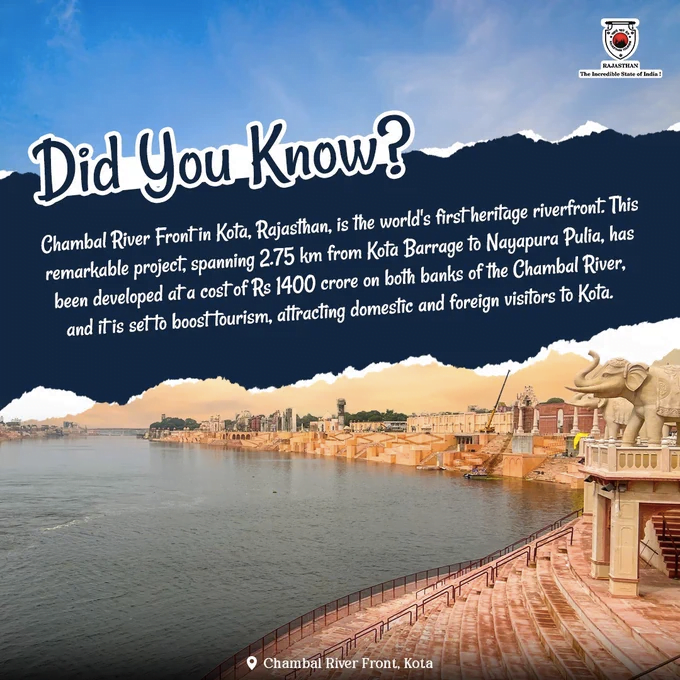
The Chambal Riverfront in Kota is making news after its grand inauguration. The riverfront stands as a mesmerising location with pristine and picturesque scenes spread around.

It stands as India’s first heritage riverfront project, featuring 26 meticulously designed ghats on both of its banks, each imbued with unique thematic elements.

Let’s know more about the riverfront timings and so on:

Chambal River Front – Ticket Booking Online

Chambal River Front Visit Timings10 AM to 10 PM
Riverfront Entry Closing TimeEntry will be closed at 8:30 PM
Ticket Booking ModeOnline
Ticket Booking Start Date13 September, 2023
Riverfront Ticket Price for Kota District ResidentsFREE (Only for Kota district residents) You need to book a ticket of ₹0 online) – Find booking link below
Chambal Riverfront Open ZoneBooking is open for the Eastern Zone of Chambal River Front.
⚠️ Riverfront Entry Rule– For free ticket booking Aadhar number is required. – You can book only 1 Free ticket on one Aadhar number – Aadhar card is required for Entry.
Chambal Riverfront Entry GateEast Side – Nayapura Ghat & Barrage Garden West Side – Shaurya Chowk
Official Website For Ticket Bookingchambalriverfrontkota.in/booking
Ticket Booking Process (5 Easy Steps)1. Visit ticket booking website 2. Choose the riverfront entry side (east or west) 3. Fill name, address, city, phone, Aadhar 4. Fill the captcha & Click on Submit 5. Keep your QR safe to show at entry

Hoysala Temples of Karnataka: It took 103 years for the Channakesava Temple to get completed

0

The Hoysala Temples of Karnataka have been added to UNESCO’s World Heritage list of 2023 recently which has taken the number of Indian listings to a total of 42. 

The three temples include the Chennakeshava temple in Belur, the Hoysaleswara Temple in Halebidu, and the Keshava Temple in Somanathapura. 

Situated in Beluru and Halebidu in the Hassan district and Somnathapura in the Mysuru district of Karnataka, these three temples on the list have been enlisted as the ‘The Sacred Ensembles of Hoysalas’ and The history of the Hoysala Temples.

All three temples were built by the Hoysala dynasty which ruled over a major part of the Deccan plateau, including all of current day Karnataka, from the 11th to the 14th century.

The Hoysalas had developed a unique architectural style bespeaking a story of combination of Nagara and Dravidian styles. 

These temples are made with a deep grey soapstone and follow the stellate plan that spreads out like a star and are always built over a low platform. 

The architecture

* The Channakesava Temple which is the oldest of the three temples in Beluru was commissioned by king Vishnuvardhan in 116 AD and is said to have taken 103 years to complete

* The sprawling complex comprises multiple smaller shrines set around the main sanctum dedicated to the ‘most beautiful Vishnu’ (hence Channakesava). 

* The exquisite carving gives it an edge over other temples, be it on the exterior walls, which depict detailed scenes from the epics and major mudras of Bharatnatyam, or inside, where mythological figures like nymphs and apsaras come to life. 

* The pillars here are the most well-known feature and are said to have inspired the designs of traditional temple jewellery in South India.

The Hoysaleswara Temple in Halebidu: This temple is dedicated to Lord Shiva. 

The Hoysaleswara Temple dates back to the 12th century, built a century after the Channakesava Temple, and was however plundered in the 14th century and has been a ruin ever since, albeit an exceptionally beautiful one.

 One of the largest Shiva temples built by the Hoysalas, the place is especially famous for the work on its exterior walls, some of which may remind you of Khajuraho. 

The large Nandi right in front of the temple is also a striking structure on its own. 

The Keshava temple Somnathapura

About 30 mins from the Hoysaleswara Temple is The Keshava temple Somnathapura, close to Mysuru.

 Built by king Somanatha Dandanayaka during the regime of Narasimha III in 1268, it is similar to the other two in the architecture, layout and style with large star-shaped platforms, intricately carved ceiling, a grand sanctum sanctorum and a striking idol of lord Vishnu.

Where to stay

Although Beluru and Halebidu are small towns, they have few places to stay as many resorts have now come up in the vicinity. 

Is Cricket Betting Legal in India in 2023?

0

Cricket is legal on secure online platforms in India. Use the prepared full instructions on betting: place bets on cricket on bookmaker sites, register an account, make a deposit and withdraw your winnings correctly. All clear instructions will take your betting experience to the next level quickly and easily.

Cricket most popular sport

It is no secret that cricket is a popular sport that most fans bet on. It is not only a national sport, but also an integral part of Indian culture. The option to bet on the results of cricket matches online is offered by many bookmakers who specialize in this sport.

Cricket: It is legal to bet online in India at licensed sites?

Cricket is an integral part of the country’s culture and most betting companies offer betting opportunities on the sport. It is legal to bet online in India at licensed sites that have a license in place.

How to bet on cricket on bookmaker sites: step-by-step instructions

To start cricket betting in India on a bookmaker’s website, you need to follow a few steps:

  1. Create an account;
  2. Make a deposit;
  3. Place a bet;
  4. Withdraw money.

The first three steps will take only a few seconds. After receiving the winnings, its transfer to a card or e-wallet will take from 1 hour to 7 days. Let’s consider each step in detail.

Account Registration

Each user is entitled to set up only one account on the cricket betting site. This procedure is free of charge and is done on the homepage of the site. What you need to do:

  1. Visit the site of the site you are interested in;
  2. Go to the website of the site you are interested in; Open the registration form. The button for registration is usually located in the top right corner of the screen or hidden in the menu;
  3. Complete the data. In all empty fields, you must specify the information corresponding to the name of the field;
  4. Verify your email or phone number. A link or password will be sent to the specified contacts to confirm registration;
  5. After that you will be able to log in to your account using your username and password.

How to deposit in cricket betting

Depending on the bookmaker you choose and the terms and conditions they offer, you need to go through the registration process to be able to bet with real money. To do this, making a deposit is required. This is done through the personal cabinet, in the Deposit tab with the local currency of the account. The process is as follows:

  1. Go to this section, select the Deposit tab;
  2. Specify the payment system, fill in the details;
  3. Specify the transfer amount and confirm the operation.

The application processing time is only a few seconds. The money will be credited to your account as soon as it is debited from your e-wallet or bank card. Cricket betting sites usually do not charge a commission for such operations, but it may be stipulated by the payment service. More detailed terms of use of the payment system, including minimum and maximum top-up amounts, can be viewed at the cashier’s office.

How to bet

The bookmaker offers several options for this, either you can bet through the mobile app, or the official website. Both there and there it is simple and easy to do, the mechanism of action is the same. Follow the steps below:

  1. Select cricket. Open the section with all sports and click on cricket among the presented disciplines;
  2. Select a match. Open the championship you are interested in and select a specific match to see all the odds;
  3. Choose an event. Each match has at least 5 predictions for betting. Sometimes there are more than 20. Click on the odds corresponding to the prediction;
  4. To fill in the coupon. Specify the type of bet, its amount and confirm the forecast in the opened coupon.

Bookies accept single bets, group bets, as well as express bets. This allows you to get a larger payout. But if at least one bet from the betting sheet is unsuccessful, you will lose money.

Withdrawal of funds

If the operation is successful, the funds will be credited to your account and you will be able to withdraw them through the cash desk. To do this you need to:

  1. Open the cash desk. Log in to your account and select the “Cashier” section. There, go to the tab for withdrawal;
  2. Choose a payment system. From the list of presented services, select the one to which you want to receive funds;
  3. Fill in the data. Specify the amount of payment and details of your wallet or bank card;
  4. Confirm the transaction. Complete the transaction and wait for the money to arrive. Usually it takes from 1 hour to 7 days.

To withdraw large sums of money, many bookmakers require clients to undergo verification. The verification procedure includes filling out a questionnaire with personal data and sending scans or photos of ID for verification.

Pros and cons of using cricket betting sites

In India, each of these betting websites works within the law. The web applications produced by these organizations are multi-purpose and include a separate section dedicated to cricket and the Indian Premier League. Considering the fact that cricket is quite popular in the country, the betting companies offer weighty terms and generous bonuses to attract as many users as possible to place bets with them.

Article Written by Jayesh Bhattar.

Fact Checked by Avesh Joshi.

Osman Mir – An “Upnishad for Secularism”

0

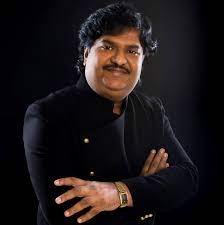
Priyanshi Pareek reports on Osman Mir..

In the vast tapestry of India’s music industry, there are artists who transcend boundaries and bring people together through their soul-stirring melodies. One such artist is Osman Mir, often hailed as an “Upnishad for Secularism” owing to his unique ability to harmonize diverse cultures and beliefs through his music.

Born on May 22, 1974, in Vayor, Kutch, Gujarat, India, Osman Mir emerged from a humble background, where his father, Husenbhai, was a tabla player in the world of Gujarati folk music. His early exposure to music ignited a passion that would shape his destiny.

Osman Mir’s journey into the world of music began with tabla lessons from his father. At the tender age of 13, he took the stage alongside his father, performing live events and establishing his career as a tabla player. However, his heart beat to a different rhythm—he was more interested in singing.

With unwavering determination, Osman Mir transitioned from tabla to vocal music. His father provided the initial lessons, and he was later trained by his Guru Ismail Datar. This marked the beginning of a remarkable singing career that would bridge cultural gaps and inspire millions.

In 2013, Osman Mir made his foray into the Indian playback singing scene, predominantly lending his captivating voice to Hindi and Gujarati songs. His rendition of “Mor Bani Thanghat Kare” from the movie ‘Goliyon Ki Raasleela Ram Leela’ marked his debut in Bollywood, garnering widespread acclaim.

Yet, it was his Gujarati roots that remained close to his heart. His first Gujarati song, “Me to chundadi odhi tara nam ni,” composed by Advin Vaj Appu, showcased his love for regional music.

The turning point in Osman Mir’s career came when he was introduced to the renowned Pujya Shree Moraribapu’s Ashram at Talgajarda. His vocal prowess caught the attention of the audience, and he soon began enchanting listeners with hits like “Dil Kash Tera Naksha Hai.”

One of the most significant moments in Osman Mir’s journey was when he caught the ear of acclaimed filmmaker Sanjay Leela Bhansali. Bhansali had long harbored a dream of reviving an old folk song he had heard years ago. Osman Mir’s powerful voice left an indelible mark on Bhansali, and he was chosen to sing this dream song. With this collaboration, Osman Mir’s rendition breathed fresh life into a classic, earning international recognition.

The artist’s versatility knows no bounds, as he effortlessly transitions between various music genres, including Bhajan, Ghazal, Semi-Classical, Sugam, and Gujarati-Folk. His talent and charisma have graced thousands of public performances and contributed to nearly 58 Gujarati movies as a playback singer.

Osman Mir’s influence extends far beyond India’s borders. He has mesmerized audiences in 25 countries across the globe, showcasing the universal appeal of his music.

In a world often divided along cultural and religious lines, he stands as a symbol of unity and harmony. His melodies have the power to dissolve differences and connect people from all walks of life. In this age of discord, Osman Mir’s music serves as a reminder of the profound impact that art and culture can have in fostering peace and understanding. Truly, he is an “Upnishad for Secularism,” using his talent to bridge gaps and bring the world closer together, one note at a time.