Stock markets around the world suffered steep losses after former U.S. President Donald Trump warned that foreign governments would need to pay “a lot of money” to have sweeping tariffs lifted. His comments triggered panic across global financial markets, pushing major indices into sharp declines.
London’s FTSE 100 dropped as much as 6.3%, hitting a one-year low, while Germany’s DAX plunged 10.4%. In Asia, Hong Kong’s Hang Seng Index collapsed nearly 13%, marking its worst single-day drop since 1997. This steep fall pushed the index into a bear market, having now fallen more than 20% from its record highs in March—when it was the world’s top-performing stock market.
Japan’s Nikkei 225 also suffered a severe blow, falling 7.8% in a single day. The index is now down over 20% from its December peak, also placing it in bear market territory.
Despite the trillions of dollars wiped from global stock values, Trump appeared unfazed. Speaking to reporters aboard Air Force One on Sunday night, he compared the tariffs to “medicine” and showed no concern over the financial turmoil his comments had triggered.
India experienced one of its hottest years in 2024, but 2025 may surpass it. With heatwave conditions setting in as early as April, the Indian Meteorological Department (IMD) has already issued red alerts in several states. The rising temperatures are being linked to heat trapped due to the warming of sea water, a trend that could make this year one of the hottest on record.
According to the IMD, Gujarat is on red alert from April 6 to 10, with severe heatwave conditions expected in the Saurashtra and Kutch regions on April 6 and 7. Rajasthan is under an orange alert for the same period, where some areas are likely to face severe heatwave spells between April 7 and 9. Yellow alerts have also been issued for Himachal Pradesh, Haryana, Chandigarh, Punjab, Delhi, western Uttar Pradesh, and Madhya Pradesh in the coming days.
With heatwaves starting in early April, concerns are growing over what May and June may bring. The IMD has warned that the number of heatwave days in northwest India—covering Haryana, Punjab, Rajasthan, Himachal Pradesh, Jammu and Kashmir, Uttarakhand, and Delhi—could double this year. Typically, heatwaves last 5 to 6 days, but this summer may see extended spells of 10 to 12 days. If this trend continues, 2025 could become the hottest year ever recorded in India, with temperatures rising 5°C or more above the seasonal average.
A heatwave is defined by the IMD as a period when the temperature in plains exceeds 40°C, in coastal areas exceeds 37°C, and in hilly regions crosses 30°C. A deviation of 4.5°C above the normal constitutes a heatwave, while an increase of 6.4°C or more is classified as a severe heatwave. According to the World Meteorological Organization (WMO), a heatwave occurs when the maximum temperature of an area remains at least 5°C above average for five or more consecutive days.
In recent years, India has been experiencing more frequent and longer-lasting heatwaves. For instance, eastern Rajasthan faced 23 heatwave days in 2024, while western Rajasthan saw 29. Uttar Pradesh was hit hardest, enduring 32 heatwave days. This marks a significant rise from the historical average of 8 to 12 heatwave days in states like Rajasthan and UP.
The IMD has identified 13 states as highly vulnerable to heatwaves. These include Rajasthan, Punjab, Haryana, Chandigarh, Delhi, West Madhya Pradesh, Uttar Pradesh, Chhattisgarh, Odisha, Vidarbha, coastal Andhra Pradesh, Telangana, and parts of Gangetic West Bengal. These regions lie within the Core Heatwave Zone (CHZ), which typically experiences extreme temperatures from March to June, and sometimes even in July. In 2024, records were already broken in April.
This year, the IMD predicts a higher-than-normal number of heatwave days across most of North, Central, and East India. The only exceptions are expected to be the far southern states, parts of the Northeast, Jammu and Kashmir, and Himachal Pradesh.
Scientific studies confirm that heatwaves in India are becoming more intense and frequent. Research from the Indian Institute of Tropical Meteorology in Pune indicates that since 2000, heatwave days have increased by three per decade in many parts of the country. The impact is far-reaching, affecting public health, agriculture, and entire ecosystems. In 2024 alone, India recorded 554 heatwave days nationwide, making it the hottest year on record. By comparison, 2023 had 230 heatwave days.
With early signs pointing to a prolonged and more intense summer, 2025 could see heat levels and records that surpass anything experienced so far.
India and China have emerged as the only developing nations with significant private investments in Artificial Intelligence (AI), according to the latest UNCTAD Frontier Technologies Readiness Index. The report highlights India’s progress in technology readiness and AI capabilities, placing it among the top countries globally. This is a crucial development, as AI is expected to have a transformative impact on global economies and job markets.
India’s Rise in the UNCTAD Readiness Index
India has moved up from 48th in 2022 to 36th in the 2023 UNCTAD Frontier Technologies Readiness Index. The index assesses countries on five key parameters: ICT, skills, R&D, industrial capacity, and financial access. India, along with Bhutan, Morocco, Moldova, and Timor-Leste, showed improvement due to gains in human capital—primarily higher education and high-skill employment.
Category
India’s Rank
ICT (Information & Communication Tech)
99th
Skills
113th
Research & Development (R&D)
3rd
Industrial Capacity
10th
Access to Finance
70th
Global AI Investment Landscape
The United States leads AI investment globally, contributing $67billion (70%) of the total global AI funding in 2023. China ranks second with $7.8 billion, while India comes in at 10th place with $1.4 billion. While the gap in funding highlights challenges for developing nations, India’s position reflects a growing interest and capability in AI.
AI’s Impact on Employment and the Economy
The AI industry is projected to reach $4.8 trillion by 2033 and affect nearly 40% of global jobs, raising concerns around automation and job displacement. The report underscores the need for reskilling and upskilling to ensure AI enhances productivity while creating new job opportunities instead of eliminating them.
India’s Policy Push for AI Development
The Indian government has taken an active role in fostering AI growth through public-private partnerships and academic collaboration. Initiatives like the India AI Mission are designed to build a strong AI ecosystem by expanding access to AI education and setting up Centres of Excellence in key tech areas.
Technological Specialisation Around the World
Different countries are focusing on specific tech sectors. India is recognised for its advancements in nanotechnology, while Germany leads in wind energy. Such specialisation showcases how countries are aligning their technological growth with their economic strengths and resources.
The Indian stock market witnessed its second major crash of the year on Monday, April 7. The Sensex tumbled by 3,200 points, or 4.20%, to trade around 72,150, while the Nifty dropped by 1,000 points or 4.50%, slipping below the 22,000 mark. This marks the biggest fall since June 4, 2024, when the market declined by 5.74%.
All 30 stocks in the Sensex are trading in the red. Tata Steel, Tata Motors, and Infosys have plummeted by nearly 10%, while Tech Mahindra, HCL Tech, and L&T are down by over 8%.
Sectoral Bloodbath
Among the NSE sectoral indices, Nifty Metal took the biggest hit, falling 8%. The IT, Oil & Gas, and Healthcare sectors declined by around 7%, while Auto, Realty, and Media were down by approximately 5%.
Global Sell-Off & Crude Oil Slump
Crude oil prices have also taken a hit, falling 12.11% since April 2. Brent crude is down 4% today, slipping below $64 per barrel, marking its lowest level in the past four years.
Three Major Reasons Behind the Market Crash
Trump’s Global Tariff Move The U.S. has announced sweeping tariffs, including a 26% tariff on Indian imports. Other countries facing tariffs include China (34%), the EU (20%), South Korea (25%), Japan (24%), Vietnam (46%), and Taiwan (32%).
China’s Retaliatory Tariff In response, China has imposed a 34% retaliatory tariff on U.S. imports, effective from April 10. This escalation follows President Trump’s April 3 announcement of tit-for-tat tariffs targeting multiple global trading partners.
Fears of Global Economic Slowdown The surge in tariffs is expected to raise prices and reduce consumer demand, leading to concerns about a slowdown in global economic activity. The declining demand is also reflected in plummeting crude oil prices, triggering panic among investors.
Midcap and Smallcap Indices Also Plunge
The BSE Midcap Index fell 1,850 points (4.60%) to 38,630, while the Smallcap Index declined 2,860 points (6.20%) to 42,999.82.
Investors Lose ₹20 Lakh Crore in Market Value
The sharp sell-off wiped out nearly ₹20 lakh crore of investor wealth. On April 4 (Friday), the total market capitalization of BSE-listed companies was ₹404 lakh crore, which dropped to ₹383 lakh crore by 10 AM on April 7.
Asian and U.S. Markets Join the Meltdown
Asian markets witnessed a synchronized decline:
Hong Kong’s Hang Seng: down 10%
China’s Shanghai Index: down 6.50%
Japan’s Nikkei: down 6%
Korea’s Kospi Index: down 4.50%
The Nifty traded on the NSE International Exchange dropped by 800 points (3.60%), now at 22,180.
U.S. markets closed sharply lower on April 3:
Dow Jones: down 3.98% to 40,545
S&P 500: down 4.84%
Nasdaq Composite: down 5.97%
Jim Cramer Predicts ‘Black Monday’-Style Crash
CNBC’s Mad Money host Jim Cramer warned of a potential repeat of 1987’s Black Monday, predicting a 22% single-day drop if global tensions escalate further. “If President Trump doesn’t offer relief to rule-abiding nations, we could be looking at a 1987-style meltdown—three days of decline followed by a dramatic crash on Monday,” Cramer said.
Recent Market Movement Recap
On April 4, the Sensex had already fallen by 930 points (1.22%), closing at 75,364, while the Nifty dropped 345 points (1.49%) to end at 22,904. Among NSE sectors, Metal lost 6.56%, and Pharma, Realty, IT, Auto, and Media sectors dropped by 3–4%.
Hold onto your lathis and hide the tank, because Phulera’s most chaotic panchayat office is back in business! That’s right—after three back-to-back hit seasons, the superhit desi dramedyPanchayat is returning for Season 4, and it’s officially dropping on July 2, 2025, exclusively on Prime Video.
The internet is already losing its collective chill—and for good reason. The makers didn’t just announce the season, they dropped a whole vibe with it.
The Promo: Meme Dreams and Meta Madness
Prime Video took the announcement game to another level with a laugh-out-loud video featuring influencers like Bhupendra Jogi, Darshan Magdum, and the internet’s OG Gopi Bahu, Gia Manek.
Gia opened the video by washing books (don’t ask why, just go with it) while roasting Panchayat for allegedly stealing all the good memes. She wasn’t impressed by the now-iconic “Ek-ek chai hojaaye?” either, dismissing it with a sassy, “It’s just a sentence.” Yeah… try telling that to meme-loving India.
Cue Jitendra Kumar—first as calm, collected Abhishek Tripathi, then shapeshifting into fan-favorite Jeetu Bhaiya from Kota Factory. He looked directly into the metaphorical camera and dropped this philosophical bomb:
“Don’t run after going viral, create a moment.”
Mic. Drop.
And just when we thought this multiverse couldn’t get madder, Jeetu teased that Panchayat Season 4 is coming this year. Gia shot back, “So can we drink green tea while sitting on a tank?” Classic.
He didn’t answer. He just… ran. Because how do you even top that?
Fan Reactions: Chaos, Crying, and Chai Cravings
The comment section? Absolute pandemonium.
“Is universe ko kya naam du?” “Prime is doing the real multiverse of madness.” “We got this collab before GTA 6!” “Brainrot final boss.”
Forget Hollywood. Phulera Cinematic Universe is where the action is.
Wait, You’ve Never Watched Panchayat?
First of all: Kya kar rahe ho, bhai?
If you’ve somehow missed this gem, here’s the scoop: Abhishek, a fresh-out-of-college engineering grad, ends up as the secretary of a panchayat office in rural Uttar Pradesh. What starts as a reluctant government job becomes an unexpectedly emotional ride through village drama, unlikely friendships, hilarious power struggles, and slow-burn life lessons.
And yes, there’s chai. Lots of chai.
The Minds Behind the Madness
Created by Deepak Kumar Mishra and Chandan Kumar, and produced by the internet’s storytelling wizardry team—The Viral Fever (TVF)—Panchayat hits that sweet spot between gut-busting comedy and tear-jerking realism.
The dream team cast includes:
Jitendra Kumar as the tortured city boy turned reluctant hero
Neena Gupta as the lowkey highkey boss
Raghubir Yadav as the eternal Pradhan Ji
Faisal Malik, Chandan Roy, Sanvikaa, and the entire quirky crew that makes Phulera feel like home
Mark the Date. Mute the World. It’s Phulera Time.
Whether you watch for the wisecracks, the soul-hitting moments, or just to see Abhishek’s slow descent into small-town madness—Season 4 is about to give us more of everything we love.
So grab your chai, prep your memes, and maybe don’t sit on tanks unless you’re cleared for it—because July 2nd, we’re all moving (virtually) to Phulera.
Panchayat Season 4 is coming. And this time, it’s personal.
In the high-altitude silence of India’s borderlands — where rugged mountains meet political frontiers — a quiet transformation is brewing. These are not just edges of a map anymore. With the launch of Phase Two of the Vibrant Villages Programme (VVP), the Government of India is lighting the path toward a more connected, secure, and thriving frontier.
With a hefty ₹6,839 crore financial commitment and a long-term vision stretching till 2028–29, this phase aims to breathe life into the often-overlooked hamlets hugging India’s international boundaries.
From Isolation to Integration
In Phase One, the focus was sharp: develop villages along the China border. Now, in Phase Two, the initiative spreads its wings across 15 states and 2 Union Territories, reaching villages nestled within 10 kilometers of India’s international boundary — from the snow-laced ridges of Himachal Pradesh and Uttarakhand to the remote corners of the Northeast and beyond.
But this is not merely a development project. It’s a strategic and human-centered reimagining of India’s border policy.
Why It Matters: People as the First Line of Defense
These villages are not just geographic locations. They’re home to citizens who have lived for generations at the edge of India’s map, often with limited access to the kinds of infrastructure and opportunity found further inland.
The Vibrant Villages Programme flips that narrative. It sees border residents not as outliers, but as stakeholders in national security and engines of local development. By improving their quality of life — from better roads and power supply to mobile connectivity and education — the programme hopes to ensure that staying in these remote villages becomes a choice, not a compromise.
And yes, there’s a strategic undertone. A populated, thriving border is harder to infiltrate — both literally and ideologically. Prosperity becomes protection.
Building Bricks and Beyond: What’s Changing on the Ground
This phase brings with it a clear-eyed focus on infrastructure and inclusion:
Roads and Telecom: Linking once-isolated villages to the national grid, quite literally.
Power Supply: Reliable electricity is no longer a luxury — it’s a foundation.
SMART Classrooms: Education gets a tech upgrade, ensuring that even in the remotest corners, learning is modern and competitive.
Tourism Circuits: These regions are rich in cultural heritage and natural beauty. Promoting tourism isn’t just about economics; it’s about telling the stories of the land and its people.
A 100% Central Sector Scheme — With Local Soul
Funded entirely by the Union government, VVP-II will be monitored by a high-powered committee capable of tweaking rules for maximum impact. But despite its top-down funding structure, the soul of this programme is bottom-up.
Through fairs, festivals, and awareness camps, the government is aiming to rekindle the cultural spark in these regions. Local communities won’t just benefit from development — they’ll be the heart of it.
Regular visits by officials are expected to ensure that these efforts aren’t one-off headline grabbers but sustained partnerships with the people.
Empowering Hands, Enriching Lives
The Vibrant Villages Programme goes beyond bricks and broadband. It reaches into homes and fields, bringing with it initiatives for:
Skill Development & Entrepreneurship: So that people can build livelihoods where they live, rather than leaving in search of work.
Agricultural & Horticultural Cooperatives: To make farming more collaborative and profitable.
Housing, Health, and Sanitation: Because dignity begins with the basics.
The Vision: Thriving Borders, Steady Populations
There’s an overarching goal at play here: population stability in strategic areas. Too often, border villages face migration and decline. VVP wants to reverse that — making these places not just livable, but aspirational.
Imagine a young person choosing to stay in a border village because it offers opportunity, security, and pride. That’s the future VVP is aiming for.
A Blueprint Worth Watching
As the programme unfolds, its success won’t be measured only in kilometers of road or number of schools built. It will be seen in confidence restored, cultures revived, and communities rooted.
In the end, the Vibrant Villages Programme isn’t just about fixing what’s broken. It’s about building what’s possible — one village, one voice, one vision at a time.
The Boys Who Stayed: How Kashmir Youth Courage Is Rewriting the Story of the Forgotten
It started with a glimpse — a man on the roadside, torn clothes clinging to him, wild beard, no shoes, no shelter. Most people looked past. But a ten-year-old boy couldn’t.
That image stayed with Musadiq Bashir. He grew up, but the man’s loneliness followed him into adulthood like a silent question: What if that were me?
By 2022, Musadiq, then an engineering student in Pulwama, had seen too many like that man — people society had abandoned. They weren’t just poor. They were lost, mentally unwell, forgotten by their families and ignored by their communities.
Musadiq decided not to ignore them.
Turning Memory Into Mission
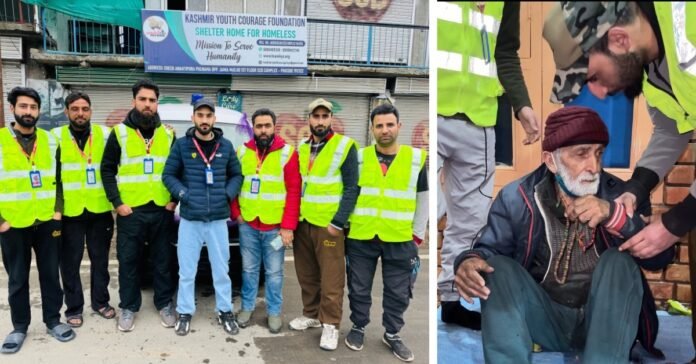
What began with quiet observation soon turned into quiet action. He and a few friends started walking the streets with food packets, blankets, and soap — small things, but offered with care. Slowly, those simple acts turned into something bigger: Kashmir Youth Courage (KYC).
KYC was never about grand gestures. It was about showing up. A group of just over 20 active members became the heart of the initiative. Today, KYC has grown into a volunteer network of 500 to 600 people across Kashmir, helping the invisible regain their place in the world.
In less than two years, they’ve assisted over 45 people — many of them mentally unwell, homeless, or abandoned by families. Some found their way back home. Others found something they hadn’t known in years: safety.
A Shelter with No Conditions
KYC operates from a humble rented space that doubles as a community centre and emergency shelter. At any time, 10 to 15 people live there, receiving not just meals and care, but something deeper — a renewed sense of worth.
Volunteers search the streets daily, not with orders or instructions, but with presence and patience. Many of those they help have been ignored, rejected, or mistreated for years. Building trust is the first step — and it often takes time.
The team approaches with calm and consistency, offering what’s needed most: clean clothes, a bath, a warm meal — and above all, someone willing to stay.
Stories That Stay
One of the toughest rescues involved a former businessman from Srinagar. A financial collapse left him mentally shattered. He walked away from his life and vanished into isolation. When KYC found him, he was volatile and withdrawn. The volunteers stayed — slowly earning his trust. One haircut, one clean shirt, one quiet moment at a time. Eventually, something changed.
Another story is that of Sameer — once abandoned by his family, now a committed KYC volunteer. His journey from suspicion to service is a testament to what happens when someone is seen, not dismissed.
Changing How a Community Sees the Forgotten
At first, KYC’s work confused many. Why help people who seemed beyond help? But over time, perceptions shifted. Shopkeepers began offering food. Strangers brought clothes. Students and professionals joined the mission. KYC wasn’t just changing lives — it was changing the community’s conscience.
Now, where there was once apathy, there’s awareness. Where there was once stigma, there’s solidarity.
Bigger Dreams, Limited Resources
Despite its impact, KYC runs solely on public support. There’s no corporate funding or government aid — just donations, volunteer hours, and shared humanity. Their rented shelter is small. Supplies are often scarce. But the spirit is strong.
Musadiq hopes the KYC model can be replicated elsewhere. He knows this isn’t just a Kashmir issue. Across India — across the world — people are living and dying unnoticed. The need is universal. The solution begins with noticing.
One Small Action at a Time
The message is simple: You don’t need a degree or a big bank account to help. A meal. A conversation. A warm blanket. Even noticing someone on the street is a start.
Because in a world that often looks away, the greatest act of courage is to stop — and care.
Support Kashmir Youth Courage
If you’d like to support their mission:
Account No: 1003010100000200
IFSC: JAKA0TOKUNA
UPI: JKBMERC00260553@jkb
Contact: +91 9622969690
This isn’t just a story about helping the homeless. It’s about reclaiming humanity — one forgotten soul at a time.
UN Human Rights Council Declares Healthy Oceans a Human Right in Landmark Plastic Pollution Resolution
In a groundbreaking move that cements the link between environmental degradation and human rights, the United Nations Human Rights Council (UNHRC) adopted a powerful new resolution on April 4, 2025, during its 58th session. The resolution boldly acknowledges the urgent need for a clean, healthy, and sustainable environment — and, for the first time, directly ties plastic pollution and ocean protection to the fundamental rights of individuals.
This historic decision signals a major shift in global environmental governance, as it calls on nations to adopt a human rights-based approach to tackling one of the planet’s most pressing ecological crises.
The Resolution in Context: A Wave of Change
The new resolution rides on the momentum of recent years, where the intersection of human dignity and environmental health has gained unprecedented international recognition.
In 2021, the UNHRC formally recognized the right to a healthy environment.
In 2022, the UN General Assembly reinforced this principle with its own resolution.
And now in 2025, the Council goes one step further — weaving the protection of the ocean biome, the fight against plastic pollution, and the defense of human rights into one cohesive call to action.
Human Rights, Plastic, and the Planet
At the core of the resolution is a powerful assertion: plastic pollution, climate change, and biodiversity loss are not just environmental issues — they are human rights issues.
The oceans, often romanticized as nature’s vast wilderness, are reframed here as a vital biome that underpins human life. The resolution stresses that protecting marine ecosystems isn’t only about saving whales or coral reefs — it’s about safeguarding human dignity, health, and survival, especially for communities that live closest to the shorelines.
This new stance was heavily informed by a December 2024 report by the UN Special Rapporteur on human rights and the environment, which emphasized how closely human well-being is tied to the health of our oceans — particularly for coastal and small island communities.
A Human Rights-Based Approach to Ocean Governance
This is where the resolution truly sets sail into new waters. It urges UN member states to embrace a governance model that centers around:
Participation of local communities
Protection of vulnerable groups
Inclusion, transparency, and accountability
This human rights-based approach isn’t just lip service. It means that environmental policies must be inclusive, must listen to those who are directly impacted, and must ensure that everyone — especially the most marginalized — has a seat at the table.
It also calls for coordinated, global action across the entire plastic lifecycle — from production and consumption to waste management and pollution cleanup.
Indigenous Knowledge: A Compass for Sustainability
One of the most vital — and long overdue — recognitions in this resolution is the role of Indigenous Peoples and local communities. Their traditional knowledge of sustainable resource use is now formally acknowledged as a key pillar in ocean governance.
This is a critical move. For too long, indigenous and community-based voices have been sidelined in global policy forums. The resolution now paves the way for their expertise to be integrated into environmental decision-making, ensuring policies are not only effective, but also equitable and culturally grounded.
Plastic Pollution in Focus
The resolution does not mince words about the devastating impact of plastic, particularly in marine environments. From choking marine life to disrupting food chains and affecting livelihoods, plastic waste is one of the most visible — and insidious — threats to both ecosystems and economies.
The Council emphasizes that the fight against plastic pollution must be global, cooperative, and centered around climate resilience and justice. It draws attention to the fact that the burden of this crisis is disproportionately borne by those least responsible — vulnerable communities in the Global South, coastal populations, and small island states.
What Comes Next?
With this resolution, the UNHRC has sent a clear message: environmental protection and human rights are inseparable. As nations negotiate legally binding global treaties on plastics and climate action, this resolution could serve as a moral compass and a strategic blueprint.
For activists, policy-makers, and communities alike, it opens the door for new advocacy tools, stronger legal frameworks, and a reinvigorated push toward environmental justice.
Final Word: A Sea Change in Perspective
The 2025 resolution may not eliminate plastic pollution overnight, but it does something just as important: it changes the narrative. The oceans are no longer seen merely as victims of human negligence — they are now recognized as a human rights frontier, and their protection is no longer optional. It is a global responsibility, and a moral imperative.
As the tides of international law shift, one thing is clear: a clean ocean is not just a dream — it’s a right.
A Slice of Summer in Ratnagiri: Where Mangoes Rule and Nature Reigns
As the mercury climbed and the city air began to feel more like soup than atmosphere, our quest to bid a fitting farewell to a seemingly endless summer led us 30 kilometers off the Mumbai-Goa highway. What we found wasn’t just an escape — it was an experience.
Tucked between swaying paddy fields and orchards drenched in golden hues, Ganesh Agro Tourism in Ratnagiri is a 40-acre patch of paradise where mangoes aren’t just a fruit — they’re a way of life. This vibrant agro-tourism homestay, lovingly nurtured by Ganesh Ashok Ranade and his family, is a masterclass in organic farming, rural hospitality, and how to live in sync with the land.
From Commerce to Cultivation: Ganesh’s Homegrown Dream
Ganesh didn’t start his career with soil under his nails. A commerce graduate, he was poised for a life in the corporate fast lane. But life had other plans — quieter, richer, and rooted in tradition. A rekindled passion for farming pulled him back to his family’s land and into the fold of his father’s legacy.
In 1978, Ganesh’s father had taken a gamble — planting 1,000 Alphonso mango saplings on what was then a harsh, rain-starved patch of land. Overcoming unreliable roads, power cuts, and parched soil, he turned it into a mango oasis. Decades later, Ganesh followed suit, planting another 1,000 trees. Today, the 2,000-strong orchard stands as a living monument to their shared perseverance.
Where the Trees Teach and Mangoes Star in Every Meal
The homestay, which once served as the farm’s packing unit, now houses curious visitors eager to experience farm life up close. With five rustic rooms, including an authentic mud-walled room sans air conditioning, the space is both raw and refreshing — a perfect antidote to city fatigue.
Here, mangoes aren’t just consumed; they’re celebrated. From the tree to your plate, guests are immersed in every step of the mango’s journey. You can:
Learn to spot ripe mangoes
Climb the very trees they grow on
Pluck, ripen, and taste the fruits of your labor
Watch mangoes transformed into chutneys, pickles, panna, and the much-loved aamras
All while being treated to sumptuous, home-cooked Maharashtrian meals by Ganesh’s wife, Varada, where the mango (you guessed it) plays the starring role.
A Lesson in Sustainability and Soil
But it’s not all sunshine and aamras. Ganesh is clear-eyed about the challenges of organic farming. Since 2002, he’s committed to chemical-free practices — crafting natural fertilizers from cow dung, warding off pests with neem-based sprays, and constantly tending to his orchard with a mix of tradition and innovation.
The inspiration to build a homestay came from an unexpected detour. While driving through Neral, Ganesh stumbled upon Saguna Baug, India’s first agro-tourism model spearheaded by food scientist-turned-farmer Chandrasekhar Bhadsavle. A tour of that lush space lit a spark. “That was all I needed,” says Ganesh. “It gave my vision a name.”
More Than Mangoes: A Rural Experience for All Seasons
Though summer is the obvious headliner, the farm doesn’t hibernate when the last mango falls. Monsoons bring a whole new learning curve — paddy cultivation, tractor rides, and mud-splashing adventures are on the menu. The rest of the year is dedicated to orchard maintenance, prepping the land for the next season’s bounty.
And if mangoes ever need a break, there’s birdwatching, boating, tractor joyrides, and mango canning lessons to keep guests enchanted. Every activity is a brushstroke on the broader canvas of agro-tourism — a model that connects people to their food, their environment, and the people who tend to it.
A Market Favorite with a GI-Tagged Legacy
Ganesh’s mangoes don’t just charm tourists — they’re in high demand in Mumbai, Thane, Kolhapur, Sangli, Nashik, and Pune. And it’s no surprise. The Alphonso mango, named after Portuguese nobleman Afonso de Albuquerque, is known for its honeyed aroma, smooth pulp, and firm, golden skin. Thanks to Ratnagiri’s laterite-rich soil and coastal climate, Ganesh’s farm produces some of the finest Alphonsos around — GI-tag certified and full of character.
Though the family experimented with growing vegetables, the mango proved to be not just delicious but pragmatic. “Cows ate the vegetables,” Ganesh laughs. “And we couldn’t afford to hire watchmen. So mangoes it was.”
Where Passion Bears Fruit — Literally
What started as a passion project has blossomed into a full-fledged agro-tourism experience. For Ganesh, this is more than just a livelihood — it’s a love letter to nature, legacy, and honest food. “I ventured into farming out of passion,” he says. “And it was the best decision of my life.”
So, if you’re looking to wrap up your summer with something sweet, tangy, and meaningful — Ganesh Agro Tourism in Ratnagiri is calling. And yes, there’s plenty of mangoes waiting.
To book your stay and bite into a summer well spent, reach out to Ganesh at 9422433676.
In the windswept steppes of Central Asia, a discovery of global consequence is shaking up the world of high-tech resource politics. Kazakhstan, long known for its vast mineral wealth and strategic location, has unearthed what could become one of the largest rare earth metal deposits in the world—catapulting the country into a new era of strategic relevance.
Nestled in the Karaganda region, about 300 kilometres southeast of Astana, the Kuirektykol site has revealed nearly one million tons of rare earth metals (REMs). The announcement, made by Kazakhstan’s Ministry of Industry and Construction, has sent ripples through international markets, especially at a time when the global appetite for REMs is reaching an all-time high.
The Kuirektykol Jackpot: What’s in the Ground?
Early exploration indicates that the Irgiz and Dos zones within Kuirektykol hold particular promise. Rare earth element concentrations exceed 0.1%, with some samples boasting levels up to 0.25%—a significant benchmark in REM mining. The Irgiz area alone may contain around 800,000 tons of these high-demand materials.
Among the elements identified are cerium, lanthanum, neodymium, and yttrium—all indispensable for modern technologies. From the magnets in electric vehicles and wind turbines to critical components in smartphones, military equipment, and satellite systems, these metals form the quiet backbone of 21st-century innovation. The deposit features an average concentration of 700 grams per ton, a yield that could justify serious commercial interest if properly developed.
A Global Resource at a Global Crossroads
This discovery couldn’t come at a more pivotal moment. The global race to secure rare earth elements is intensifying, driven by the green energy transition and defence modernisation. Traditionally, countries like China, Russia, and the United States have dominated both supply and strategic policy in this domain. Now, Kazakhstan stands poised to reshape the map.
The country’s geographic positioning between Europe and Asia already offers a logistical edge. Add to that the newfound mineral wealth, and Kazakhstan’s role as a critical node in the rare earth supply chain becomes undeniable.
Development Hurdles and Global Collaboration
But Kazakhstan’s ambitions are tempered by a technological reality: it currently lacks the full industrial capacity to extract and refine these rare earth metals on its own. Recognising this, the government is actively seeking foreign investment and partnerships. Plans are underway to develop sophisticated extraction and processing infrastructure capable of handling the scale and complexity of REM production.
If successful, this could not only generate massive economic returns but also elevate Kazakhstan’s standing in the global green economy. Some geological models suggest the site’s total reserves could even surpass 20 million tons with deeper exploration—placing it among the world’s top rare earth repositories.
Strategic Leverage in a Shifting Geopolitical Landscape
Kazakhstan’s rare earth potential isn’t just a matter of economics—it’s a geopolitical asset. The announcement came just as the country hosted the first-ever EU-Central Asia summit, a timely intersection of opportunity and diplomacy. As the European Union pursues carbon neutrality by 2050, its dependency on stable sources of rare metals is growing.
The EU’s interest in non-Chinese sources of rare earths could lead to stronger strategic ties with Kazakhstan, offering both investment and political cooperation. For the EU, Kazakhstan represents a reliable, resource-rich partner in a region increasingly shaped by the strategic tensions of major powers.
Looking Ahead: A Nation on the Brink of Transformation
Kazakhstan has long been a mineral powerhouse, but this rare earth discovery at Kuirektykol opens a new frontier—one that blends energy policy, geopolitics, and technological evolution. With careful development and strategic partnerships, Kazakhstan could transition from a raw materials exporter to a central player in the global supply chain of next-gen technologies.
This isn’t just a mining story; it’s the emergence of a new chapter in global resource dynamics—with Kazakhstan turning the page.