Home Blog Page 325

Double Your Harvest, Halve Your Water Use: Why Urban Farmers Love Aquaponics & How You Can Start

0

The Future of Farming: How Aquaponics is Revolutionising Our Backyards and Terraces

In a world where arable land is shrinking and water scarcity is tightening its grip, an eco-friendly revolution is quietly blooming—not in sprawling fields, but in compact city terraces and modest backyards. Meet aquaponics, a farming method that fuses hydroponics (growing plants in water) with aquaculture (raising fish), creating a symbiotic ecosystem where both plants and fish thrive using minimal resources. Think of it as nature’s closed-loop system—on steroids.

What is Aquaponics, Really?

Imagine this: fish are fed, they do their business (as fish do), and that nutrient-rich waste becomes food for plants. In return, the plants filter and clean the water, which is then cycled back to the fish tanks. No chemical fertilisers, no soil, minimal water usage—and maximum sustainability. It’s like having a farm and an aquarium that are best friends and business partners.

But aquaponics isn’t just about environmental brownie points; it’s also about smart economics. This highly organic approach can yield a dual income—harvest both fish and vegetables from the same system. It’s productive, pocket-friendly, and planet-conscious.


Getting Started: What Do You Need?

You don’t need acres of farmland or a tech degree to get started. According to Kerala-based farmer Vijayakumar Narayanan, you can set up a productive aquaponics unit in less than 900 sq ft. Ideally, split your space evenly—half for the fish pond, half for the plant beds. With this setup, you can raise up to two tonnes of fish.

Components to Include:

  • Fish tanks
  • NFT pipes (Nutrient Film Technique)
  • Water pumps
  • Bio-filters

Aquaponics expert Peter Singh from Delhi, who turned his setup into a green lung for battling air pollution, describes a basic unit of 2×6 feet, with a height of 6 feet. It uses just 250 litres of water, artificial lighting (about 200 watts), and can grow 180 leafy greens like lettuce, kale, and bok choy. One tank can comfortably sustain 10 freshwater fish (around 5kg total fish mass). Efficient, compact, and chic.


What Fish Should You Start With?

If you’re just dipping your toes in the water, go for hardy species like Tilapia, or ornamental fish such as goldfish and koi. These guys are low-maintenance and produce generous amounts of waste—ideal for feeding your plants. A 1,000-litre tank can host around 150 fish; for edible varieties, scale up to 3,000 litres.


Let’s Talk Substrate

Your plants still need something to anchor their roots. Skip the regular river sand—quartz silica sand is where it’s at. Rich in organics and excellent for filtration, it’s a game-changer. You’ll also need two pumps—one to aerate the pond and the other to send nutrient-rich water to your plant beds. Many of these components are available with government subsidies, so don’t forget to check with your local horticulture department.


How Much Does It Cost?

A starter system of 150 sq ft will set you back about Rs 60,000–65,000. According to Mamatha Kamireddy, a Bengaluru-based aquaponics trainer, this is more than enough to feed a family of five. If you’re going vertical on your terrace (think stacking shelves of veggies), the cost goes up to about Rs 800 per sq ft. Want to keep things horizontal? That brings the cost down to Rs 400 per sq ft.


Do You Even Need Fertilisers?

Not really. The beauty of aquaponics is that it’s self-fertilising. Fish waste is naturally rich in ammonia, which gets converted by beneficial bacteria into nitrates—excellent plant food.

Engineer-turned-urban-farmer Shashank Dubey from Vadodara has even upcycled old drums and cans to create thriving terrace systems. He adds iron nails, lime, and eggshells to supplement nutrients. Fancy, functional, and eco-friendly.


Mastering the Environment: pH and Temperature

Double Your Harvest, Halve Your Water Use: Why Urban Farmers Love Aquaponics & How You Can Start

You don’t need to be a scientist, but a little monitoring goes a long way.

  • pH levels should be tested and adjusted before introducing fish.
  • Leafy greens love 25–30°C, while strawberries do better around 18°C.
  • For lettuce, keep it cool—15°C is ideal.
  • Use urban clay pots to help regulate temperature.

Water You Waiting For?

If water conservation is your thing (and it should be), aquaponics is a no-brainer. The system recycles water continuously, with only minor loss through evaporation. You could save up to 80% more water compared to traditional farming.


Why Aquaponics is More Than Just a Trend

Aquaponics isn’t just another Pinterest-worthy urban farming fad. It’s a smart response to real-world crises—climate change, water shortage, food insecurity, and chemical-laden produce. With rising awareness and growing support from local governments and innovators, aquaponics is becoming an accessible lifestyle shift for urban dwellers and small farmers alike.

So whether you’re a sustainability enthusiast, a backyard gardener, or just someone who likes the idea of growing dinner while your fish do half the work—aquaponics might just be your calling.

Time to turn that terrace into a thriving food forest.

Widowed by Tigers, 500 Sundarbans Women Rebuilt Their Lives With 1 Woman’s Help & Fish Farming

0

Deep in the tangled green of the Sundarbans — where the rivers breathe mist and the trees have roots like claws — there are two things that rule: tigers and resilience. One kills. The other refuses to die.

This is a story not of tragedy, but of tenacity. Not just of wild beasts and whispered legends, but of women — bold, broken, rebuilding.

And at the center of it all? A woman from Mumbai with a dream and a shovel full of stubbornness.


The Honey That Costs Blood

Widowed by Tigers, 500 Sundarbans Women Rebuilt Their Lives With 1 Woman’s Help & Fish Farming

In most parts of the world, honey is a sweet treat.

In the Sundarbans, it’s a gamble with death.

Men here — the moulis — don’t just gather honey. They battle crocodile-infested waters, mangrove spikes, venomous snakes, and worst of all, the Royal Bengal Tiger. These majestic predators don’t just hunt deer. They hunt humans.

Step into this swampy wilderness, and the rules are clear: You take honey from the forest, the forest may take your life.

That’s not a saying. That’s a statistic.

Over 3,000 women in this region have lost their husbands to tiger attacks. They’re called bagh-bidhobas — tiger widows. It’s a title that comes with pain, stigma, and often, poverty.


“The Tiger or Hunger — What Would You Choose?”

Widowed by Tigers, 500 Sundarbans Women Rebuilt Their Lives With 1 Woman’s Help & Fish Farming

When philanthropist and restaurateur Neeti Goel first visited the Sundarbans in 2022, she came looking to understand. What she found was a brutal choice faced daily by the people here.

“Why do you keep going into the forest when you know it could kill you?” she asked a local honey gatherer.

His answer?
“If I don’t go, we don’t eat. Either the tiger kills us — or hunger does.”

Those words lit a fire in her that hasn’t gone out.


The Beast Beneath the Water

The tigers here aren’t like the ones you see in documentaries. These are swimmers, stalkers of the sea. With webbed paws and saltwater-soaked stripes, they cross rivers like roads. They hunt in silence and strike with precision.

One tiger was seen swimming across the delta faster than any human could manage. They aren’t just apex predators. They’re nightmares with fur.

And yet, the people stay.

Because behind every jungle venture is a hungry family, a child to clothe, a loan to repay.

But when a man doesn’t return by sunset, the village lights a candle and prepares for mourning.


From Widow to Warrior: Enter Neeti Goel

Widowed by Tigers, 500 Sundarbans Women Rebuilt Their Lives With 1 Woman’s Help & Fish Farming

Neeti didn’t come to hand out sympathy. She came to hand over shovels.

“I won’t spoon-feed you,” she told the widows. “But if you want to earn, I’ll show you how.”

And so, they started digging.

Literally.

In front of their homes, 100 women began to carve out fish ponds. With bamboo pipes and a crash course in aquaculture, they turned swampy patches into self-sustaining micro-businesses.

In just four months, the fish were thriving.

Today, those same fish are plated at five-star hotels. But more importantly, they’re feeding children. They’re paying for schoolbooks. They’re restoring dignity.


One Pond, One Phoenix

Take Souravi Mandal.

She lost her husband and son to a tiger. Then her daughter to a crocodile. It was as if the Sundarbans had swallowed her entire family.

But today? Souravi stands by the pond in front of her home with a quiet pride that roars louder than any beast. She earns ₹150 a day. She smiles again. She matters again.

And she’s just one of nearly 500 women Neeti has helped rise from the ashes.


From the Delta to the Dusty Heartland

Widowed by Tigers, 500 Sundarbans Women Rebuilt Their Lives With 1 Woman’s Help & Fish Farming

Neeti’s mission didn’t stop at the edge of the Sundarbans. Her battle for dignity rolled into Uttar Pradesh, Madhya Pradesh, and beyond.

  • In Mirzapur, where Naxalism kept girls from school, she gave them bicycles to pedal toward education.
  • For sex workers and domestic abuse survivors, she launched micro-businesses: papad stalls, vegetable carts, sewing units.
  • When Shabana’s husband sold her only rickshaw for booze, Neeti didn’t just buy her a new one — she bought her an e-rickshaw, turning her into a boss and a breadwinner.
Widowed by Tigers, 500 Sundarbans Women Rebuilt Their Lives With 1 Woman’s Help & Fish Farming

During the pandemic, when most were stuck indoors, Neeti co-led Khaanachahiye, delivering 80 lakh meals to migrants and the homeless.


A Quote to Remember

“Women don’t need to be empowered. They are empowered.
They just need opportunity.”
Neeti Goel

This belief isn’t a slogan for her. It’s a system. A way of doing things. It’s digging ponds instead of writing cheques. It’s rewriting tragedy into triumph — one woman, one story at a time.


The Final Word: Hope Has Webbed Feet Too

The Sundarbans is still dangerous. The tigers still swim. The forest still watches.

But now, there’s something else taking root here. Not just mangroves — but hope.

The kind that wears a widow’s sari, carries a bamboo pipe, and isn’t afraid of the dark anymore.


From fear to fish farms.
From prey to providers.
From loss to legacy.

The women of the Sundarbans aren’t just surviving anymore.

They’re rising.

The Talking Crow of Palghar: A Feathered Friend Who Found His Voice

0

Somewhere in the quiet village lanes of Palghar, Maharashtra, an unexpected celebrity is ruffling feathers—both literally and figuratively. He doesn’t wear sunglasses or post selfies, but he’s got a fan base, a viral video, and a voice that has social media hooked. Meet the talking crow who calls you out, chats with the locals, and casually asks, “What is your work?” like a nosy neighbor with wings.


A Crow with a Story—and a Vocabulary

The unlikely tale began when Mangalya Munke stumbled upon a tiny, injured crow—just 15 days old—lying helplessly beneath a tree. Rather than leave it to fate, Munke took the bird home, nursing it back to health. What started as an act of compassion soon turned into a full-blown family adoption. The crow, now a lively, chatty member of the Munke household, not only recovered but evolved into something of a feathery phenomenon.

The children fed it, played with it, and showered it with the kind of love usually reserved for the family dog. And the crow responded. Oh, did it respond.

According to a report by India Today, the crow didn’t just mimic sounds—it started speaking Marathi words like “Aai” (mother), “Baba” (father), and whole phrases like “What are you doing?” and “Why did you come home?” Better yet, it apparently knows how to greet—and grill—visitors, reportedly asking newcomers, “What is your work?” in classic small-town aunty fashion.


More Than Mimicry: A Bond Beyond Words

“It talks to us now. It calls us by name,” says Tanju Munke, Mangalya’s wife. “We didn’t teach it, it just picked it up.”

That might sound like a family exaggerating the pet’s party trick—but videos say otherwise. The crow, now a viral sensation, is seen perched comfortably on shoulders, hopping around the living room like a feathered roommate, and, yes, talking. Not chirping—talking.

What’s more, even though the crow spends the day flying off with its fellow birds, it always returns home before sunset. Every. Single. Day. The Munke household isn’t just its nest—it’s home.


Viral Wings and Social Media Stardom

As word spread, locals began flocking (pun intended) to the Munke house, phones ready, eager to witness the miracle bird in action. Some visitors even tried striking up conversations with the crow, hopeful it might say something back. Social media, of course, did what it does best—turn the crow into a sensation.

sted in the comments.


Crows: The Underrated Geniuses of the Bird World

As surprising as it might seem, science has long been aware of crow intelligence. Crows are known for their problem-solving skills, memory, emotional awareness, and even the ability to recognize human faces. But a crow that talks like a neighborhood uncle and returns home on time? That’s a plot twist no one saw coming.

This particular bird may not have a name (yet—can we suggest Kaw-lvin?), but it’s become a symbol of something bigger. It’s a reminder that kindness, connection, and a bit of curiosity can lead to the most unexpected bonds.


From Wings to Words: What This Story Really Tells Us

In a world constantly searching for viral trends and moments that “break the internet,” sometimes all it takes is a crow, a family, and a little compassion. The story of the Palghar talking crow isn’t just about a bird with a cool party trick—it’s about the kind of connection that transcends language, species, and expectation.

So the next time you hear a crow calling outside your window, maybe listen a little closer. Who knows? It might just ask you, “What is your work?”

Recent Discovery of Rajaraja Chola Inscription

0

High above the ancient plains of Madurai, nestled atop the rugged Somagiri hills of Melavalavu, history has whispered yet another of its long-buried secrets. Carved into stone, weathered by a thousand monsoons, an inscription has surfaced—one that draws a direct line to one of South India’s most illustrious emperors: Rajaraja Chola I.

This discovery has lit a spark among historians, archaeologists, and lovers of Tamil history. Not just because of the find itself—but because of what it tells us about an empire that once ruled the seas, sculpted stone into poetry, and transformed South India into a cultural powerhouse.


A Hilltop Inscription, A Pan-Regional Empire

The newly unearthed inscription, dated to around 1000 CE, mentions Viranarana Pallavarayan, a military commander under Rajaraja Chola I, and details a temple built by Malaiyappa Sambu. But this is more than a note on a stone—it is a geopolitical marker.

The location of the inscription—in Pandya territory—reinforces what historians long believed but rarely saw spelled out in such direct terms: that Rajaraja Chola’s influence had not only entered but firmly entrenched itself in the Pandya heartland. This was no fleeting conquest. It was a statement: “I am here, and I intend to stay.”


The Rise of a Titan: Rajaraja Chola I

Born to Parantaka Chola II, Rajaraja ascended the throne in 985 CE. But unlike rulers who are born into power, he had to earn it. Rajaraja was recognised early for his strategic mind and leadership, and when the crown did fall upon his head, he wore it with purpose.

And what a reign it was. In less than thirty years, Rajaraja Chola reshaped the map of southern India. He wasn’t merely a king—he was an empire builder.


The Sword and the Sceptre: Conquests and Consolidation

Rajaraja’s military brilliance is legendary. In 988 CE, he struck the Cheras with a crushing victory at Kandalur Salai. Soon after, he stormed the Pandya capital, Madurai, and stamped it with his name—Rajaraja Mandalam, marking the transformation of the region into a Chola province.

By 993 CE, his ambitions crossed the seas. Sri Lanka fell to his forces, with a new provincial capital established in its northern reaches. He didn’t stop there—his campaigns rolled into Karnataka, clashing with the Chalukyas, and expanding the empire deep into the Deccan.

But Rajaraja was more than a warrior. He understood that empires are built not just by the sword, but by the structure.


Rewriting Governance: From Lineage to Loyalty

Breaking from tradition, Rajaraja dismantled the hereditary power structures that had long dominated local governance. He introduced a system of appointed officials—loyal, trained, and accountable.

His empire was split into nine provinces, each allowed a degree of local autonomy. This was no chaotic decentralisation; it was a masterstroke of administrative balance. Villages held assemblies. Local decisions mattered. And yet, everything fed back into the heart of the empire, like tributaries flowing into a mighty river.


Temples as Testimony: The Cultural Pulse of an Empire

Rajaraja’s reign wasn’t just felt in battlefield victories or royal edicts—it was carved in stone, sung in verses, and painted in glorious murals. His magnum opus: the Brihadeshwara Temple in Thanjavur. Towering over the landscape even today, this UNESCO World Heritage site is more than a temple—it’s a statement of identity.

Dravidian architecture found its zenith here. The temple’s shadow never falls on the ground. Its walls whisper stories of Shiva, of kings, of celestial dancers, and of a golden age. Inside, we find murals that could rival Renaissance masters—centuries before the Renaissance even began.

Rajaraja didn’t stop at stone. He minted new coinage, a novel idea in South India at the time. His face appeared beside a seated goddess, a visual blend of divine right and sovereign power.


The Economic Web: Ports, Ships, and Spices

If war built the empire and art adorned it, trade fed it. The Chola economy was a beehive of mercantile activity. Spices, pearls, textiles, and precious stones flowed out of Indian ports toward West Asia and Southeast Asia. In return came gold, horses, and influence.

Mercantile guilds weren’t just business bodies—they were political forces, sometimes more powerful than local kings. They built temples, sponsored art, and even negotiated foreign deals.


So, What Does This Inscription Mean?

In many ways, it’s not just about the text. It’s about the echoes. A thousand years later, a piece of stone from a lonely hill tells us that Rajaraja’s vision was vast, deliberate, and enduring. It shows that his reach extended beyond maps—into culture, architecture, governance, and identity.

The Somagiri inscription is more than an archaeological find. It’s a bridge across time, a moment where the past reaches out and taps us on the shoulder, saying, “Remember me? I shaped your world.”

Unveiling the Secrets Beneath: How ChaSTE Took the Moon’s Temperature and Made History

0

On August 23, 2023, history echoed softly across the barren, silver plains of the Moon’s south pole as India’s Chandrayaan-3 mission etched its name into the annals of space exploration. But while the world cheered the Vikram lander’s triumphant touchdown, a lesser-known hero quietly got to work beneath the surface: the Chandra’s Surface Thermophysical Experiment—better known as ChaSTE.


Diving Into the Lunar Soil

Imagine this: a tiny probe, no larger than a soda can, plunges into alien soil on a world 384,400 km away. No fanfare. No dramatic music. Just pure science. ChaSTE’s mission? To uncover how the Moon handles heat—something critical not just for curiosity’s sake, but for the survival of future explorers.

Nestled within Vikram, ChaSTE deployed just a day after landing. Armed with ten ultra-sensitive Platinum Resistance Temperature Detectors (fancy speak for really precise thermometers), the probe began its slow descent—burrowing up to 140 mm deep into the regolith like a lunar mole on a mission. Each sensor, spaced like checkpoints along the probe, captured the temperature at a different depth, building the first-ever vertical thermal profile of the Moon’s south polar region.

But wait, there’s more—ChaSTE wasn’t just passively measuring temperature. A small ribbon heater near its tip heated the surrounding soil to actively test how well the regolith conducts heat. Think of it as toasting moon dust to see how fast it cools down.


What Did ChaSTE Discover?

Let’s talk numbers. During the scorching lunar day, surface temperatures climbed to a blistering 70°C—hotter than your average summer in Delhi. But dive just 80 mm down, and the mercury drops dramatically to a frigid -10°C. That’s a thermal cliff, not a gradient! These sharp contrasts tell scientists just how poorly the Moon’s surface conducts heat—like wrapping a lava rock in a cozy thermal blanket.

This steep thermal shift is more than just a neat science fact. It’s a clue—one that could point to regions where water ice, or other volatiles, might be hiding in the shadows. Areas with such steep gradients may help preserve precious resources, untouched for billions of years. And where there’s water, there’s potential for human habitats.


Engineering Marvel: Built for the Moon’s Extremes

ChaSTE’s design is a masterclass in subtle genius. Its sensors—RTD Pt-1000s—are prized for their accuracy and resilience in harsh environments. The probe itself is crafted from composite material that resists heating from within and maintains strength during penetration. Unlike past missions (looking at you, InSight and Philae), ChaSTE’s rotating mechanism and step-wise insertion proved both gentle and effective. No bounce. No jam. Just smooth lunar science.


Why This Matters More Than You Think

Previous lunar missions, including Apollo and Luna, focused mostly around the Moon’s equator—a region comparatively “tame.” Chandrayaan-3, by contrast, set its sights on the mysterious south pole. This region is cloaked in shadows, dotted with craters that never see sunlight, and may hold keys to sustaining long-term lunar presence.

ChaSTE’s data challenges existing thermal models that were mostly based on equatorial assumptions. It tells us that the poles are a different beast—unpredictable, volatile, and, therefore, valuable. For mission planners, this is gold. Understanding heat behavior helps in designing equipment that won’t fry or freeze, and structures that can keep astronauts safe during their extended stays.


The Bigger Picture: Beyond India, For Humanity

ChaSTE didn’t just work. It succeeded where other global missions had stumbled. ESA’s Philae struggled to anchor itself and failed to drill. NASA’s InSight probe, despite its sophisticated design, couldn’t bury itself into the Martian surface. ChaSTE, with its elegantly simple mechanism and India’s trademark ingenuity, nailed it.

It’s a proud moment, not just for India, but for the entire planetary science community. Chandrayaan-3 has proven that with careful design and a relentless pursuit of knowledge, even small instruments can yield seismic (or should we say thermic?) shifts in understanding.


What’s Next?

With one lunar day of continuous data—every single second for 14 Earth days—scientists now have a treasure trove of information. Future missions can build upon this foundation, targeting specific depths for resource extraction, planning habitats in thermally stable zones, and even setting the stage for human footsteps in these frosty shadows.

So the next time you look up at the Moon, spare a thought for the little probe that could. ChaSTE may be small, but in the cold silence of the Moon’s south pole, it spoke volumes.

Ram Navami 2025: Ayodhya Gears Up For Mesmerising Celebrations To Celebrate Lord Rama’ Birth Anniversary

0

After hundreds of years, Ayodhya’ Ram Bhoomi will be glowing with thousands of flickering lamps, and echoing with the rhythmic chants of “Jai Shri Ram.” On April 6, 2025, the birth city of Lord Ram prepares to celebrate Ram Navami with unparalleled grandeur at the newly consecrated Ram Mandir. For the first time since its historic inauguration, the temple will host Lord Rama’s birth anniversary in full splendor, blending ancient rituals with modern marvels. From a celestial “Surya Tilak” to streets blooming with flowers, this Ram Navami promises to be a soul-stirring experience for millions. Buckle up as we dive into the heart of this divine celebration!

The Countdown to Divinity

Ram Navami, falling on April 6 this year, marks the ninth day of Chaitra Shukla Paksha, commemorating the birth of Lord Rama the Maryada Purushottam, the epitome of righteousness. The auspicious timing begins with the Navami Tithi on April 5 at 7:26 PM, stretching until 7:22 PM on April 6. The prime puja window sparkles between 11:08 AM and 1:39 PM, with the sacred “Madhyahna Kshan” at 12:24 PM. But this isn’t just about dates—it’s about a cosmic alignment of faith, tradition, and festivity.

A Temple Aglow: The Grand Preparations
The Ram Mandir, a symbol of triumph and devotion, is gearing up to dazzle the world. Picture this: the temple adorned with cascades of marigolds, twinkling lights weaving through its spires, and the air thick with the fragrance of incense. The Shri Ram Janmabhoomi Teerth Kshetra Trust has left no stone unturned to make this a historic affair.

The Surya Tilak Miracle

At high noon, a breathtaking moment awaits. Using an intricate system of lenses and mirrors, sunlight will kiss Ram Lalla’s forehead for four mesmerising minutes—a “Surya Tilak” that merges science with spirituality. This celestial spotlight stole hearts last year, and 2025 promises an encore that’ll leave devotees spellbound.

Rituals That Stir the Soul

The day kicks off at 9:30 AM with sacred ceremonies. By 10:30 AM, Ram Lalla will be bathed in a divine abhishekam, followed by a private dressing ritual behind curtains from 10:30 to 10:40 AM. At 10:40 AM, the Shringar Aarti unveils the deity in regal attire, with darshan flowing seamlessly until the grand birth celebration at noon.

A Royal Makeover

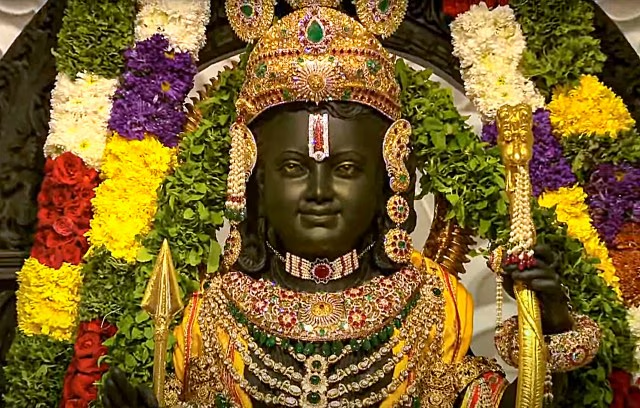
Ram Lalla will don the garb of a prince—think ornate robes, glittering jewels, and garlands of fragrant blooms. This isn’t just decoration; it’s an invitation to witness divinity in its most majestic form.

Welcoming the Faithful: Arrangements for Millions

With an expected flood of over 5 million pilgrims, Ayodhya is transforming into a fortress of faith and hospitality. The local administration, led by IG Praveen Kumar and Commissioner Gaurav Dayal, is orchestrating a seamless experience:

Safety First: Police and paramilitary forces stand guard, while crowd management squads ensure order amid the fervor.

Comfort in Chaos: Cleanliness crews are on overdrive, water stations dot the landscape, and rest areas offer respite. Fifty LED screens will beam the Surya Tilak and festivities to those beyond the temple’s walls.

Smooth Journeys:

Roads are polished, extra buses rumble into action, and parking zones sprawl to accommodate the faithful.
The streets of Ayodhya will pulse with life, as devotees from across the globe converge to soak in this once-in-a-lifetime celebration

A Cultural Extravaganza

Ram Navami isn’t just a day it’s a symphony of devotion. the city will come alive with bhajans that tug at the heartstrings, Ram Leela performances that reenact Rama’s epic tale, and soulful recitations of the Ramcharitmanas. Temples and monasteries around the Mandir will join the chorus, draped in lights and flowers, turning Ayodhya into a living tapestry of faith.

Cosmic Blessings: Rare Alignments

This Ram Navami isn’t your ordinary affair. The stars have aligned to sprinkle extra magic, with rare yogas like Ravi Pushya, Sarvartha Siddhi, and Sukarma Yoga gracing the day. Astrologers say this celestial combo, unseen for 13 years, doubles the blessings of prayers and fasts. It’s as if the universe itself is bowing to Lord Rama!

A Feast for the Divine

What’s a celebration without food?
Ram Lalla will savor a special bhog of kheer, makkhan-mishri , tulsi leaves, and a vibrant pnjiri made from yellow fruits offerings steeped in love and lore. Devotees, too, will share in the joy as prasadam is distributed, binding the community in sacred sweetness.
Ayodhya’s Heartbeat

Even days before the main event, Ayodhya hums with anticipation. The chants of “Jai Shri Ram” ripple through the air, lamps flicker along the ghats, and the Ram Mandir stands as a beacon of hope and heritage. For the faithful, this isn’t just a festival it’s a homecoming to the land where righteousness was born

Ujjain-situated Harsiddhi Temple Bespeaks Story of King Vikramaditya and His Eternal Bond With The Goddess

0

By Anjali Solanki

In the ancient city of Ujjain, where the sacred Shipra River flows and the air hums with spiritual energy, there stands a temple unlike any other—the Harsiddhi Mata Temple. Its towering pillars, adorned with hundreds of flickering lamps, cast a golden glow over the city each evening, a beacon of divine presence. But this is no ordinary shrine. It is one of the 51 Shakti Peethas, where the elbow of Goddess Sati is said to have fallen, and its story is intertwined with the legendary King.

Vikramaditya, a ruler whose name echoes through time as a symbol of wisdom, valor, and devotion.
Long ago, in the golden age of Ujjain, Vikramaditya ruled with a just hand and a fearless heart. Known for his intelligence and his unyielding quest for truth, he was no stranger to the divine. Yet, among all the gods and goddesses he revered, it was Harsiddhi Mata, the fulfiller of wishes, who held a special place in his soul. The tale of how this bond came to be is one of courage, sacrifice, and a miraculous swing that sways to this day.

It began when Vikramaditya, still a young prince, heard whispers of a powerful goddess residing in the distant land of Dwarka, Gujarat. She was Harsiddhi Mata, a fierce yet benevolent form of Shakti, protector of the seas and granter of boons. Legends claimed that her temple atop a hill by the ocean was a place where prayers were answered with divine precision. Driven by a longing to bring her blessings to his people, Vikramaditya embarked on a perilous journey across rivers, forests, and bandit-ridden plains to seek her favor.
When he arrived at the Dwarka temple, weary but resolute, he fell to his knees before the goddess’s idol, painted in dark vermilion, radiant with power. “O Mother,” he prayed, “Ujjain is a city of faith, yet it yearns for your presence. Come with me, and I will build you a temple worthy of your glory.” The air grew still, and then, a voice—soft yet commanding—spoke from the sanctum.

Ujjain-situated Harsiddhi Temple Bespeaks Story of King Vikramaditya and His Eternal Bond With The Goddess

“Vikramaditya, your heart is pure, but my spirit is bound to this place by day. If you prove your devotion, I will dwell in Ujjain by night.”
Undeterred, Vikramaditya asked, “What must I do, O Divine Mother?” The goddess replied, “Offer me your head, not once, but eleven times, every twelve years. If your resolve holds, I will grant your wish.” The young prince did not hesitate. Drawing his sword, he severed his own head and laid it at her feet. The temple trembled, and in an instant, Harsiddhi Mata restored him, his head reattached as if untouched by the blade. “Your courage pleases me,” she said. “Return to Ujjain, and I will follow.”

True to his word, Vikramaditya built a magnificent temple in Ujjain near the Rudra Sagar Lake, a sanctuary of stone and spirit. The goddess, as promised, took residence there each night, her presence felt in the cool breeze that swept through the courtyard. But her test of devotion was far from over. Every twelve years, Vikramaditya returned to the temple, offering his head in a ritual of unwavering faith. Eleven times he did this, and eleven times the goddess revived him, her power stitching his life back together. The people of Ujjain marveled at their king’s devotion, and the temple became a place of pilgrimage, its fame spreading far and wide.

Yet, on the twelfth occasion, something changed. As Vikramaditya knelt before the goddess, his sword raised for the final offering, a celestial light enveloped the temple. Harsiddhi Mata appeared before him, her form resplendent, seated on a swing that seemed to float between earth and sky. “Your devotion has transcended all trials,” she declared. “This time, your head will not return, for your reign must end. But your legacy will live forever, and I will remain in Ujjain, answering the prayers of those who seek me.”
With a serene smile, Vikramaditya offered his head one last time. The swing swayed gently, and the king’s spirit ascended, leaving behind a temple alive with his sacrifice. From that day, it is said that Harsiddhi Mata’s swing moves of its own accord, a divine sign that she hears the pleas of her devotees. During Navratri, when the temple’s twin pillars blaze with 726 lamps, the air thrums with chants, and the swing sways as if pushed by an unseen hand, fulfilling the wishes of those who believe.

To this day, the Harsiddhi Mata Temple stands as a testament to Vikramaditya’s devotion and the goddess’s grace. Pilgrims flock to Ujjain, drawn by the legend of a king who gave everything for his people and a swing that dances with divinity. And if you listen closely on a quiet night, amid the flicker of lamps and the rustle of the Shipra’s waters, you might hear the faint creak of that sacred swing—a reminder that faith, like Vikramaditya’s, can move the heavens themselves.

DROID 7.0: A Brilliant Confluence of Technology and Creativity Boosts Students’ Spirit in Mody University

0

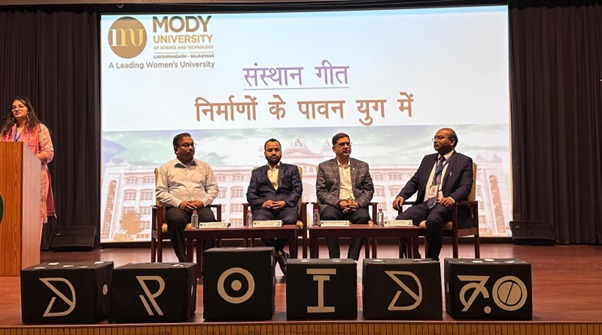
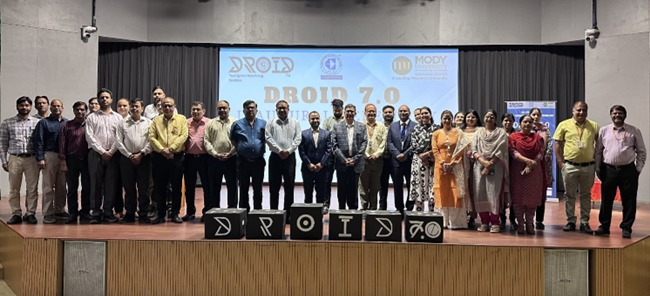
The campus of Modi University radiated innovation, energy, and enthusiasm as DROID 7.0, the university’s flagship techno-cultural fest, wrapped up with great fanfare. Organised by the School of Engineering and Technology, the two-day festival witnessed over 250 enthusiastic participants, a host of spectacular events, and countless memorable moments.

The fest kicked off with an inspiring keynote by Dr. Naveen Sharma, who spoke on “Multimedia, Mind, and Mental Health: A Psychological Perspective.” He shed light on the importance of mental well-being in today’s digitally-driven world, encouraging students to reflect deeply on the intersection of technology and mental health.

Dr. Ashutosh Bhardwaj, President of Modi University, addressed the gathering with insights into the New Education Policy, underlining its emphasis on entrepreneurship, innovation, and technology. He urged students to explore the emerging opportunities in these areas.

A standout moment of DROID 7.0 was the keynote session by renowned entrepreneur Mr. Mukesh Khandelwal, Founder of Discovery Commercial Solutions, accompanied by his daughter Priyanshi Khandelwal, an MBA (Finance) student. Their engaging talk offered a seamless blend of real-world experience and fresh perspectives on entrepreneurship, fintech, and taxation, earning appreciation from the entire audience.

DROID 7.0: A Brilliant Confluence of Technology and Creativity Boosts Students' Spirit in Mody University

A special workshop titled “Engineering and Entrepreneurship in the Age of AI and Robotics”, conducted by Dr. Sunil Kumar, encouraged students to embrace the rapidly evolving landscape of technology and gear up for the future.

The fest featured a variety of technical competitions, including coding challenges in collaboration with leading platforms such as Unstop and GeeksforGeeks. These events saw enthusiastic participation and showcased the students’ problem-solving skills and technical prowess.

The second day was highlighted by Funtopia, a lively celebration filled with games and informal activities that fostered camaraderie among students. A mix of technical and non-technical contests added a vibrant touch, making the festival an unforgettable experience.

At the Valedictory Ceremony, Anjali Modi, Head of the DROID 7.0 Committee, welcomed Faculty Coordinator Dr. Anand Sharma, honoring him as the cornerstone of the event’s success. His unwavering guidance and support played a crucial role in elevating the fest to new heights.

The celebration concluded with a heartfelt vote of thanks by Student Coordinator Navneet Kaur, who expressed gratitude to all guests, participants, organizers, and sponsors for their contributions in making DROID 7.0 a grand success

Pandava-Era Temple in Ratlam: Maa Satarunda Bespeaks Stories of Faith and Legends

0

In Ratlam, the ancient Maa Satarunda Temple witnesses a massive influx of devotees during Chaitra Navratri. Perched atop a solitary hill, this temple stands as a striking marvel of nature, surrounded by vast stretches of flat land. This lone hill not only showcases the unique beauty of the landscape but also lends credence to a popular tale that echoes through time. Legend has it that during the Pandava era, Bhima, while in exile, visited this spot. When his cow went missing, he sculpted this towering hill to search for it, a story that still captivates the imagination.

The goddess is offered liquor as a sacred offering, a tradition upheld by devotees. During Navratri, throngs of faithful from far and wide flock to this temple. Even on ordinary days, devotees present liquor as an offering to the deity. The Chaitra Navratri fair draws thousands of worshippers from Ratlam district and neighboring regions like Ujjain, Dhar, Jhabua, Dewas, and Indore, all eager to seek blessings from Maa Kalka.

The Goddess in Three Forms

Situated about 35 kilometers from Ratlam, the Satarunda Mataji hill is home to this historic Pandava-era temple, where Maa Kalka reigns supreme. It is believed that the goddess reveals herself in three distinct forms: as a child in the morning, a youthful figure at noon, and an elderly woman by evening, blessing her devotees in each phase of the day.

Tales and Beliefs Surrounding the Temple

One haunting legend recounts a dark chapter from 200 years ago. Thieves, lured by rumors of hidden treasure, infiltrated the temple with malicious intent and hanged the priest’s son to death. In her divine grace, Maa Kalka blessed the grieving priest, Bhuvani Giri, promising him three sons in place of the one he lost. She foretold that the first son would bear the mark of the noose around his neck. True to her word, when Bhuvani Giri’s eldest son, Pratap Giri, was born, he carried the telltale sign. Alongside his younger brothers, Shankar Giri and Shiv Giri, their lineage continues to serve the goddess. Today, Ramesh Giri Goswami and his family uphold the sacred rituals of worship.

A Ritual for Childbirth

The temple is renowned for fulfilling the prayers of those seeking offspring. Women craft a reverse swastika from cow dung on the western side of the temple, beseeching the goddess for a child. Once their wish is granted, they return to create a forward swastika with vermilion and offer a cradlemade of wood, iron, steel, or silver to the sacred banyan tree. Every year, during both Navratri celebrations, the temple teems with devotees.

Echoes of the Pandavas

Folklore ties this sacred site to the Pandavas’ time in exile. Though no inscribed evidence exists, it’s said they spent part of their hidden years here. The story goes that when their grazing cows wandered off, Bhima fashioned six small mounds to locate them. When the cows remained elusive, he added a fistful of earth to create this grand hill. From its peak, he spotted the herd in Mandav and hurled a massive stone to corral them—a pillar now famed as the “Bhima Lat” in Mandav. The region, dotted with these smaller mounds, earned the name “Satarunda,” meaning “seven mounds.”
This temple, steeped in myth and devotion, remains a beacon of faith, drawing pilgrims to its hallowed hilltop year after year.

The Temple of Wealth: Where Prasad Shines with Gold, Silver, and Cash

0

By Anjali Solanki

Often, when we visit a temple, we receive prasad after the aarti, which could be fruits or some sweets. But what if I told you about a temple where the prasad consists of gold and silver jewelry and cash? Wouldn’t you be surprised? Yes, so on the occasion of Chaitra Navratri’s Ashtami, let me tell you the story of one such temple.
In the Malwa region of Madhya Pradesh, in Ratlam, there is a temple where people are given jewelry as prasad. The belief associated with this temple is that whatever is offered here as a donation doubles by the end of the year. Especially during Diwali, this temple sees a huge crowd. Before Diwali, people come here with full devotion, bringing bundles of cash and jewelry. During this time, the cash bundles and jewelry are kept in the temple itself. Proper entries are made for these offerings, and a token is provided to the devotees. After Bhai Dooj, they can return the token and take their offerings back if they wish.

A Dream Visited the King

It is said that Ratan Singh, the royal king of Ratlam, had a dream in which Goddess Lakshmi appeared and instructed him to build this temple. Following this, the king invested a portion of his royal treasury into constructing the temple and offered wealth for the peace and prosperity of his people. Since then, this tradition has continued.

Devotees came from Other States

Today, this temple is not limited to Ratlam alone. Devotees from Madhya Pradesh, as well as Rajasthan, Gujarat, and Maharashtra, come here with their cash, jewelry, and treasures. During the five-day Diwali festival starting from Dhanteras, the sanctum sanctorum of the temple is decorated like the treasure trove of Kubera. Garlands made of currency notes, gold and silver coins, and precious jewelry adorn Goddess Lakshmi. The unique aspect is that this wealth is not taken as a donation; rather, devotees offer it for decoration and take it back after Bhai Dooj.

No Security, Yet No Incidents

In the temple, Goddess Lakshmi is worshipped alongside Lord Ganesha and Goddess Saraswati. This tradition began with the worship of the family deity of kings and royals, which has now become a symbol of faith for the masses. According to the devotees, there is no special security arrangement in the temple, yet no untoward incident has ever occurred. The devotees consider this a miracle of the Goddes