

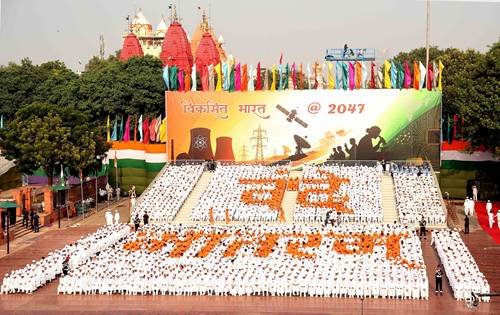
The historic Red Fort in Delhi became the centre of India’s 80th Independence Day celebrations on August 15, 2026, as the nation marked eight decades of Independence with a ceremony that brought together the legacy of the freedom movement and the aspirations of a future-ready India.
This year’s celebrations carried added significance as they coincided with the 150th anniversary of ‘Vande Mataram’ and placed particular emphasis on the role of young Indians in building Viksit Bharat by 2047.
A historic ‘Vande Mataram’ moment
One of the most memorable moments of the celebrations was the rendition of ‘Vande Mataram’ from the ramparts of the Red Fort for the first time.
The national song, which played a powerful role in inspiring the freedom movement, was brought into the Independence Day ceremony as India commemorated its 150th anniversary. Its presence at the historic venue connected the present-day celebrations with the country’s struggle for freedom.
The Tricolour rises over the Red Fort
Prime Minister Narendra Modi led the national ceremony by hoisting the Tricolour from the ramparts of the Red Fort, followed by the traditional 21-gun salute.
The salute was fired by the 1721 Field Battery (Ceremonial) using indigenous 105 mm Light Field Guns, underlining the emphasis placed on India’s growing defence capabilities and self-reliance. The National Anthem accompanied the ceremony, with petals also showered from the sky.
The Prime Minister subsequently addressed the nation, outlining his vision for India’s development and highlighting the ‘Shakti Ki Saptadhara’, a seven-stream framework covering manufacturing, agriculture and food production, technology and innovation, connectivity, defence, the green and blue economy, and India’s soft power.
Youth at the heart of the celebrations
The 2026 ceremony placed particular emphasis on Yuva Shakti, reflecting the idea that India’s young population will be central to achieving the country’s 2047 development goals.
The celebrations brought together thousands of special guests representing different sections of society, including achievers, sportspersons, innovators, community representatives and grassroots leaders. The participation was intended to showcase the contribution of ordinary citizens to India’s development journey.
A ceremony blending tradition and modern India
The event retained the grandeur of the traditional Independence Day ceremony while also reflecting contemporary India.
Personnel from the armed forces and Delhi Police played key ceremonial roles, while the presence of national dignitaries, representatives from different parts of the country and special invitees added to the diversity of the gathering. The ceremony symbolised the connection between India’s constitutional democracy, its armed forces and its citizens.
The military elements were particularly prominent, with the ceremonial guard, flag-hoisting sequence, gun salute and aerial elements creating a display of discipline and national pride.
From freedom struggle to Viksit Bharat
The celebrations also served as a bridge between India’s past and its future.
The Red Fort, a monument deeply associated with the country’s modern political history, once again became the setting from which the Prime Minister spoke about India’s next phase of development. Modi’s address focused on self-reliance, technology, manufacturing, energy security, infrastructure, defence and youth, while reiterating the goal of transforming India into a developed nation by 2047.
The ceremony therefore carried two distinct but connected messages: remembering the sacrifices that made Independence possible and preparing the country for the challenges and opportunities ahead.
A Red Fort celebration with a message for the future
The 2026 Independence Day celebrations stood out for the way they brought together patriotism, history, culture, military tradition and a forward-looking national vision.
The first rendition of Vande Mataram at the Red Fort added a historic dimension, while the Tricolour ceremony and military honours reinforced the symbolism of national sovereignty. At the same time, the focus on young Indians and Viksit Bharat@2047 placed the future at the heart of the celebrations.
From the freedom movement that inspired Vande Mataram to the vision of a developed India in 2047, the Red Fort once again became a stage where India’s past, present and future converged under the Tricolour.