

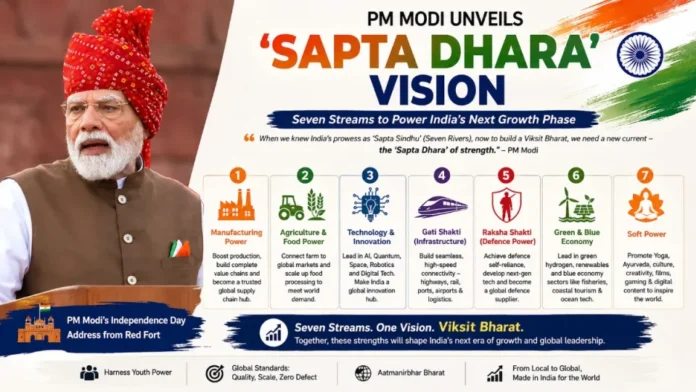
In his Independence Day address from the Red Fort on August 15, 2026, Prime Minister Narendra Modi presented ‘Shakti Ki Saptadhara’, a seven-point framework that he described as a roadmap for India’s journey towards Viksit Bharat by 2047.
The term Saptadhara literally refers to seven streams. In the context of the Prime Minister’s speech, it represents seven interconnected areas that are expected to strengthen India’s economic, technological, strategic and cultural capabilities.
Rather than treating development as the responsibility of a single sector, the framework brings together manufacturing, agriculture, technology, infrastructure, defence, sustainability and soft power.
1. Manufacturing Power — Building in India
The first stream focuses on making India a stronger global manufacturing hub.
Modi stressed the need for India to manufacture not only finished products but also the components and technologies that go into them. The emphasis is on quality, scale, self-reliance and global competitiveness.
The objective is to reduce dependence on imports, strengthen domestic industries and enable Indian companies to become more deeply integrated into global supply chains.
2. Agriculture and Food Production — From Farms to Global Markets
The second stream centres on agriculture, food production and processing.
The vision goes beyond increasing agricultural output. It includes greater value addition through food processing, improving agricultural exports and encouraging modern and chemical-free farming.
The idea is to ensure that Indian farmers benefit not only from producing crops but also from the larger value chain connecting farms to domestic and international consumers.
3. Technology and Innovation — Preparing for the Next Frontier
Technology forms the third stream of Saptadhara.
The Prime Minister highlighted areas such as artificial intelligence, semiconductors, quantum technology, robotics, data centres and 6G as critical to India’s future.
The government’s focus on training one crore young Indians in AI over the coming year was also presented against this larger technological vision. The objective is to create a workforce capable of developing and using emerging technologies rather than remaining merely a consumer of them.
4. Gati Shakti — Connecting a Faster India
The fourth stream is Gati Shakti, centred on infrastructure, connectivity and logistics.
Efficient roads, railways, ports, airports, waterways and digital connectivity are essential for reducing the cost and time involved in moving people and goods.
Under the Saptadhara framework, stronger connectivity is therefore viewed not simply as infrastructure development but as an engine of economic growth and national integration.
5. Defence Power — From Security to Self-Reliance
The fifth stream focuses on defence strength and self-reliance.
Modi called for India to develop advanced defence capabilities domestically, including drones, counter-drone systems and hypersonic technologies. The broader aim is to reduce dependence on foreign suppliers while turning India into a producer and exporter of defence technology.
This connects defence preparedness with the larger idea of Aatmanirbharta, ensuring that critical national-security capabilities are increasingly designed and manufactured within India.
6. Green and Blue Economy — Growth with Sustainability
The sixth stream combines the green economy and blue economy.
The green component focuses on renewable energy, clean technologies and sustainable development, while the blue economy encompasses the economic potential of India’s oceans and marine resources.
The approach seeks to balance economic expansion with environmental responsibility and make emerging areas such as clean energy and marine resources important contributors to India’s future growth.
7. Soft Power — Taking India’s Identity to the World
The seventh stream is India’s soft power.
Unlike the other pillars, this is less about physical infrastructure and more about India’s ability to influence the world through its culture, traditions, knowledge systems, creativity and global presence.
Yoga, Ayurveda, Indian traditions, films, literature, tourism and other expressions of Indian culture can contribute to India’s global influence. The idea is to use the country’s civilisational and cultural strengths alongside its economic and technological capabilities.
Why does Saptadhara matter?
The significance of Saptadhara lies in its attempt to present India’s development as an interconnected national project.
A strong manufacturing sector needs technology and infrastructure. Agriculture benefits from food processing, logistics and global markets. Defence increasingly depends on advanced technology. Green energy can support industrial growth, while culture and soft power can strengthen India’s global influence.
Together, these seven streams form the broader framework that Modi presented for achieving Viksit Bharat by 2047, a developed India that is economically strong, technologically capable, strategically self-reliant, environmentally conscious and globally influential.
In essence, Saptadhara is not a single scheme or programme. It is a seven-part vision for the areas India seeks to strengthen as it moves towards its centenary of Independence.