

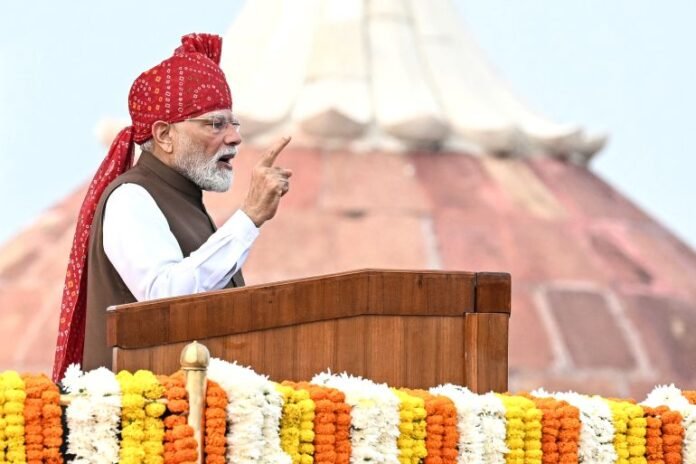
At the Red Fort, Prime Minister Narendra Modi outlined a seven-pronged roadmap for a developed India by 2047, while announcing new initiatives in AI, education, defence, energy and women-led development.
NEW DELHI: Prime Minister Narendra Modi’s Independence Day address from the Red Fort on August 15, 2026, marked India’s 80th Independence Day with a strong focus on the country’s transformation over the past 12 years and the roadmap towards Viksit Bharat by 2047.
The Prime Minister highlighted achievements across manufacturing, digital infrastructure, energy, social security, education and defence, while presenting ‘Sapt Dhara’, seven streams of strength, as a broad framework for India’s next phase of development.
Viksit Bharat by 2047
Modi reiterated the goal of making India a developed nation by the time it completes 100 years of Independence in 2047. He said the vision would require the collective effort of citizens and stronger national capabilities.
He also highlighted what he described as the transformation of the past 12 years, including nearly four-fold growth in defence production, seven-fold growth in electronics manufacturing, a 35-fold increase in mobile phone production and a 100-fold rise in digital transactions.
Seven streams for India’s next leap
A major theme of the speech was Sapt Dhara, covering manufacturing, agriculture and food production, technology and innovation, Gati Shakti and connectivity, defence, the green and blue economy, and India’s soft power.
The Prime Minister called for India to become a trusted global manufacturing hub, producing everything from components to finished products. He stressed quality and reliability as the foundation of India’s global brand.
In agriculture, he emphasised food processing, exports and chemical-free farming, noting that new trade agreements are opening international markets for Indian farmers.
AI skills for one crore youth
One of the biggest announcements of the address was a new AI-skilling push. Modi announced that one crore young Indians will be trained in artificial intelligence skills over the next year, with the aim of preparing India’s youth to compete and lead in the global AI economy.
He also highlighted India’s startup ecosystem, which he said now has more than 2.5 lakh registered startups, and referred to a ₹1 lakh crore Innovation Fund to support research and innovation.
The government will also establish a network for free online coaching for various examinations, using digital infrastructure and India’s pool of teachers and educators.
Semiconductors, 6G and critical minerals
Technology and self-reliance emerged as another central theme. Modi said three semiconductor plants have already been initiated and indicated that five to eight more plants could come up in the next seven to eight years.
He also set out an ambition for Made-in-India 6G to reach the world and stressed the importance of AI, quantum technology, robotics and data centres. The National Critical Minerals Mission and Critical Minerals Corridor were cited as efforts to secure resources essential for future technologies.
Energy security and nuclear power
The Prime Minister placed energy security at the heart of India’s development ambitions. He announced a target of 100 GW of nuclear power capacity by 2047, with five new nuclear reactors targeted during the current decade.
He also highlighted India’s expansion in solar energy, saying capacity had risen from around 2 GW in 2014 to about 160 GW. The PM Surya Ghar Muft Bijli Yojana has crossed 50 lakh households, according to his address.
Defence and civil preparedness
Defence self-reliance featured prominently in the speech. Modi called for the development of next-generation defence technologies, including drones, counter-drone systems and hypersonic defence capabilities.
He also announced plans for a vibrant civil defence network, with citizens and civil defence personnel to be equipped with modern systems and trained in contemporary preparedness methods. The Prime Minister said India’s defence exports had risen nearly 50-fold and now reach around 100 countries.
Women’s empowerment
The Prime Minister announced an expansion of the Lakhpati Didi target from three crore to six crore women, after saying the original three-crore target had been surpassed.
He also appealed to political parties to ensure 33% representation for women in the Lok Sabha and state Legislative Assemblies, urging the implementation of women’s reservation at the earliest.
Sports, education and youth
The speech also looked towards India’s sporting ambitions. Modi said India is preparing for the 2036 Olympics and will host the Commonwealth Games in 2030. He announced a nationwide talent hunt to identify promising athletes aged 5–15 from villages, cities and schools.
On education, he highlighted the expansion of universities, medical institutions and Atal Tinkering Labs, along with the National Education Policy and new opportunities created through technology and innovation.
A self-reliant India with global ambitions
From semiconductors and nuclear energy to AI, defence, manufacturing, sports and women-led development, Modi’s 2026 Independence Day address sought to combine the government’s record of the past decade with a longer-term vision for 2047.
The overarching message was clear: India’s next phase of growth, according to the Prime Minister, must move beyond being a large market to becoming a global producer, innovator and technology leader, while ensuring that the benefits of development reach citizens across the country.