

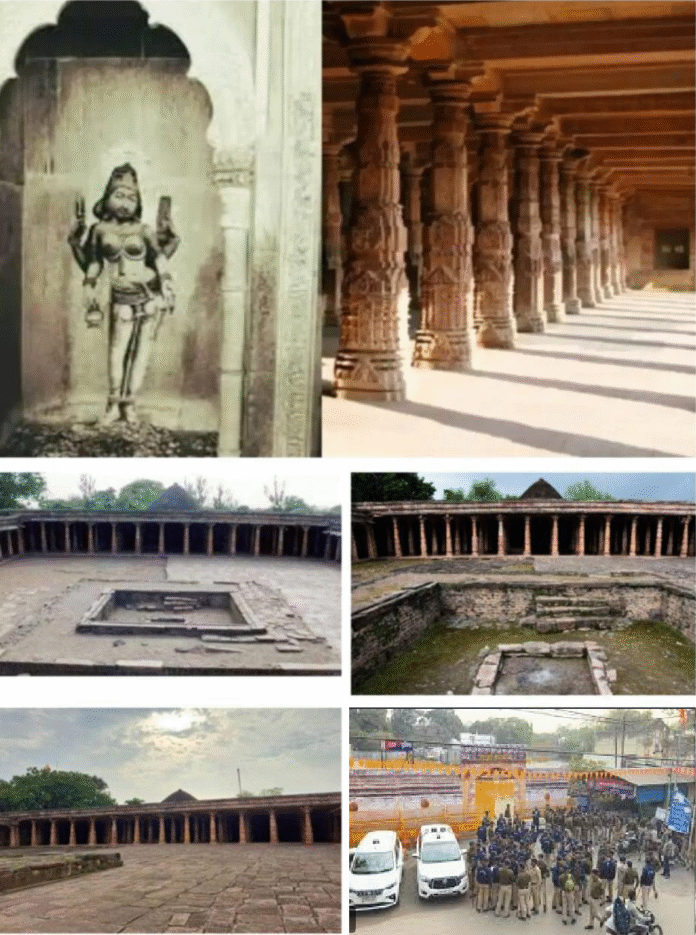
In a landmark judgment that has reignited national discussion around historical religious sites in India, the Madhya Pradesh High Court has declared the disputed Bhojshala complex in Dhar as a temple dedicated to Goddess Saraswati, also known as Vagdevi. The court quashed the Archaeological Survey of India’s 2003 arrangement that had allowed Muslims to offer Friday namaz at the site while restricting Hindu worship to specific days and timings.
The verdict is being viewed by many Hindu groups as a historic moment and a major legal recognition of the site’s original religious character. Celebrations were reported in several parts of Madhya Pradesh after devotees gathered to offer prayers at the complex following the judgment.
What is Bhojshala?
Bhojshala is an ancient monument located in Dhar district of Madhya Pradesh and has long been at the centre of a religious and historical dispute. Hindus regard the site as a temple of Goddess Saraswati and a renowned Sanskrit learning centre established during the reign of the Paramara king Raja Bhoj in the 11th century. Muslims, on the other hand, have referred to the site as the Kamal Maula Mosque, associated with Sufi saint Kamaluddin Chishti.
According to historical accounts, Raja Bhoj established Bhojshala around 1034 AD as a centre for education, literature, and worship dedicated to Goddess Saraswati. Over the centuries, invasions and political changes altered the structure, and Islamic additions including domes and tombs were introduced during the medieval period.
For decades, the site remained under ASI protection, with a controversial arrangement permitting Hindus to worship on Tuesdays and Muslims to offer namaz on Fridays. Tensions frequently arose, especially when Hindu festivals coincided with Friday prayers.
What Did the Court Say?
The Indore bench of the Madhya Pradesh High Court ruled that the religious character of the disputed complex is that of Bhojshala and a temple of Goddess Vagdevi (Saraswati). The court stated that historical records, inscriptions, and archaeological findings strongly establish the site’s Hindu origin and continuity of Hindu worship.
The High Court also set aside the 2003 ASI order that had allowed namaz within the premises. However, the court noted that the Muslim community may seek alternate land for the construction of a mosque elsewhere in Dhar.
Importantly, the court observed that the structure was originally a Sanskrit learning centre and Saraswati temple established during Raja Bhoj’s reign and that later modifications did not erase its original religious identity.
Evidence Cited by the Court and ASI
One of the strongest aspects of the case was the extensive archaeological evidence presented before the court. Following a High Court order in 2024, the ASI conducted a detailed scientific survey of the complex over nearly 100 days and submitted a report exceeding 2,000 pages.
According to the ASI findings cited in court:
●More than 90 sculptures and over 150 Sanskrit inscriptions were discovered.
●Architectural remains and carvings associated with Hindu temple construction were found across the site.
●Pillars, motifs, and structural elements indicated reuse of temple material in later Islamic construction.
●Historical and literary references linked the site directly to Raja Bhoj and Saraswati worship.
The court also referred to principles used in the Ayodhya judgment, where archaeological and historical evidence played a major role in determining the original religious character of disputed land.
Response from the Other Side
Muslim organisations and groups opposing the verdict expressed disappointment and concern. Some organisations argued that the judgment reflected growing fears among the Muslim community after the Ayodhya verdict and raised concerns about the interpretation of the Places of Worship Act.
They maintained that the site had also functioned as a mosque for centuries and questioned aspects of the interpretation of historical evidence. Legal and community discussions around the verdict are expected to continue.
Why the Verdict is Significant
For many Hindus, the judgment represents the restoration of a sacred site linked to India’s civilisational and educational heritage. The recognition of Bhojshala as a Saraswati temple is being viewed as an acknowledgment of historical evidence and continuity of worship traditions that had existed for centuries.
The verdict has also strengthened discussions around the preservation of ancient Indian heritage sites and the importance of archaeological evidence in resolving historical disputes. Supporters of the decision argue that the judgment honours India’s cultural history while providing legal clarity on a dispute that lasted decades.