

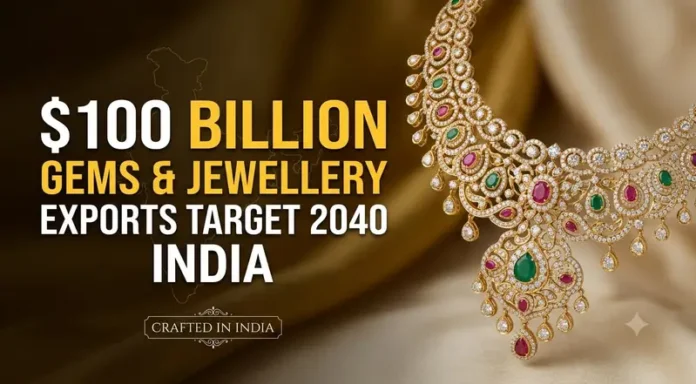
India is preparing for a major transformation of its gems and jewellery industry, with an ambitious target of taking exports to $100 billion by 2040. The roadmap, discussed at the ‘Chintan Shivir – 2040 Roadmap for Gems & Jewellery’ organised by the Department of Commerce and the Gem & Jewellery Export Promotion Council on August 19, aims to take the sector beyond traditional manufacturing and position India as a global centre for jewellery design, technology, innovation and branding.
The target represents a significant jump from the sector’s current export performance. Gems and jewellery exports stood at around $27.72 billion in 2025–26, and the government now wants to more than triple that figure over the next 14 years. The vision is part of a broader effort to increase the sector’s contribution to India’s economy while strengthening its position in international markets.
Under the 2040 roadmap, the industry aims to double its manufacturing output to approximately ₹15 lakh crore and achieve an overall economic value of nearly ₹60 lakh crore. The sector is also expected to contribute around 1.2 per cent to India’s GDP and account for nearly 14 per cent of the country’s merchandise exports. Employment is another key focus, with the roadmap envisioning opportunities for around one crore people across the sector.
A major shift in the strategy is the move from low-margin contract manufacturing towards value-added products, original designs and globally recognised Indian brands. India has traditionally been known for its skilled artisans, diamond cutting and polishing capabilities and large manufacturing base. The new vision seeks to build on these strengths by encouraging Indian companies to develop their own designs, intellectual property and brands, allowing them to capture a larger share of the value generated in the global jewellery market.
The roadmap places strong emphasis on the idea of ‘Crafted by India’, which seeks to combine India’s rich cultural heritage and traditional craftsmanship with contemporary design. Indian motifs, artistic traditions and craftsmanship could become distinctive features of jewellery created for international consumers. The larger objective is to make Indian jewellery recognised not only for its manufacturing quality but also for its design identity and cultural character.
Small and medium enterprises are expected to play an important role in achieving this transformation. The roadmap proposes greater support for MSMEs, along with improved access to finance, technology and international markets. Faster and simpler import-export procedures are also being considered to reduce delays and make Indian businesses more competitive globally. Easier trade processes could be particularly important for smaller exporters that often face greater administrative and financial challenges.
Technology and talent development are equally central to the strategy. Emerging technologies such as artificial intelligence and 3D printing can open new possibilities in jewellery design and manufacturing, enabling companies to create more customised and innovative products. At the same time, the industry needs a new generation of designers, artisans, technologists and professionals who can combine traditional skills with modern tools. Greater collaboration between educational institutions and industry is therefore expected to support innovation and skill development.
The roadmap also looks at emerging opportunities beyond India’s traditional strengths. The lab-grown diamond ecosystem, gold mining and refining, along with continued growth in natural diamonds and jewellery, could contribute to the industry’s expansion. India’s established expertise in diamond processing provides a strong foundation, but the next phase will require greater diversification and movement towards higher-value activities.
The five broad priorities of the roadmap include expanding global market access, scaling up MSMEs, creating faster export-import systems, promoting ‘Crafted by India’ and developing next-generation talent and design capabilities. Together, these areas reflect an attempt to build a more competitive and future-ready industry.
Reaching $100 billion in exports by 2040 will nevertheless be a significant challenge. India will need to expand into new markets, respond to changing consumer preferences, invest in technology, develop strong international brands and improve the competitiveness of smaller businesses. The transition from being primarily a manufacturing hub to becoming a design and branding powerhouse will require sustained investment and coordination between the government and industry.
The 2040 roadmap, therefore, is about more than increasing export numbers. It represents a broader ambition to reshape India’s place in the global gems and jewellery value chain. If successfully implemented, India could emerge not only as one of the world’s leading jewellery manufacturing centres but also as a country known for original design, craftsmanship, innovation and globally recognised jewellery brands.