

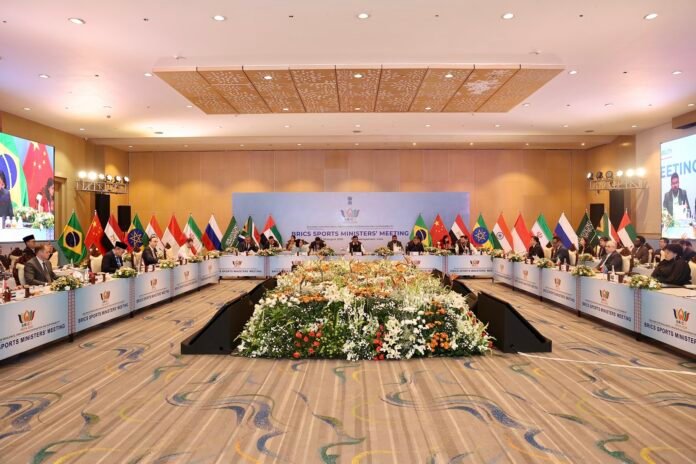
The BRICS Sports Ministers’ Meeting concluded in Visakhapatnam, Andhra Pradesh, on August 23, with member countries adopting a joint declaration aimed at strengthening cooperation in sports. Held under India’s BRICS Chairship 2026, the meeting brought together sports ministers and heads of delegation from all 11 BRICS member countries to discuss sports development, technology, manufacturing, youth participation and traditional games.
Chaired by Union Minister for Youth Affairs and Sports Dr. Mansukh Mandaviya, the meeting sought to move sports cooperation beyond discussions and towards practical, sustained partnerships. The participating countries reaffirmed their commitment to cooperation based on dialogue, mutual respect and inclusiveness, while recognising the role of sport in promoting healthy lifestyles, youth development, cultural exchange and stronger people-to-people connections.
A key outcome of the meeting was the unanimous adoption of the BRICS Sports Joint Declaration. The declaration provides a framework for greater cooperation among the member countries and encourages the sharing of knowledge, experiences and best practices. It also places emphasis on athlete development, youth participation and stronger institutional cooperation in sports. The meeting included country statements, bilateral discussions and cultural engagements involving representatives from Brazil, China, Egypt, Ethiopia, India, Indonesia, Iran, Russia, Saudi Arabia, South Africa and the United Arab Emirates.
One of the most significant initiatives advanced during India’s chairship is the proposed BRICS Working Group on Sports Technology. The initiative is expected to encourage collaboration in sports science, artificial intelligence and digital innovation. With technology increasingly influencing athlete training, performance analysis, injury prevention and sports management, cooperation in these areas could help BRICS countries develop more science-based sporting ecosystems.
The meeting also placed considerable focus on sports manufacturing. India highlighted its plans to strengthen domestic sports-goods manufacturing and attract global investment under the Make in India initiative. As part of this effort, a BRICS Sports Manufacturing Conclave is proposed to be held in Udaipur, Rajasthan, in November 2026. The conclave is expected to provide a platform for manufacturers, businesses and stakeholders to explore opportunities in sports equipment, technology, innovation and international trade.
The emphasis on manufacturing reflects India’s broader ambition to build a stronger sports economy. Greater cooperation among BRICS nations could create opportunities for technology transfer, investment, trade and innovation while supporting domestic manufacturers. It could also help Indian companies explore international markets for sports equipment and related products.
Another important area of cooperation is the promotion of traditional and indigenous sports. India has proposed Traditional and Indigenous Sports Demonstration Games in Ahmedabad in October. The initiative aims to give greater visibility to sporting traditions that are closely connected with the cultural identities of participating nations.
The focus on indigenous sports also gives the BRICS sports agenda a cultural dimension. Traditional games can serve as a means of preserving heritage while encouraging young people to engage with local sporting traditions. Bringing these activities into an international platform could create opportunities for cultural exchange and mutual learning among BRICS countries.
The meeting further highlighted the importance of increasing women’s participation and promoting para-sports. India has been working to expand opportunities across different sections of society, and the BRICS platform provides an opportunity to exchange experiences on making sports more inclusive. Athlete and coach exchanges, joint competitions and cooperation in sports science were also highlighted as areas where participating countries could work together.
The outcomes of the Visakhapatnam meeting reflect India’s broader BRICS Chairship theme of “Building for Resilience, Innovation, Cooperation and Sustainability.” By placing technology, manufacturing, inclusion and indigenous sports alongside traditional sporting cooperation, India has sought to broaden the scope of the BRICS sports agenda.
The adoption of the joint declaration marks an important step, but its larger significance will depend on how these proposals are implemented. Working groups, manufacturing partnerships, athlete exchanges and indigenous sports initiatives can give the declaration a practical dimension if sustained through future BRICS chairships.
For India, the meeting also provides an opportunity to position itself not only as a growing sporting nation but as a potential hub for sports technology, manufacturing, innovation and cultural sporting exchange. The proposed events in Udaipur and Ahmedabad will be closely watched as the next steps in translating the Visakhapatnam commitments into action.
The BRICS Sports Ministers’ Meeting has therefore placed sports within a much wider framework of cooperation. From artificial intelligence and sports science to indigenous games and manufacturing, the emerging agenda seeks to use sport as a bridge for technology, business, youth development and cultural exchange among BRICS nations.