

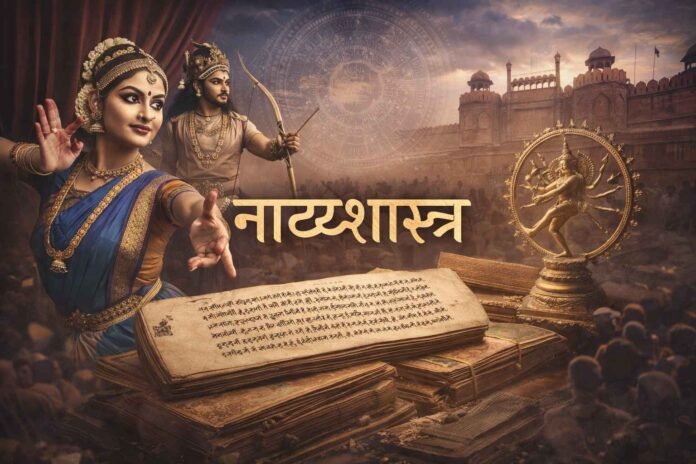
The Natya Shastra is one of the most significant and foundational texts in the history of Indian art and aesthetics. Attributed to the ancient sage Bharata Muni, this Sanskrit treatise is often described as the ultimate guidebook for drama, dance, and music. Written and compiled between roughly 200 BCE and 200 CE (with some estimates extending beyond this range), it stands as an encyclopedic work that shaped centuries of artistic traditions in India.
What is the Natya Shastra?
The term itself combines two Sanskrit words—Natya (drama or performance) and Shastra (treatise or manual). Together, it literally means “the science of theatrical performance.” True to its name, the Natya Shastra is not just about theatre—it is a comprehensive manual that covers virtually every aspect of performing arts, including acting techniques, stage design, music, dance movements, costumes, makeup, and even audience engagement.
The text consists of about 36 chapters and nearly 6,000 verses, reflecting a highly structured and systematic approach to art.
Purpose and Philosophy
The Natya Shastra views performance as more than entertainment—it is a medium for education, moral reflection, and spiritual experience. According to the text, drama was created to communicate ethical values and depict human life in a way that audiences could relate to and learn from.
It is often called the “Fifth Veda,” as it is believed to combine elements from the four Vedas—speech, music, action, and emotion—into a single art form.
The Theory of Rasa: Its Core Contribution
One of the most influential ideas introduced in the Natya Shastra is the Rasa Theory, which forms the backbone of Indian aesthetics. Rasa refers to the emotional essence or “flavour” experienced by the audience during a performance.
Bharata Muni identified eight primary rasas, including love (śṛṅgāra), laughter (hāsya), anger (raudra), compassion (karuṇa), heroism (vīra), fear (bhayānaka), disgust (bībhatsa), and wonder (adbhuta).
The goal of any performance, according to this theory, is not merely to entertain but to evoke these emotions deeply, transporting the audience into a reflective and almost transcendental state.
Key Elements of Performance
The Natya Shastra lays out a detailed framework for performance, including:
●Abhinaya (Expression): The art of conveying emotions through body, speech, costume, and inner feelings. It is divided into four types—Angika (body), Vachika (speech), Aharya (costume), and Satvika (inner emotion).
●Bhava (Emotion): The psychological states portrayed by the performer.
●Raga and Tala: The musical aspects, including melody and rhythm.
●Stagecraft: Design and construction of theatre spaces, along with roles like the Sutradhara (stage manager).
It also categorizes different types of plays, acting styles, gestures (mudras), and body movements, making it a complete manual for performers and directors alike.
Dance and Duality: Tandava and Lasya
The text also explains two fundamental styles of dance—Tandava (vigorous, masculine, associated with energy and power) and Lasya (graceful, delicate, associated with beauty and emotion). These represent the balance of opposing forces in art and life, reflecting a deeper philosophical worldview.
Legacy and Influence
The Natya Shastra has had a profound and lasting influence on Indian classical arts. Dance forms like Bharatanatyam, Kathak, and Odissi, as well as traditional theatre and music, draw heavily from its principles. Even today, it continues to guide performers, scholars, and choreographers.
Beyond India, its ideas on aesthetics—especially the concept of emotional engagement—have contributed to global discussions on art and performance theory.
Conclusion
The Natya Shastra is far more than an ancient text—it is a living tradition. By blending art, philosophy, and spirituality, it elevates performance into a powerful medium of human expression. Its enduring relevance lies in its universal insight: that art, at its best, connects deeply with human emotions and reveals the essence of life itself.