

In an era dominated by fast fashion, mass production, and ever-changing trends, India’s centuries-old craft traditions are witnessing a remarkable revival. From intricate embroideries and handloom weaves to block prints and artisanal textiles, handmade fashion is once again finding favour among consumers in India and across the world.
But what is driving this renewed appreciation for craftsmanship? Are there enough artisans to meet the growing demand? Can handmade products remain accessible while ensuring fair compensation for the people behind them? And what role does this sector play in India’s economy and global identity?
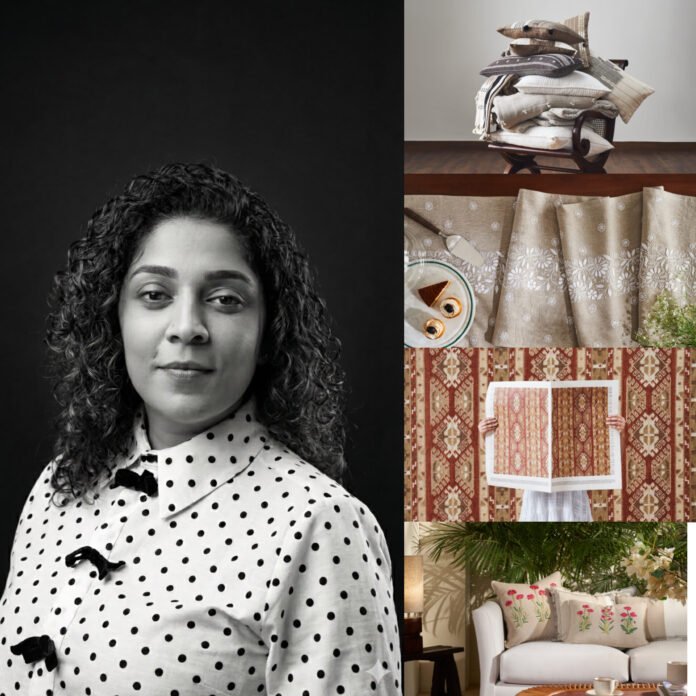
In this conversation, Richa Jain, Head of Design, Home Linen at Swadesh, Reliance Retail, shares her insights on the resurgence of handmade fashion, the challenges facing India’s artisan communities, and why she believes Indian craftsmanship has the potential to redefine luxury and sustainability for the future.

Q. Why is India’s handmade fashion making such a strong comeback in an age of fast fashion?
Richa Jain: I think the comeback is actually a correction. For decades, we collectively chased speed and scale, and somewhere in that pursuit, we lost texture, both literally and emotionally. What’s happening now is that consumers, especially post-pandemic, are craving meaning. They want to know where something came from, whose hands touched it, and what tradition it carries.
Handmade fashion answers all of that in a single object. At Swadesh, we see this intimately in home linen. The moment a customer understands that a border was hand-block-printed in Sanganer or a weave came off a loom in Banaras, the product transforms for them. It stops being a bedsheet and becomes a relationship with a place and a person. Fast fashion simply cannot compete with that emotional register.
Q. Are today’s consumers valuing story, craftsmanship, and heritage more than before?
Richa Jain: Absolutely, and I’d say they’re also becoming more discerning about authenticity. It’s no longer enough to use the word “handmade” as a label—consumers are asking follow-up questions. Which region? Which community? Is this a dying craft or a living one?
That level of curiosity is genuinely new and genuinely exciting. What I find particularly encouraging is the younger buyer—the 25 to 35-year-old—who is consciously choosing a hand-embroidered cushion or a jamdani quilt not just for aesthetics but as a values statement. Heritage has become a form of identity expression, and that is a powerful shift for the industry.
Q. What has changed that is making Indian handwork a major luxury and mainstream trend again?
Richa Jain: Several things converged at once. Global luxury houses such as Dior, Valentino, and Chanel have been sourcing Indian embroidery for years, which gave our crafts a certain aspirational revalidation in the domestic market.
Then came a generation of Indian designers who stopped apologising for their roots and started leading with them. Add to that the rise of conscious consumption globally, and suddenly Indian handwork sits precisely at the intersection of luxury, sustainability, and cultural pride.
What’s different now versus earlier revivals is that it isn’t charity-driven or nostalgia-driven—it’s commercially confident. Brands like Swadesh are built on the premise that craft can be contemporary, scalable, and profitable without being diluted.
Q. Are enough artisans still practising crafts like chikankari, zardozi, handloom weaving, and embroidery to meet growing demand?
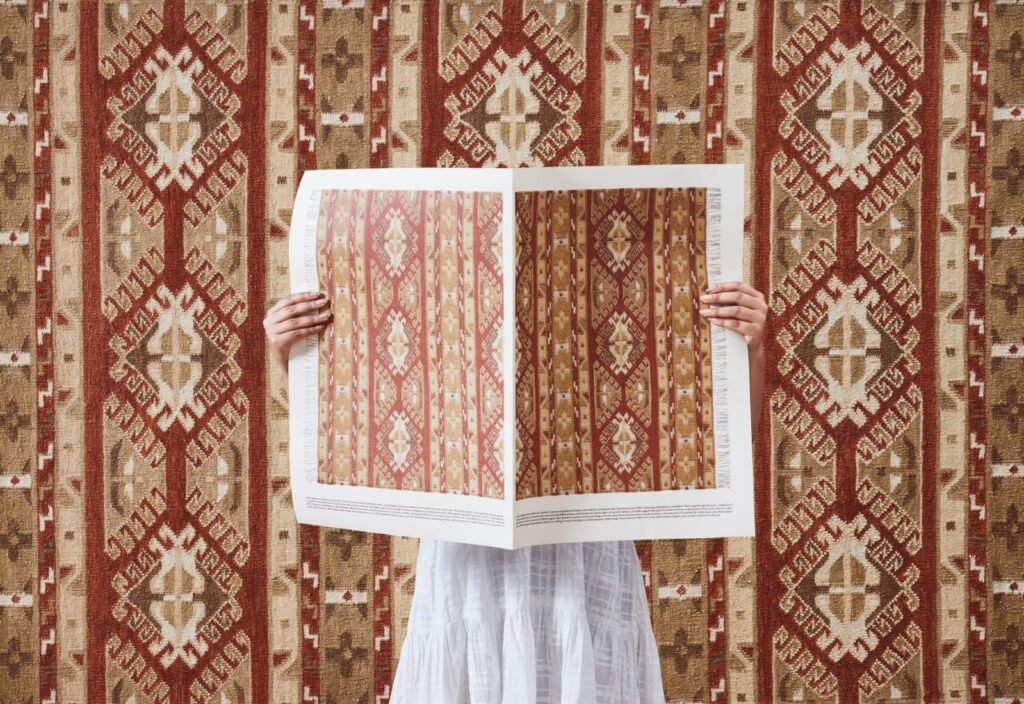
Richa Jain: Honestly, supply is under serious pressure. The artisan base is there, but it is ageing and geographically concentrated. Chikankari clusters in Lucknow, kantha and jamdani in Bengal, brocades and hand-knotted carpets in Uttar Pradesh—these are functioning ecosystems, but fragile ones.
When demand spikes suddenly, as it has in the past few years, the supply chain strains badly. Turnaround times stretch, quality becomes inconsistent and artisans get fatigued. What we need is not just more artisans but better infrastructure around them—design support, fair pricing, working capital and market access. The craft exists; the ecosystem around it needs urgent strengthening.
Q. Is India facing an artisan shortage, and do we urgently need to train a new generation?
Richa Jain: Yes, and I would say the urgency is not theoretical—it is already here. In my own sourcing work, I regularly encounter situations where a particular technique exists in perhaps one or two villages with a handful of practitioners, most of them in their fifties or sixties.
Their children have moved to cities for more predictable incomes. Can you blame them? We never made craft economically aspirational for young people. That has to change.
Training alone isn’t sufficient—we need to make being a skilled artisan a dignified, well-compensated and respected profession. Government schemes like NIFT’s craft documentation initiatives and the Office of the Development Commissioner (Handicrafts) programmes are a start, but industry has to step up and create sustained demand that makes it worthwhile for someone to spend years learning a craft.
Q. What actually goes into creating a handcrafted piece that people may not fully understand?
Richa Jain: Almost everything that is invisible.
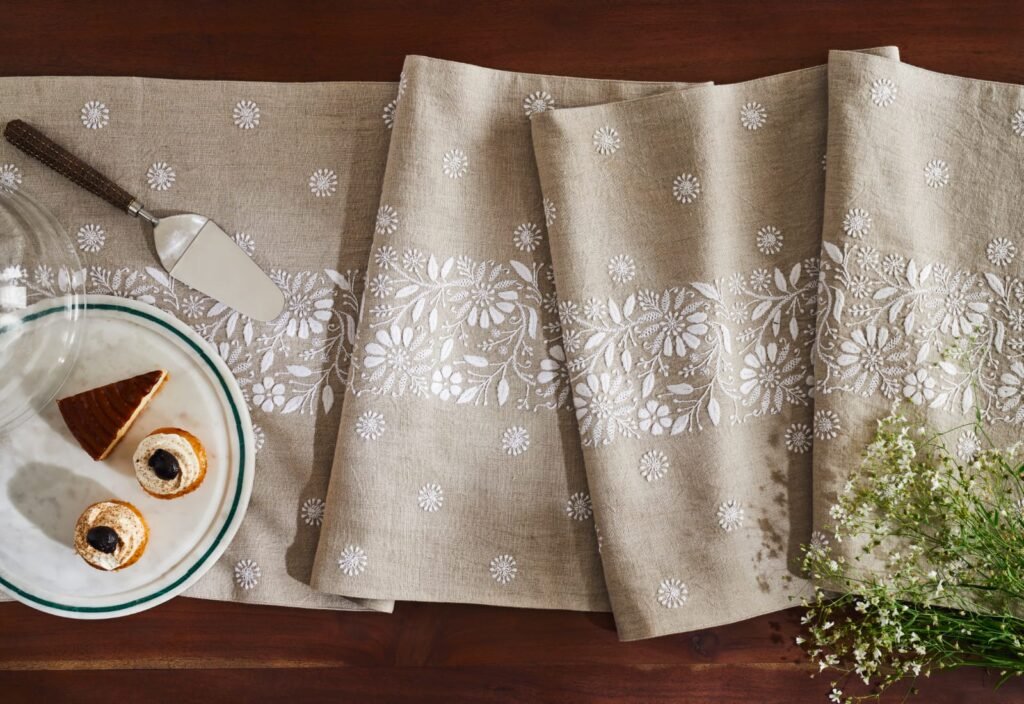
Take a hand-embroidered linen cushion cover. Before a single stitch is placed, there is the sourcing of the base fabric, the preparation and sizing of the ground, the transfer of the design, the dyeing or printing of threads, and then the actual embroidery work, which can take a skilled artisan anywhere from two days to two weeks depending on density.
Each of those steps has its own supply chain, its own craft knowledge and its own quality variables. When you price a handcrafted piece, you are pricing all of that invisible labour plus the years of skill embodied in the person doing it.
What people see is a beautiful object. What they’re actually holding is compressed human time, and that framing changes everything.
Q. Is handcrafted Indian fashion becoming accessible to the middle-class consumer, or is it still largely a luxury market?
Richa Jain: It’s a spectrum and I think the market is genuinely opening up at multiple price points.
The super-premium—heavily worked zardozi or custom handloom silks—will always be luxury by nature of input costs. But block-printed cottons, simple kantha work and handwoven khadi are accessible, and the middle class is absolutely engaging with them.
What Swadesh is trying to do and I’m proud of this, is create a credible, well-designed craft product that a middle-income household can buy for their home without it being either unaffordable or dumbed down.
The challenge is educating consumers on why a hand-block-printed duvet cover costs more than a digitally printed one while keeping that gap reasonable. That’s a design and communication challenge as much as a pricing one.
Q. How can designers balance authenticity and craftsmanship while making handmade fashion commercially sustainable?
Richa Jain: This is the central creative tension of my work every single day.
My belief is that you protect the technique, but you don’t freeze the aesthetic. A Sanganeri block print doesn’t have to look like it did in 1970 to be authentic. Authenticity lives in the process, the materiality, and the human hand—not in a static visual vocabulary.
When I develop a collection, I work closely with artisan clusters, understand what their hands can do best and then let contemporary design sensibility guide the colour, scale, and application.
That collaboration—where the artisan’s expertise and the designer’s market awareness meet—produces something that is both genuinely crafted and commercially relevant. Sustainability comes when artisans are paid fairly and orders are consistent, not seasonal bursts. That requires discipline on the brand side.
Q. How important is the handmade fashion industry to India’s economy, employment, and rural livelihoods?
Richa Jain: It is the second-largest employer in India after agriculture. That statistic alone should anchor every policy conversation about this sector.
We are talking about millions of livelihoods, the majority of them women working from home in semi-rural and rural contexts, earning incomes that are woven directly into household economics.
When a craft cluster thrives, it sustains not just the artisan but schools, local markets and community structures around it. When it collapses—as many have—it triggers migration, social disruption and the permanent loss of intangible cultural heritage.
This isn’t romantic; it’s economic and developmental reality. The handmade industry is India’s most scalable rural employment programme, and we are chronically underinvesting in it relative to its potential.
Q. Do Indian artisans finally get the recognition they deserve as Indian textiles are celebrated on global runways?
Richa Jain: Not yet, and I feel strongly about this.
There is a fundamental asymmetry that hasn’t been corrected: the global fashion house gets the headline, while the Indian artisan gets a footnote in the press release, if they’re lucky.
I’ve seen collections where karigar communities from Uttar Pradesh or Rajasthan did months of intricate work and received zero credit in any public communication.
Recognition means attribution—naming the cluster, the region, the technique, and the community. It means fair compensation, not just fair wages but royalty-type arrangements for techniques that are the intellectual property of communities.
The global runway loves Indian craft. The question is whether that love translates into equity. That conversation is only just beginning.
Q. Has social media and celebrity fashion helped revive interest, or has it also led to over-commercialisation?
Richa Jain: Both, and I think we have to acknowledge that honestly.
Social media has been transformative for awareness. A weaver in Kutch now has a direct window to a global audience and that is genuinely revolutionary. Celebrities wearing handloom saris or chikankari ensembles have normalised and glamourised craft in a way that no government campaign could.
But the flip side is the commodification of aesthetics without respect for origin. Trends move so quickly that crafts get consumed as visual motifs—block print becomes a “pattern”, ikat becomes a “look”—stripped of context and replicated in factories within weeks.
That’s deeply damaging. The answer isn’t to resist social media but to use it more intentionally—to tell complete stories, credit artisans and build literacy alongside aspiration.
Q. What does the future of Indian handmade fashion look like—revival, reinvention, or complete global takeover?
Richa Jain: All three, sequenced.
We are in the revival phase right now—reclaiming pride, rebuilding supply chains and rediscovering techniques. Reinvention is already happening in parallel, as younger designers and brands recontextualise craft for global sensibilities without apology.
The global takeover? I genuinely believe it’s coming, but only if we solve the infrastructure problem.
India sits on an unparalleled depth of craft knowledge, a density and diversity of textile traditions that no other country on earth can match. If we pair that indigenous genius with better design education, technology-enabled supply chains, fair trade frameworks and a new generation of artisans who choose craft as a career of choice rather than compulsion, Indian handmade will not just be a trend on a global runway. It will set the terms of what luxury, sustainability, and beauty mean for the next century. That’s not a romantic notion, that’s just following the logic ofwhat we already have.
(Image source: https://swadeshonline.com)