

PC:(Jagran)
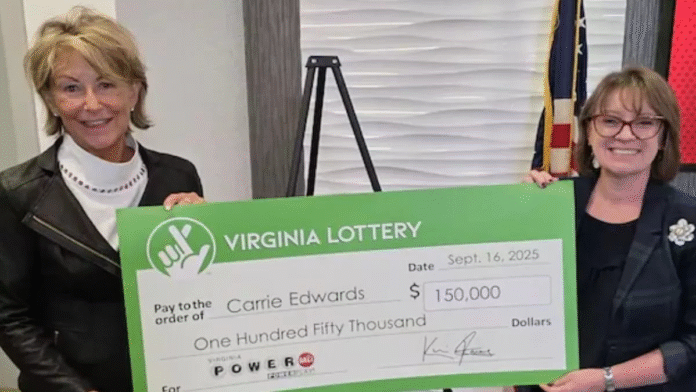
In a tale that’s equal parts miracle and modern tech wizardry, Carrie Edwards, a 68-year-old widow and grandmother from Midlothian, Virginia, turned to artificial intelligence for lottery luck—and it paid off in spades. On September 8, 2025, Edwards matched four of the first five numbers plus the Powerball in the Virginia Lottery’s Powerball drawing, securing an initial prize of $50,000. But with a savvy $1 add-on for the Power Play feature—which multiplied her winnings by three—her haul ballooned to a staggering $150,000 (approximately ₹1.32 crore). For Edwards, a retired public relations executive who rarely plays the lottery, this wasn’t just a windfall; it was a “divine” surprise she never saw coming.
Edwards, who lost her husband Steve to frontotemporal dementia (FTD) five years ago, decided to try her hand at online lottery play for the first time. Stumped on number selection, she pulled out her phone and fired up the voice-enabled ChatGPT app. “I’m like, ChatGPT, talk to me… Do you have numbers for me?” she recounted at a Virginia Lottery press conference, her voice laced with amusement. The AI, ever the cautious companion, first quipped, “Carrie, you know it’s all about luck, right?” before obligingly generating five sets of random numbers. Edwards picked one set, added the Power Play, and hit submit—never imagining the cosmic alignment that followed.
The Shock of Victory: Dismissing a “Scam” Alert
Two days later, while immersed in a work meeting, Edwards’ phone buzzed with a notification: “Please collect your lottery winnings.” Her immediate reaction? Skepticism. “I look at my phone and it says ‘please collect your lottery winnings’ and I thought, ‘I think it’s a scam. I know I didn’t win,'” she shared, laughing at the memory. As a widow raising grandchildren and navigating life’s curveballs, the idea of sudden fortune felt too good—or too suspicious—to be true.
Rushing home, Edwards logged into her account and froze. There it was: confirmation of her $50,000 base win, tripled to $150,000 thanks to the multiplier. “As soon as that divine windfall happened and came down upon my shoulders, I knew exactly what I needed to do with it,” she later reflected. What followed was a whirlwind of verification, tears, and a profound sense of purpose. This wasn’t just about money; for Edwards, it was a message from above, echoing the resilience she’d built after losing Steve.
A Heart of Gold: Donating Every Penny in Memory of Her Late Husband
In a move that has captivated hearts worldwide, Edwards announced she would donate the entire $150,000—every last cent—to three cherished causes, honoring her husband’s legacy of generosity. After taxes whittle the net to about $108,000, she plans to cover the shortfall from her own savings to ensure each organization receives a full $50,000 slice.
The recipients?
A heartfelt trio tied to her family’s story: Navy-Marine Corps Relief Society (NMCRS): A nod to Steve’s service as a Marine, supporting military families in crisis.
Association for Frontotemporal Degeneration (AFTD): Fueling research into the disease that claimed Steve’s life, with AFTD CEO Susan L-J. Dickinson praising the gift as a “vital boost” for treatments.
Shalom Farms: A Richmond-based nonprofit championing food justice and equitable farming, aligning with Edwards’ values of community upliftment.”I’ve been so blessed, and I want this to be an example of how other people, when they’re blessed, can bless other people,” Edwards said, her words radiating quiet conviction. Far from the headlines of lottery winners squandering fortunes on extravagance, Edwards’ choice flips the script—turning personal blessing into collective good and inspiring a ripple of kindness.
The AI Enigma: Can ChatGPT Really Predict the Future?
Edwards’ win has sparked a frenzy of curiosity: Did ChatGPT crack the lottery code? The short answer: No, and it never claimed to. Lotteries are designed as pure games of chance, with draws governed by random number generators impervious to prediction. When users prompt ChatGPT for numbers, it simply spits out random selections—much like flipping a coin or drawing straws—fully aware that outcomes hinge on luck alone.This “win” is a delightful anomaly, a one-in-millions coincidence amplified by AI’s growing role in everyday whimsy. As Edwards herself put it, it’s less about the tool and more about the timing: “Luck is luck.” Yet, in an era where AI assists with everything from recipes to resumes, her story underscores its power not as a fortune-teller, but as a spark for serendipity.
A Legacy of Light: Why Edwards’ Story Resonates
Carrie Edwards’ journey—from a widowed grandmother’s offhand AI query to a full-hearted act of giving—transcends the lottery glamour. It’s a reminder that true jackpots aren’t measured in dollars, but in the lives we touch. As she pays forward her “divine windfall,” Edwards isn’t just blessing charities; she’s challenging us all to reimagine windfalls as opportunities for good. In a world often quick to celebrate excess, her quiet generosity shines as the real prize.