

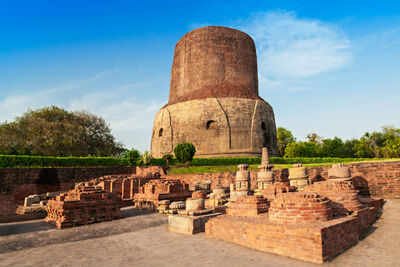
In a landmark recognition of India’s timeless spiritual and cultural heritage, the Ancient Buddhist Site of Sarnath in Uttar Pradesh has been inscribed on the UNESCO World Heritage List during the 48th session of the World Heritage Committee in Busan, Republic of Korea. With this inscription, Sarnath becomes India’s 45th UNESCO World Heritage property, reaffirming the country’s enduring contribution to global civilization and the preservation of humanity’s shared heritage.
Located about 10 kilometres from Varanasi, Sarnath is among the most sacred places in Buddhism. It was here, in the 6th century BCE, that Gautama Buddha arrived after attaining enlightenment under the Bodhi Tree at Bodh Gaya. At this serene site, then known as Rishipatana, Ishipatana, or Mrigadava (Deer Park), the Buddha delivered his first sermon, known as the Dhammacakkappavattana Sutta (“Setting in Motion the Wheel of Dharma”), to his first five disciples. This event marked the birth of the Buddhist Sangha, the monastic community that would spread the Buddha’s teachings across Asia and beyond.
Sarnath is one of the four principal Buddhist pilgrimage sites, alongside Lumbini (the Buddha’s birthplace), Bodh Gaya (where he attained enlightenment), and Kushinagar (where he attained Mahaparinirvana). For over 2,500 years, pilgrims, monks, scholars and travellers from across the world have journeyed to Sarnath in search of spiritual inspiration and historical understanding.
The site reflects centuries of architectural, artistic and religious development. Among its most prominent monuments is the Dhamek Stupa, believed to mark the spot where the Buddha delivered his first sermon. Nearby are the remains of ancient monasteries, temples, the Dharmarajika Stupa, and the Mulagandha Kuti, which together narrate the evolution of one of the world’s oldest living spiritual traditions.
Sarnath also occupies a unique place in India’s national identity. During the reign of Emperor Ashoka in the 3rd century BCE, the site flourished as a major Buddhist centre. Ashoka erected a magnificent sandstone pillar here, crowned by the Lion Capital of Ashoka, a masterpiece of Mauryan sculpture featuring four majestic lions standing back-to-back. Today, this Lion Capital serves as the National Emblem of India, symbolising courage, strength, peace and righteousness. The famous Ashoka Chakra, featured at the centre of India’s national flag, also traces its origins to this sacred site.
The UNESCO inscription recognises Sarnath not merely for its archaeological remains but for its Outstanding Universal Value. It acknowledges the site’s profound influence on the history of Buddhism, its exceptional artistic and architectural legacy, and its continuing role as a place of pilgrimage and intercultural dialogue. The recognition also strengthens international efforts to conserve the site’s monuments while promoting sustainable tourism and scholarly research.
For India, this achievement is both a matter of national pride and a reminder of its responsibility to preserve its civilisational treasures. As the world increasingly looks towards heritage as a bridge between cultures, Sarnath stands as a powerful symbol of peace, compassion and wisdom, values that remain as relevant today as they were over two millennia ago.
The addition of Sarnath to the UNESCO World Heritage List is more than an honour bestowed upon an ancient monument. It is a tribute to an enduring philosophy that transformed human thought, inspired millions across continents, and continues to guide people on the path of mindfulness, non-violence and compassion. In recognising Sarnath, the world celebrates not only a remarkable archaeological site but also one of humanity’s greatest spiritual legacies.