

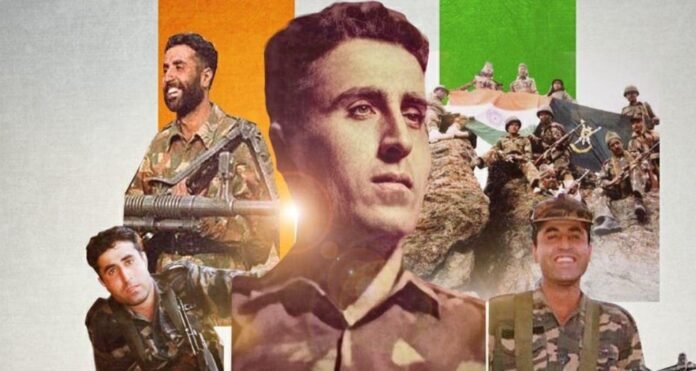
Among the countless heroes of the 1999 Kargil War, one name continues to inspire every Indian with unparalleled courage and patriotism, Captain Vikram Batra, PVC. Revered as the “Lion of Kargil” and remembered by his iconic radio message, “Yeh Dil Maange More!”, Captain Batra became the face of India’s victory in the Kargil conflict. His extraordinary bravery, fearless leadership and supreme sacrifice earned him the nation’s highest wartime gallantry award, the Param Vir Chakra, posthumously.
Born on September 9, 1974, in Palampur, Himachal Pradesh, Vikram Batra grew up with a strong sense of discipline and patriotism. He excelled in academics as well as sports and was deeply inspired by the ideals of service to the nation. Although he had opportunities to pursue a career in the merchant navy, he chose to join the Indian Army, believing that serving the country was his true calling. After completing his training at the Indian Military Academy, Dehradun, he was commissioned into the 13 Jammu and Kashmir Rifles (13 JAK Rifles) in December 1997.
When the Kargil War broke out in 1999, Lieutenant Vikram Batra and his battalion were deployed to the conflict zone. The war was unlike any conventional battle. Indian soldiers had to climb near-vertical mountain slopes under enemy fire to recapture strategically important peaks occupied by Pakistani forces.
Captain Batra first came into the national spotlight during the mission to capture Point 5140, one of the most heavily defended enemy positions. Leading his troops through treacherous terrain and intense firing, he launched a daring assault that resulted in the successful capture of the peak. After the victory, he radioed the now-famous message, “Yeh Dil Maange More!”, a phrase that quickly became a symbol of India’s determination and the fighting spirit of its armed forces.
Despite the success and the dangers he had already faced, Captain Batra volunteered for yet another critical mission, to recapture Point 4875, a strategically vital peak overlooking the national highway connecting Srinagar and Leh. During the fierce battle in early July 1999, he led from the front, engaging enemy soldiers in close combat and inspiring his men to press forward despite heavy resistance.
As the operation progressed, one of his fellow officers was seriously injured in enemy fire. Without hesitation, Captain Batra moved forward to rescue him. While shielding his comrade and continuing to engage the enemy, he was fatally wounded on July 7, 1999. He was just 24 years old. His courage and selflessness ensured that the mission succeeded, and Point 4875 was eventually secured by Indian forces. Today, the peak is popularly known as Batra Top in his honour.
For his conspicuous bravery, indomitable spirit and leadership beyond the call of duty, Captain Vikram Batra was posthumously awarded the Param Vir Chakra, India’s highest award for gallantry in the face of the enemy. His actions became a defining chapter of Operation Vijay and inspired an entire generation of Indians.
More than two decades later, Captain Vikram Batra’s legacy remains etched in the nation’s memory. Schools, military institutions and memorials across India honour his sacrifice, while books, documentaries and the acclaimed film Shershaah have introduced his story to younger generations. His life continues to remind Indians that courage is not the absence of fear, but the determination to put duty before self.
Captain Vikram Batra did not merely fight a war, he embodied the spirit of a soldier who believed that the nation always came first. His sacrifice helped secure India’s victory in Kargil, and his legacy continues to inspire every citizen to serve the nation with integrity, courage and unwavering resolve.
His words and actions remain immortal, reminding generations of the true meaning of patriotism: “Either I will come back after hoisting the Tricolour, or I will come back wrapped in it, but I will be back for sure.”