

PC:( Pinterest, Visit okiniva japne, Okaycrete)
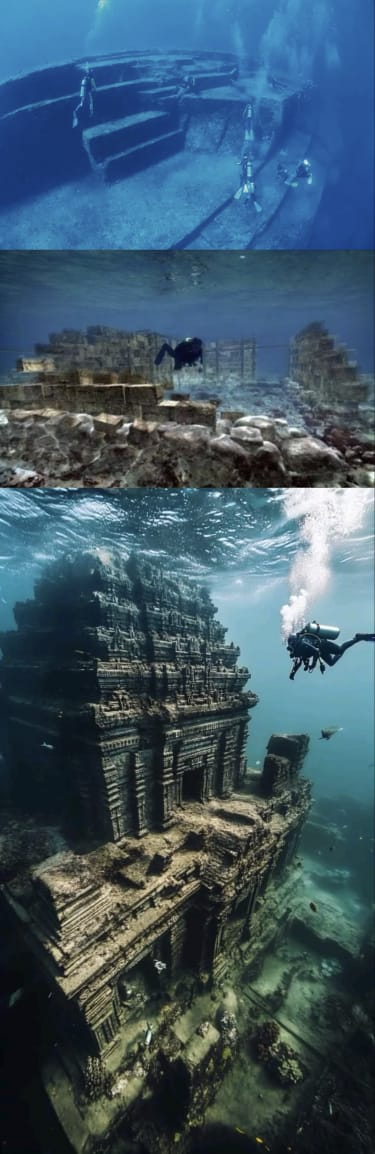
The ocean hides a treasure trove of history, with ancient cities submerged beneath its depths, waiting to be rediscovered. These underwater relics, once thriving hubs of culture, trade, and power, have been reclaimed by the sea due to natural disasters or geological shifts. From the mythical city of Dwarka in India to the Roman elite’s playground of Baiae in Italy, these sunken cities offer a glimpse into humanity’s past. Below, we explore some of the most remarkable submerged cities that archaeologists have brought back into the light.
Dwarka, India: The Legendary City of Krishna
Off the coast of Gujarat lies Dwarka, a submerged city believed to be the mythical home of Lord Krishna from the Indian epic Mahabharata. Marine archaeologists have uncovered stone blocks, pillars, and other structures suggesting a fortified city that served as a bustling trade hub. According to legend, Dwarka sank into the sea after Krishna’s death, a story now supported by the discovery of its underwater ruins. These findings continue to captivate historians and devotees alike, blending mythology with archaeological evidence.
Yonaguni, Japan: A Monument or Nature’s Art?
The Yonaguni Monument, found off Japan’s Yonaguni Island, remains one of the most debated underwater discoveries. Its angular terraces and carved-like features have sparked theories of a man-made structure, possibly a lost city or temple. However, some scientists argue it’s a natural geological formation shaped by tectonic activity. Whether crafted by human hands or nature, the Yonaguni Monument continues to intrigue researchers and divers, raising questions about ancient civilizations in the Pacific.
Heraklion, Egypt: The Lost Port of the Nile
Once a thriving port near the Canopic Mouth of the Nile, Heraklion (also known as Thonis-Heracleion) was a vital trade and religious center in ancient Egypt. Submerged in the Mediterranean Sea, about 32 km northeast of Alexandria, its ruins have revealed statues, inscriptions, and artifacts that highlight its significance. Rediscovered in the early 2000s, Heraklion offers a window into Egypt’s maritime and cultural history before it vanished beneath the waves.
Port Royal, Jamaica: The Pirate City Swallowed by the Sea
In the 17th century, Port Royal was a notorious Caribbean pirate haven and a bustling trade center. A catastrophic earthquake in 1692, followed by a tsunami, sank much of the city into the sea, preserving it as a time capsule. Today, Port Royal is one of the best-preserved underwater archaeological sites, with artifacts like buildings, streets, and even household items offering insights into colonial life and piracy in the Caribbean.
Pavlopetri, Greece: A Bronze Age Marvel
Dating back to the Bronze Age, Pavlopetri, off the coast of Greece, is one of the oldest known submerged cities. Likely sunk by an earthquake around the 2nd millennium BC, its remarkably preserved streets, buildings, and tombs provide a rare glimpse into early urban planning. Discovered in 1967, Pavlopetri continues to reveal secrets about Bronze Age civilization, making it a significant archaeological treasure.
Baiae, Italy: Rome’s Sunken Playground
Known as the “Las Vegas of the Roman Empire,” Baiae was a luxurious resort town frequented by Rome’s elite. Its lavish villas, mosaics, and baths sank due to bradyseism, a geological process causing land to rise and fall in hydrothermal zones. Now an underwater archaeological park in the Bay of Naples, Baiae’s submerged ruins, including statues and intricate mosaics, attract divers and historians eager to explore Rome’s opulent past.
Olous, Crete: A Minoan City Beneath the Waves
Near modern-day Elounda in Crete, Olous was a thriving Minoan and later Dorian settlement with a democratic society and its own coinage. Submerged around 780 AD, possibly due to an earthquake or landslide, its ruins are visible both along the shoreline and underwater. Olous’s remnants, including walls and structures, offer a glimpse into Crete’s ancient maritime culture, blending history with the serene beauty of the region.
Falasarna, Crete: The Fortified Harbor of Antiquity
Located on Crete’s western tip, Falasarna was a powerful city-state in the 4th century BC, renowned for its advanced naval harbor. Destroyed by the Romans in 67 BC, its ruins include harbor structures, city walls, and a cemetery, with artifacts displayed in local museums. The enigmatic “Throne of Poseidon,” a carved stone structure, adds to its mystique. Today, Falasarna’s archaeological significance is complemented by its stunning beaches, making it a unique historical and natural site.
A Legacy Preserved Beneath the Sea
These submerged cities, from Dwarka’s mythical origins to Baiae’s Roman extravagance, tell stories of human ingenuity, resilience, and the relentless power of nature. Rediscovered through modern archaeology, they remind us of the transient nature of civilizations and the secrets still hidden beneath the waves. As exploration continues, these underwater wonders will undoubtedly reveal more about our shared past, bridging the gap between history and mystery