

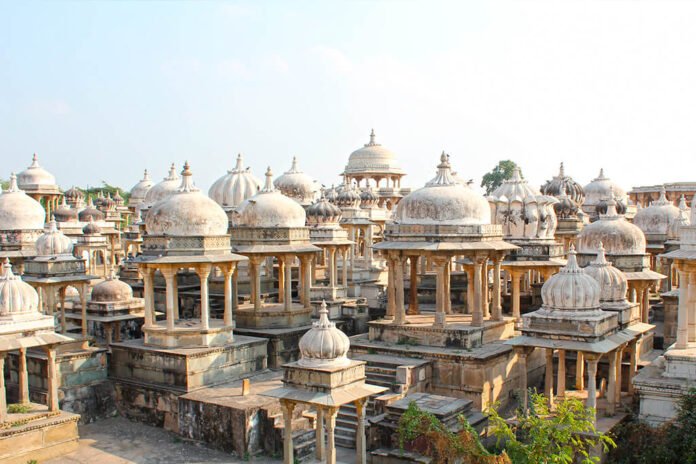
Just a few kilometres from the grandeur of Udaipur’s City Palace, away from the bustle of the city, stands a place of quiet dignity and extraordinary historical significance.
Known as Mahasatya, Mahasatiyaji or the Ahar Cenotaphs, this is the historic royal cremation ground of the House of Mewar. For more than four centuries, Ahar has been associated with the final rites of the Mewar royal family, beginning with Maharana Amar Singh I, the son of Maharana Pratap, and continuing into the present generation.
It is a place where the history of Mewar is not merely written in books or displayed inside museums. It is carved into marble.
Where the Mewar rulers came to their final rest
The tradition of royal cremation at Ahar is closely associated with Maharana Amar Singh I, who ruled Mewar from 1597 to 1620 and was the son of Maharana Pratap.
Amar Singh I was the first Maharana of Mewar to die in Udaipur and was cremated at Ahar after his death in January 1620. His immediate successor and son, Maharana Karan Singh, subsequently commissioned his cenotaph there.
This distinction is historically important because Maharana Pratap himself was not cremated at Ahar. Pratap died at Chavand in 1597 and his memorial is at Bandoli. Maharana Amar Singh I therefore marks the beginning of the Ahar tradition for the ruling line.
From then onwards, Ahar became the sacred cremation ground associated with successive generations of the House of Mewar.
From Amar Singh I to the modern House of Mewar
Over the centuries, the site grew into an extraordinary complex of royal memorials.
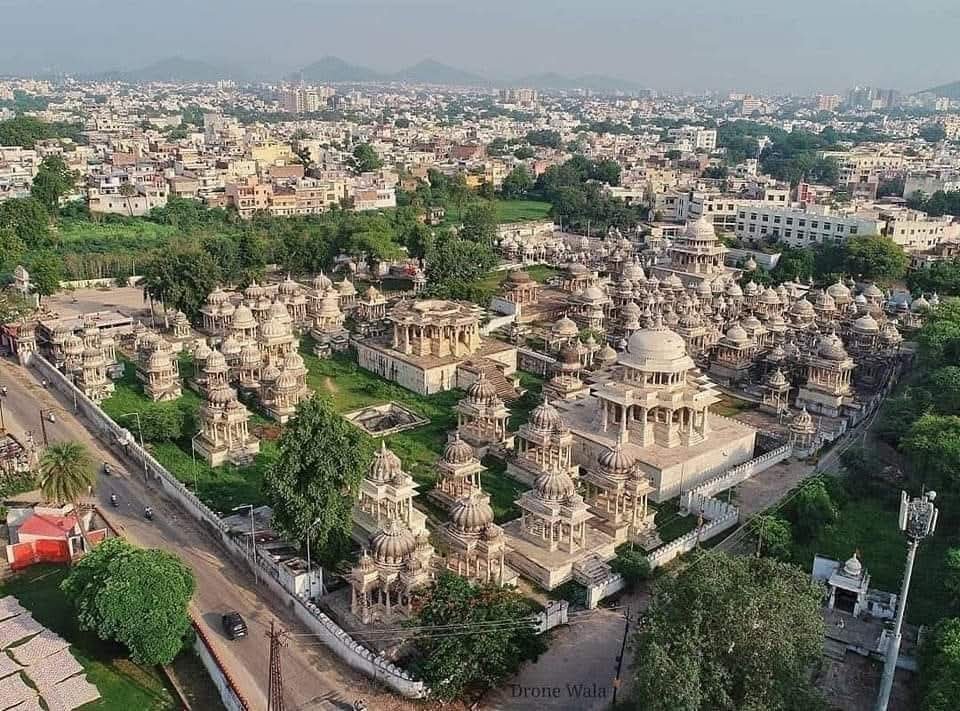
The Ahar complex contains hundreds of memorial structures associated with members of the Mewar royal family. One source identifies 372 cenotaphs and memorials, while the principal royal group includes 19 major chhatris associated with Mewar rulers.
Among the prominent rulers commemorated here are Maharana Amar Singh I, Maharana Sangram Singh II, Maharana Swaroop Singh, Maharana Shambhu Singh, Maharana Sajjan Singh, Maharana Fateh Singh, Maharana Bhupal Singh and Maharana Bhagwat Singh Mewar, among others.
The complex therefore represents not one generation, but a remarkable span of Mewar history.
The tradition has continued into the contemporary House of Mewar as well. Maharana Arvind Singh Mewar was cremated at Ahar on March 17, 2025, making his final rites part of a tradition that stretches back to the early 17th century.
And on September 15, 2026, Rajmata Vijayraj Kumari Mewar, his wife, was also taken to Mahasatya at Ahar for her final rites, once again bringing the historic cremation ground into the present-day story of the House of Mewar.
What exactly is a chhatri?
The most distinctive feature of Ahar is its chhatris.
The word chhatri literally refers to an umbrella. In the architectural traditions of Rajasthan, it came to describe an open pavilion with a domed roof, generally raised on pillars and constructed as a memorial to a deceased ruler or member of a royal family.
At Ahar, these chhatris function as cenotaphs, or memorial monuments associated with the deceased. They commemorate the person whose funeral rites took place at the site and preserve their memory through architecture.
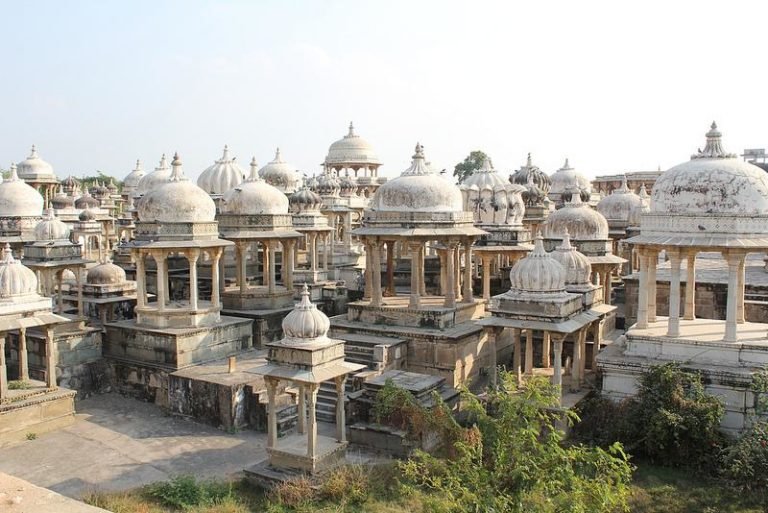
The structures generally stand on raised platforms and feature domes supported by intricately carved pillars. Much of the complex’s distinctive white marble architecture is associated with the region around Kankroli.
They are not simply monuments of death. Their carvings record the culture, artistic traditions and royal symbolism of the period in which they were built.
The magnificent chhatri of Maharana Amar Singh I
Among the oldest and most significant structures is the cenotaph of Maharana Amar Singh I.
It occupies a special place in the history of the complex because Amar Singh I was the first Mewar ruler to be cremated at Ahar.
His cenotaph, built by his son Karan Singh, contains distinctive sculptural work, including a four-faced figure and carved panels associated with the ruler and members of his household.
The monument therefore connects three generations of Mewar history: Maharana Pratap, his son Amar Singh I and Amar Singh’s son Karan Singh.
Maharana Sangram Singh II’s magnificent memorial
Another particularly striking monument is the chhatri of Maharana Sangram Singh II, who died in 1734.
Built in 1734, it is considered one of the most spectacular structures in the complex. Its design features a prominent octagonal dome, elaborate marble carving and numerous pillars. Its decorative programme includes Hindu religious motifs such as the lotus and trident, along with depictions associated with the Maharana.
The scale and craftsmanship of this chhatri demonstrate how royal memorial architecture in Mewar developed into a sophisticated form of artistic expression.
Every pillar, dome and carved surface carries something of the aesthetic language of its time.
Ahar is more than a collection of monuments
The significance of Mahasatya does not lie only in its architecture.
The complex is part of the ancient landscape of Ahar, an archaeological site much older than Udaipur itself. Ahar was an ancient settlement with archaeological remains that reach back thousands of years. The nearby Ahar Archaeological Museum preserves artefacts from this older history, including ancient pottery and sculptures.
Within the royal cremation complex is also the Gangod Bhava Kund, traditionally associated with ritual practices following royal cremations. The presence of the sacred water structure adds another dimension to the ceremonial character of the site.
Thus, Ahar brings together several layers of history: the ancient settlement, the religious landscape and the later royal traditions of Mewar.
The memory of queens and the history of sati
The name Mahasati is also connected with the historical practice of sati, under which some widows were subjected to or chose self-immolation on their husband’s funeral pyre.
Historical accounts of the Ahar complex record memorials associated with royal women who died in this manner. Some of the carvings and smaller memorials preserve the memory of these women.
This aspect of the site needs to be understood historically rather than romanticised. Sati was a deeply troubling and ultimately prohibited practice, and its presence in the architectural record is part of the complex history of the region.
The memorials therefore tell us not only about royal grandeur, but also about social customs and beliefs that existed in earlier centuries.
A living tradition of Mewar
Perhaps what makes Mahasatya particularly remarkable is that it is not merely an archaeological monument.
It remains connected to the House of Mewar.
The cremation of Maharana Arvind Singh Mewar at Ahar in March 2025 demonstrated that the site’s ceremonial significance continues into the modern era.
The final rites of Rajmata Vijayraj Kumari Mewar in September 2026 have once again brought attention to the same sacred ground.
Generations have changed. The political world in which the Maharanas once ruled has disappeared. India became a republic, princely privileges ended and Udaipur transformed into a modern city.
Yet the relationship between the House of Mewar and Ahar has endured.
Where history becomes a landscape
The Ahar Cenotaphs are often overshadowed by Udaipur’s palaces, lakes and forts. Yet few places convey the continuity of Mewar history quite as powerfully.
At the City Palace, one sees the splendour of the living court.
At Ahar, one encounters the memory of those who came before.
From Maharana Amar Singh I, the son of Maharana Pratap, to rulers of successive centuries and members of the contemporary House of Mewar, the site represents an unbroken historical relationship between a royal family and its traditional cremation ground.
The white marble chhatris stand quietly beneath the Udaipur sky, their domes and pillars carrying stories of rulers, queens, ceremonies, artistry and changing times.
They remind us that dynasties may change, kingdoms may disappear and political power may pass into history.
But memory has its own architecture
And at Mahasatya of Ahar, the story of Mewar continues to live in stone.