

Jaipur, Rajasthan’s iconic Pink City, celebrates its Foundation Day on November 18, 2026, marking 299 years since its establishment and the beginning of its 300th year. Founded in 1727 by Maharaja Sawai Jai Singh II, Jaipur has evolved from a carefully envisioned royal capital into one of India’s most prominent cultural, historical, commercial and tourism destinations. Nearly three centuries later, the city continues to preserve its royal legacy while embracing the aspirations of a modern metropolis.

Known for its magnificent palaces, architectural landmarks, colourful bazaars, traditional crafts and vibrant cultural traditions, Jaipur holds a special place in India’s heritage landscape. Its foundation anniversary is an occasion to celebrate not only its history but also the vision, planning and cultural richness that have shaped its identity.
The story of Jaipur began in the early 18th century under Maharaja Sawai Jai Singh II, the ruler of Amber. Before Jaipur, Amber served as the seat of the Kachwaha Rajput rulers. However, growing population pressure, limited water resources and the need for a more expansive capital encouraged the Maharaja to establish a new city on the plains south of Amber. A ruler with deep interests in astronomy, mathematics, architecture and town planning, Sawai Jai Singh II envisioned a city that would combine administrative efficiency, commercial opportunities, security and aesthetic appeal.
He entrusted the planning and architectural design to Vidyadhar Bhattacharya, a Bengali architect and scholar who played a central role in translating the Maharaja’s vision into a carefully organised urban settlement. The foundation of Jaipur was laid on November 18, 1727. Its planning drew inspiration from ancient Indian architectural traditions, particularly Vastu Shastra and Shilpa Shastra, while also incorporating other architectural influences.
The city was organised into nine rectangular sectors, known as chowkris, with broad roads intersecting at right angles and large public squares called chaupars. Fortified walls and gates provided protection, while markets, temples, royal buildings and residential areas were integrated into the planned layout. Unlike many older settlements that developed gradually, Jaipur was conceived as a planned commercial and administrative capital. Its development made it one of India’s earliest and most remarkable examples of organised urban planning.
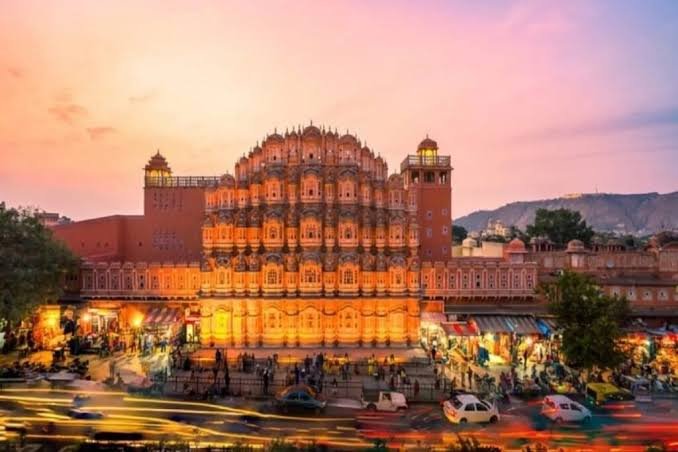
Jaipur’s distinctive identity is closely associated with its pink-coloured architecture. The city acquired this appearance in 1876, when Maharaja Sawai Ram Singh II ordered the historic city to be painted in a terracotta-pink shade to welcome Albert Edward, the Prince of Wales, who later became King Edward VII. Pink was traditionally associated with hospitality, and the colour gradually became an inseparable part of Jaipur’s identity. Even today, the uniform facades of the old city’s markets, traditional buildings and heritage structures give it a character unlike any other Indian city.
The architectural splendour of Jaipur is among the finest representations of Rajasthan’s royal heritage. The City Palace, Hawa Mahal, Amber Fort, Jaigarh Fort, Nahargarh Fort, Jantar Mantar and Albert Hall Museum reflect different dimensions of its history, artistic excellence and royal patronage. The Hawa Mahal, with its distinctive honeycomb-like facade and hundreds of small windows, has become one of the most recognisable symbols of the city. The City Palace reflects the traditions of the former royal family, while Jantar Mantar stands as a remarkable example of India’s historical contributions to astronomy and scientific observation. Amber Fort, with its grand courtyards, intricate mirror work and artistic detailing, continues to attract visitors from across the world.
In 2019, Jaipur’s historic Walled City was inscribed on the UNESCO World Heritage List, recognising its exceptional urban planning, architectural character and cultural significance. The recognition further strengthened its position as one of India’s most important heritage destinations.
Beyond its monuments, Jaipur’s identity lies in its living traditions. The city is renowned for block printing, blue pottery, meenakari, lac jewellery, gemstone cutting and polishing, miniature paintings, traditional textiles and handcrafted products. Its famous markets, including Johari Bazaar, Bapu Bazaar, Tripolia Bazaar and Chandpole, continue to showcase the craftsmanship and entrepreneurial spirit that have flourished here for generations.
Jaipur is equally celebrated for its folk music, dance, literature, festivals and traditional cuisine. Celebrations such as Teej and Gangaur bring its streets alive with colourful processions, traditional attire, folk performances and religious festivities. Events such as the Jaipur Literature Festival have further established the city as an important meeting point for writers, intellectuals, artists and cultural enthusiasts from India and abroad.
Today, Jaipur is much more than a historical and tourist destination. As the capital of Rajasthan, it serves as the state’s administrative, political, educational and economic centre. The city has developed into an important hub for information technology, business, hospitality, education, healthcare, jewellery, handicrafts and trade. Its position in the Golden Triangle tourism circuit, alongside Delhi and Agra, makes it one of India’s most prominent tourist destinations. Improved connectivity, infrastructure, educational institutions and expanding business opportunities have further contributed to its growth as a modern urban centre.
As Jaipur completes 299 years and enters its 300th year on November 18, 2026, the occasion offers an opportunity to reflect on its extraordinary journey and the importance of preserving its architectural and cultural heritage. The anniversary also brings renewed attention to heritage conservation, responsible tourism, traditional crafts and the need to balance urban development with the preservation of the historic Walled City.
Nearly three centuries after Sawai Jai Singh II envisioned a city of knowledge, commerce, planning and culture, Jaipur continues to stand as a remarkable expression of that vision. Its beauty lies not only in its forts and palaces but also in its streets, craftspeople, festivals, food, traditions and the everyday life that keeps its heritage alive. As the Pink City steps into its 300th year, it celebrates not merely the passage of time but a legacy that continues to inspire generations. It remains a city where history lives alongside modernity, where architecture tells stories and where the spirit of Rajasthan finds one of its most beautiful expressions.