

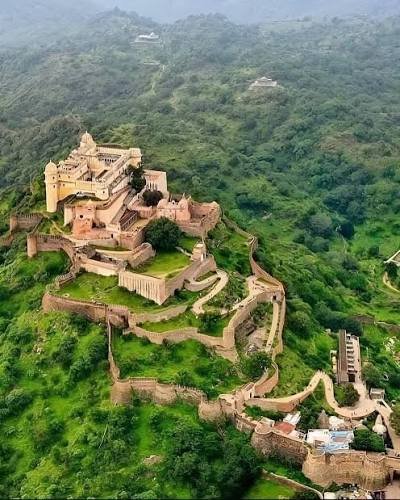
Perched high in the rugged Aravalli hills of Rajasthan, Kumbhalgarh Fort stands as one of India’s most remarkable architectural and historical treasures. Surrounded by dense forests and protected by massive fortifications, it was here that one of India’s greatest warrior-kings, Maharana Pratap, began his life journey. Long before he became a symbol of resistance and courage, Kumbhalgarh was his first home, a place that would become inseparable from his legacy.
Maharana Pratap was born on 9 May 1540 within the walls of Kumbhalgarh Fort. Tradition identifies his birthplace as the Badal Mahal complex, situated at the highest point of the fort. Though parts of the palace visible today were altered and expanded in later centuries, the site remains closely associated with the birth of the future ruler of Mewar. Standing amid the clouds during the monsoon and offering sweeping views of the surrounding hills, Badal Mahal reflects the strategic and majestic character of Kumbhalgarh itself.
Built in the 15th century by the great ruler Rana Kumbha, Kumbhalgarh was far more than a fortress. It served as a secure refuge for the rulers of Mewar during times of crisis. Its location, deep within the Aravalli range, made it extremely difficult for invading armies to capture. For generations, the fort protected the royal family and safeguarded the continuity of the Sisodia dynasty.
Kumbhalgarh’s significance in Mewar’s history cannot be overstated. Several future rulers spent crucial years here, and the fort often became the kingdom’s fallback capital whenever Chittorgarh faced threats. Its strategic importance was evident again in the 16th century when Maharana Udai Singh II, Maharana Pratap’s father, sought safety here during turbulent political times. In many ways, Kumbhalgarh served as the shield of Mewar.
The fort is perhaps best known today for its extraordinary defensive wall. Stretching approximately 36 kilometres across the hills, it is often described as the world’s second-longest continuous wall after the Great Wall of China. Wide enough in several places for multiple horsemen to ride abreast, the wall snakes across mountains, valleys, and ridges, creating a formidable defensive barrier. Its sheer scale continues to astonish visitors and has earned Kumbhalgarh international recognition as one of Rajasthan’s most impressive monuments.
Yet Kumbhalgarh’s importance extends beyond architecture and military engineering. The fort represents the spirit of resilience that defined Mewar. Surrounded by more than 300 temples and protected by seven fortified gateways, it embodied the determination of a kingdom that valued independence above all else. These were the traditions into which Maharana Pratap was born.
It is tempting to see symbolism in the fact that a ruler renowned for his steadfastness and strength first opened his eyes within one of India’s strongest forts. While history is shaped by many forces, Kumbhalgarh undoubtedly provided the backdrop for the early years of a prince who would one day become a legend.
Today, Kumbhalgarh Fort is a UNESCO World Heritage Site and one of Rajasthan’s most visited landmarks. Visitors come to admire its magnificent walls, palaces, and panoramic views, but they also come to connect with a larger story, the story of Maharana Pratap.
Every stone of the fort seems to echo the memory of the warrior king whose life began here and whose legacy continues to inspire India centuries later.
For Maharana Pratap, Kumbhalgarh was more than a birthplace. It was the first chapter in an extraordinary journey, a journey that would make him one of the most respected figures in Indian history.