

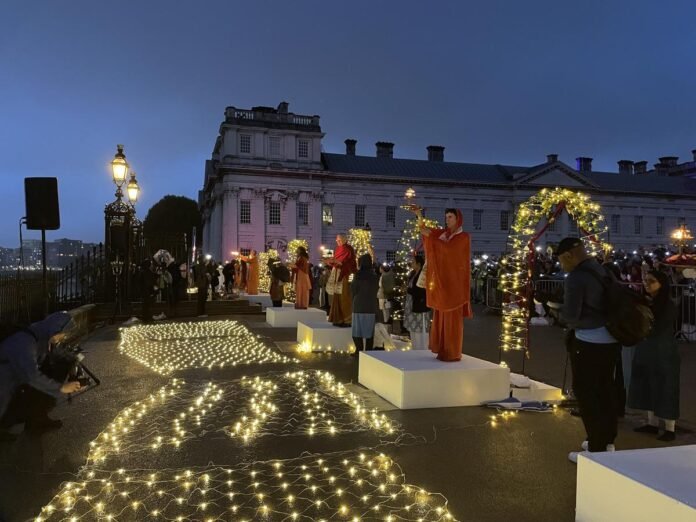
For one evening, the banks of the River Thames in London echoed with the chants, music and spiritual rhythm of an Indian riverfront tradition. On September 13, 2026, the first-ever “Ganga Aarti on the Thames: A Ceremony of Light” was held at the Old Royal Naval College in Greenwich, bringing thousands of people together for an evening inspired by the iconic aartis performed along the Ganga in Varanasi, Haridwar and Rishikesh.
The event was organised by Chinmaya Mission UK in collaboration with the annual Totally Thames festival. It was also part of global celebrations marking the 75th anniversary of Chinmaya Mission, giving the ceremony a significance that extended beyond a single cultural event. On the banks of one of Britain’s most recognisable rivers, a centuries-old Indian tradition of expressing reverence towards a sacred river was recreated in a new setting.
As the evening unfolded, the Thames became the backdrop for chants, devotional music and the glow of multi-tiered brass oil lamps. Priests and participants performed the traditional movements associated with aarti, creating an atmosphere reminiscent of India’s famous riverfront ceremonies. The gathering brought together members of the Indian diaspora, local residents and visitors, allowing people unfamiliar with the tradition to experience an important aspect of Indian spiritual and cultural heritage.
The symbolism of the ceremony was particularly striking. In India, Ganga Aarti is closely associated with reverence for the Ganga, a river regarded as sacred by millions. It is traditionally an offering of light accompanied by prayers, chants and music. Bringing the ceremony to the Thames did not seek to turn the British river into the Ganga, but rather used the familiar ritual language of light, gratitude and reverence to create a cultural bridge between India and Britain.
The choice of the Thames was also significant from an environmental perspective. The organisers made a conscious decision not to release lamps, flowers or other ritual materials into the river. The ceremony therefore retained its spiritual character without introducing offerings into the Thames ecosystem. Single-use plastics were also prohibited at the event, reinforcing the message that cultural traditions and environmental responsibility can exist together.
This environmental sensitivity added another layer to the ceremony. Indian traditions surrounding rivers have historically placed rivers at the heart of community and spiritual life, but today’s celebrations also face the responsibility of protecting these waterways. By ensuring that nothing was immersed in the Thames, the organisers demonstrated how a traditional ritual can be thoughtfully adapted to a different ecological setting.
The event also represented the continuing evolution of Indian cultural traditions abroad. For generations, the Indian diaspora has carried festivals, languages, music, food and religious practices across continents. Events such as the Ganga Aarti on the Thames offer younger generations an opportunity to connect with these traditions while also introducing them to wider communities.
For those who have witnessed Ganga Aarti along the ghats of Varanasi, Haridwar or Rishikesh, the Thames ceremony may have evoked familiar images of flickering lamps and devotional chants. For others, it offered a first encounter with a ritual deeply embedded in India’s spiritual imagination.
There was something poetic about the setting itself. The Thames, which has shaped the history of London for centuries, became the setting for an Indian ceremony whose central symbol is the river. Two rivers, separated by geography and history, came together through a shared language of light and reverence.
The first Ganga Aarti on the Thames was therefore more than a religious ceremony. It was an expression of cultural memory, diaspora identity and cross-cultural connection. It demonstrated how traditions can travel without losing their essence, while also adapting thoughtfully to new surroundings.
As hundreds of lamps illuminated the evening sky beside the Thames, the ceremony offered a simple but powerful message: light can travel across borders, traditions can find new homes, and cultural heritage can become a bridge between communities.