

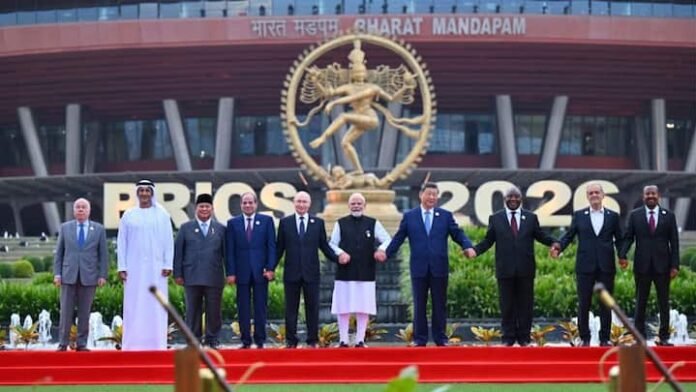
The 18th BRICS Summit, held in New Delhi on September 12–13, 2026, concluded with the adoption of the New Delhi Declaration, a 140-paragraph document that lays out the grouping’s priorities on global governance, economic cooperation, security, technology, climate action and sustainable development. Held under India’s chairship and the theme “Building for Resilience, Innovation, Cooperation and Sustainability,” the summit also marked two decades of BRICS.
The summit was significant not only for the declaration itself but also for the scale of India’s year-long chairship. More than 400 meetings and engagements involving ministers, parliamentarians, officials, experts, businesses and civil society were organised across 30 Indian cities. The declaration described these engagements as contributing to greater cooperation, resilience, innovation, sustainable development and a stronger voice for BRICS in global governance.
A stronger voice for the Global South
One of the central messages of the New Delhi Declaration is the need to make international institutions more representative of today’s geopolitical and economic realities. BRICS reaffirmed its support for comprehensive reform of the United Nations and greater representation of emerging markets and developing countries in global decision-making.
The declaration also called for more equitable geographical representation in the UN system and greater participation of women, particularly from emerging and developing economies, in international leadership. It specifically noted that no woman has yet served as UN Secretary-General and called for a more inclusive selection process for senior UN positions.
Trade, finance and local currencies
Economic cooperation remained another major pillar of the summit. BRICS countries reiterated their opposition to protectionist and unilateral trade measures and stressed the importance of strengthening trade and investment among member countries.
The declaration also supported continued work towards cross-border payment interoperability and greater use of local currencies in trade and financial transactions. The emphasis, however, is on improving existing payment mechanisms and reducing transaction barriers rather than creating a common BRICS currency. The New Development Bank was also recognised as an important institution for development financing, including greater local-currency financing.
A firm stand against terrorism
For India, one of the most significant elements was the declaration’s explicit condemnation of the April 22, 2025 terrorist attack in Jammu and Kashmir, in which 26 people were killed. BRICS leaders condemned the attack and reiterated their opposition to terrorism in all its forms, including terrorist financing and the provision of safe havens to terrorists.
The declaration placed this within a broader commitment to international cooperation against terrorism and violent extremism.
Conflicts and global security
The declaration also addressed several ongoing international conflicts and crises. On the situation in West Asia, BRICS expressed deep concern over continuing tensions and called for restraint and measures to prevent further escalation. The grouping reaffirmed its support for peaceful resolution of disputes, international law and multilateral diplomacy.
On nuclear issues, the declaration reaffirmed support for nuclear non-proliferation, disarmament and arms control, while stressing the importance of preventing destabilising arms races.
Technology and artificial intelligence
Technology emerged as an increasingly important part of the BRICS agenda. The grouping continued its focus on digital cooperation, technological innovation and responsible development of emerging technologies, including artificial intelligence.
Rather than treating technology only as an economic opportunity, BRICS placed it within the broader questions of development, inclusion, governance and reducing digital inequalities. This reflects the grouping’s growing interest in ensuring that technological transformation benefits developing economies as well as advanced ones.
Climate, energy and food security
The New Delhi Declaration also placed considerable emphasis on sustainability and resilience. BRICS leaders highlighted the importance of energy security, resilient energy infrastructure and a just and inclusive energy transition that takes into account the different circumstances and development priorities of individual countries.
Food and agricultural security received attention as well. The declaration welcomed the creation of BRICS AGRIN, a collaborative, non-binding and farmer-centric network focusing on agro-inputs, genetic resources and information. It also called for resilient agricultural supply chains and greater cooperation in food production and trade.
Health, women and people-to-people cooperation
The summit’s agenda went beyond traditional diplomacy and economics. The declaration recognised the importance of cooperation in health, education, tourism, culture and people-to-people exchanges.
India’s chairship also placed particular emphasis on women’s participation. The BRICS Women Ministers’ meeting in Kochi focused on women-led development, while the declaration welcomed initiatives for women’s digital capacity building, entrepreneurship, financial inclusion and greater participation in economic and decision-making processes.
From declarations to implementation
Perhaps the most important question now is what happens after the summit.
The New Delhi Declaration provides a broad framework for cooperation among an expanded BRICS, but its long-term significance will depend on implementation. Payment interoperability, local-currency transactions, development financing, resilient supply chains, technology cooperation and institutional reforms will require sustained coordination among countries with different economic interests and geopolitical positions.
The declaration itself recognises the need for greater institutional continuity and outcome-oriented cooperation. It also marks the transition to the next phase of BRICS, with China set to chair the grouping and host the 19th BRICS Summit in 2027.
India’s 2026 BRICS presidency therefore leaves behind more than a summit document. The New Delhi Declaration presents a broad vision of a more representative international system, deeper South-South cooperation and stronger collaboration in areas ranging from trade and finance to technology, climate, agriculture and culture.
The real measure of the summit, however, will lie beyond the declarations, in how effectively these commitments are converted into practical cooperation and tangible outcomes for the countries and people that BRICS represents.