

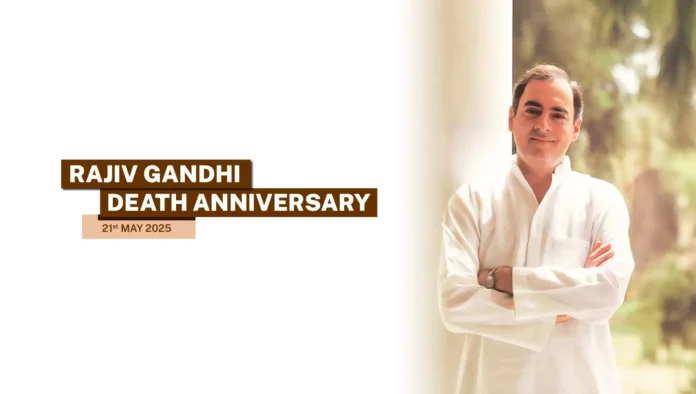
Every year on May 21, India observes National Anti-Terrorism Day in memory of former Prime Minister Rajiv Gandhi, who was assassinated on this day in 1991. The observance is not only a tribute to a former national leader but also a reminder of the devastating impact of terrorism and the importance of peace, unity and vigilance in a democratic society.
Rajiv Gandhi was born on August 20, 1944, into India’s most prominent political family. He was the elder son of former Prime Minister Indira Gandhi and grandson of Jawaharlal Nehru, India’s first Prime Minister. Despite his political lineage, Rajiv Gandhi initially stayed away from politics and worked as a commercial pilot for Indian Airlines.
His entry into politics came after the tragic death of his younger brother Sanjay Gandhi in a plane crash in 1980. Following growing public and political pressure, Rajiv joined the Indian National Congress and soon emerged as a key political figure. In 1984, after the assassination of Indira Gandhi, Rajiv Gandhi became India’s youngest Prime Minister at the age of 40.
As Prime Minister, Rajiv Gandhi was often seen as the face of a modern and technologically progressive India. He promoted computerisation, telecommunications and educational reforms at a time when India was beginning to move toward technological advancement. His government played a major role in expanding the telecom sector and encouraging scientific development. He also worked toward decentralisation through Panchayati Raj reforms and sought to modernise governance.
However, his tenure was also marked by political controversies and challenges, including the Bofors scandal and tensions in Sri Lanka. One of the most significant developments linked to his assassination was India’s involvement in the Sri Lankan civil conflict. Rajiv Gandhi had sent the Indian Peace Keeping Force (IPKF) to Sri Lanka under the Indo-Sri Lanka Accord of 1987, a move strongly opposed by the Liberation Tigers of Tamil Eelam (LTTE), a militant separatist organisation.
On May 21, 1991, during an election campaign rally in Sriperumbudur, Tamil Nadu, Rajiv Gandhi was assassinated in a suicide bombing carried out by an LTTE operative. The explosion killed Rajiv Gandhi along with several others present at the rally. The incident shocked the entire nation and became one of the darkest moments in India’s political history.
In the years that followed, the Government of India declared May 21 as National Anti-Terrorism Day. The day aims to spread awareness about the dangers of terrorism, violence and extremism. Across schools, colleges, government offices and institutions, anti-terrorism pledges, awareness programmes and discussions are organised to encourage citizens — especially young people — to uphold peace and reject violence.
Today, India’s approach against terrorism has become stronger and more coordinated. The country has enhanced intelligence systems, border security, cyber-monitoring and counter-terror operations while also raising global awareness against terrorism at international forums. Yet National Anti-Terrorism Day is not only about security measures — it is also about protecting democratic values, social harmony and humanity itself.
More than three decades after Rajiv Gandhi’s assassination, the day continues to remind India that terrorism seeks to create fear and division, but unity, resilience and peace remain the nation’s strongest answer.