

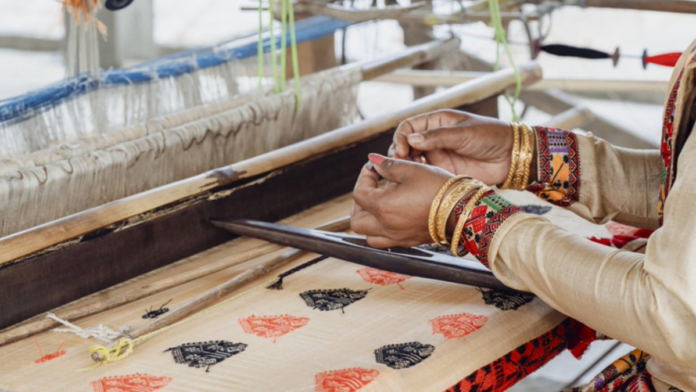
National Handloom Day 2026 will be celebrated across India on Friday, August 7, 2026, to honour the country’s rich handloom heritage, recognise the contribution of millions of weavers, and promote sustainable, indigenous textiles. The day commemorates the Swadeshi Movement launched on August 7, 1905, which encouraged Indians to boycott foreign goods and embrace locally made products. Today, National Handloom Day serves as a reminder of India’s vibrant weaving traditions while supporting the government’s ‘Vocal for Local’ and Atmanirbhar Bharat initiatives.
National Handloom Day 2026 Date
- Date: Friday, 7 August 2026
- Observed by: Government of India and the Ministry of Textiles
- Purpose: To celebrate India’s handloom heritage, honour handloom weavers and artisans, and encourage the use of authentic Indian handwoven products.
National Handloom Day 2026 Theme
The National Handloom Day 2026 theme has not yet been announced by the Ministry of Textiles.
Every year, a dedicated theme highlights India’s weaving traditions and the need to support handloom artisans. The 2026 celebrations are expected to focus on:
- Preserving indigenous weaving traditions
- Empowering handloom artisans
- Promoting sustainable and eco-friendly textiles
- Encouraging public participation in the “Vocal for Local” movement
History of National Handloom Day
National Handloom Day traces its origins to one of the most significant events in India’s freedom struggle—the Swadeshi Movement.
Key Historical Milestones
- 7 August 1905: The Swadeshi Movement began at Calcutta Town Hall, urging Indians to boycott foreign goods and support indigenous industries.
- Handloom weavers became central to the movement by producing Indian-made textiles.
- To commemorate this historic event, the Government of India declared 7 August as National Handloom Day.
- The first National Handloom Day was celebrated on 7 August 2015.
- The initiative was launched under Prime Minister Narendra Modi to recognise the contribution of India’s weaving community.
- Since then, the Ministry of Textiles has organised exhibitions, awareness campaigns, workshops and cultural programmes every year.
- National Handloom Day 2026 marks the 12th edition of the annual celebration.
Significance of National Handloom Day
National Handloom Day highlights the importance of protecting India’s centuries-old weaving traditions while strengthening the livelihoods of millions of artisans.
Why National Handloom Day Matters
- Recognises the contribution of handloom weavers and artisans.
- Commemorates the Swadeshi Movement and India’s self-reliance movement.
- Preserves India’s diverse textile heritage and traditional weaving techniques.
- Promotes sustainable and eco-friendly fashion with low environmental impact.
- Generates employment across rural and semi-urban India.
- Supports women, who constitute nearly 70% of the handloom workforce.
- Encourages consumers to purchase authentic Indian handloom products.
- Strengthens India’s textile economy and export potential.
- Promotes innovation through initiatives such as the Handloom Hackathon.
- Inspires younger generations to preserve India’s traditional craftsmanship.
Famous Handloom Traditions of India
India’s handloom sector represents diverse regional cultures and exceptional craftsmanship.
| Handloom | State | Known For |
|---|---|---|
| Banarasi Silk | Uttar Pradesh | Luxurious silk sarees with intricate zari work |
| Kanchipuram Silk | Tamil Nadu | Rich silk and gold-thread borders |
| Jamdani | West Bengal | Fine muslin with delicate motifs |
| Sambalpuri Ikat | Odisha | Traditional tie-and-dye weaving |
| Pochampally Ikat | Telangana | Colourful geometric double ikat designs |
| Paithani | Maharashtra | Silk sarees with peacock and lotus motifs |
| Chanderi | Madhya Pradesh | Lightweight sheer fabric |
| Maheshwari | Madhya Pradesh | Cotton-silk blend with reversible borders |
| Muga Silk | Assam | Naturally golden silk |
| Bhagalpuri Silk | Bihar | Eco-friendly Tussar silk |
| Kota Doria | Rajasthan | Lightweight fabric with signature square checks |
| Kasavu | Kerala | Off-white sarees with golden borders |
Government Initiatives for the Handloom Sector
The Government of India has introduced several schemes to preserve handloom traditions and improve the livelihoods of weavers.
Major Schemes
- National Handloom Development Programme (NHDP): Skill development, infrastructure, design and marketing support.
- India Handloom Brand (IHB): Certification for authentic, high-quality handloom products.
- Yarn Supply Scheme (YSS): Subsidised quality yarn for weavers.
- Comprehensive Handloom Cluster Development Scheme (CHCDS): Infrastructure and market development for handloom clusters.
- Raw Material Supply Scheme (RMSS): Better access to quality raw materials.
- Handloom Marketing Assistance (HMA): Support for exhibitions and buyer-seller meets.
- National Handloom Expo: Direct market platform for artisans.
- Weaver MUDRA Scheme: Affordable credit for handloom entrepreneurs.
- Handloom Export Promotion: Branding and international promotion of Indian handloom products.