

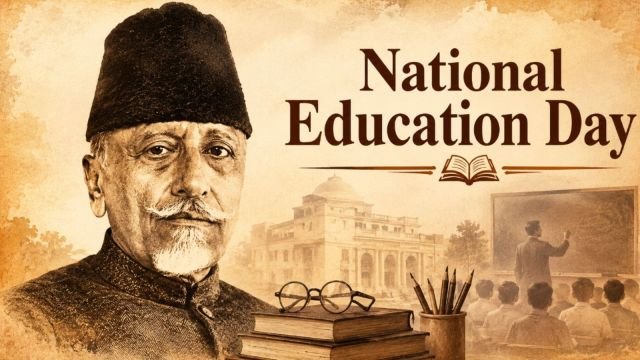
National Education Day is observed across India on November 11 every year to commemorate the birth anniversary of Maulana Abul Kalam Azad, the country’s first Education Minister. The day highlights the importance of education in nation-building and recognises the role of schools, teachers, institutions and learners in shaping India’s future. It also provides an opportunity to reflect on the progress of the Indian education system and the need to make quality education accessible, inclusive and meaningful for everyone.
Maulana Abul Kalam Azad was born on November 11, 1888. A prominent freedom fighter, scholar, journalist and educationist, he played an important role in India’s struggle for independence. Following independence in 1947, he became the first Minister of Education in the Government of India and served until his death in 1958. His contribution to education was rooted in the belief that learning should not be limited by social or economic backgrounds and that education was essential for building a progressive and democratic nation.
Azad strongly advocated universal primary education, free and compulsory education for children up to the age of 14, women’s education and vocational training. He believed that education should develop intellectual abilities while encouraging scientific thinking, creativity and social responsibility. He also emphasised the importance of providing primary education in the mother tongue to make learning more accessible to children.
During his tenure, several important institutions and initiatives helped shape the foundation of modern Indian education. He played a significant role in the development of the Indian Institutes of Technology (IITs), with IIT Kharagpur becoming the first IIT to begin functioning in 1951. The University Grants Commission (UGC), established as a statutory body in 1956, became another important milestone in strengthening higher education. He also supported the development of technical education and cultural institutions, recognising that education must include both scientific advancement and an appreciation of India’s artistic and intellectual heritage.
In recognition of his contribution, the Government of India announced in September 2008 that November 11 would be observed as National Education Day. The first celebration took place on November 11, 2008. Schools, colleges and universities across the country mark the occasion through seminars, debates, essay-writing competitions, exhibitions and other educational activities that encourage students to understand the value of learning.
The significance of National Education Day extends beyond remembering an important historical figure. It draws attention to the role of education in reducing social inequalities, creating employment opportunities, promoting gender equality and strengthening democracy. Education enables individuals to make informed decisions, understand their rights and responsibilities and participate meaningfully in society.
India’s education landscape has continued to evolve through initiatives such as the Right to Education Act, 2009, which made free and compulsory education a fundamental right for children between six and fourteen years of age, and the National Education Policy (NEP) 2020, which introduced a renewed framework for school and higher education. The policy emphasises foundational literacy and numeracy, multidisciplinary learning, skill development, flexibility and the use of technology in education.
However, challenges such as unequal access to quality education, the digital divide, learning gaps, infrastructure limitations and the need for better teacher training continue to require attention. Ensuring that students from rural, economically disadvantaged and marginalised communities receive equal learning opportunities remains an important part of India’s educational journey.
National Education Day serves as a reminder that education is not merely about acquiring degrees or securing employment. It is about developing knowledge, independent thinking, values and the ability to contribute to society. Maulana Abul Kalam Azad’s vision of an inclusive and progressive education system remains relevant as India works towards becoming a knowledge-driven nation. His legacy reminds us that investing in education is ultimately an investment in the country’s future.