

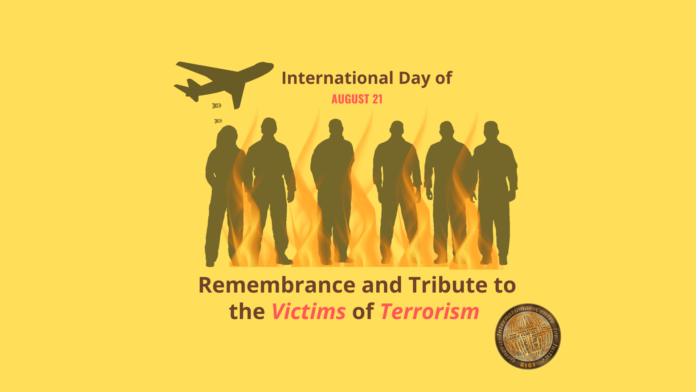
The International Day of Remembrance and Tribute to the Victims of Terrorism is observed annually on August 21 to honour victims of terrorism around the world and recognise the courage of those who survive such attacks. Established by the United Nations General Assembly in 2017 through Resolution 72/165, the day places victims and survivors at the centre of global efforts to address the human consequences of terrorism.
Terrorist attacks leave consequences that extend far beyond the immediate loss of life. Families can lose loved ones, survivors may face physical injuries and long-term psychological trauma, and entire communities can be left struggling with fear and uncertainty. The international day provides an opportunity to remember those affected while reminding governments and societies of their responsibility towards victims and survivors.
A central objective of the observance is to ensure that victims are not forgotten. Remembering those killed or injured in terrorist attacks can help preserve their stories and recognise the human cost behind statistics and headlines. Memorials, commemorations and victim-led initiatives can provide spaces where families and communities can grieve and remember.
The day also highlights the need for long-term support for survivors. Recovery from terrorism can take years, and assistance may need to extend well beyond emergency medical treatment. Survivors may require rehabilitation, psychological support, financial assistance, education, employment opportunities and help in rebuilding their lives. Ensuring that such support is accessible and sustained is an important part of a victim-centred approach.
Another important focus is the protection of human rights. Victims of terrorism have the right to dignity, justice and access to appropriate assistance. Policies addressing terrorism should therefore also take into account the rights and needs of victims and survivors, ensuring that their voices are heard in discussions about prevention, justice and recovery.
The 2026 theme, “Healing through Memory,” highlights the role that remembrance can play in the recovery process. Memory can help individuals and communities acknowledge loss, preserve the stories of victims and create a sense of solidarity. At the same time, memorialisation needs to be sensitive to the experiences of survivors and families.
In today’s digital world, remembrance increasingly takes place online. Social media, digital archives, virtual memorials and online campaigns can help preserve victims’ stories and reach audiences across borders. However, digital spaces can also expose survivors and families to distressing images, misinformation or repeated circulation of traumatic content. Safe and trauma-informed approaches to digital memorialisation are therefore increasingly important.
The observance also encourages the international community to listen to victims themselves. Their experiences can help shape policies and programmes designed to prevent terrorism, provide assistance and promote recovery. Victim associations and survivor networks play an important role in ensuring that responses to terrorism do not overlook the people whose lives have been directly affected.
Ultimately, the International Day of Remembrance and Tribute to the Victims of Terrorism is both a day of remembrance and a call for action. It asks the world to remember those whose lives were taken, stand with survivors and work towards systems that protect their rights and provide meaningful support.
By preserving memories responsibly and listening to the voices of survivors, societies can ensure that victims are remembered not merely as names or numbers, but as individuals whose lives, dreams and contributions mattered. “Healing through Memory” reminds us that remembrance can be a pathway to understanding, solidarity and a more compassionate response to those affected by terrorism.