Rajasthani handicrafts and handloom are known all across the world for their distinguished style and enchanting look.
Here are some of the handmade articles one can shop for in Jaipur.
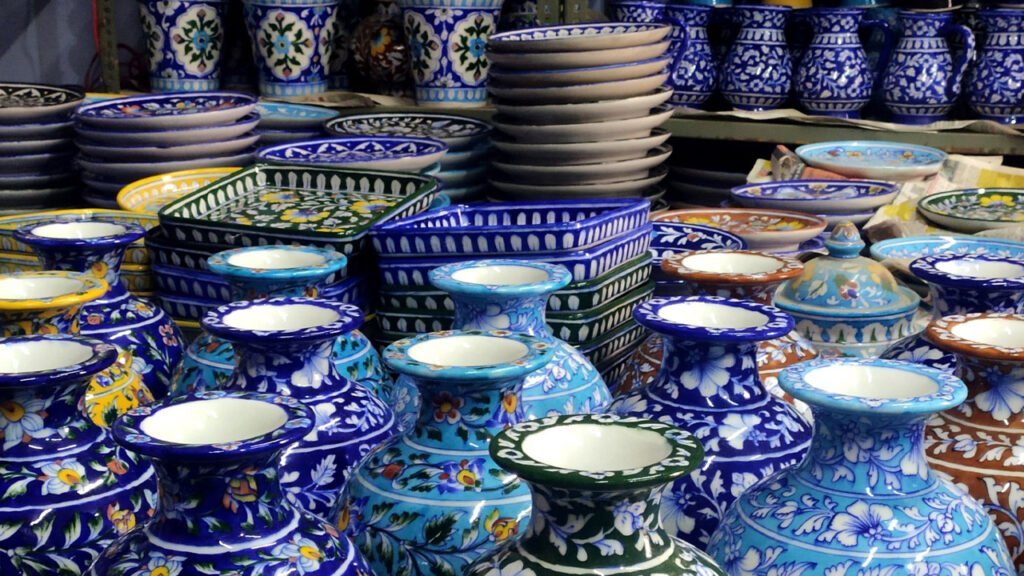
Blue Pottery
Blue pottery came to Jaipur from Persia and Afghanistan and its art form was introduced in Jaipur by the Mughals. In this style, objects are made from quartz. Materials used for blue pottery are raw glaze, sodium sulphate, and multani mitti (fuller’s earth). The attractive shades of blue and turquoise are obtained by using copper oxide and cobalt oxide..
Leather Craft: You can buy exquisite leather articles including jutis and mojaris (types of traditional shoes), chairs, musical instruments, clothes, footwear, caps, saddles, armour, bags etc being made by the skilled craftsmen of Rajasthan.
Jewellery
Jaipur is a hotspot for kundan jewellery and has a history of jewellery with precious gems that can be traced back to more than two and a half centuries. Apart from kundan, Jaipur is known for the manufacture of specialised jewellery such as Minakari and processing of coloured gems. Moreover, it is a global centre of cut and polished emeralds. One can also shop for coloured gems, silver and pearls here.
Leheriya And Bandhej: The traditional tie-and-dye fabrics like leheriya and bandhej have created a style statement across the globe. Designed by tying fabrics and then dying them is a resist-dye method, the leheriya and bandhni are iconic among Rajasthan’s traditional crafts. Bandhej designs are floral and geometric but leheriya fabrics have diagonal lines that look like waves. The colours that are mostly used in this technique are red, yellow, blue, black and green.
The 2021 International Mother Language Day will be celebrated on February 21.
The theme of the 2021 International Mother Language Day, is “Fostering multilingualism for inclusion in education and society.”
The idea to celebrate International Mother Language Day was the Bangladesh’s initiative. It was approved at the UNESCO General Conference in 1999 and has been observed throughout the world since 2000.
UNESCO believes in the importance of cultural and linguistic diversity for sustainable societies. It is within its mandate for peace that it works to preserve the differences in cultures and languages that foster tolerance and respect for others.
UNESCO believes education, based on the first language or mother tongue, must begin from the early years as early childhood care and education is the foundation of learning.
Pamela Goswami arrested with Cocaine on February 19 in Kolkata is the state secretary of the Bharatiya Janata Yuva Morcha.
She actively posts updates on social media and shares pictures of party events being held across the state.
She was arrested Friday evening in Bengal’s Kolkata for allegedly carrying 100 gm cocaine worth a few lakhs found in her purse and under the seat of the car she was sitting in.
Her friend and colleague in the Yuva Morcha, Prabir Kumar Dey, in the car was also arrested.
Do you know that Kundan jewellery came to Jaipur from Delhi. Over the years, kundan became the highlight of this royal city and hence it remains synonymous to Jaipur today.
As per the historical sources, the art of making kundan jewellery came to Rajasthan from Delhi. The process of making kundan jewellery is quite interesting which starts with a skeletal framework called ghaat.
Then, wax is poured in framework and moulded with accordance to design. This process is called paadh. Khudai is the next step where the uncut multi-coloured gemstone is laid on the framework which can be made either of pure gold or other metals. This is followed by minakari, where refining is made to define the details of the design. Then, gold foils are added that can hold the gems to the framework and this step is called pakai. Finally, the gems are polished under the chillai process.
Prithvi Vilas Palace is an offbeat getaway in Jhalawar
Prithvi Vilas Palace, a 130-year-old palace, has been converted into a heritage hotel in Jhalawar offering an experience of old bygone era Rajput chieftain residence.
This palace is recommended for offbeat getaways as it is an experiential heritage hotel, has large rooms furnished with life size paintings, frescoes, jharokas, balconies and has an open courtyard.
The property offers a variety of multi-cuisine meals such as Indian, Continental, Rajasthani and Rajput cuisine along with wellness options include an Ayurvedic massage centre.
The recreational options include a swimming pool, library, puppet shows and folk dance. Excursion activities include cycling tours, treks, jeep – camel – horse safaris, drive to Mukundgarh, Mandawa, Fatehpur and Lohargal and sightseeing
About Jhalawar
Jhalawar is a heritage town situated on border of Madhya Pradesh / Rajasthan border at a distance of 90 kms from Kota and is known for its temples with architectural significance.
As NASA’s Perseverance rover touched down on the surface of Mars after seven months in space, an Indian-American named Dr Swati Mohan, first confirmed that the rover had survived a particularly tricky plunge into the Martian atmosphere.
This Indian American Swati Mohan virtually spearheaded the successful landing of Perseverance that will search for signs on life on the Red Planet.
Swati Mohan has participated in several key NASA missions like the Cassini (a mission to Saturn) and GRAIL (a pair of spacecrafts in formation on the Moon).
She immigrated to the US from India when she was just age one and was inspired by ‘Star Trek’ series at age 9.
Mohan holds a Bachelor of Science degree in Mechanical and Aerospace Engineering from Cornell University and has completed her MS and PhD from MIT in Aeronautics/Astronautics.
Mohan wanted to be a pediatrician but she was inspired by her first physics class and saw “engineering” as a way to further her interest in space exploration.
She has been a member of the Perseverance Rover mission since its inception at NASA’s Jet Propulsion Laboratory in Pasadena, California.
The BERA BOND is a new coffee-table by Sundeep Bhutoria
Story By- Harsh Vardhan
At a time wild Tigers are in chase, Sundeep Bhutoria has engaged Macmillan publishing to sensitise readers about Leopards in Bera landscape.
About Bera and Rebaris
Bera is situated in the Pali district of Rajasthan and is often nicknamed as the ‘Leopard Country’ as it is home to one of the highest densities of leopards.
The 170-page coffee-table book (The BERA BOND) is heavy in content. But it unpacks stark humour about incredible tolerance of local shepherd community called Rebaris.
Their hamlets, agricultural fields, pastures, etc. are guarded by these predators.
“While across the globe, the coexistence of big cats with humans is marked by conflicts, the Leopards and the villagers in Bera have not attacked each other for decades” authoritatively declares this Kolkata based writer.
It has become an absorbing account of all wild big cats in the world. From the male Pasha hiding amidst granite rocks to females like Neelam and Zia, playing hide and seek with overseas and domestic visitors, you read to know more.
Lady Leopard, Neelam with her cubs, Heera and Panna, names like those of the Rebari shepherds who live along with such predators
Trace leopards at dawn and duskhere!
The text carries an inquisitive reader towards low hills, surrounded by knots of villages and a vast water body called Jawai, having a strong linkage with erstwhile royal family of Jodhpur, nay Marwar. The geography is limited for people. But Leopards find it limit-less. One time nocturnal, now this crafty animal marks its attendance, almost at an appointed hour at dawn and dusk. Like to meet him at a temple? Brilliant photos portray all this.
Villagers treat this wild animal as a divine associate
The rural fate rests on pastoral economy. Leopard’s destiny has to oscillate over the sheep-flocks. He has to stealthily snatch away a lamb to meet both ends meet. The rural folk do not mind the loss. They treat this wild animal as a divine-associate! The writer scratches local vegetation: spider-flowers, wild mushrooms, wild fungus, euphorbia, and thorny acacia trees. The photograph of a sub adult Indian Courser: wonder if any one reported it earlier? Birds at Jawai are named. So are other mammals eg Rusty-spotted Cat.
Meet this conservationist Shatrunjay
Sundeep praises Shatrunjay Pratap Singh, who spread out a rustic-looking yet most luxurious lodge at Bera. Its wondrous location enables you to spot Leopards from one’s room. He is a fierce conservationist and is adamant not to increase room-numbers, seven only! Ethics at cost of revenue. At a young age, he has become an ex situ guardian for this habitat which ironically does not enjoy appropriate regulations. Do what you like here and no entry fee to check you.
An inspirational approach runs through the text to offer tips for other wildlifers. Shatru has received a benign patron in Sundeep who has caused a niche in penmanship-partnership. CP Singh Rathore, Gopal Singh and Umesh Gogna have been acknowledged for their photography. Shatru, his wife, Katyani Kumari and their twins find appreciable mention for their impeccable hospitality and unending smiles. One shall have to visit the scene to understand what is in store.
Sundeep Bhutoria, the Kolkata-based author at the Jawai Dam, a consequential equity across the Bera landscape
For a community-led conservation initiative
Sundeep has donned a new attire by embracing wilderness and its denizens. Nearly 40% of his total books revolve around wild species. The Bera Bond is truly a promotional enterprise: “My only intention behind writing this book is to inspire people to save the big cats.” He prefers to dedicate it to Aavya and Manjari. Any reason photos of a few hotels, citation of weddings and personas in attendance, have been laced in? To entice such aficionados in to wildlife conservation?
Summing up this first travelogue treatise on Leopards, the writer sounds an optimistic note, “Bera holds out hope of a remarkable turnaround through a community-led conservation initiative.”
But he also bleeds: Any reason why Bera has not been declared as a Community Reserve to let local stake-holders start receiving economic benefits out of Leopard centric tourism? The answer may lie with good Samaritans in forest department, some cited by him in this text.
Phad painting of Rajasthan is a 700 year old legacy. Depicting a kind of scroll painting, it narrates the elaborate religious stories of local deities and Gods.
Passed down over generations within a single family, it finds its origin in Shahpura near Bhilwara in Rajasthan,
Many centuries back, these traditional paintings, created as travelling or mobile temples, were carried by priest-singers of the Rabari tribe, called Bhopas and Bhopis. They sang and performed stories of their local deities including Devnarayanji (a reincarnation of Vishnu) and Pabuji (a local hero). The Phad painting were unrolled, or unfolded after sunset, and they performed in front of village members till the night. This is perhaps why the paintings are called ‘Phad’, which means ‘fold’ in the local dialect.
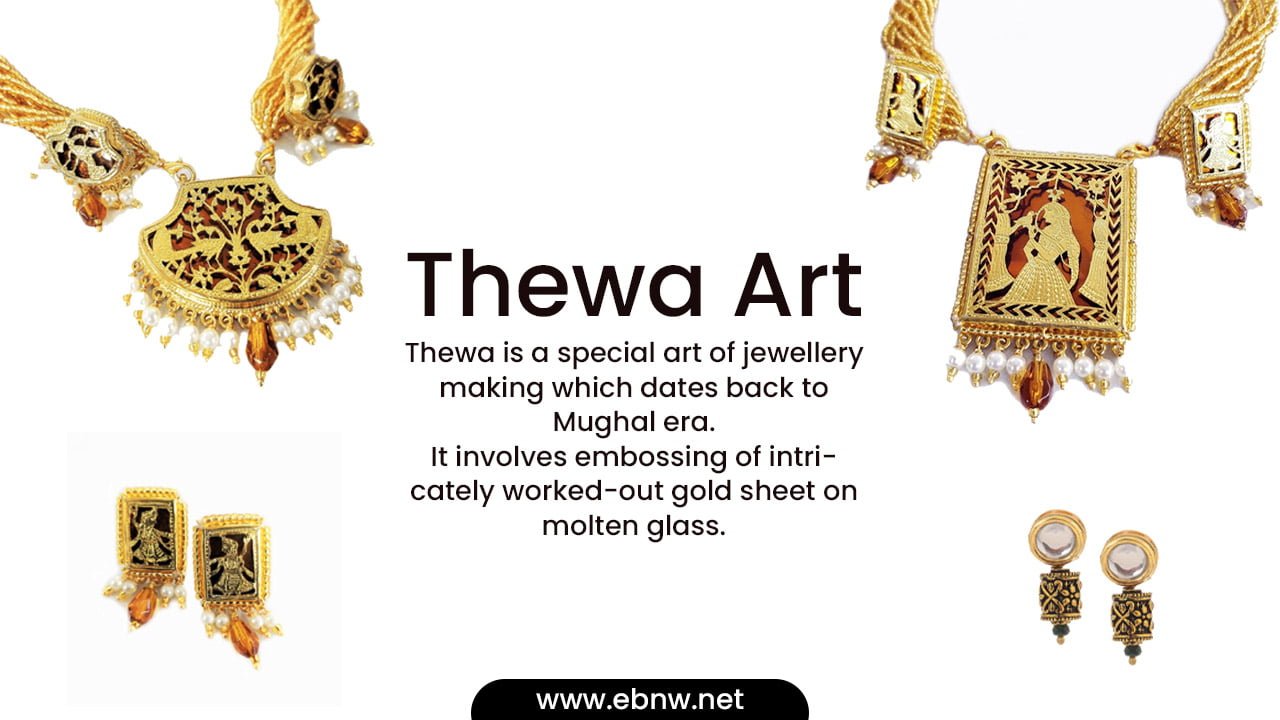
Thewa is a special art of jewellery making which dates back to Mughal era. It involves embossing of intricately worked-out gold sheet on molten glass.
This traditional art of fusing 23K Gold with multicoloured glass originated in Pratapgarh district of Rajasthan. The glass is treated with a special process to bring out glittering effects, which in turn highlights the intricate gold work. The whole Thewa piece is hand crafted which takes around a month’s time by skilled artisans.
Thewa uses motifs on jewellery, showcasing the culture, heritage and tales of romance and valour of Rajasthan .
Origin:
The origin of Thewa art goes back to 1707 when a craftsman named Nathu ji Soni from Pratapgarh invented the process to create this art, considered as one of the most expensive art forms. His skills were passed on to the next generation of his family who call themselves “Raj-Sonis”. Many craftsmen from this family have been honoured with esteemed awards including UNESCO, National and State Government awards.
In 2011, the Raj-Sonis of Rajasthan made their way into the Limca Book of Records; this is the only family with nine national awards. In 2015, Mahesh Raj Soni was bestowed with Padma Shree for his excellent Thewa handicraft.
Pichwai paintings of Rajasthan originated in Nathdwara in Udaipur district around 400-year-old. Being vibrant, attractive, intricate and visually stunning, these paintings depict the tales from Lord Krishna’s life.
The characteristic features of Pichwai paintings are large eyes, a broad nose and a heavy body, similar to the features on the idol of Shrinathji, a divine form of Lord Krishna. These paintings showcase various legends surrounding Lord Krishna.
These intricate paintings take anywhere between two weeks and a few months, depending on the size of the canvas and detailing of the work.