Home Blog Page 81

Rajasthan Courts Clear Far More POCSO Cases Than Filed, Disposal Rate Hits 170%

0

India’s disposal rate of POCSO cases is now at 109% while Rajasthan surpasses it with 170%
This means that Rajasthan courts disposed of more cases than registered in a year, clearing major chunk of backlog
A recent study suggests setting up 600 additional e-POCSO courts across India to end entire backlog in 4 years
Study conducted by Centre for Legal Action and Behaviour Change for Children, an initiative of India Child Protection

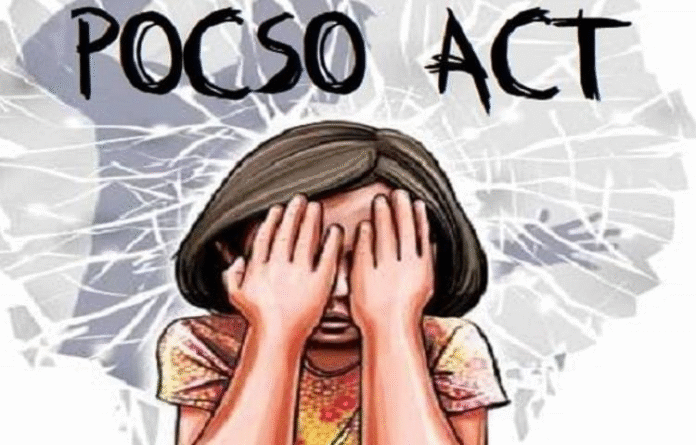
In a landmark moment for child justice in India, courts have cleared more POCSO cases than they received in a single year, and Rajasthan has surpass even the national rate of 109 percent by recording the disposal rate of 170 percent. In 2025, while 692 cases under Protection of Children from Sexual Offences (POCSO) were registered, Rajasthan courts disposed of 1173 cases clearing a major chunk of backlog from previous years. Meanwhile, nationally 80,320 child sexual abuse cases were filed while 87,754 were disposed of in 2025, achieving a disposal rate of 109 percent, according to report “Pendency to Protection: Achieving the Tipping Point to Justice for Child Victims of Sexual Abuse” by Centre for Legal Action and Behaviour Change (C-LAB) for Children, an initiative by India Child Protection. Notably, 24 states also recorded disposal rates above 100 percent. The report recommends setting up 600 additional e-POCSO courts to end the entire backlog of POCSO cases within four years.

Often tarnished by the ‘tareek pe tareek’ image, India’s backlog of POCSO cases stood at 2,62,089 as of 2023. But with this new shift when the disposals surpassed registrations, the report states that the country has reached the tipping point “where the justice system begins to move from managing backlog to actively reducing it.” The report recommends allocating INR 1977 crore for additional 600 e-POCSO courts for a period of four years to completely end pendency, for which Nirbhaya Fund can be utilized as well.

The report further highlights a few worrying gaps such as inter-state disparities in disposal rates, fluctuating conviction rate and that nearly half of pending cases remain unresolved for over two years. For instance, in Rajasthan 7 percent of the pending cases have been pending for 6-10 years, 4 percent for 5 years, 12 percent for 4 years, 31 percent for 3 years and remaining 46 percent for 2 years.

These figures reflect cases that entered the system several years ago but have not seen meaningful progress. “This suggests that pendency begins to accumulate early in the lifecycle of a case and that the system faces challenges in moving cases forward within the expected time frame,” the report said.

Highlighting the broader implications of the data in a wider justice context, Purujit Praharaj, Director (Research), India Child Protection, said, “India is now at a tipping point in its response to child sexual abuse. When the system begins to dispose of more POCSO cases than it registers, it moves from intent to impact. Our research consistently shows that prolonged delays intensify trauma for child survivors. Sustaining this momentum is essential if timely, child-centred justice is to become the norm rather than the exception.” India Child Protection is partner of Just Rights for Children which is the largest network of NGOs with over 250 NGO partners working in 451 districts across the country for child protection and child rights.

The report also recommends maintaining a year-on-year disposal rate of over 100 percent in every state/UT, providing technical and administrative support to state judiciaries lagging behind and meticulous monitoring of conviction and acquittal rates. The report also recommends the use of AI-powered legal research tools and document management systems to facilitate efficient case analysis and document retrieval.

Among states, seven states and Union Territories logged a disposal rate of over 150 percent, other seven have a disposal rate between 121-150 percent while 10 states achieved a disposal rate between 100-120 percent. These 24 states, therefore, are not only disposing of cases registered in 2025 but also managed to clear some of the previous years’ cases.

The report is based on the data (as of 2nd December, 2025) drawn and analysed from National Judicial Data Grid (NJDG), National Crime Records Bureau (NCRB) and Lok Sabha questions and answers.

India New Zealand Free Trade Agreement Negotiations Finalised, A Major Boost to Trade and Mobility

0

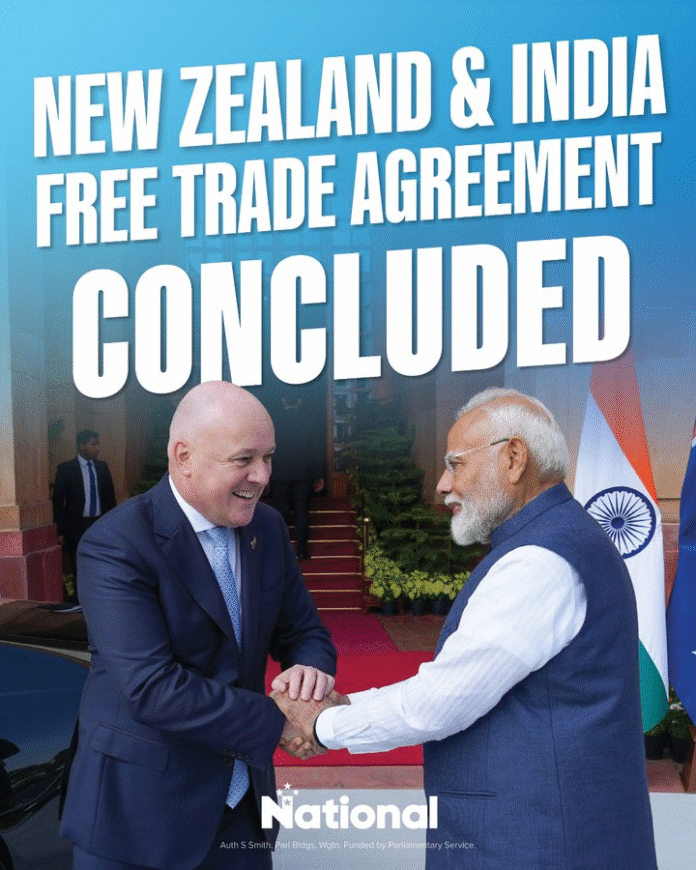
India and New Zealand have concluded negotiations on a long awaited free trade agreement, marking a major step forward in bilateral economic relations. The announcement was made after talks between Prime Minister Narendra Modi and New Zealand Prime Minister Christopher Luxon, signalling strong political intent from both sides to deepen trade, investment and people to people ties. The agreement is being seen as one of India’s fastest trade negotiations with a developed economy and aligns with India’s broader Viksit Bharat vision.

deal finalised at unusual speed

Negotiations for the free trade agreement began in March 2025 and were concluded after five formal rounds of talks within a span of nine months. Trade experts note that this is a relatively short timeframe for an agreement of this scale, particularly between economies with different market structures and sensitivities. Both governments have described the conclusion as a result of shared ambition and sustained diplomatic engagement.

What India gains from the agreement

Under the agreement, Indian exports will receive zero duty access across all tariff lines in the New Zealand market. This is expected to benefit labour intensive and manufacturing sectors such as textiles, apparel, leather, footwear, marine products, gems and jewellery, engineering goods and automobiles. Easier market access is likely to improve competitiveness of Indian products and open new opportunities for exporters, especially small and medium enterprises.

What New Zealand brings to the Indian market

New Zealand will see tariff reductions or eliminations on about ninety five percent of its exports to India, with more than half of these becoming duty free from the first day the agreement comes into effect. Key exports expected to benefit include sheep meat, wool, forestry and wood products, seafood and select industrial goods. The Indian market is expected to provide significant growth potential for these sectors.

Investment and mobility opportunities

Beyond trade in goods, the agreement places strong emphasis on investment and services. New Zealand has committed to facilitating long term investment into India over the next fifteen years, supporting sectors such as infrastructure, manufacturing, services and innovation. The pact also includes improved mobility provisions for Indian professionals, students and youth, including new employment entry pathways, work holiday visas and enhanced post study work opportunities.

Protection for sensitive sectors

India has taken a calibrated approach to tariff liberalisation under the agreement. Sensitive sectors such as dairy, milk products, coffee, sugar, onions, spices and edible oils have been excluded from tariff concessions. The government has said these safeguards are essential to protect domestic farmers and local industries from sudden import pressures.

What imeans for bilateral trade

Bilateral trade in goods and services between India and New Zealand currently stands at around two point four billion dollars annually. With the free trade agreement in place, both countries aim to double trade volumes within five years. Officials believe the deal will strengthen supply chains, create employment and enhance economic resilience on both sides.

The road ahead

The agreement is expected to be formally signed in the coming months, followed by legal vetting and parliamentary approvals. Once implemented, it will mark a significant milestone in India New Zealand relations, offering tangible benefits for exporters, investors, professionals and students while reinforcing strategic economic cooperation between the two nations.

National Farmers Day 2025: Theme, History, Significance and Role of Chaudhary Charan Singh

0

National Farmers Day 2025, also known as Kisan Diwas, is observed across India on 23 December to recognise the invaluable contribution of farmers to the nation’s economy, food security and rural livelihoods. The day marks the birth anniversary of Chaudhary Charan Singh, India’s fifth Prime Minister and a staunch advocate of farmers’ rights and agrarian reforms.

National Farmers Day serves as a reminder that India’s development is deeply rooted in the strength of its agricultural sector and the welfare of its farmers.

National Farmers Day 2025 Theme

The theme for National Farmers Day 2025 is:

The theme highlights the growing importance of Farmer Producer Organisations (FPOs) in transforming Indian agriculture into a globally competitive and market-driven sector. FPOs empower small and marginal farmers through collective bargaining, improved access to modern technology, quality inputs, institutional credit and global markets.

By strengthening agricultural value chains, promoting agri-exports and encouraging sustainable farming practices, FPOs are seen as key enablers in achieving the vision of Vikasit Bharat by 2047.

History of National Farmers Day

  • National Farmers Day, or Kisan Diwas, is observed annually on 23 December.
  • The date commemorates the birth anniversary of Chaudhary Charan Singh.
  • The Government of India officially declared the day in 2001.
  • Chaudhary Charan Singh is remembered for his unwavering commitment to farmers’ rights and rural development.
  • He played a pivotal role in land reforms and the abolition of the zamindari system.
  • The observance acknowledges farmers’ contribution to food security and economic stability.
  • It also provides a platform to discuss agrarian challenges, policy reforms and farmer welfare.
  • Seminars, awareness programmes and agricultural initiatives are organised nationwide on this day.

Who Was Chaudhary Charan Singh?

Chaudhary Charan Singh was a freedom fighter, statesman and agrarian reformer who served as India’s fifth Prime Minister (1979–1980). Born on 23 December 1902 into a farming family in Uttar Pradesh, he developed a deep understanding of rural and agrarian issues from an early age.

A consistent voice for peasants and small farmers, Charan Singh opposed urban-centric industrialisation at the cost of agriculture. He firmly believed that India’s progress depended on the prosperity of its villages. Owing to his lifelong dedication to farmer welfare, he is widely regarded as the “Champion of Farmers.”

Chaudhary Charan Singh’s Contribution to Farmers

  • Played a key role in implementing zamindari abolition laws in Uttar Pradesh in the 1950s, transferring land ownership to millions of tenant farmers.
  • Introduced land ceiling reforms as Revenue Minister and Chief Minister of Uttar Pradesh to benefit small and marginal farmers.
  • Authored “India’s Poverty and Its Solution” (1939), highlighting agricultural neglect as the root cause of rural poverty.
  • Advocated remunerative crop prices, laying the ideological foundation for price-support mechanisms.
  • Promoted cooperative institutions and institutional credit to reduce farmers’ dependence on moneylenders.
  • Emphasised strengthening the village economy as the backbone of Indian democracy.
  • As Prime Minister, prioritised rural development and farmer-centric governance.

Significance of National Farmers Day 2025

  • Recognises farmers’ critical role in food security, rural employment and economic stability.
  • Highlights agriculture’s importance as a livelihood source for nearly half of India’s population.
  • Pays tribute to Chaudhary Charan Singh’s vision of agriculture-led national development.
  • Raises awareness about challenges such as climate change, rising input costs and market volatility.
  • Encourages discussion on farmer-centric reforms, including income support and crop insurance.
  • Promotes sustainable and climate-resilient farming practices.
  • Emphasises technology, innovation and digitisation in agriculture.
  • Strengthens focus on FPOs for better market access and collective growth.
  • Serves as a platform to review government schemes for farmers’ welfare.
  • Reinforces the idea that rural prosperity is essential to achieving Vikasit Bharat 2047.

Viksit Bharat G RAM G Bill Receives Presidential Assent: A Major Overhaul of India’s Rural Employment Law

0

In one of the most significant policy shifts in recent years, President Droupadi Murmu has given her assent to the Viksit Bharat Guarantee for Rozgar and Ajeevika Mission (Gramin) Bill, 2025, officially transforming it into law. The new legislation, now known as the VB-G RAM G Act, 2025, replaces the two-decade-old Mahatma Gandhi National Rural Employment Guarantee Act (MGNREGA), 2005, which has been one of India’s most prominent rural livelihood programmes. The bill was introduced in the Lok Sabha on December 16, swiftly passed by both houses of Parliament later that week and signed into law on December 20.

Why this matters: What the new laguarantees

Under the new VB-G RAM G Act, rural households whose adult members are willing to undertake unskilled manual work are entitled to a statutory guarantee of at least 125 days of wage employment in each financial year. This builds on MGNREGA’s existing framework, which legally guaranteed 100 days of work per year, expanding the horizon for rural job opportunities. The government says the aim is not only to ensure more work but to link employment with the creation of durable, productive rural assets such as water conservation, infrastructure and livelihood assets, strengthening long-term economic security.

shift in approach: From accountability to development focus

The VB-G RAM G Act reflects a shift in the way rural employment is structured. While MGNREGA was a rights-based, demand-driven legal guarantee, the new law embeds rural work within a broader development framework. It emphasises convergence of government schemes, saturation-based service delivery and alignment with the national vision of Viksit Bharat 2047, an integrated approach aimed at transforming rural economies and infrastructure. According to the Union Rural Development Ministry, this marks a transition from a standalone welfare scheme to a tool for inclusive growth, resilience and empowerment.

Key Features: Modernisation and governance

Several features distinguish the VB-G RAM G Act from its predecessor. A 60:40 cost-sharing model between the Centre and states, with higher Central support for north-eastern and Himalayan states, replaces the earlier predominantly Central funding pattern. There is greater emphasis on digital tools such as biometric attendance, geo-tagging and real-time monitoring dashboards to improve transparency and accountability. Local planning through Gram Panchayats and Gram Sabhas continues, but within a framework designed for better convergence across schemes and departments.

Supporters and Critics: A heated debate

The bill’s passage has sparked mixed reactions. The government and its supporters argue the VB-G RAM G Act modernises rural employment policy, strengthens livelihood security and lays the foundation for a prosperous rural Bharat. They contend that the increased guarantee of employment days and enhanced implementation tools will improve both living standards and rural infrastructure.

However, critics, including opposition parties and worker groups, have raised objections. Many worry that replacing MGNREGA undermines the enforceable legal right to work that the 2005 Act provided, turning a guaranteed entitlement into a more discretionary, budget-controlled scheme. Some argue that the shift in funding responsibility to states and the change in approach may weaken rural workers’ leverage and introduce uncertainty into what was once a robust social safety net. Protests and debates in Parliament reflected these concerns.

What happens next

With presidential assent secured, the VB-G RAM G Act will come into force on dates notified by the central government. State governments are required to announce schemes consistent with the Act within six months of its commencement. As implementation begins, the country will watch closely to see how this redesigned rural employment programme unfolds on the ground and how it impacts the lives of millions of rural households across India.

Travel in 2026 Will Be Different: From Noctourism and Pop Culting to Passioncations and Eco-scapes

0

Travel is no longer just about changing locations; it is about changing perspectives. As 2026 approaches, the way people plan holidays is undergoing a quiet but powerful transformation. Travellers are moving away from rushed itineraries and checklist tourism, choosing instead journeys shaped by emotions, interests and personal meaning. New-age travel trends reflect a desire to connect more deeply with culture, creativity, nature and even oneself. From night-time adventures to pop culture pilgrimages, travel next year is set to be more intentional, immersive and expressive than ever before.

Pop Culting: When stories decide the destination

Pop culting is redefining why people travel. Instead of asking “where should I go?”, travellers are now asking “what do I love?” and building trips around it. Films, music, television shows, books and celebrity culture are becoming powerful travel motivators. Fans travel to filming locations, music landmarks and cultural hubs not just for sightseeing, but to experience nostalgia and emotional connection. Visiting K-pop districts in Seoul, Harry Potter filming spots in the UK, Bollywood locations in Switzerland or iconic football stadiums in Europe allows travellers to step into worlds they have admired for years. These trips blend fandom with exploration, turning holidays into deeply personal experiences.

Passioncation: Travel that reflects whyou are

Passioncations focus on interests rather than destinations, making holidays feel purposeful and fulfilling. Food lovers design trips around culinary trails, wine enthusiasts explore vineyards, wellness seekers choose yoga retreats, while art and architecture lovers plan journeys through museums and historic cities. Instead of packed schedules, passioncations allow travellers to slow down, learn and engage deeply with what excites them. This trend also reflects a shift toward self-growth through travel, where holidays become opportunities to nurture creativity, skills and curiosity rather than just escape routine.

Noctourism: Discovering the world after sunset

Night-time travel experiences are becoming a major draw as travellers seek unique, less crowded and more atmospheric adventures. Noctourism highlights activities that come alive after dark, such as stargazing in deserts, northern lights viewing in Arctic regions, night safaris, moonlit beach walks and late-night food explorations. Many destinations are now curating experiences specifically for night-timetravellers, offering a different rhythm and sensory appeal. For those overwhelmed by daytime crowds, noctourism provides a calmer, almost magical way to explore places under the stars.

Calmcations: The rise of quiet, restorative travel

In a world dominated by notifications, noise and constant movement, calmcations offer a much-needed pause. These holidays prioritise mental wellness, digital detox and emotional restoration. Travellers choose serene destinations with minimal distractions, focusing on mindfulness, nature walks, slow mornings and restorative therapies. Whether it’s a mountain retreat, countryside stay or wellness resort, calmcations respond to burnout culture by redefining luxury as peace, silence and quality rest rather than indulgence.

Frolleagues and bucket list breaksblending work, friendship and dreams

The boundaries between work and leisure continue to blur, giving rise to travel with frolleagues colleagues who double as friends. These trips balance meetings with exploration, turning work travel into shared experiences. At the same time, many travellers are prioritising bucket-list journeys, driven by a renewed appreciation for life after global disruptions. From Antarctica expeditions to African safaris and ancient heritage routes, people are investing in once-in-a-lifetime experiences that leave lasting memories.

Eco-scapes: Travelling with responsibility

Sustainability is no longer a niche concept but a core travel value. Eco-scapes represent journeys that respect nature, local communities and cultural heritage. Travellers are choosing eco-friendly accommodations, low-impact activities and destinations committed to conservation. This trend reflects a growing awareness that travel should give back rather than take away, allowing people to explore the world while protecting it for future generations.

What this means for travellers in 2026

Travel in 2026 is about intention over impulse. Whether it’s chasing childhood fandoms, exploring passions, finding peace, embracing night adventures or travelling responsibly, the focus is on experiences that resonate emotionally. The future of travel invites people to journey not just across maps, but into stories, interests and moments that truly matter.

Pink Tax and Beyond: The Invisible Bill Women Pay Every Single Day

0

The cost of being a woman is rarely printed on a receipt, yet it quietly adds up across a lifetime. From personal care to safety, healthcare and even career choices, women often end up paying more not because they consume more, but because systems are designed that way. This layered financial burden is now being described as the hidden taxes women pay, long before salaries are counted or savings are planned.

The pink tax that begins early

The pink tax refers to products marketed to women costing more than similar products for men. Razors, deodorants, perfumes, haircuts and even clothing often carry a higher price tag simply because they are labelled for women. Studies and consumer audits in India and globally have repeatedly shown that functionally identical products differ in price due to packaging, colour or branding. It starts early from toys and school supplies and quietly follows women into adulthood.

The safety tax nobody budgets for

Safety is not optional, but it is expensive. Women routinely spend extra on cabs instead of public transport, live closer to workplaces to avoid late travel, pay more for secure housing, or invest in self-defence classes and safety gadgets. Even something as simple as choosing well-lit cafés or trusted delivery services often comes at a premium. These costs exist not out of choice, but necessity and they are rarely acknowledged as economic pressure.

Health tax hidden in Biology

Healthcare adds another invisible layer. Menstrual products, gynaecological visits, prenatal care, contraception and hormone-related treatments form a recurring expense that men simply do not face. Despite policy changes like GST reductions on sanitary products, associated costs pain medication, doctor consultations, supplements still fall largely on women. Long-term health issues like anaemia, PCOS and post-pregnancy recovery often demand sustained spending, both medical and emotional.

The career cost of caregiving

Women frequently pay a career tax that directly affects lifetime earnings. Career breaks for childbirth, childcare or elder care reduce promotions, increments and retirement savings. Even when women return to work, flexible roles often come with lower pay. This invisible penalty compounds over decades, widening the gender wealth gap far beyond monthly salaries.

Beauty, appearance and social expectations

Society places disproportionate pressure on women to look a certain way, especially in professional spaces. Grooming, skincare, makeup and wardrobe upkeep are often seen as basic expectations rather than optional choices. The financial and emotional investment required to meet these standards is rarely acknowledged, yet deeply ingrained.

Why this hidden cost matters

These layered taxes may seem small individually, but together they form a significant financial disadvantage. Recognising them is the first step toward policy change, workplace reform and consumer awareness. Until these costs are acknowledged, equality will remain incomplete not just socially, but economically.

The real question is no longer whether the hidden cost exists, but why it continues to go unpaid, unmeasured and unnoticed.

(The writer of this article is Rishita Sogani)

Shooting Begins for PM Modi Biopic ‘Maa Vande’; Unni Mukundan to Play the Prime Minister

0

Shooting has commenced for the biopic Maa Vande, based on the life of Prime Minister Narendra Modi. Popular Malayalam cinema actor Unni Mukundan will portray the role of the Prime Minister in the film. Mukundan was last seen in the film Marco.

The makers announced the start of filming on Saturday through their official X (formerly Twitter) handle. The post included a video offering glimpses of the traditional puja ceremony held ahead of the shoot.

The caption read, “Shooting for Maa Vande has begun. A new chapter is now beginning in telling the story of the man who shaped the destiny of the nation.”

The film was officially announced in September on the occasion of Prime Minister Modi’s birthday. Maa Vande is being produced by Veer Reddy M under the banner of Silver Cast Creations, while direction is helmed by filmmaker Kranti Kumar CH.

Notably, Unni Mukundan had met Prime Minister Narendra Modi in Kochi in 2023.

Who is Unni Mukundan?

Unni Mukundan is a well-known actor in the Malayalam film industry. He was born in Thrissur, Kerala, but spent a significant part of his early life in Gujarat, completing his schooling in Ahmedabad.

He made his acting debut with the Tamil film Seedan in 2011. After initially playing supporting roles, he rose to prominence with his first lead role in Mallu Singh (2012). He went on to feature in several successful films, including Vikramadithyan (2014), KL 10 Patthu (2015), Style (2016), Oru Murai Vanthu Parthaya (2016), Achayans (2017), Malikappuram (2022), and Marco (2024).

Unni Mukundan has also worked in other languages, appearing in the Telugu blockbuster Janatha Garage (2016) and the Tamil film Garudan (2024).

In recognition of his work, he won the National Film Award in 2021 for his performance in Meppadiyan.

Elon Musk Wealth Surpasses Combined GDP of Pakistan, Sri Lanka, and Nepal

0

The world’s richest person, Elon Musk, now has a net worth exceeding the combined GDP of Pakistan, Sri Lanka, and Nepal. In just four days, Musk’s wealth surged by $150 billion (₹13.46 lakh crore), briefly crossing $750 billion (₹67.18 lakh crore). The combined GDP of the three countries is estimated at around $555 billion.

Musk is the first individual in history to reach such a staggering level of personal wealth. Earlier, on December 16, his net worth stood at $600 billion (₹54 lakh crore). This dramatic rise followed a key ruling by the Delaware Supreme Court, which significantly enhanced Musk’s Tesla compensation package.

According to the Forbes Billionaires Index, Musk’s current net worth is estimated at $649 billion. This amount is equivalent to the combined wealth of India’s top 40 richest individuals. Remarkably, Musk’s fortune also exceeds the combined wealth of the world’s next richest tech billionaires—Larry Page ($252.6 billion), Larry Ellison ($242.7 billion), and Jeff Bezos ($239.4 billion).

Three Major Reasons Behind Musk’s Wealth Surge

1. Restoration of Tesla’s $56 Billion Pay Package
In 2018, Tesla awarded Musk a $56 billion stock-option compensation package. A lower court cancelled it in 2024, but in December 2025, the Delaware Supreme Court reinstated the package. Due to Tesla’s rising valuation, the package is now worth an estimated $139 billion. This decision triggered the single largest jump in Musk’s wealth, pushing it beyond $700 billion for the first time.

2. SpaceX Valuation Touches $800 Billion
According to Reuters, an internal share sale recently valued SpaceX at $800 billion. Musk owns about 42% of the company. If SpaceX eventually lists on US stock exchanges at this valuation, Musk’s stake alone could be worth more than $336 billion.

3. Tesla Share Price Rise and New $1 Trillion Pay Package
Tesla’s rising share price, combined with shareholder approval of Musk’s new $1 trillion pay package in November 2025, further boosted his wealth. More than $340 billion was added to Musk’s net worth in 2025 alone. Musk holds around a 12% stake in Tesla, meaning any increase in share price directly raises his personal wealth.

Elon Musk’s Net Worth Increased 75 Times in 10 Years

YearNet Worth
2016$10.70 billion (₹94,800 crore)
2017$13.90 billion (₹1.23 lakh crore)
2018$19.90 billion (₹1.76 lakh crore)
2019$22.30 billion (₹1.97 lakh crore)
2020$24.60 billion (₹2.18 lakh crore)
2021$151.00 billion (₹13.38 lakh crore)
2022$219.00 billion (₹19.41 lakh crore)
2023$180.00 billion (₹15.96 lakh crore)
2024$195.00 billion (₹17.29 lakh crore)
2025$500.00 billion (₹43.99 lakh crore)
2025 (Dec)$750.00 billion (₹67 lakh crore)

Source: Forbes, December 2025

Role of Tesla and xAI

Tesla:
Apart from SpaceX, Tesla remains a major contributor to Musk’s fortune. In 2025, Tesla shares have climbed 13%. On Monday, shares rose nearly 4% after Musk announced that Tesla was testing robotaxis without a safety monitor in the front passenger seat. Musk’s Tesla stake is currently valued at approximately $197 billion.

xAI:
Musk’s artificial intelligence startup, xAI, is reportedly in advanced talks to raise $15 billion in new funding at a valuation of $230 billion, further adding to his growing wealth portfolio.

From a Teenage Game Developer to Global Tycoon

Elon Musk began his entrepreneurial journey at a young age. He learned computer programming at 10 and created a video game called Blastar at just 12 years old, selling it to a local magazine for $500—his first business success.

In 1995, Musk co-founded web software company Zip2, which was acquired by Compaq in 1999 for $307 million. Musk earned $22 million from his 7% stake. He went on to found PayPal in 1999, which was acquired by eBay in 2002 for $1.5 billion, earning Musk $180 million.

Soon after, Musk founded SpaceX with the ambition of making humanity a multi-planetary species by establishing a colony on Mars—a vision that continues to shape his business empire today.

Year-End 2025 Property Sale Tax Tips You Must Know to Save Capital Gains Tax

0

If you sold a property in 2025, you might be facing a significant capital gains tax bill or you may have smart options available to reduce or even eliminate that liability. The tax rules for property sale profits have changed recently, and understanding how to optimise your tax position before the financial year closes can make a substantial difference to your finances. 

How long term capital gains tax works after selling property

When you sell a property held for more than 24 months, it is treated as a long term capital asset in India. Long term capital gains (LTCG) on such assets are subject to tax at a lower rate. Under the current regime, LTCG tax is charged at 12.5 percent without indexation, which replaced the older system where gains were taxed at 20 percent with inflation indexation. That means your gains are calculated on the raw difference between the sale price and the purchase cost, making exemptions and deductions even more important to reduce tax. 

How comparing two computation methods can help

Under the amended tax rules, taxpayers must calculate long term capital gains in two ways: one at a 12.5 percent rate on unadjusted gains and another at a higher rate after adjusting for indexation benefits. You are required to pay tax on the lower of the two figures. This can reduce your tax burden substantially if indexation works in your favour, as seen in real scenarios where the second method yields a much lower taxable gain. 

Section 54 exemption for buying a new home

One of the most powerful tax savings options is provided under Section 54 of the Income Tax Act. If you sell a residential property and use the long term capital gains to buy or construct another residential property, you can claim full exemption on the capital gains. The new home must be purchased within one year before or two years after the sale, or it must be constructed within three years. This rule remains one of the most popular ways for sellers to avoid paying any tax on profits, provided all conditions are met. 

Section 54F or non residential assets

If the capital gains arise from selling an asset other than a house such as land, commercial property, gold, or other capital assets you can still claim exemption under Section 54F by investing the net sale proceeds (not just the gains) into a residential house. The same timelines apply for purchase or construction. This option helps investors diversifying into real estate to save tax when selling non-residential assets. 

Section 54EC for bonds to save tax without reinvesting in property

If you do not plan to buy or build a new house, Section 54EC offers a way to defer or avoid capital gains tax by investing the gains in specified government-approved bonds, such as those issued by the National Highways Authority of India or the Rural Electrification Corporation. These bonds must be purchased within six months of the sale, and they usually come with a five-year lock-in period. While the returns tend to be modest, this method locks in a tax break on the capital gains. 

Use of capital gains account scheme when reinvestment is delayed

Sometimes you may not be ready to buy a new property immediately after selling one, or you may be waiting for a suitable opportunity. In such cases, the Capital Gains Account Scheme (CGAS) lets you park your gains in a designated bank account, effectively preserving your eligibility for exemptions under Section 54 and Section 54F. However, be cautious: depositing without a clear reinvestment plan can increase tax if the funds are withdrawn without fulfilling exemption conditions. 

Why joint ownership and expense deductions can reduce tax

If a property was jointly owned with family members, splitting the capital gains among co-owners can utilise each person’s basic exemption limit, thereby lowering the total tax. In addition, deducting legitimate selling expenses such as brokerage fees, legal charges and advertising costs can reduce your taxable gain. These smaller steps can add up to meaningful tax savings, particularly when combined with other exemption strategies. 

Timing your sale and advance tax planning

Where timing allows, carefully planning the sale date can improve your cash flow and tax outcome. Selling before the end of a fiscal year triggers advance tax liability that often needs to be settled quickly. Postponing a sale into the next fiscal year, when possible, can allow you to spread advance tax payments over instalments and optimise your planning. 

Why professional advice matters before filing ITR

Property tax planning can be complex, especially when exemptions, bonds, reinvestment deadlines and capital gains computations intersect. Consulting a qualified chartered accountant or tax advisor before filing your income tax return is crucial to ensure you have claimed all eligible exemptions and complied with conditions. This can help you avoid penalties or missed opportunities that result in unnecessary tax. 

Why UPSC Ethics Syllabus Revamp Matters for Gen Z Aspirants and Civil Services Preparation

0

The Union Public Service Commission (UPSC) has updated its ethics component within the Civil Services examination framework, spotlighting contemporary relevance, real-world application and value-based governance. Often seen as one of the most challenging papers, the ethics paper now calls for a deeper understanding of how moral values, integrity and professional conduct influence public administration, policy decisions and leadership in complex societal contexts. The revision reflects changing expectations from future civil servants and emphasises ethical reasoning as an essential skill rather than just another theoretical subject. 

Ethics as the heart of civil services values and governance

The UPSC ethics syllabus, formally known as Ethics, Integrity and Aptitude, occupies a central place in the Civil Services exam. It tests not just what candidates know but how they think, judge and respond to real life dilemmas. Instead of rote memorisation, the paper looks for clarity in reasoning, coherence in ethical arguments and sensitivity towards social realities. It evaluates aspirants on values like truth, compassion, accountability, impartiality and respect for diversity, all of which are fundamental to the civil services ethos. 

Understanding human values as the foundation of decision making

At the core of the updated syllabus is the idea of human values the basic principles that guide behaviour and shape ethical choices. This includes self-reflection, empathy, respect for others and commitment to fairness. The syllabus encourages aspirants to connect these values with everyday decisions that public servants must make, especially when balancing competing interests, social expectations and legal boundaries. By placing human values at the centre, UPSC nudges future administrators to internalise integrity rather than merely learn definitions. 

Role of governance and public service in the ethics framework

The syllabus extends beyond individual values to how they integrate with governance systems. Candidates must understand concepts like accountability mechanisms, transparency, citizen centricity and responsiveness in public institutions. This shift recognises that ethical civil services are not just about personal virtue but how those virtues translate into policies that respect rights, uphold justice and deliver equitable outcomes. Governance, in this context, is framed as a lived practice, not abstract theory.

Ethical dilemmas and case studies as tools for real world learning

One of the distinctive features of the ethics paper is the use of case studies and situational questions. These scenarios mirror real life challenges where values may conflict or where there are no straightforward answers. Aspirants are expected to analyse, prioritise and propose balanced responses that reflect ethical sensitivity, legal awareness and practical viability. This method bridges the gap between examination preparation and real administrative responsibilities that officers will face on the ground. 

Why Gen Z aspirants should take special note of this shift

For Gen Z students preparing for the UPSC, this update serves as both a challenge and an opportunity. Unlike topics that rely heavily on memorisation, ethics rewards deeper thinking, personal reflection and a nuanced grasp of societal dynamics. Younger aspirants who are already engaged with issues of social justice, climate action, transparency and digital governance can relate these real world concerns directly into their answers, making their preparation more contemporary and relevant.

How ethics shapes the modern image of civil services

Today’s civil servant is expected to be a problem solver, mediator and public steward rather than a distant bureaucrat. The emphasis on ethics aligns with evolving public expectations where citizens demand integrity, fairness and empathy from administrators. By foregrounding these values within the examination itself, UPSC reinforces that civil services are not just about power or prestige but about responsible leadership that fosters trust and social harmony. 

Preparing ethically for life beyond the exam

Success in the ethics paper is not limited to marks alone. The process of learning ethics itself enriches personal worldview, decision making and interpersonal conduct. Aspirants who internalise principles like accountability, humility and service often find that these qualities better prepare them for leadership roles in public life, civil organisations and even the private sector. In this sense, ethics education becomes a lifelong asset, not just an exam requirement.

Why the revised ethics syllabus reflects India’s future needs

As India navigates rapid social change, technological disruption and complex governance challenges, the expectation from civil servants has evolved. The updated ethics syllabus positions future officers to think not just in terms of rules and procedures but in terms of moral imagination, equity and sustainable impact. In a world that demands both competence and conscience, this shift by UPSC signals a progressive redefinition of what it means to serve the nation.