Home Blog Page 759

National Science Day 2022: Know theme, history and significance

0

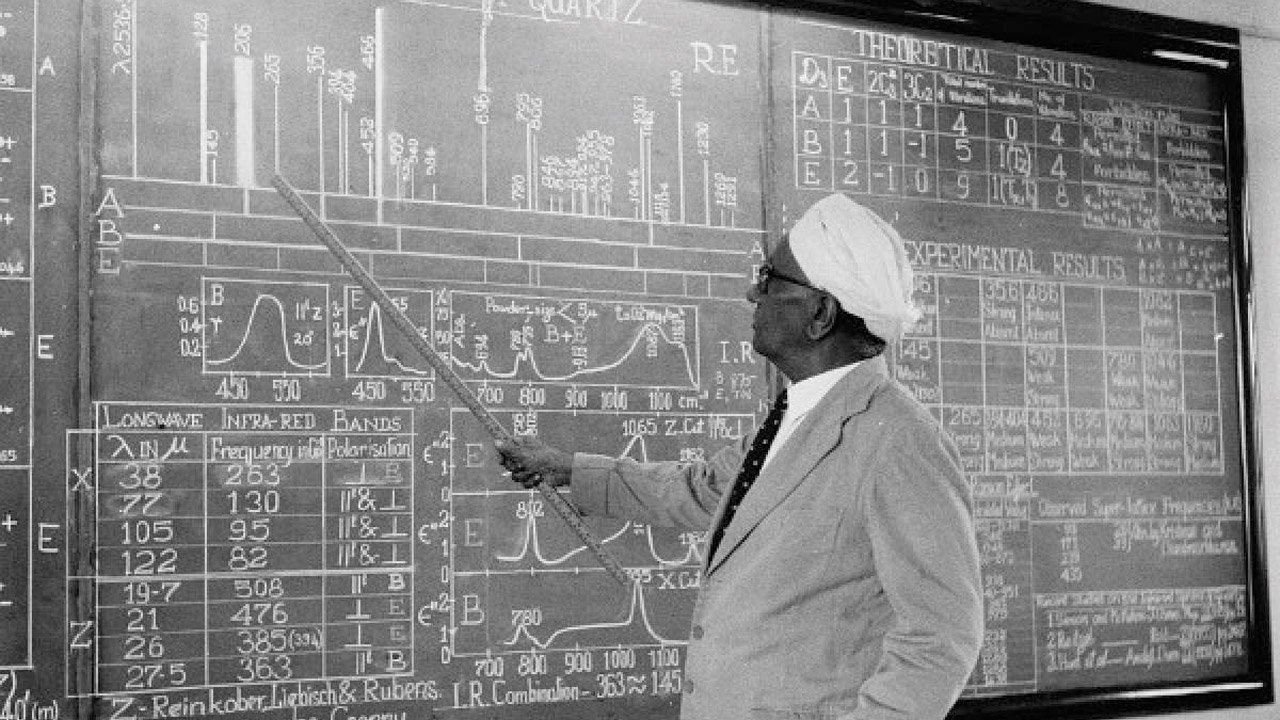
National Science Day is celebrated each year on February 28 to mark the discovery of the ‘Raman Effect’, which is a particular phenomenon of light scattering by matter uncovered by the Indian physicist Sir Chandrasekhara Venkata Raman on 28 February 1928.

CV Raman was awarded with a Nobel Prize in Physics in 1930 for his discovery on Raman Effect.

History of the National Science Day

In 1986, the National Council for Science and Technology Communication (NCSTC) requested the Central Government to designate February 28 as the National Science Day (NSD).

The aim behind the initiative was to honor the achievements of Sir C.V. Raman as well as other scientists for their achievements in the scientific field.

The National Science Day, after approval, is celebrated all over India in schools, colleges, universities and other institutions. 

The National Council for Science and Technology Communication, following the first NSD in Feb 28, 1987, announced the creation of the National Science Popularization awards which recognised individuals for their contributions in the realm of science and communication.

National Science Day 2022: Theme

  • The theme of the National Science Day 2022 is, “integrated approach in science and technology for a sustainable future”.

Significance of National Science Day

The NSD is celebrated to spread the message about the significance of science and its ability to improve the daily lives of people.

Themes of National Science Day

Since 1999, the National Science Day has been celebrated keeping in mind certain specific themes. They are as follows:

National Science Day

YearTheme
1999Our Changing Earth
2000Recreating Interest in Basic Science
2001Information Technology for Science Education
2002Wealth From Waste
200350 years of DNA & 25 years of IVF – The Blueprint of Life
2004Encouraging Scientific Awareness in Community
2005Celebrating Physics
2006Nurture Nature for our future
2007More Crop Per Drop
2008Understanding the Planet Earth
2009Expanding Horizons of Science
2010Gender Equity, Science & Technology for Sustainable Development
2011Chemistry in Daily Life
2012Clean Energy Options and Nuclear Safety
2013Genetically Modified Crops and Food Security
2014Fostering Scientific Temper
2015Science for Nation Building
2016Scientific Issues for Development of the Nation
2017Science and Technology for Specially Abled Persons
2018Science and Technology for a sustainable future
2019Science for the People, and the People for Science
2020Women in Science
2021Future of STI: Impact on Education Skills and Work

Arunachal Pradesh and Mizoram statehood day: Know history and significance 

0

Arunachal Pradesh and Mizoram statehood day is celebrated each year on February 20 as these two northeastern states attained statehood on February 20, 1987 following the 53rd Amendment of the Indian Constitution in 1986.

The mountainous frontier state of Arunachal Pradesh, which in Sanskrit means ‘land of the rising sun’, is situated in the northeastern part of the country. It was formerly known as the North East Frontier Agency (NEFA)

Until it was made a union territory in 1972 and a full-fledged state on February 20, 1987, it was part of Assam.

Arunachal Pradesh is bordered by Bhutan to the west, Tibet Autonomous Region of China to the north, Myanmar and Nagaland to the south and southeast and Assam to the south and southwest.

Mizoram meanwhile is bounded by Myanmar to the east and south, Bangladesh to its west, Tripura to the northwest, Assam to the north, and Manipur to the northeast.

The ‘Land of Mizos’ was earlier called as the Lushai hills district of Assam before it was renamed as the Mizo hills District in 1954 and became union territory in 1972 and it achieved statehood on February 20, 1987.

On 21st February (1987), these two states came into being as the 23rd and 24th states of the Indian Union respectively.

Mizoram Facts

Arunachal Pradesh and Mizoram statehood day: Know history and significance 
  • Capital: Aizawl
  • Sex Ratio: 975 female per 1000 male (National: 943)
  • Literacy: 91.58 % (National: 74.04%)
  • Mizoram shares the International Border with Myanmar and Bangladesh.
  • It has the highest concentration (percentage) of tribal population among all states of India.
  • According to the ISFR 2019, Mizoram has the maximum forest cover as a percentage of their own geographical area at (85.4%).

Arunachal Pradesh

  • Capital: Itanagar
  • Sex Ratio: 938 female per 1000 male (National: 943)
  • Literacy: 65.38 % (National: 74.04%)
  • Arunachal Pradesh shares an international border with Bhutan, China and Myanmar.
  • It is the largest state area wise in the north-eastern region, even larger than Assam which is the most populous.
  • It is inhabited by the world’s largest variety (diversity) of ethnic tribal groups and subgroups.

Mumbai Suburban Railway makes the busiest network connecting 119 stations

0

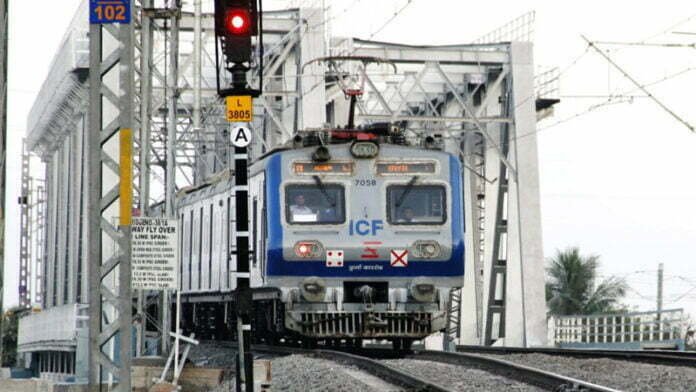
Mumbai Suburban Railway, coming under the Indian Railways, plays a pivotal role in the public transport system of the metro city.

Being the busiest Suburban Railway Network in India, this railway line is also known as lifeline to the Nation as it connects many local districts to suburbs. 

The best part of this railway network is that you get unique travel experience along with a socialising platform. 

This busiest Suburban Railway stretches up to the length of 427.5 kilometers.

Mumbai’s local trains carry about 7.5 million passengers every day, packed, on average, to 2.6 times of their capacity.  And hence it makes it the most crowded and Busiest Suburban Railway Network.  

The trains on track runs with the average speed of 30km/h (19 mph). Yearly ridership is around 2.64 billion which is quite high. Passengers can use seen climbing on a train.

This Busiest Suburban Railway daily networks with 119 stations. Trains run from 04:00 until 01:00, and some trains also run up to 02:30 am.

Morning peak hour for Mumbai locals is  8.30-9.30am with 6,32,000 travelling in it. Evening peak hour ranges from  6-7 pm with 587,000 passengers.

About Indian Railways

Indian Railways is the largest rail network in Asia and the second largest in the world.

In India, on 16th April 1853, the first passenger train between Mumbai and Thane ran for the distance of 34 km. 

World Day of Social Justice: Know significance, theme and history…

0

The World Day of Social Justice is celebrated each year on February 20 across the world. On 26 November 2007, the UN General Assembly declared that this day will be celebrated annually as the World Day of Social Justice.

An underlying principle for peaceful and prosperous coexistence within and among nations is defined as Social Justice according to the official website of the United Nations Organization. 

The principles of Social Justice are upheld to promote gender equality or the rights of indigenous people and migrants. Promoting development and human dignity through Social Justice is the core value of the UN. 

World Social Justice Day Theme

The theme this year of the World Day of Social Justice is “Achieving Social Justice through Formal Employment”. The focus will be on the formalization of employment as a prerequisite for reducing poverty and inequality. 

World Social Justice Day Purpose

The purpose of the day is to raise your voice against social injustice and to promote social justice throughout the world. The objective of the day is to bring the various communities globally closer and together that can help to eliminate poverty, physical and gender discrimination, racism, religious discrimination, illiteracy, and biases, etc. If societies of the planet become pure from the mentioned curses, only then a diverse global culture can emerge where everyone has equal opportunities and everyone has acceptance for others

The commemorative event has been held since its first proclamation by the General Assembly in 2007 under the leadership of the Kyrgyz Republic. 

The commemoration supports efforts by the international community to search for solutions to achieve sustainable development and fulfil many of the aspirations set out in the Secretary-General’s report, including poverty eradication, the promotion of full employment and decent work, universal social protection, gender equality and social justice for all.

Water taxi service connects Mumbai and Navi Mumbai in Maharashtra

0

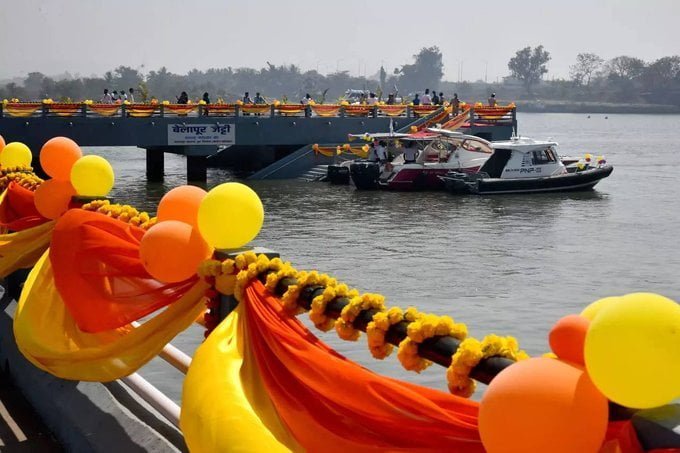
The water taxi service between Mumbai and Navi Mumbai has been inaugurated by Maharashtra Chief Minister Uddhav Thackeray. The Belapur Jetty project, which started in January 2019, was wrapped up in September 2021. This project, which was funded under the Sagarmala program, cost a total of Rs. 8.37 crore.

Water taxi service connecting points

The newly inaugurated waterway will be connected with the water taxi service, with Belapur, Nerul, and Elephanta Islands. For the first time, Mumbai and Navi Mumbai shall be linked by dependable and fast transportation services, which will help to cut travel time.

What is Water Taxi

A water bus or water taxi is a kind of watercraft which is used to provide private or public transportation in urban areas.  Its service may be planned with multiple stops, which are similar to a bus, or is available on-demand to many locations, similar to a taxi. The first known water taxi service started operating around the area which later became known as Manchester, England.

Sagarmala Programme

The Indian government’s Sagarmala Program aims to improve the country’s logistics industry. The programme aims to maximize the potential of coastlines and rivers in order to reduce the amount of infrastructure needed to fulfill the logistics goal of the nation.

Gotthard Base Tunnel in Switzerland is the world’s longest railway tunnel

0

With a length of 57 kilometre, Gotthard Base Tunnel is listed as the world’s longest railway tunnel. This tunnel passing through Alps in Switzerland encompasses the depth of 2,300 meters which makes it the deepest tunnel in the world as well. 

Gotthard Base Tunnel is located in heart of Central Europe, Switzerland. It runs between the towns of Erstfeld in the north and Bodio in the south.

This spectacular GB tunnel has overtaken Japan’s Seikan rail tunnel as the longest in the world and pushed the Channel Tunnel into third place. 

The project took 17 years to build this fantastic tunnel. Work on the first tunnel through the Gotthard began as early as 1872 and opened in 1882. The final breakthrough of the Gotthard Base Tunnel took place in 2010. The test operations for Gotthard Base Tunnel began in 2015 and the tunnel finally opened in 2016. Commercial train services began in December 2016.

And during the construction of this tunnel, nine workers died in accidents. Four were Germans, three Italians, and one each came from South Africa and Austria. 

The tunnel starts from Erstfeld, canton of Uri then crosses Alps and ends in Bodio, canton of Ticino. Gotthard base tunnel provides a high-speed rail link under the Swiss Alps between northern and southern Europe. 

Benefits of Gotthard Base Tunnel 

  1. Gotthard Base Tunnel provides a high-speed facility to passengers to travel more quickly through Alps. 
  2. It also shorten the distance between Altdorf and Bellinzona. 
  3. Gotthard Tunnel also works to increase the conversion of heavy traffic from road to rail.

National Parks of India: You will find alligators, crocodile, lizards in these lessor known jungles…

0

National Parks of our country are integral part of Indian geography. For those who love nature, these parks are like asset to them.

Overall, there are 104 enchanting national parks in India which come with wide range of geographical and climatic diversity. 

The National Parks in India are home to astonishing degree of biodiversity wildlife which includes  Bengal Tigers, vulnerable Rhinoceros, sloth bears, hundreds of bird species, Leopards, pandas, Wolf, and many more. 

Kanha National Park, Bandhavgarh National Park, Kaziranga National Park, Ranthambhore National Park are some of the most famous National Parks in India. But other than these, there are some National Parks which are less known. 

Let’s explore the lesser known National Parks of India 

1. National Chambal Sanctuary 

Chambal Sanctuary is a paradise for wildlife lovers. It is also known as the National Chambal Gharial Wildlife Sanctuary as it home to world’s largest population of Gharial (alligators). Red crowned roof turtle and Gangetic dolphins are also famous residents at National Chambal Sanctuary. This sanctuary covers an area of 5,400km² of Northern India.  It is located on the Chambal River near the tri-point of Rajasthan, Madhya Pradesh and Uttar Pradesh. This place is truly a treat for wildlife enthusiasts and photographers. 

2. Nagzira Wildlife Sanctuary, Maharashtra 

This picturesque sanctuary is named after the temple of the serpent god. Located on the eastern most part of India, Nagzira is rich in biodiversity and scenic beauty. This sanctuary preserve lizards, crocodiles, cobras and vipers along with variety of birds. It is a unique landscape that attracts wildlife lovers who get mesmerised by birds, and rich biodiversity. 

3. Eaglenest Wildlife Sanctuary, Arunachal Pradesh 

As the name suggests, this sanctuary is a paradise which is rich in species of birds. There are almost 500 bird species in this sanctuary. Way up among the soaring peaks of the Himalayas, the legendary mystique Eaglenest Wildlife is dotted with pretty valleys and enchanting rivers. It is a part of the Kameng Elephant Reserve. This sanctuary provides protection to endangered bird species. 

4. Dudhwa National Park, Uttar Pradesh 

It is a gem of Terai region. Dudhwa National Park, encompassing 490.3 km² area, is a part of the Dudhwa Tiger Reserve in the Kheri district. It is home to Barasingha known as Swamp deer. You can also easily spot the rare species of Saras crane and white vultures.

Border Tourism in India: Sanchu post in Bikaner opens for tourists in Rajasthan

0

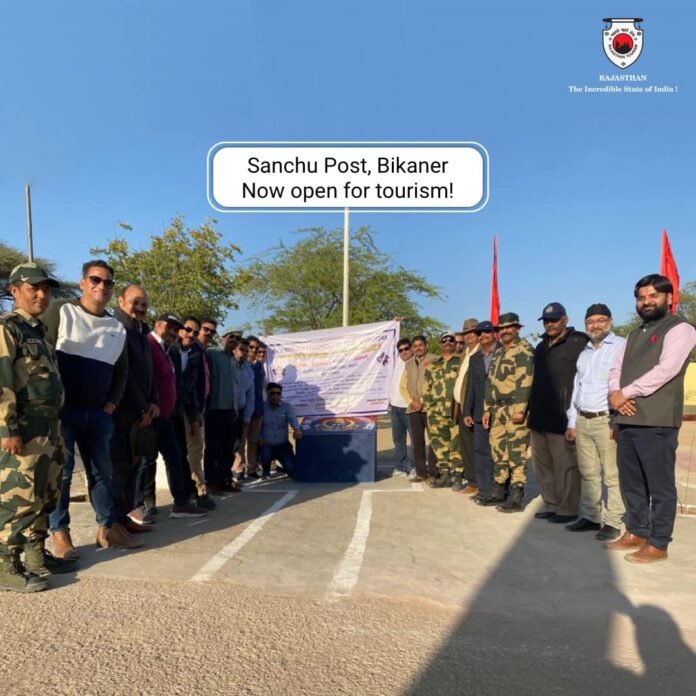
Sanchu Post in Bikaner has opened to tourists who can now visit this historic Indo-Pak border which has seen the 1965 and 1971 wars fought against Pakistan.

This border hence echoes with the tales of gallantry and bravery of the BSF soldiers till date.

Sanchu post in Bikaner is situated near international border and has venues like Tanot temple in Jaisalmer and Hindumalkot of SriGanganagar on the western border of Rajasthan adjoining Pakistan which is expected to become a tourist destination soon.

Actually, a small war museum has been built at Sanchu Post to attract the tourists. Here the story of the Indo-Pak war in 1965 and 1971 has been carved on stone. A large hall has been built here in which documentaries of the war will be shown.

The international border fencing can be seen just two km away from Sanchu. A watch tower has been created here where BSF personnel are being stationed.

There is a view point which  is made up of glass. Tourists will be able to sit there and see the border from the binoculars. They will see the Indo-Pak border line (Zero Line). Pakistan’s Ranihal post will also be visible. From here.

BSF and Rajasthan Tourism have developed Hindu Malkot post by giving it the status of Adarsh ​​Chowki. The platform has been specially made to give a glimpse of Pakistani territory to the tourists.

Both the battles were fought in Sanchu

The Indo-Pak war of 1965 and 1971 was fought on this post. Before the 1965 war, Sanchu was the largest village in the border belt of Bikaner district. During the 1965 war, the Pak army captured Sanchu. Then the soldiers of 3 RAC and 13 Grenadier together conquered the post. In the 1971 war, the Indian Army and BSF jawans captured Pakistan’s Ranihal, Bijnoth and Rukanpur posts from the Sanchu post itself.

During the Sanchu visit, people will get an opportunity to know how the border guards protect the border in adverse geographical conditions. Be it 50 degree temperature in the scorching heat or the mercury dropping below the freezing point in the scorching cold, BSF jawans keep standing on the border. Their eyes keep an eye on the activities of the enemy far and wide in Pakistan.

Madhya Pradesh: 10 million year old rock-like dinosaur eggs found in Barwani

0

Madhya Pradesh state in India became witness to the finding of 10 rock like dinosaur eggs which were found in Barwani district. These dinosaur eggs weighted 25 kg to 40 kg.

According to archaeologist Dr DP Pandey, “The eggs are known to be as old as 10 million years. The largest of these eggs weighs about 40 kg, and other of them are of 25 kg each. The eggs are from the Cretaceous period,” he added.

Dinosaurs are the most weirdest prehistoric creatures. Earth is almost 4 billion years old and the dinosaurs walked the earth some 65 million years ago. Bones, teeth, and other hard evidence have revealed that Earth was the domain of the dinosaurs for millions of years. Evidence shows that an asteroid ended the age of dinosaurs. A volcanic eruption was the main reason for disappearance of dinosaurs. 

However, their abundant most common fossils like teeth and bones are being found all across the globe. Just like that some eggs of dinosaurs are found in Barwani district of Madhya Pradesh. 

“The biggest one weighs around 40kg and there are many of 25kg. I’ve brought three eggs to Indore. The department is likely to display them at Indore Museum.” archaeology department official Dr D P Pandey said. He also added that “My team have been surveying a region of Sendhwa since January 30.” 

Meanwhile, a few Geology experts say that the rock like thing may not be eggs, they can be old basaltic rocks instead. Sometimes take such a shape over millions of years. 

Palaeontologist Dr Dhananjay Mohabey a former deputy director general of Geological Survey of India said  “From the pictures, it looks like spherical weathering of some basaltic rocks that can produce what is called ‘onion peel weathering.” 

Prehistoric fossils have often been found in Madhya Pradesh. Dinosaur fossils were also found in Dhar district in 2007, which have been kept in the in a museum in Mandu.

The year 2022 travel survey: 82% want to travel to relax from stress

0

The year 2022 comes with a good news…most of the nations have lifted the pandemic curbs giving a chance to avid traveller to take a sojourn somewhere on long/short haul. 

This freedom to travel is crucial to the post-pandemic recovery – not only for economic reasons, but because of the sheer joy of it. From the ability to see friends and family to exploring new cultures, travelling is a unique opportunity. Let’s see what one of the US surveys quotes as the top reasons for travelling:

85% to see my child excited about the experience

82% to relax/reduce stress

81% to make memories

78% for fun, excitement, and adventure

73% to see or do something new

72% to see more of the world

66% to strengthen relationship with a significant other

65% to strengthen bonds with family and friends

60% to improve outlook on life

55% to learn something new about a place, culture or history

40% to continue a family tradition

35% to cross off an item on bucket list