Home Blog Page 744

Gita Contest: Thousands take test on Divine Law, Absolute Truth & answer what is ‘Aham Brahma Asmi’

0

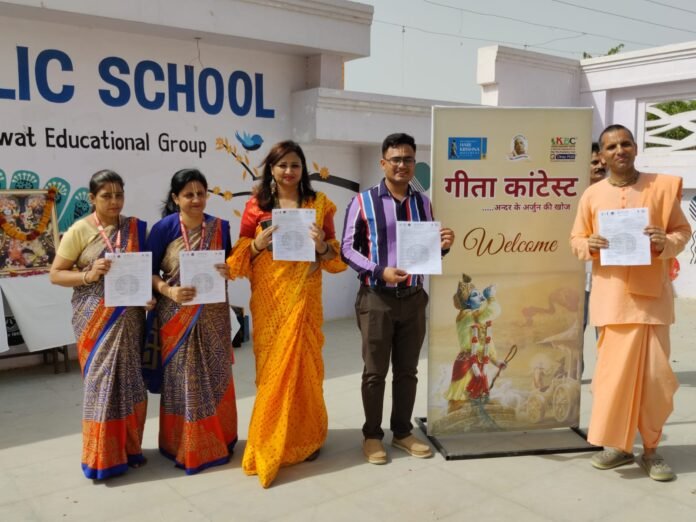
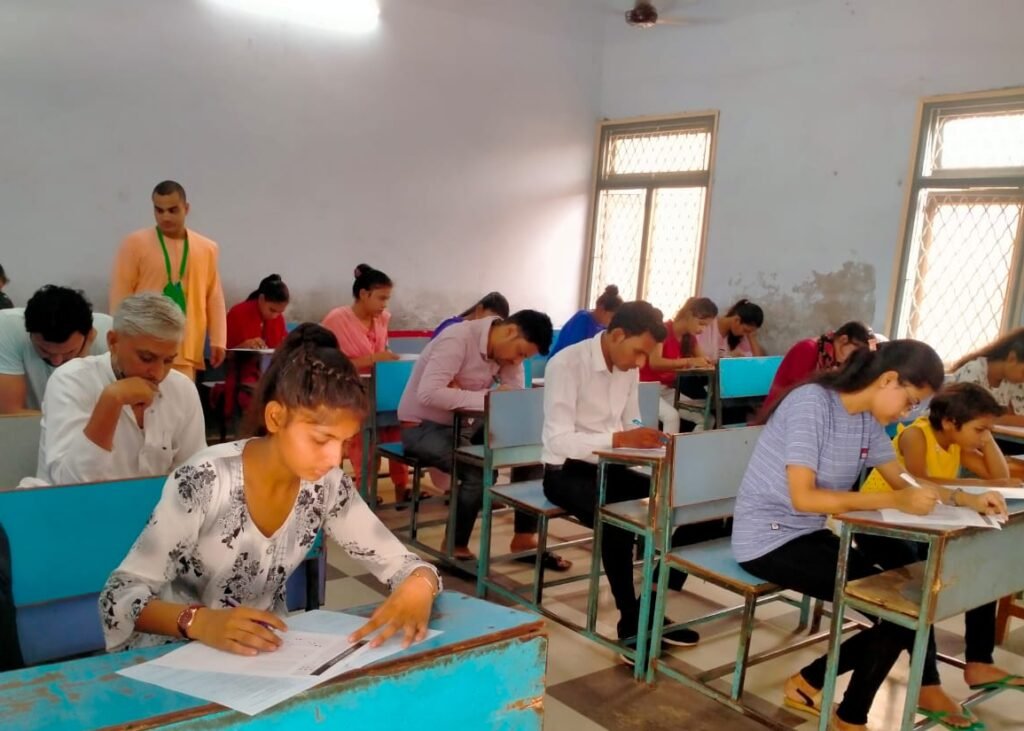
Gita Contest competition was organised under the aegis of Hare Krishna Movement Rajasthan across the country on Sunday in which thousands of students participated with enthusiasm. 

According to Amitasan Das, President, Hare Krishna Movement Rajasthan, “The online participants in the competition appeared online for their examinations from major cities of India, whereas for those opting for offline competition, the examination was held in Jaipur, Udaipur and Mathura, the birthplace of Lord Krishna, on Sunday morning.”

Results will be announced in the first week of June and prize distribution will be given to the winners on the basis of category on June 26, said Siddha Swaroop Dasa.

“Geeta Contest Senior Category First prize winner will get ₹ 25,000/-, second prize Geeta Bhushan will be given ₹ 11000/-, third prize Geeta will be worth ₹ 11000. 

Along with this, special attractive trophies and certificates will be given to winners. 

Consolation prize worth Rs 1100 will be given to the contestants who come in the top 10 ranks in the contest.
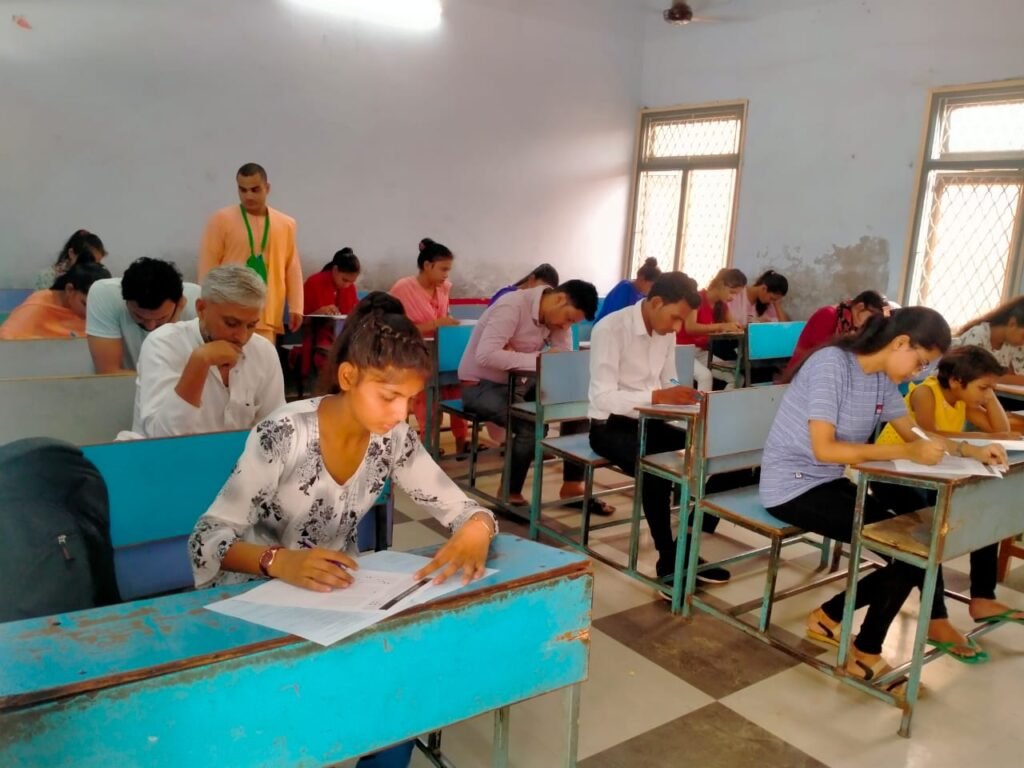
Gita Contest: Thousands take test on Divine Law, Absolute Truth & answer what is 'Aham Brahma Asmi'

Examinees share their experience

Rajveer Singh, Senior Software Engineer in the country’s reputed software company said that there is a lot to learn in Gita. It is also a better opportunity for us to take the exam. The solution to every first and foremost problem of life is given in Gita.

Neeta, who was working in Mahatma Gandhi Medical College and Hospital, came to take the exam with full preparation. She told that because of the Gita contest, she was able to study the Bhagavad Gita and understand the importance of life.

Anurag Sharma of Jaipur is studying law from Udaipur. He is appearing for Gita exam because he is interested in Vedic literature. I had heard about reading Bhagvad Gita from many big names, but due to lack of time or some constraints, I could not read it, but now I have got a chance to read it.
Gita Contest: Thousands take test on Divine Law, Absolute Truth & answer what is 'Aham Brahma Asmi'

Komal Sharma from Jaipur participated in the Geeta contest online, said that many concepts have become clear after reading the Gita.

During the launch of Gita Contest, Secretary of Aksendra Welfare Society Narendra Rawat and Convenor of the competition Siddha Swaroop Das were present. 

Rawat said that Gita is the practical side of life, without the knowledge of Gita, life is incomplete, today Gita is very important for the student.

Some questions asked in Gita contest

According to Srimad Bhagavatam, what is the sequence for realization of the Absolute Truth? What is considered the biggest violation of divine law? What is the meaning of the word ‘Aham Brahma Asmi’? Who takes a man on the new path of life at the time of death? Why was the knowledge of Bhagavad Gita given to Arjuna?
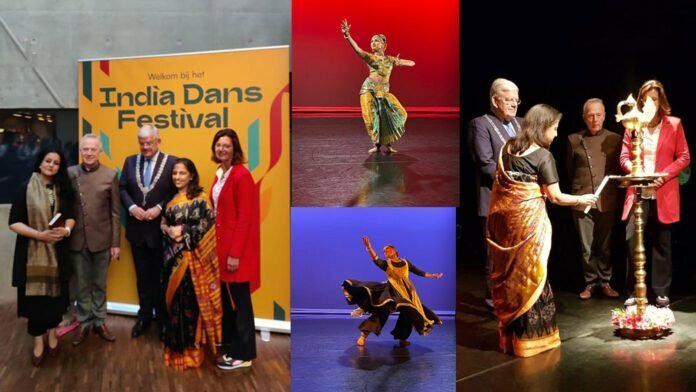
Korzo welcomes the public in The Hague, Netherlands to the India Dance Festival which is to be held from 19 thru 29 May 2022

0

India Dance Festival at Korzo theater in The Hague inaugurated today in the presence of Mayor Jan van Zanen, Her excellency Ambassador @Reenat Sandhu, Leo Spreksel, Gemma Jelier & Gauri Sharma.

During the India Dance Festival, Korzo celebrates the rich Indian dance and culture.
From Bharatanatyam to contemporary Indian and modern dance; Korzo presents leading and starting talents from home and abroad. Inspiring performances by major international artists are interspersed with refreshing, contemporary productions.
The festival showcase with the new work by Aakash Odedra Company (UK) in collaboration with Aditi Mangaldas (IN).
The international residency also filled by Kuchipudi dancer Bhavana Reddy and new pieces from the Netherlands by Shailesh Bahoran and Poernima Gobardhan are on the program. Kalpana Raghuraman brings Samarpan from 2013 in a brand new version and the festival closes with a weekend full of emerging talent in various Indian dance styles.
Ticket sales for India Dance Festival 2022 have begun.

For more information, please check: www.indiadansfestival.nl


By- Pranita Deshpande

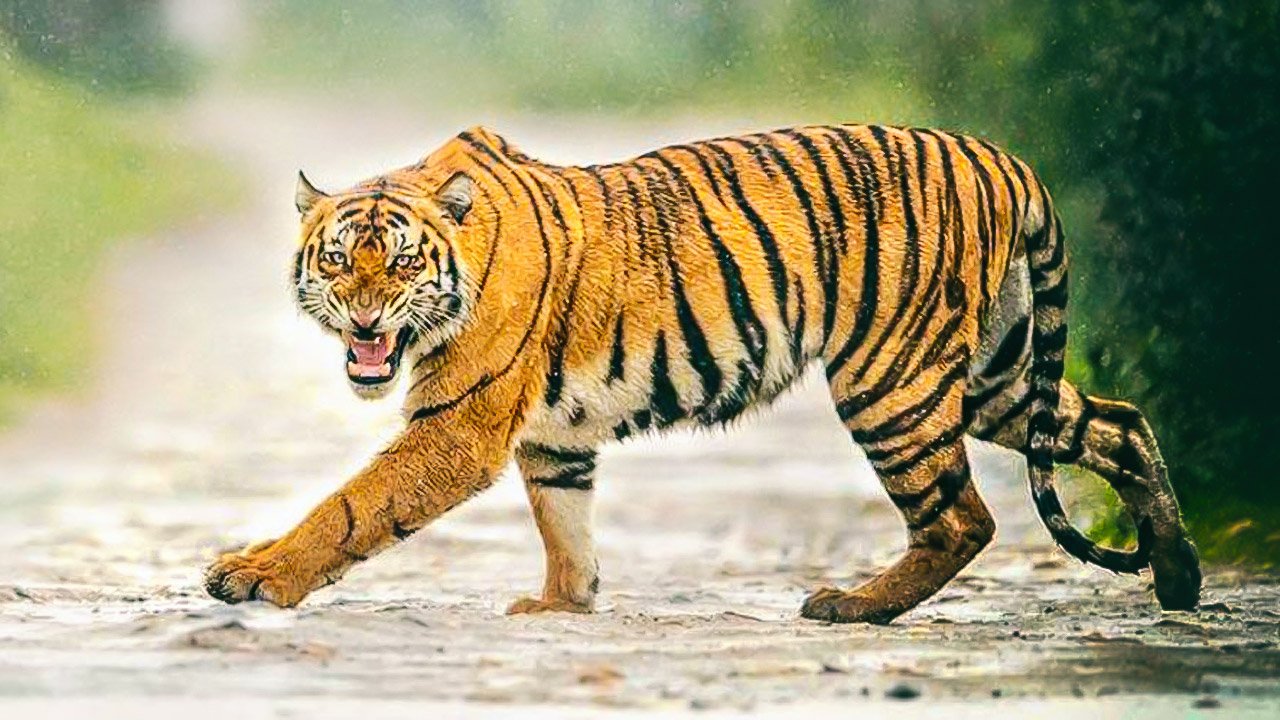
Ramgarh Vishdhari Wildlife Sanctuary in Rajasthan notified as India’s 52nd tiger reserve

0

The process for notification started in April 2020 when the Rajasthan government sent the proposal to develop the Ramgarh Vishdhari sanctuary for tigers. 

In July 2021, in-principle approval was given by National Tiger Conservation Authority (NTCA) to make Ramgarh Vishdhari Wildlife Sanctuary and nearby areas as tiger reserves.

Extent of Ramgarh Vishdhari Wildlife Sanctuary

The Ramgarh Vishdhari Wildlife Sanctuary covers 252 square kilometers of area and has been declared a sanctuary in 1982 under the Rajasthan Wildlife and Bird Protection Act, 1951.

Wild animals seen in this tiger reserve?

Wild animals like Indian wolf, leopard, sloth bear, golden jackal, fox, etc. can be seen.

Total tiger reserves in Rajasthan?

There are total four tiger reserves in Rajasthan with Ramgarh Vishdhari Sanctuary being the fourth tiger reserve. The other three tiger reserves are Ranthambore Tiger Reserve- Sawai Madhopur district, Mukundra Hills Tiger Reserve – Kota district, and Sariska Tiger Reserve – Alwar district.

Significance of declaring Ramgarh Vishdhari Sanctuary as a tiger reserve?

  • Ramgarh Vishdhari Sanctuary plays a significant role in the movement of tigers as it will connect the Ranthambore Tiger Reserve with the Mukundra Hills Tiger Reserve, thus becoming an important tiger corridor.
  • Acting as a buffer for the Ranthambore Tiger Reserve, it shall facilitate the dispersal of tigers from it. Thus it prevents the problem of overcrowding in Ranthambore.
  • Eco tourism shall get a boost owing to many  sites within the tiger reserve like Bhimlat, and Ramgarh palace. This will also provide livelihood opportunities to locals.

A tiger corridor?

A stretch of land connecting tiger habitats, thereby allowing the movement of tigers and other wildlife is called tiger corridor.

Tiger corridors in India?

There are over 30 major tiger corridors and many smaller tiger corridors in India.

Significance of tiger corridors?

Because of corridors, tigers get more space, and Human-wildlife conflicts can be reduced.

Swastik, Damru, Elephant trunks, tridents, paan, bells on Gyanvapi Masjid walls, claims survey report

0

Gyanvapi Masjid of Varanasi survey reports leaked recently claims that there is no hole been found in the black colored stone figure found in the middle of the pool, which the Muslim community was describing as the fountain. Also,  there is no place to put any pipe in it. There is a separate white stone on top of the 2.5 feet high circular Shivling-like figure. 

The Hindu party asked Munshi Ejaz to turn on the fountain and show it. But Munshi Ejaz expressed his inability to run the fountain. 

At the same time, a swastika symbol was found on the southern pillar under the main dome in the mosque. Signs of three damru were found near the first gate of the mosque. In the north-west direction, the artefacts like temples were seen on the stones lying there.

Highlights of the survey report

Elephant trunks, tridents, paan, bells were seen inside the mosque. A swastika symbol was found on the southern pillar under the main dome.

Signs of three damru were found near the first gate of the mosque. In the north-west direction, a basement of 15 * 15 feet was visible, on which the debris was lying, the artefacts like temples on the stones lying there.

A 3 feet deep pool was found. There were 30 taps all around the pool. A well about 6 feet deep was seen in the middle of the pool. A round stone-shaped figure was seen in the middle of the well.

The distance between the Nandi sitting outside and the pool found inside (in the middle of which one side is said to have established a Shivling) is 83 feet 3 inches.

The pillar is inscribed in 7 lines in Hindi language. The space of four doors has been closed with new bricks. There are symbols of Sanatan culture on the wall of the basement.

It was told by the Anjuman Insanjariya Masajid Committee that a coal shop was also running in the premises, but no evidence of that was found anywhere.

When the key to the fourth cellar was not found, its lock was cut by getting a cutter. On going ahead, a small basement filled with rubble was found, where it was not possible to reach.

Read more on Gyanvapi Complex: https://ebnw.net/history/gyanvapi-complex-know-history-controversy-and-the-developments-till-date/

In 5 years, Bharat will be amongst leading quality content producing nations across globe, says Thakur at Cannes Festival

0

In 5 years, Bharat will be amongst leading quality content producing nations across globe. Center has envisioned major initiatives over the last 8 years to boost co-productions, film shoots and film facilitations in India, States like Uttar Pradesh and Madhya Pradesh have formulated their own film facilitation policies and provided co-production opportunities. He stated that these efforts are aimed at boosting India’s media and entertainment ecosystem, which is expected to generate USD 53 billion annually by 2025, said  Union Minister of Information and Broadcasting Anurag Thakur addressed the India Forum at the famous Palais des Festivals in Cannes. Representing a 6000 year old culture and 1.3 billion people the Minister delivered his keynote address in front of audience comprising foreign and Indian filmmakers, journalists and delegates. 

In 5 years, Bharat will be amongst leading quality content producing nations across globe, says Thakur at Cannes Festival

75th year celebration

This year marks the 75th year celebration of both Cannes Film Festival and of establishment of India-France diplomatic relations. 

India shall emerge as the ‘content hub of world

Speaking on the importance of Cannes, the Minister said that over the years, ‘Festival de Cannes’ has played a significant role in strengthening Indo-French relations. The Minister noted the historic highs of Indian cinema and said that Indian content has been ruling the hearts and minds of the global audience and the stepping stone was laid by bestowing the Palme d’Or to the prolific Indian filmmaker Chetan Anand’s film Neecha Nagar in 1946 and a decade later in 1956, Satyajit Ray’s Pather Panchali won the Palme d’Or. Today the recognition of our cinematic excellence the world over is set to manifest the country  into the ‘content hub of the world’, the Minister added.

In 5 years, Bharat will be amongst leading quality content producing nations across globe, says Thakur at Cannes Festival

“India intends to give you – the global audience, a flavour of the country’s cinematic excellence, technological prowess, rich culture and illustrious heritage of storytelling”. “India’s red carpet presence captured the diversity of our cinematic excellence not only in terms of representation of actors and film makers from various languages and regions, but also OTT platforms, with a strong presence of music composers and a folk artist who have enthralled audiences both young and old”, the Minister further added.

The startups from media and entertainment sector will showcase their technological prowess and pitch to the  best from the world of AVGC along with a strong delegation of animation professionals from the sector. 

“Government of India officially designated audiovisual services as one of 12 ‘champion service sectors’ and recently set up an AVGC task force comprising of industry leaders to prepare a policy roadmap for India to take a quantum leap in this sector and position us as the preferred ‘post production hub of the world’ “.

OTT market in India predicted to nearly 2 Billion Dollars

Thakur painted a bright future for M&E sector in India saying that on one hand artificial intelligence, virtual reality, immersive technologies such as the Metaverse, present immense possibilities to India’s IT skilled workforce, the OTT market in India is predicted to grow at      21% annually to nearly 2 Billion Dollars by 2024 on the other. 

Skills of youth will make India preferred Post Production Hub for AVGC sector

The Minister promised that the Government will take all necessary measures to transform India into a Global Content Sub Continent and use the skills of our youth to make India the preferred Post Production Hub for AVGC sector and to that end Government will speed up co-production collaborations from around the world and also offer the best locations in India for Film Shoots. 

These steps, Thakur envisioned, will in the next 5 years, catapult Bharat into the league of leading quality content producing nations across the globe.

Thakur concluded his statement by extending a warm invitation to foreign film makers to shoot in India, bask in its hospitality and relish its breathtaking landscape. 

India will become the world’s biggest ‘influencer economy

Shekhar Kapur spoke about the effect of access to cheap broadband and mobile devices having a disruptive effect on movie industry and said that India is about to become the world’s biggest ‘influencer economy’ and that cinema will soon be redefined by the young film makers.

India is a pool of restless dreams, dreams that are restless to make it big, of looking forward, added Prasoon Joshi to the comment of Shekhar Kapur.

Roxborough said the style of Indian storytelling needs a lot more to become appealing to world market.

Apurva Chandra contested the notion by Scott Roxborough by citing movies like Lunchbox, Mr and Mrs Iyer and Rocketry that are typically Indian in their story but have resonated with audience across the world. He further reiterated the incentives announced by the Government of India yesterday for film makers from across the world. 

R. Madhavan commented on how India has so much to tell the world in the field of science and technology and the cinema world must explore this idea. From Aryabhatta to Sundar Pichai India has extraordinary stories which are aspirations of youngsters around the world.

Cannes session moderation

The session moderated by Vani Tripathi had on the panel Apurva Chandra, Secretary, Information & Broadcasting, Government of India, Prasoon Joshi, Writer, Poet, and Chairman, Central Board of Film Certification, R Madhavan, Indian actor, writer, director, and producer Shekhar Kapur, Indian filmmaker, actor, television presenter and entrepreneur and Chairman, Film and Television Institute of India,  Scott Roxborough, Editor, Hollywood Reporter and Philip Avril, Producer

Vikramaditya built the Qutub Minar tower to study the Sun,’ claims ASI ex-officer

0
Qutub Minar Complex and Qutab Minaret Tower. The Qutub Minar was constructed in the year 1192 out of red sandstone and marble.Is the tallest minaret in India, with a height of 72.5 meters (237.8 feet). Qutub Minar, Delhi, India.

A former officer of the Archaeological Survey of India claimed that the Qutub Minar was built by Emperor Vikramaditya in the fifth century. 

“Vikramaditya had built this tower because he wanted to study the positions of the Sun,” he said.

Three claims of former ASI officer

1. It is Sun Tower, not Qutub Minar

In an interview to India Today, former ASI Regional Director Dharamvir Sharma has claimed that Qutub Minar was not built by Qutb-ud-din Aibak. He said that this is not the Qutub Minar, it is the Sun Tower. I have a lot of evidence in this regard. Sharma has surveyed Qutub Minar several times on behalf of ASI.

2. The tower of the minaret has a 25-inch inclination

He said, ‘The tower of Qutub Minar has a tilt of 25 inches, as the Sun was studied from here. That is when the sun was changing place in the sky on June 21  even then there was no shadow of Qutub Minar at that place for half an hour. This is science and also an archaeological evidence.’

3. The Pole Star was seen at night

Sharma told that people claim that Qutub Minar is an independent building and it is not related to the nearby mosque. Actually, its doors are north facing, so that the pole star can be seen from it at night.

Hindu organizations demanded to change Qutub Minar’s name

Last week, Hindu organizations recited Hanuman Chalisa in the Qutub Minar complex and demanded to rename it Vishnu Stambh. The United Hindu Front claimed that Qutub Minar was built by demolishing Jain and Hindu temples. The police had taken some people of the organization into custody.

Qutub Minar History as per Delhi Tourism

According to the Delhi Tourism website, Qutub Minar was built in 1193 by Qutb-ud-din Aibak, the first Muslim ruler of Delhi. After defeating the last Hindu ruler of Delhi, he started the construction of this 73 meter high building.

However, they could only get the basement built. After him Iltutmash built three storeys and after him in 1368 Firoz Shah Tughlaq built the remaining two storeys.

The first three storeys are made of red sandstone and the fourth-fifth storeys are made of marble and sandstone. Underneath the tower is the Quwwat-al-Islam Mosque, which is said to be the first mosque to be built in India.

There is a 5 meter high iron pillar in the courtyard of the mosque, whose biggest feature is that it is made of pure iron, but till date it has never rusted. This iron pillar is believed to have been built by King Chandragupta Vikramaditya (Raj 375-412).

Indian economy back on track, says Moody’s Analytics

0

India’s economy is back on track after the pandemic and it does not expect the military conflict (in Ukraine) to derail the recovery, said Global financial services provider firm Moody’s Analytics.

“Following a robust rebound of over 9 per cent in the year ending March 2022 (fiscal 2021), we expect real GDP to grow 8.2 per cent in fiscal 2022, the fastest expansion among G20 countries globally and partly reflecting ongoing base effects from pandemic-led disruptions,” it said in a report.

The buoyant economy creates favourable operating conditions for the country’s banks, besides their loan performance and profitability are improving, albeit from a low base. Capital and liquidity levels are also stable.

The global economic fallout from the Russia-Ukraine military conflict will push up inflation and interest rates in India, and create supply constraints, it said.

International Museum Day 2022: Know why it is celebrated and what is its theme this year

0

International Museum Day 2022: Date, theme and significance

International Museum Day is celebrated each year on May 18 by museums across the globe aiming to generate awareness on the significant role of museums in community building, national and international cooperation as well as cultural exchange.

International Museum Day 2022 theme

The theme of International Museum Day 2022 is ‘The Power of Museums’.

Cannes Opening Night Red Carpet: Largest ever official Indian Delegation walks together

0

Mame Khan scripts history, becomes first folk artist to open Red Carpet for India at Cannes

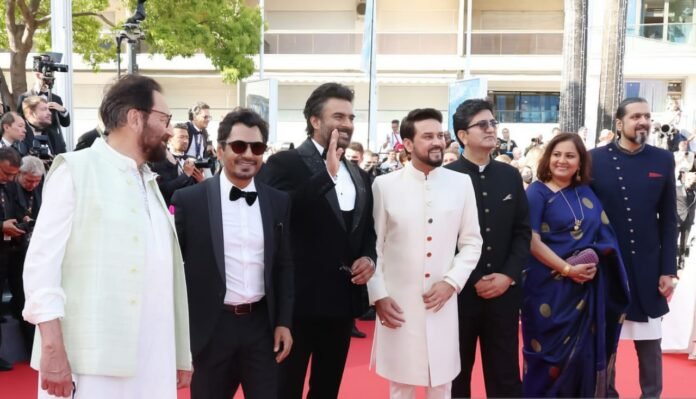
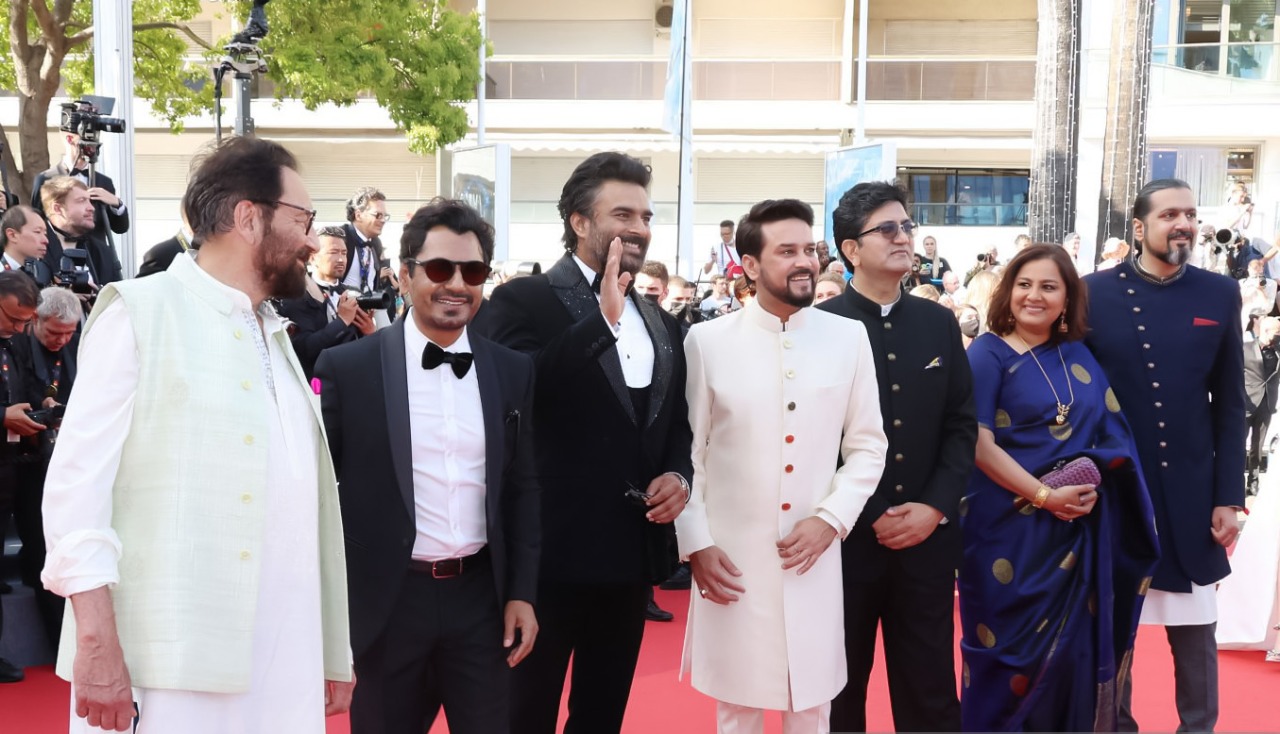
In a star studded presence on the Red Carpet, Union Minister of Information & Broadcasting Anurag Thakur led the largest ever Indian official delegation of eleven celebrities walking together on the inaugural event at Cannes Film Festival on May 17, 2022.

In a historic moment for Indian folk arts, Mame Khan became the first ever folk artist to open a Red Carpet for Indian contingent at Cannes ever.

Cannes Opening Night Red Carpet: Largest ever official Indian Delegation walks together

Putting on display the diversity and uniqueness of Indian cinema, the glamorous red carpet contingent comprised film celebrities from across India. Consisting of eleven members walking towards the legendary stairs of the Palais des Festivals, the delegation carried all the symbolism of India’s ambition to become as a global cinema hub.

10 celebrities accompany the minister

The ten celebrities that accompany the Minister feature three musical maestros, who have been raising India’s flag on the international scale, and renowned film makers and actors from Indian Cinema who represent a kaleidoscope of diversity from various regions, languages, mainstream and OTT led cinema. India the land of story tellers is setting a beautiful narrative for the world through its strongest ever Red Carpet presence at Cannes.

Starts include actor Nawazuddin Siddique

Among the stars was actor Nawazuddin Siddique, a regular at Cannes. His raw, powerful acting and the realism of his movies, such as The Lunchbox or Gangs of Wasseypur, have a particular resonance among European audiences, and signal that India is capable of producing movies catering to a wide range of sensitivities.

Music composer AR Rahman, Mame Khan folk singer present

Presence of superstar music composer AR Rahman in the group displayed the intent of the Indian delegation to pay tribute to cinematographic music – for, maybe more than anywhere in the world, soundtracks play a massive role in the DNA of Indian cinema. Showcasing the musical eclecticism of the country, different genres were represented on the red carpet. Ricky Kej, an internationally acclaimed new age music composer and multi-Grammy Award winner, represented a more contemporary side of India, while Mame Khan, a film composer and folk singer from Rajasthan, personified the influence of folk culture on Indian cinema. Prasoon Joshi, a lyricist who penned innumerable evergreen film songs, and now Chairman of the Central Board for Film Certification (CBFC), was also present.

India sends strong signal to world

Ambassadors from different regional cinemas were included in delegation, sending the signal to the world that India – which boasts of 25 regional film industries – has many different flavours and styles to offer in terms of film production. This year, cinema from the south was in spotlight. R. Madhavan, actor and producer who has been involved in movies shot in six different languages (Tamil, Telugu, Malayalam, Kannada, Hindi and English) was a good example of the staggering diversity of Indian cinema. Two Telugu cinema superstars, Tamannah Bhatia and Pooja Hegde, also made their dazzling appearance as part of the delegation.

Shekhar Kapur, director of legendary films such as Mr. India, and now chairman of the Film and Television Institute of India (FTII), as well as Vani Tripathi Tikoo, actress and member of CBFC, also took part in the Indian delegation.

Delegation members in order of appearance on Red Carpet

1. Mame Khan, famous folk singer from Rajasthan

2. Shekhar Kapur, Globally acclaimed Director

3. Pooja Hegde, Actress

4. Nawazuddin Siddiqui, Actor

5. Tamannah Bhatia, Actress

6. Anurag Thakur, Head of the delegation and the Union Minister of Information & Broadcasting, India

7. R Madhavan, Actor, Director, and Producer

8. AR Rahman, leading singer & Music Composer

9. Prasoon Joshi, Chairman CBFC & renowned lyricist

10. Vani Tripathi, Producer, Member CBFC, Indian film personality

11. Ricky Kej, the two times Grammy award winner and musician

Background:

Cannes Film Festival, which gathers every year the who’s who of the global movie industry, will take place from May 17th to 28th, 2022, and will be the occasion for Indian delegates to take part in various events and high-level meetings.

The festival is special this year for its celebration of Indian cinema’s prowess as India is the first ever official Country of Honour at Marche du Film. India is also a “Country of Honour” at the Cannes Next, under which 5 new Startups would be given an opportunity to pitch to the Audio-Visual Industry. Ten professionals will participate on the Animation Day networking. As a major highlight of India’s participation at this edition of Cannes Film Festival, World Premier of the Movie “Rocketry” produced by Shri. R. Madhavan is scheduled to be showcased at the Palais des Festivals on the 19th May 2022.

May 18 1974: When India became nuclear power with operation ‘Smiling Buddha’ 

0

On May 18, 1974, India conducted its first atomic bomb test successfully at the army base at Pokhran in Rajasthan. The operation ‘Pokhran-I’ was undertaken with the code name ‘Smiling Buddha’ under the supervision of several key Indian Army generals.

The then Prime Minister of India Indira Gandhi felt the need to make India a nuclear power after winning the war against Pakistan in 1971.

On 7 September, 1972, she gave verbal authorization to Indian scientists to manufacture nuclear device and make preparations for a test. Till that time, the permanent members of the United Nations possessed nuclear weapons which included United States, France, China (the Republic of China), Russia (Soviet Union) and United Kingdom.

Soon after these orders, started the preparations for making India a nuclear power. The practical work of engineering the paper design for the operation ‘Smiling Buddha’ started. Works started for locating, surveying, and preparing a suitable test site.

The operation was kept a secret due to international pressure by permanent members of United Nations which was against any country practicing nuclear test.

The government employed 75 civilian scientists for the project which included Raja Ramanna, Basanti Dulal Nagchaudhuri and Dr. Nagapattinam Sambasiva Venkatesan among others who played a key part for completing the operation. The DRDO Terminal Ballistics Research Laboratory (TBRL) in Chandigarh developed and manufactured high explosive implosion system, which after being tested on May 18, 1974, madeIndia the sixth nation in the world to become a Nuclear power.