Home Blog Page 646

Fostering Innovation: Unleashing Young Minds with INSPIRE Awards – MANAK 2023-24

0

Imagine a world where young minds are nurtured, their innovative ideas taking flight, and creativity knows no bounds. The Innovation in Science Pursuit for Inspired Research (INSPIRE) scheme, a flagship initiative of the Department of Science & Technology (DST), Government of India, envisions just that. As we step into the realm of INSPIRE Awards – MANAK 2023-24, a doorway to ignite the sparks of innovation among the young generation beckons.

Empowering Minds, Igniting Innovations

The INSPIRE Awards – MANAK (Million Minds Augmenting National Aspirations and Knowledge), in collaboration with the National Innovation Foundation – India (NIF), an autonomous body of DST, is designed to nurture and celebrate innovation among students aged 10 to 15. Embracing those in classes 6 to 10, this initiative aims to unleash the potential of a million young minds, fostering a culture of creative thinking and pioneering solutions that harmonize science with societal needs.

Empowering Students with Opportunities

The heart of the INSPIRE Awards MANAK Scheme 2023-24 beats with the pulse of opportunity, extended to the vibrant minds of students from Classes 6 to 10. This flagship program, under the stewardship of the Department of Science and Technology, Ministry of Science and Technology (Government of India), isn’t just a competition; it’s a transformative journey, a call to think beyond boundaries.

A Symphony of Ideas: Eligibility and Benefits

Schools become the conduits of change as they nominate up to five of the best original ideas or innovations from their creative pool. The young innovators must be aged 10-15 and pursuing education in the dynamic spectrum of Class 6 to 10. A platform awaits to recognize and celebrate their brilliance with an award of INR 10,000, a testament to the power of ideas.

Embarking on the Journey: The Application Process

Embarking on this exhilarating journey is as simple as a few clicks. Schools serve as the launchpad for these young inventors, guiding them through the process with care. Here’s how it unfolds:

1. Registration: Schools register with the click of a button, unlocking the path to innovation.

2. Nomination: Five outstanding ideas or innovations are nominated, poised to change the world.

3. Selection Criteria: Originality, social impact, eco-friendliness, user-friendliness, and comparative advantage are the guiding stars.

4. National Recognition: The crème de la crème – the top 1,000 ideas – shine at the National Level Exhibition & Project Competition (NLEPC).

5. Shaping the Future: The brightest 60 innovations emerge as torchbearers, illuminating the path of future possibilities.

6. Productive Progress: NIF steps in to cultivate these ideas, nurturing them toward product and process development, seamlessly integrating them with other visionary schemes.

A Gateway to Innovation: The INSPIRE Awards – MANAK 2023-24

In this journey of innovation, dreams know no limits. With the INSPIRE Awards – MANAK 2023-24, they sow the seeds of creativity, watering them with knowledge and nurturing them to fruition. The future beckons, and these young minds stand poised to redefine what’s possible, one ingenious idea at a time.

India’s Best Dancer Season 3: All You Need to Know

0

India’s Best Dancer, the popular dance reality show on Sony Entertainment Television, is back with its third
season. The show, which showcases the journey of some of the best talent who compete to win the title with their
solo performances, promises to be the toughest dance reality show on Indian television. The makers have ensured
to make it challenging at every step for the contestants, who have to impress the judges and the audience with their
unique and innovative moves.
The third season of India’s Best Dancer will premiere from 8 April 2023 on Sony Entertainment Television and
will also be available on SonyLIV OTT platform. The show will be judged by Geeta Kapoor, Terence Lewis and
Sonali Bendre, who are known for their expertise and experience in the field of dance. The show will be hosted by
Jay Bhanushali, who is a popular actor and anchor.
The auditions for the third season of India’s Best Dancer began on 19 January 2023 and saw thousands of aspiring
dancers from across the country participate in the ground and online auditions. Out of these, only 13 contestants
have made it to the final stage of the competition, where they will be paired with choreographers who will mentor
them and help them showcase their best performances.

  • The contestants of India’s Best Dancer Season 3 are:
  • Aakash Sharma from Delhi
  • Anjali Singh from Mumbai
  • Arjun Kumar from Kolkata
  • Divya Sharma from Jaipur
  • Harshita Singh from Lucknow
  • Karan Patel from Ahmedabad
  • Manisha Yadav from Pune
  • Nisha Kumari from Patna
  • Pranav Rajput from Chandigarh
  • Ravi Kumar from Hyderabad
  • Sana Khan from Bangalore
  • Shreya Jain from Indore
  • Varun Sharma from Chennai

The winner of India’s Best Dancer Season 3 will receive a cash prize of Rs. 15 lakh and a trophy. The show will
also feature special guests and celebrities who will grace the stage and encourage the contestants. The show will
air every Saturday and Sunday at 8:00 PM only on Sony Entertainment Television.
India’s Best Dancer Season 3 is a dance extravaganza that will entertain and inspire the viewers with its amazing
talent and spectacular performances. Don’t miss the chance to witness the best dancers of India battle it out for the
ultimate glory. Tune in to India’s Best Dancer Season 3 from 8 April 2023 only on Sony Entertainment Television.

Exploring the largest and deepest ocean of the world

0

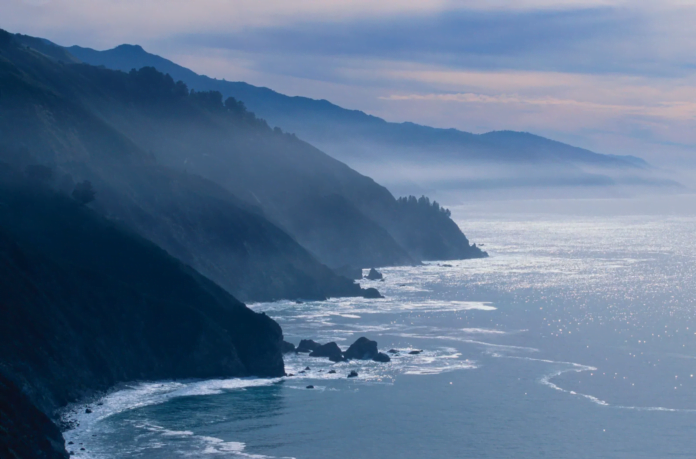
The Earth’s oceans, shrouded in mystery and beauty, hold a captivating allure for scientists, explorers, and dreamers alike. Among these expansive bodies of water, one stands out both in size and profundity – the majestic Pacific Ocean. Spanning across an awe-inspiring 63 million square miles, the Pacific Ocean reigns as not only the largest but also the deepest ocean basin on our planet.

Encompassing more than half of Earth’s free water, the Pacific Ocean stretches its dominion between the continents of Asia and Australia to the west and North and South America to the east. This vast expanse holds a unique moniker, the “Ring of Fire,” which aptly describes the geological tapestry encircling its periphery. A continuous and dramatic series of oceanic trenches, volcanic mountain ranges, and island arcs mark the boundaries of several tectonic plates, creating a dynamic tableau of seismic activity and volcanic eruptions.

Dating back an astonishing 200 million years, the Pacific Ocean holds the title of the oldest among the world’s ocean basins. Its ancient rocks bear witness to eons of shifting tectonic plates, sculpting the ocean floor and shaping the landscapes of our planet’s past. The “Ring of Fire” is not merely a poetic descriptor; it’s a testament to the intense forces at play beneath the ocean’s surface. This region teems with earthquakes and volcanic eruptions, a result of tectonic plate subduction, where one massive slab of Earth’s crust surrenders to the embrace of another.

The most profound point on our planet’s crust resides within the Pacific’s embrace. Known as the Challenger Deep, this abyssal chasm reaches unfathomable depths, plunging over 10,911 meters (35,797 feet) below sea level. Here, the pressures are crushing, the darkness absolute, and the secrets of the deep remain largely uncharted.

The Pacific Ocean isn’t merely a colossal expanse of water; it’s a dynamic and intricate ecosystem that sustains life in its many forms. From the enchanting dance of bioluminescent creatures in its sunless depths to the vibrant coral reefs that adorn its shallows, this oceanic realm teems with a biodiversity that continues to captivate scientists and explorers. Its currents and rhythms influence climate patterns, shaping weather systems and regulating temperature across the globe.

In a world where water covers over 70% of the Earth’s surface, the Pacific Ocean reigns supreme, claiming a staggering 46% of the water surface. If all the continents were placed within its basin, they would rest comfortably, a testament to the ocean’s vastness and the might of Earth’s hydrosphere.

From the tranquil lapping of waves against idyllic shores to the tumultuous maelstrom of its deepest trenches, the Pacific Ocean is a reminder of both the splendor and power of our planet. As we gaze across its boundless expanse, we are reminded of the Earth’s capacity for both creation and destruction, a delicate balance that has shaped the world we inhabit today.

Saksham Sanchar Takes the Stage at Army Public School

0

In an exciting blend of education and enjoyment, the esteemed Saksham Sanchar Foundation graced the premises of Army Public School today, on the 4th of August, 2023. The occasion served as an excellent platform for the foundation to not only introduce itself to the school community but also to share its profound insights into the world of journalism. Led by the visionary and founder, Archana Sharma, a stalwart with over three decades of media experience, the event was nothing short of inspiring.

The seminar boasted an impressive lineup of speakers, including distinguished figures like Meena Sharma from NEWS 24 and Manish Kumar Sharma, a senior journalist at DD National. Each speaker brought their unique perspectives and experiences to the forefront, making the session an engaging and enlightening experience for the eager students.

The heart of the seminar was undoubtedly the interactivity it offered. Through captivating activities and a lively Q&A session, students found themselves not merely passive listeners, but active participants in their own learning journey. These activities not only captivated the students’ attention but also opened their minds to the fascinating world of journalism, nurturing their creativity and critical thinking.

The session resonated deeply with the young minds, igniting a newfound enthusiasm for writing, discussing current affairs, and exploring the vast realm of news media. Witnessing the spark of interest in the students’ eyes was truly heartwarming, as they showcased their eagerness to contribute to the evolving landscape of journalism.

In the culmination of this insightful event, students who are already part of the Saksham Sanchar initiative shared their personal experiences and growth stories. From covering prestigious events like the Jaipur Literature Festival (JLF) and AAWA, to enriching visits to Constitution Park, the speakers shed light on the myriad opportunities the foundation has provided. They emphasized the crucial skill of content writing, unveiling its significance in today’s interconnected world.

The seminar at Army Public School wasn’t just a lecture; it was a voyage of discovery, a rendezvous with the limitless potential of journalism. Through the seamless fusion of learning and enjoyment, Saksham Sanchar Foundation managed to sow the seeds of curiosity and exploration in the young minds, nurturing a generation of informed and empowered individuals ready to take on the world of media.

As the remarkable event came to an end , the lingering excitement in the air was palpable. The foundation’s commitment to fostering a passion for journalism and nurturing future leaders was evident in every word spoken, every activity conducted, and every idea shared. The echoes of this day will undoubtedly resonate through the corridors of Army Public School, reminding everyone that learning, when coupled with fun and engagement, becomes an unforgettable experience.

Our sincere thanks to Colonel Rathore, Welfare Head of AAWA, for providing us this opportunity to engage with students and ensuring a fruitful event. Your support is greatly appreciated in shaping this learning journey.

Modern Wonders Unveiled: Celebrating the Global Heritage of the New Seven Wonders

0

In a resounding declaration of awe-inspiring marvels, more than 100 million people from every corner of the globe united to elect the New Seven Wonders of the World. The following list of illustrious winners, presented without hierarchical distinction, stands as a testament to the unparalleled richness of our collective global heritage.

Great Wall of China (China)

Spanning an astonishing timeline from the 5th century B.C. to the 16th century, the Great Wall of China stands as an indomitable stone-and-earth fortress conceived to safeguard the boundaries of the Chinese Empire against the relentless tides of Mongol invaders. This monumental achievement manifests as an interconnected network of walls, stretching across approximately 4,000 miles, etching its name as the world’s most extensive human-engineered structure.

Christ the Redeemer Statue (Rio de Janeiro)

In a remarkable display of Art Deco grandeur, the Christ the Redeemer statue has cast its benevolent gaze over the vibrant city of Rio de Janeiro since its consecration in 1931. As a towering beacon of eternal benediction, this 130-foot statue, crafted from reinforced concrete and soapstone, stands as a striking embodiment of devotion. Designed by the visionary Heitor da Silva Costa and brought to life through community donations, it has imprinted itself as an unmistakable icon synonymous with the heart and soul of Brazil.

Machu Picchu (Peru)

Perched with breathtaking audacity between the craggy heights of two formidable Andean peaks, Machu Picchu emerges as a testament to Incan ingenuity. Revered as an enigmatic archaeological sanctuary, this Incan city, believed to be a hallowed center for the nearby Incan capital of Cusco, was meticulously constructed during the zenith of the Incan Empire in the mid-1400s. Rediscovered by the intrepid archaeologist Hiram Bingham in 1911, Machu Picchu remains a destination of mystique, reachable only by foot, train, or helicopter, captivating modern explorers much as it did its ancient inhabitants.

Chichen Itza (Yucatan Peninsula, Mexico)

The vestiges of Chichen Itza offer a glimpse into the remarkable prowess and adaptability of Mayan culture. Flourishing as a bustling hub of commerce for textiles, slaves, honey, and salt from approximately 800 to 1200, Chichen Itza radiates the vibrancy of a city that was both the political and economic nucleus of the Mayan civilization. Within its splendid ruins, the grandeur of El Caracol, an intricate astronomical observatory, serves as a vivid reminder of the Mayans’ intellectual and architectural prowess.

The Roman Colosseum (Rome)

Rome’s enduring icon, the Colosseum, stands as an embodiment of ancient glory. Erected between A.D. 70 and 80, this elliptical masterpiece bore witness to spectacles spanning five centuries, drawing nearly 50,000 spectators to revel in gladiatorial contests, battle reenactments, and riveting public exhibitions. Although time and tumult have left the Colosseum in a state of partial ruin, its essence lives on through its lasting influence on modern amphitheater design, a testament to the indomitable spirit of human innovation.

Taj Mahal (Agra, India)

Commissioned as an eternal tribute to the cherished wife of Mughal Emperor Shah Jahan, the Taj Mahal stands as a harmonious synthesis of architectural styles. Crafted between 1632 and 1648, this resplendent mausoleum is hailed as a quintessential exemplar of Muslim art in India. Its pristine white marble facade harmoniously interweaves Persian, Islamic, Turkish, and Indian design elements, while its encompassing formal gardens, adorned with raised pathways, sunken flower beds, and a meandering reflecting pool, further amplify its ethereal charm.

Petra (Jordan)

Bestowed with the prestigious title of a World Heritage Site in 1985, Petra reverberates with the echoes of a bygone era. Serving as the capital of the Nabataean empire under the reign of King Aretas IV, Petra’s golden age flourished from 9 B.C. to A.D. 40. Ingenious feats of hydraulic engineering, exemplified by intricate tunnels and water chambers, transformed Petra into a veritable oasis in the heart of the arid landscape. With its captivating stone-carved structures, a majestic 4,000-seat amphitheater, and the resplendent El-Deir monastery, Petra stands as a timeless masterpiece etched into the annals of human achievement.

In the unveiling of the New Seven Wonders of the World, we celebrate not only the extraordinary accomplishments of our ancestors but also the enduring spirit of human innovation, creativity, and determination. As these modern wonders stand resolute against the passage of time, they beckon us to ponder the boundless potential of human endeavor, a legacy that transcends generations and enriches the tapestry of our shared human heritage.

Tesla’s India Entry Gains Momentum with Pune Office Lease Amid Chinese Automakers’ Setbacks

0

With Indian Prime Minister Narendra Modi’s recent meeting with Tesla CEO Elon Musk during his US visit, the electric vehicle manufacturer seems to be making significant strides towards setting up a manufacturing facility in India. In the latest development, Tesla has signed a five-year lease for a 5,850 sq ft office space on the first floor of B wing in Panchshil Business Park, Pune, signaling its intent to establish a strong presence in the country.

The lease agreement with Tablespace Technologies, as reported by real estate analytics firm CRE Matrix, highlights Tesla’s commitment to exploring opportunities in the Indian market. The monthly rent for the office space is reported to be Rs 11.65 lakh, with a security deposit of Rs 34.95 lakh for the 5-year term. The deal also includes five car parks and ten bike parks, providing Tesla with the necessary infrastructure to operate efficiently.

While Tesla sets its sights on India, Chinese automakers are facing hurdles in their plans to invest in the country. The Indian government recently rejected BYD’s (Build Your Dreams) proposal to invest $1 billion in setting up an EV manufacturing plant in India. This decision comes in the wake of heightened scrutiny and tightened approval requirements following the Indo-China border dispute in 2020. Great Wall Motors of China also encountered a similar fate when its $1 billion investment plan for EV manufacturing in India was scrapped.

Moreover, BYD is facing potential tax evasion charges for its operations in India. The Directorate of Revenue Intelligence’s probe revealed that the automaker may have underpaid taxes by up to $9 million for the cars assembled at its Sriperumbudur plant near Chennai.

In contrast, Tesla’s move to lease office space in Pune is seen as a strategic advantage amid the setbacks faced by its global rivals. India, as the world’s third-largest automobile market, presents a promising opportunity for the electric vehicle manufacturer. Elon Musk expressed his appreciation for PM Modi’s commitment to India, stating that the Prime Minister is actively encouraging Tesla to make significant investments in the country, which the company intends to do.

As Tesla takes steps to explore its entry into the Indian market, the lease of office space in Pune signals the company’s determination to make a mark in the rapidly growing EV industry in the country. With a visionary leader like Elon Musk at the helm and the support of the Indian government, Tesla’s venture into India’s automotive landscape is poised to be an exciting chapter in the company’s global expansion.

Conservation Congress 2025: A Milestone in Global Conservation

0

In a significant triumph for conservation efforts, the United Arab Emirates (UAE) has been chosen to host the prestigious World Conservation Congress (WCC) in 2025. The International Union for Conservation of Nature (IUCN) has bestowed this honor upon Abu Dhabi, marking a momentous occasion for global environmentalists. The WCC, renowned as the world’s largest gathering of conservationists, is expected to attract over 10,000 delegates from more than 160 countries. From October 9th to October 15th, 2025, the conference will serve as a critical platform for addressing pressing challenges and formulating innovative solutions for a sustainable future.

A Global Confluence of Conservationists:

With an estimated attendance of 10,000 to 15,000 delegates, the 2025 WCC will witness an unprecedented convergence of conservationists, environmentalists, scientists, policymakers, and activists from around the world. The conference will foster collaboration and knowledge exchange on an unparalleled scale. Participants will have the unique opportunity to network, share insights, and forge partnerships that can drive effective conservation efforts worldwide.

Tackling Pressing Environmental Challenges:

The WCC in Abu Dhabi will serve as a vital platform to address the most urgent environmental challenges facing our planet. Delegates will engage in discussions, workshops, and presentations covering a wide range of topics, including climate change, biodiversity loss, deforestation, ocean conservation, and sustainable development. The conference will provide a unique opportunity to exchange ideas and experiences, explore innovative solutions, and collectively strategize to mitigate these threats and safeguard our natural heritage.

Proposals and Recommendations for Future Conservation Efforts:

One of the highlights of the 2025 WCC will be the presentation of crucial proposals and recommendations that will shape future conservation initiatives. Through collaborative efforts and interdisciplinary dialogues, the conference aims to develop actionable strategies to address complex environmental issues. Delegates will work together to draft resolutions, policies, and frameworks that can guide conservation efforts at local, national, and international levels. These outcomes have the potential to revolutionize conservation practices and set the stage for a sustainable future.

Galvanizing Global Conservation Actions:

The IUCN WCC in 2025 promises to galvanize conservation actions worldwide. By bringing together experts, practitioners, and decision-makers from diverse backgrounds, the conference will create a powerful momentum for change. The event will serve as a catalyst for mobilizing resources, fostering international collaborations, and amplifying the voices of environmental advocates. Through increased awareness and collective action, the WCC aims to inspire individuals, communities, and governments to take bold steps towards protecting and preserving our planet for future generations.

The selection of the UAE as the host of the 2025 World Conservation Congress represents a crucial step in the global effort to address environmental challenges. With the world coming together in Abu Dhabi, this event holds the promise of driving transformative change and ushering in a sustainable future for all.

Supermoon August 2023: How to Watch the Rare Sturgeon Moon in India

0

Did you miss the Supermoon on August 1st? No worries! There’s still another chance to witness this rare celestial event. On August 30, the second Supermoon of the month, known as the Blue Moon, will be gracing the night sky. But let’s talk about the one you might have missed – the Sturgeon Moon.

What is a Supermoon and Sturgeon Moon?

A Supermoon occurs when the Moon is orbiting closest to the Earth, coinciding with a Full Moon. During this extraordinary event, the Moon appears slightly brighter and larger than a regular full moon. The term “Supermoon” was coined by astrologer Richard Nolle in 1979 and refers to either a new or full Moon that occurs when the Moon is within 90 percent of perigee, its closest approach to Earth.

The Supermoon on August 1st was a Sturgeon Moon, so named by Native American tribes who believed this was the best time to catch giant sturgeons from the Great Lakes. It’s also known by other names, including Green Corn Moon, Grain Moon, Flying-Up Moon, Harvest Moon, Black Cherries Moon, and Mountain Shadow Moon.

When and How to Watch the Rare Sturgeon Moon?

If you missed the Sturgeon Moon on August 1st, don’t worry; you still have a chance to catch the Blue Moon on August 30th. To watch the Supermoon or Sturgeon Moon, you’ll need favorable weather conditions with clear skies and an unrestricted view of the night sky. If the weather cooperates, you can enjoy the breathtaking sight of the Moon shining brightly.

For those in India, the Supermoon on August 30th will reach its peak at 12:02 am IST. However, you can start observing it from 2:32 pm EDT on August 1st (August 2nd, 12:01 am IST). Remember to use binoculars or telescopes if you have them, as they can enhance your viewing experience. So, mark your calendars for August 30th and get ready to witness the magnificent Blue Moon, the second Supermoon of the month. Remember to check the weather and find a location with an unobstructed view of the sky to make the most of this celestial spectacle. Happy skygazing!

Shri Jirawala Parshwanath Jain Tirth & Temple

0

Find tranquility in the air as you submerse in the divinity of Shri Jirawala Parshwanath Jain Tirth & Temple, only 55-60 Km away from Sirohi City, Rajasthan. It is one of the important Jain temples, situated in Rajasthan.

Thus, this temple is home to several magnificently decorated buildings, including the main temple and devotee housing and bhojanalayas. Each building is surrounded by lovely gardens, canals, and fountains.

Therefore, in the building, there’s no ticket for entry and it is free for everyone. The food is available and paid for in the Bhojanalayas.

The “Lord Parshvanath” idol that is housed at the temple was discovered in a cave close to the temple’s location. After divine signals were delivered, the current temple is thought to have been constructed around 300 CE.

Kishan Bagh Jaipur: A Rejuvenated Oasis in the Thar Desert

0

Kishan Bagh Jaipur, a hidden gem in the heart of Rajasthan’s capital city, is a beautiful and attractive tourist destination that offers a unique oasis experience. Once a barren piece of land, it has now been transformed into a lush green paradise, thanks to the efforts of the Jaipur Development Authority and the visionary environmentalist, Pradeep Krishen. Spread over 30 acres, Kishan Bagh boasts a variety of natural desert landscapes, including mesmerizing sand dunes, crystal-clear water bodies, and a diverse range of flora and fauna.

Historical Background:

Kishan Bagh’s history can be traced back to Prince Jagat Singh, son of King Mirza Man Singh of Amer, who built a palace around the area. The palace, named Mariam Mahal after his beloved wife Mariam, was surrounded by a beautiful garden, known as Kishan Bagh. Over time, the garden fell into neglect, and an unsuccessful attempt to turn it into a cactus garden led to significant losses.

Revival and Transformation:

In January 2016, the Jaipur Development Authority sought the expertise of environmentalist Pradeep Krishen, known for his successful restoration of the Rao Jodha Desert Rock Park in Jodhpur. Together with architect Golak Khandual, they embarked on the ambitious project of rejuvenating Kishan Bagh into a natural desert landscape. Through their efforts, the garden was reinvigorated, with native plants and trees reintroduced to the area, along with soil from richer habitats, ensuring the return of local flora and fauna.

The Splendor of Kishan Bagh:

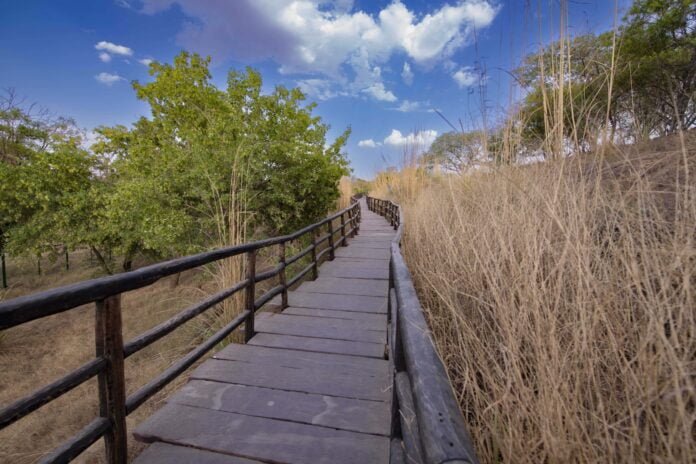
Today, Kishan Bagh is a sight to behold, attracting a growing number of tourists and locals alike. The park’s key feature is the natural shrubland, locally known as ‘Roee,’ which offers visitors a unique opportunity to experience the desert ecosystem up close. A raised walkway of 600 meters and a sand dune walk of 1.2 kilometers allow visitors to explore the exhibits on sand, rocks, and plants, providing valuable insights into the region’s natural history.

Special Sand Dunes of Kishan Bagh:

The sand dunes of Kishan Bagh are particularly remarkable, given their location in the Thar Desert, one of the most arid regions in the world. Shaped by the winds, these vast and beautiful dunes showcase a mesmerizing array of shapes and shades. Moreover, the sand dunes are home to various wildlife species, including endangered ones like the Indian wolf and the great Indian bustard, making them an essential conservation area.

Timing and Entry Fee:

Kishan Bagh is open to visitors during specific hours throughout the year. In winter (November to March), the timing is from 8 AM to 5.30 PM, while in summer (April to October), it is from 6 AM to 6.30 AM. The entry fee for adults is Rs. 50, while students can enjoy free or in minimal charge of Rs 25 only.

How to Reach Kishan Bagh:

Kishan Bagh is conveniently located just 15 km from Jaipur and is easily accessible by various modes of transportation. Visitors can reach the park by car, public buses, or taxis, making it a convenient day trip destination.

Dos and Don’ts:

– Wear comfortable walking shoes and cotton clothes, and don’t forget a hat to protect from the sun.

– Avoid bright colors, opting for green, khaki, or camouflage outfits if interested in birdwatching.

– Carry water and some snacks for a more enjoyable experience.

– Seek help from naturalists at the ticket counter for a free guided tour.

Kishan Bagh Jaipur has risen from the pages of history to become a thriving tourist spot and a testament to the successful restoration efforts of dedicated individuals like Pradeep Krishen and Golak Khandual. With its natural beauty, desert landscapes, and diverse flora and fauna, Kishan Bagh offers a unique experience that captivates the hearts of visitors and locals alike. Whether one is a nature enthusiast, a history buff, or a casual traveler, Kishan Bagh is an excellent destination to explore and appreciate the wonders of Rajasthan’s Thar Desert.