Home Blog Page 616

Explained: The Supreme Court’s Firecracker Ban and What’s Allowed Across India

0

On November 7, the Supreme Court of India issued a clarification regarding its decision to ban firecrackers nationwide, with a particular focus on those containing barium and other prohibited chemicals. The significance of this clarification lies in its applicability to the entire country, dispelling any misconception that the ban was restricted solely to the National Capital Region.

The clarification came in response to an application seeking direction to the Rajasthan government to comply with the top court’s order on barium crackers, specifically addressing concerns related to air and noise pollution. The bench, consisting of Justices A S Bopanna and M M Sundresh, affirmed that the previous orders issued during various petitions would bind every state, emphasizing the need for all states, including Rajasthan, to take steps to minimize air and noise pollution not only during festive seasons but also beyond.

This development gains significance as it precedes Diwali, a festival synonymous with the tradition of bursting firecrackers. As the country readies for celebrations on November 12, questions arise about the permissible types of firecrackers and their composition.

The Supreme Court’s stance on firecrackers has evolved over the years. In October 2018, the court imposed a ban on the sale and production of all crackers except ‘green crackers,’ which are designed to have reduced emissions and improved features. The ban also extended to ‘joined crackers’ and the use of barium salts in firecrackers. The court specified that noise levels should remain within permissible limits.

This position was reiterated in an order issued on October 29, 2021, wherein the court rejected a plea from the firecracker manufacturers’ association seeking permission to use joined crackers and add barium salt to green crackers. The ban on all types of firecrackers in the National Capital Region, except green crackers in areas with poor or moderate air quality, was already established by the National Green Tribunal in 2020.

Understanding what goes into the making of firecrackers is essential to grasp the implications of these bans. Typically, firecrackers consist of four primary ingredients: colorants, fuel, oxidizers, and binders. The court’s prohibition of chemicals like barium stems from their harmful impact on human health, causing issues such as skin allergies, respiratory difficulties, and even cancer.

Alternatives like aluminium, magnesium, and titanium are used for color emission without the adverse health effects. This aligns with the court’s emphasis on balancing traditional festivities with environmental responsibility.

In an effort to address environmental concerns, ‘green crackers’ have been introduced. These crackers aim to reduce pollution by replacing traditional components with less harmful alternatives. A network of Council of Scientific & Industrial Research (CSIR) labs, including the Central Electro Chemical Research Institute (CECRI), Indian Institute of Chemical Technology, National Botanical Research Institute, and National Chemical Laboratory, has researched and defined three broad categories of green crackers: SWAS (Safe Water Releaser), STAR (Safe Thermite Cracker), and SAFAL (Safe Minimal Aluminium).

SWAS releases water vapor to suppress dust, STAR emits reduced particulate matter at lesser sound intensity, and SAFAL minimizes aluminum usage, emitting less noise compared to traditional crackers. These innovations, rooted in scientific research, seek to align with the court’s directives on environmental safety.

As the nation approaches Diwali, these guidelines underscore the importance of adopting eco-friendly alternatives to ensure a celebration that is not only joyous but also environmentally sustainable. The Supreme Court’s decisions and the development of green crackers signify a collective effort toward striking a balance between cultural traditions and ecological responsibility.

The Fall and Rise: It’s the Journey of Football in India

0

Are you a football lover? Then this is the article of your interest. Do you want to know the history of India in football? Our sports enthusiast and content writer Priyanshi Pareek has got it summed up in this article.

History

British soldiers introduced football into India in the mid-nineteenth century. In 1872, Calcutta FC was the first football club to be established. 

Tournaments like the Gladstone Cup, the Trades Cup and the Cooch Behar Cup were started around this time. The Durand Cup and IFA Shield were both started in the late nineteenth century.

The first Indian team to achieve success was Sovabazar Club, which won the Trades Cup in 1892.

One of the most remarkable achievements in Indian football history occurred in 1951 when the Indian national team triumphed at the Asian Games in New Delhi.

India first took part in Olympic soccer in 1948. 

In between the two Olympics, in 1950, India received an invitation from Brazil to take part in the World Cup. India failed to accept the invitation and since then has never been a part of the tournament. 

Even for the 1954 World Cup in Switzerland, an invitation was extended to India. True to form, our football authorities returned the entry form after the date of submission. Consequently, India was not allowed to participate in the tournament. The lackadaisical approach of the football administrators continues even today.

Politics and Suspension 

On August 22, the Supreme Court is due to hear a case related to the All India Football Federation (AIFF). The hearing has assumed significance in view of AIFF’s suspension, on August 15-16, by FIFA, the sport’s premier international body, on grounds of “undue interference by a third party”.

The third party in question is a Supreme Court-appointed Committee of Administrators (CoA), which had recommended that 36 seats (or half the total strength) of the AIFF electoral college go to former players, including the likes of former India captain Baichung Bhutia and Vijayan.

On August 6, FIFA wrote to the Indian sports ministry to clarify that it was not opposed to player representation, but in the interest of the state bodies (who comprise the AIFF general assembly), mandatory player representation should be restricted to 25 per cent of the electoral college. It also issued a note of caution: by upending the current order of things ahead of AIFF elections, due on August 28, India was risking a suspension and related consequences.

The man Behind Success 

The man of the hour, the “bhai” of Indian football, Captain Fantastic. Anything said about football legend Sunil Chhetri would not come close to the actual legacy the man beholds and propels upwards each passing day. 

The captain who filled an entire stadium with just a video. Not many football players have that kind of accolade to their names.

Indian football has witnessed a remarkable transformation in recent years, with significant milestones and achievements contributing to the steady rise of the sport in the country.

From winning the Intercontinental Cup in 2023 to qualifying for the AFC Asian Cup to be held in 2024, Indian football is making its presence felt.

Dhanteras 2023: Let’s know the story behind this festival..

0

Dhanteras, known as Dhanavantri Trayodashi and Dhanatrayodashi, hold a significant place in the Hindu calendar as they signify the beginning of Diwali celebrations across India. Falling on the 13th lunar day (Trayodashi Tithi) of Krishna Paksha or the Dark Fortnight, this year Dhanteras is celebrated on November 10th. It’s a day that inspires people to invest in utensils, jewellery, vehicles, and various metal items, as they believe it’s an auspicious time to acquire metals. Devotees unite to offer their prayers to Goddess Lakshmi on Dhanteras, seeking happiness, prosperity, and wealth.

Historical and Mythological Significance

Dhanteras is deeply intertwined with Hindu mythology, boasting three captivating tales that illuminate the essence of this auspicious day.

The Legend of Lord Dhanvantri:

In Hindu tradition, Lord Dhanvantri is revered as the god of Ayurveda and Medicine. It is believed that he bestowed the knowledge of Ayurveda upon humanity, helping them combat diseases and ailments. On Dhanteras, devotees honour Lord Dhanvantri, seeking relief from chronic illnesses through Ayurveda.

According to ancient Hindu texts, Lord Dhanvantri was not just a healer but also the personal physician of the Hindu gods. Mythology states that Dhanvantri emerged from the Samudra Manthan, the churning of the cosmic ocean, holding a book on Ayurveda and the pot of Amrit (the nectar of immortality) in his hands.

The Tale of Goddess Lakshmi

Another enchanting narrative related to Dhanteras revolves around Goddess Lakshmi. Hindu mythology tells of Goddess Lakshmi’s emergence from the churning of the cosmic ocean, seated on a lotus, holding a vessel brimming with gold. This symbolizes good fortune, prosperity, happiness, and wealth. To welcome and seek the blessings of Goddess Lakshmi, devotees decorate their homes with beautifully crafted rangolis and illuminate them with earthen lamps.

In Hindu households, daughters are often seen as embodiments of Goddess Lakshmi, symbolizing good luck. Dhanteras rituals also include the tradition of daughters or daughters-in-law leaving their footprints at the entrance of their homes using ‘kumkum,’ a gesture believed to bring success and prosperity to the family.

The Legend of Lord Yamaraj

The most intriguing of the Dhanteras legends centers around King Hima’s son. His horoscope predicted that he would meet his demise on the fourth day of his marriage due to a snakebite. In a bid to change her husband’s fate, his newlywed wife took extraordinary measures. She kept him awake throughout the night by narrating stories and ensuring he did not fall asleep.

To thwart the snake’s arrival, she placed all her coins and ornaments at the entrance of their sleeping chamber and lit numerous earthen lamps. When Yamaraj, the god of death, arrived in the guise of a serpent, the brilliance of the lamps and the metal items blinded him. Yamaraj spent the entire night there and left the next morning without claiming King Hima’s son. This legend is why Dhanteras is also known as Yamadeepdaan, with people offering earthen lamps to Lord Yamaraj to appease him and pray for the long lives of their loved ones.

On the evening of Dhanteras, devotees fervently seek the blessings of Lord Dhanvantri and Goddess Lakshmi to bring peace and happiness into their homes. In Hindu culture, it is believed that Goddess Lakshmi only enters clean and well-kept households. Therefore, people engage in thorough cleaning to attract and invite the goddess into their abode. Lighting earthen lamps, creating intricate rangolis, and adorning the entrances with torans are common practices to welcome Goddess Lakshmi.

Many also perform rituals to worship Lord Yamaraj at night, seeking his blessings for the well-being of their families. Dhanteras is considered highly auspicious for the purchase of silverware, gold jewellery, and other metal items, as it is believed to bring good luck and wealth. Moreover, people in various professions, such as shopkeepers and farmers, also worship their main sources of income for prosperity.

Dhanteras is not merely a festival; it is a celebration that beautifully blends captivating mythology, hope, devotion, and festivity. Across India, people adorn themselves in traditional attire and celebrate the day with utmost enthusiasm. Dhanteras is a reminder of the rich tapestry of Indian culture, highlighting the importance of faith, togetherness, and the pursuit of prosperity.

As the festival of Dhanteras dawns, it is an occasion to welcome new hopes, cherish fresh dreams, and create cherished memories. Wishing you a joyous and prosperous Dhanteras!

What is Govardhan Puja and Why it is celebrated?

0

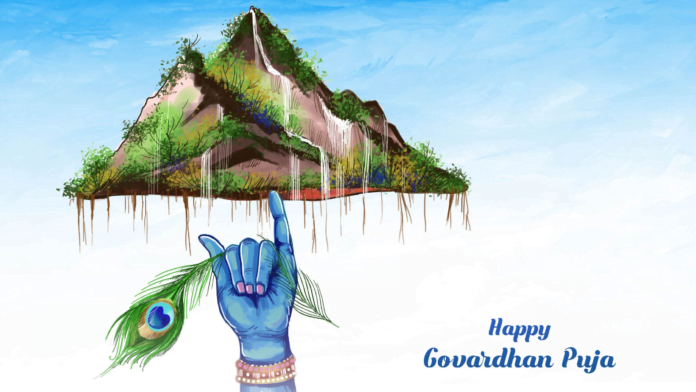
Govardhan Puja, also known as Annakut, is a Hindu festival celebrated with great enthusiasm and devotion in India, especially in the northern states. It falls on the fourth day of Diwali, which usually occurs in the month of October or November. This festival holds a significant place in Hindu mythology and is celebrated to commemorate an event from the life of Lord Krishna. Govardhan Puja is a day of expressing gratitude, community bonding, and fostering a sense of responsibility towards the environment.

The Legend of Govardhan Puja:

The origins of Govardhan Puja can be traced back to the Bhagavata Purana, an ancient Hindu scripture. The story behind the celebration revolves around Lord Krishna’s divine intervention to protect the people of the town of Vrindavan from the wrath of Lord Indra, the god of rain and thunderstorms. According to the legend, the residents of Vrindavan used to worship Lord Indra to ensure a bountiful harvest and good weather. However, young Lord Krishna advised them to worship Govardhan Parvat (mountain) instead, emphasizing the importance of nature and the environment.

In a fit of anger, Lord Indra sent torrential rains and thunderstorms to punish the people of Vrindavan for disobeying him. To protect the residents from the deluge, Lord Krishna lifted the massive Govardhan Parvat on his little finger for seven days and nights, providing them shelter from the elements. Realising the futility of his actions, Lord Indra withdrew the storm, and peace was restored.

The significance of Govardhan Puja:

 Gratitude towards nature: Govardhan Puja serves as a reminder of the reverence Hindus have for nature. The act of worshiping the Govardhan Parvat represents gratitude towards the Earth and its resources, which sustain life and provide for the community.

Environmental consciousness: The story of Lord Krishna lifting the mountain to protect the people underscores the importance of responsible environmental stewardship. Govardhan Puja encourages people to appreciate and care for the environment and its resources.

Community bonding: This festival brings communities together as they collectively prepare a massive feast called “Annakut” consisting of a wide variety of vegetarian dishes. The food is offered to deities and then distributed among the community members, emphasizing the spirit of sharing and togetherness.

 Spiritual significance: Govardhan Puja holds a spiritual significance as it teaches the importance of faith and devotion in overcoming adversities. Lord Krishna’s act of protecting the people of Vrindavan through divine intervention is seen as a symbol of hope and faith.

Celebrations and Rituals:

On Govardhan Puja, devotees create a replica of the Govardhan Parvat using cow dung, clay, or other materials. This representation is decorated with flowers and food items to offer to the deities. People also prepare an array of vegetarian dishes, sweets, and traditional foods as an offering to Lord Krishna. These offerings are later distributed among the community members, emphasizing the spirit of sharing and unity.

Govardhan Puja is a significant Hindu festival that celebrates nature, community, and the power of faith. It reminds us to be grateful for the environment that sustains us and to take responsibility for its well-being. As we celebrate Govardhan Puja, we should also reflect on the timeless lessons of this festival and incorporate them into our daily lives to foster a sense of environmental consciousness, unity, and gratitude.

Do you know there are places in India where Diwali is not celebrated?

0

Diwali, the festival of lights, is one of India’s most celebrated festivals, spreading joy and illumination across the nation. The festival transcends religious boundaries and is observed by Hindus, Jains, Sikhs, and Newar Buddhists. Despite this widespread celebration, there are a few places in India where you’ll be surprised to find no traces of Diwali. These unique destinations offer a different perspective on the festival of lights and are ideal for travelers seeking a quieter and more tranquil experience.

1. Kerala – The Land of Onam: Kerala, with its rich culture and customs, stands out as a state where Diwali is notably absent. The unique traditions of this southern state and its geographical isolation from the rest of India until British colonization have contributed to this absence. Instead, Kerala celebrates Onam with great enthusiasm, featuring elaborate decorations and festive rituals.

2. Melukote, Karnataka – A Day of Mourning: For the Mandyam Iyengar community in Melukote, Diwali serves as a somber reminder of their tragic past. They observe “Naraka Chaturdasi” as a day of mourning, marking the day when Tipu Sultan massacred hundreds of Mandyam Iyengar men, women, and children over two centuries ago. For them, Diwali symbolizes darkness and loss.

3. Bisrakh, Uttar Pradesh – Descendants of Ravana: The people of Bisrakh believe themselves to be the descendants of Ravana, the antagonist of the Diwali story. They venerate Ravana and his connection to their village, making the celebration of his defeat unthinkable.

4. Ponnanapalem, Andhra Pradesh – Superstitions of Death: In Ponnanapalem, a village in Srikakulam, Andhra Pradesh, the belief that celebrating Diwali brought bad luck persists. Two centuries ago, a baby died of a snakebite and two oxen perished on Diwali day. This led to a ban on Diwali celebrations in the village.

5. Baijnath, Himachal Pradesh – Respecting Ravana: The residents of Baijnath revere Ravana as a devoted follower of Lord Shiva. They believe that celebrating Diwali, which signifies Ravana’s defeat, will invite divine wrath. As a result, Baijnath remains a peaceful getaway during Diwali.

6. Nagaland – A Christian State: Nagaland, primarily a Christian state, does not celebrate Diwali as it is not part of their religious beliefs. While a few regions may witness limited celebrations, the state government has imposed restrictions on firecracker use due to their harmful effects.

7. Kashmir – A Quiet Diwali: Diwali in Kashmir is a subdued affair. Although some Hindus and Sikhs in Srinagar celebrate the festival, the festivities are minimal compared to other parts of the country.

8. Meghalaya – Tribal Simplicity: Diwali is not widely celebrated in the tribal villages of Meghalaya. The peaceful and serene atmosphere in these villages offers a unique Diwali experience for those seeking solitude.

9. Thoppupatti and Saampatti, Tamil Nadu – Protecting Sacred Bats: These villages in Trichy, Tamil Nadu, refrain from celebrating Diwali due to ecological reasons. Fireworks disturb the bats living in the branches of a sacred banyan tree, which villagers worship as part of their tradition. Crackers are unheard of during any village festival.

10. Mandore, Rajasthan – Revering Ravana: In Mandore, it is believed that Ravana married Mandodari. The local Maudgil Brahmins consider Ravana as a son-in-law, and celebrating his defeat and death is against their beliefs.

While these places may not partake in the traditional Diwali festivities, they offer a unique charm and a tranquil escape during the festival. Exploring these destinations allows travelers to experience India’s diversity and witness alternative celebrations that light up these regions throughout the year. So, if you’re seeking a different perspective on Diwali, consider visiting one of these remarkable places where the festival of lights remains a far-off notion.

Pushkar Fair 2023: Know dates, specialities and competitions

0

Pushkar is gearing up to host the world-renowned cattle fair which is a grand carnival where one will see captivating camel races to enchanting folk performances and bustling markets.

Pushkar dates: November 18-27

Pushkal festival specialities: Pushkar Camel Fair is basically livestock trading fair but it is a fair where one gets to experience spiritual rituals, and witnesses the unique culture of the Rajasthani people.

The Pushkar Fair was primarily a livestock fair, where traders as well as farmers from the Thar Desert region bought and sold camels, horses, cattle, and other animals. The fair’s primary purpose was to facilitate these transactions. Back then, the fair had a pretty agenda  to procure or sell off livestock. However, over the years, it has evolved into a multi-dimensional extravaganza.

Pushkar Fair Celebrations

Here you can see thousands of camels, all beautifully decorated with colourful bridles and accessories. This is also when you will get to witness camel races, camel dance performances, folk music and dance performances, acrobats, traditional puppet shows, and several other competitions. One of the biggest crowd-pullers is the moustache competition. The moustache competition, celebrates the magnificence of Rajasthani facial hair.

Tourists on board Palace on Wheels to celebrate Diwali in Jaisalmer

0

A total of 28 tourists who will be travelling in the luxury train Palace on Wheels will celebrate Diwali in Jaisalmer.

The train after leaving from Safdargunj railway station in evening will be reaching Jaisalmer on Diwali where tourists from different countries will celebrate the festival of lights.

This train will have 28 passengers from Netherlands, New Zealand, Italy, UK and others, confirmed officials.

Explore the famous Paintings of Rajasthan

0

Rajasthan, often referred to as the “Land of Kings,” is renowned for its rich culture, heritage, and vibrant art forms. One of the most captivating expressions of this cultural tapestry is the diverse range of painting styles that have flourished in the region over centuries. Let’s embark on a journey to explore nine popular painting styles of Rajasthan that have left an indelible mark on the world of art.

1. Phad Paintings: These ancient scroll paintings originating from Bhilwara, Rajasthan, narrate intricate stories of religion and deities. Often dubbed “mobile temples,” Phad artists would travel with their artworks, accompanied by singing and dancing, making these paintings a truly immersive experience.

2. Miniature Paintings: The 16th-century Miniature Paintings are known for their meticulous detailing and enchanting narratives. Some are created on paper, while others grace ivory canvases. Artists use fine brushes made from squirrel tails or bird feathers, and the use of natural colors continues to this day.

3. Gemstone Paintings: A relatively recent addition to Rajasthan’s artistic landscape, Gemstone Paintings emerged over the last two centuries. These unique artworks utilize semi-precious gemstones like agate, amethyst, and carnelian, ground into a paste and applied to surfaces like marble or acrylic sheets.

4. Kajali Paintings: This lesser-known ancient style is popular in eastern Rajasthan. Kajali, or carbon black, is the primary color used. The absence of paintbrushes is a distinctive feature as artists employ hands and cloth to create these remarkable works. Soot from burning oil lamps is the source of Kajali, enhancing the color’s absorption on cream-laminated paper.

5. Pichwai Paintings: Focusing on Krishna deities, Pichwai paintings grace temple walls and are crafted with natural colors, though modern iterations may use artificial brushes. Wealthy families opt for large backdrops, while others choose more modest versions beside their deities.

6. Bhitti Chitra Paintings: Utilizing mineral-based paint, Bhitti Chitra paintings, dating back 200 years, offer elaborate depictions of religious themes, adorned temples, patrons, and intricate embellishments. The Usta technique incorporates gold and silver embossing for added allure.

7. Kishangarh Paintings: Originating in the 18th century from the princely state of Kishangarh, these paintings stand out for their distinct facial features, sensitivity, and refined details. Unique serpentine hair locks and panoramic backgrounds contribute to their charm.

8. Sanjhi Paintings: Rooted in Krishna devotees’ folklore, this style was initially practiced by the priestly upper caste. Now, it’s a rare art form. Stencils are handcrafted and used to replicate designs on paper.

9. Bani Thani Paintings: Dedicated to Bani Thani, a beloved singer and poet in Kishangarh, these artworks replace Radha and Krishna with the King and Bani Thani. The paintings bear resemblance to Kishangarh school art, with one of her works gracing an Indian postal stamp.

Rajasthan’s painting styles not only capture its rich heritage but also showcase the enduring creativity and artistic mastery that has thrived through centuries. Each style offers a unique glimpse into the state’s culture, history, and the remarkable talents of its artists.

Dr. Zakir Hussain’s Oath to Bharat: A Review of “Bharat is My Home”

0

Dr. Zakir Hussain’s presidential address in 1967, famously titled “Bharat is My Home,” is a profound testament to his unwavering dedication to India’s rich cultural heritage and the ideals of unity and prosperity. In this remarkable speech, he unfolds his deep commitment to the nation and presents a vision for a harmonious and progressive India.

At the heart of Dr. Zakir Hussain’s address is his solemn promise to safeguard and nurture India’s culture. With a spirit of humanity and wholehearted dedication to the constitutional framework, he emphasizes the importance of upholding absolute values and fostering the growth of national culture and character. He posits that India’s cultural legacy is not a static relic but a dynamic force that shapes the present and future.

One of the most touching aspects of Dr. Zakir Hussain’s speech is his unwavering loyalty to both India’s past culture and the nation as a whole. He pledges to work for the welfare of all people, transcending barriers of caste, colour, and creed, boldly declaring, “The whole of Bharat is my home, and its people are my family.” His vision is to strengthen and embellish this vast familial home, ensuring that its inhabitants lead prosperous and dignified lives.

Hussain underlines the need for collective efforts to enhance the nation’s well-being. He stresses the importance of silent, sincere, solid, and steady work, recognizing two essential dimensions – the individual and the social. While individuals must strive to fulfil their personal, physical, and moral needs under strict discipline, he underscores the interdependence of individuals and society, where personal growth is intertwined with collective welfare.

The most compelling message of Hussain’s speech is his assertion that the state should not be just a mere organization of power but a moral institution. This echoes Mahatma Gandhi’s philosophy, emphasizing the use of state and individual power solely for moral purposes. He promises to dedicate his time to the welfare of the people of Bharat, highlighting the moral compass that guides his actions as the President.

“Dr. Zakir Hussain’s Oath to Bharat” is a powerful and inspiring speech, encapsulating his unwavering commitment to India’s culture and the well-being of its people. It is a call for unity, collective endeavour, and the pursuit of moral and ethical values in service to the nation. His words remain a timeless source of inspiration for those dedicated to the betterment of India and its diverse cultural heritage.