Home Blog Page 391

Golden-headed Cisticola Spotted in Mathikettan Shola National Park

0

The recent sighting of the Golden-headed Cisticola (Cisticola exilis) in Mathikettan Shola National Park, Idukki, has created excitement among ornithologists and bird enthusiasts. This discovery adds to the avian diversity of the southern Western Ghats, a region already known for its rich biodiversity. The species was identified after a prolonged absence in this part of India, making it a significant record for conservationists and researchers.

Background of the Species

The Golden-headed Cisticola is a small passerine bird commonly found in grasslands. It is easily recognized by its striking golden-orange plumage, which is most prominent in males during the breeding season. Other distinguishing features include a pinkish beak, black streaks on its back, and a distinctive high-pitched call that aids in identification.

Significance of the Discovery

This sighting is particularly notable as it marks the first recorded presence of the Golden-headed Cisticola in the southern part of the Palakkad Gap. Previously, the bird had been documented only in select regions of Karnataka, Tamil Nadu, and northern Kerala. The discovery underscores the rich and evolving biodiversity of the Western Ghats and highlights the need for further ecological research in this region.

Conservation Status and Concerns

Though the Golden-headed Cisticola is not classified as critically endangered, the preservation of its natural habitat remains crucial. The Western Ghats are increasingly threatened by deforestation, urbanization, and agricultural expansion. Since the species thrives in grassland ecosystems, conservation efforts must focus on protecting these habitats to ensure the sustainability of bird populations.

Mathikettan Shola National Park: A Biodiversity Hotspot

Mathikettan Shola National Park, located in Kerala’s Idukki district, is a vital ecological region known for its dense shola forests. Declared a national park in 2008, it plays a crucial role as an elephant corridor and a sanctuary for diverse flora and fauna. The park’s unique ecosystem provides an essential refuge for various endemic and migratory bird species, making it an ideal location for avian studies and conservation initiatives.

The sighting of the Golden-headed Cisticola in Mathikettan Shola National Park serves as a reminder of the untapped biodiversity within the Western Ghats. It also emphasizes the importance of continuous monitoring and conservation efforts to protect these fragile ecosystems and their inhabitants.

Narmada Jayanti 2025: Date, Time, Significance, and Rituals

0

Narmada Jayanti is a sacred Hindu festival that commemorates the divine manifestation of the holy Narmada River on Earth. Revered as one of the holiest rivers in India, the Narmada primarily flows through Madhya Pradesh and Gujarat. Devotees believe the river embodies Goddess Narmada, who bestows purity, prosperity, and protection upon her worshippers. In 2025, Narmada Jayanti will be observed on Tuesday, February 4th, aligning with the Saptami Tithi (seventh day) of Shukla Paksha in the Magha month of the Hindu calendar.

Date and Timings of Narmada Jayanti 2025

  • Saptami Tithi Begins: February 4, 2025, at 04:37 AM
  • Saptami Tithi Ends: February 5, 2025, at 02:30 AM

Why is Narmada Jayanti Celebrated?

Narmada Jayanti honors the birth of the sacred Narmada River, revered as a goddess in Hinduism. The festival signifies spiritual purification, as it is believed that bathing in the river’s waters cleanses sins and grants divine blessings. Devotees express their gratitude through prayers, rituals, and environmental initiatives, promoting awareness of river conservation for future generations.

Significance of the Narmada River

The Narmada River holds immense spiritual significance in Hinduism. Unlike the Ganges, where flowing water is considered sacred, Narmada’s holiness extends to the unique stones (Shiva Lingams known as Banalingas) found along its banks, which are worshipped by devotees.

According to Hindu mythology, the Narmada River is a divine manifestation of Goddess Narmada, created by Lord Shiva. Worshippers seek her blessings for peace, prosperity, and liberation from past sins. Many believe that a pilgrimage along the river’s banks, known as the Narmada Parikrama, bestows immense spiritual merit.

Rituals Performed on Narmada Jayanti 2025

1. Holy Bath (Snan)

Taking a dip in the sacred Narmada River is the most significant ritual of Narmada Jayanti. Devotees gather at riverbanks in places like Omkareshwar, Maheshwar, and Hoshangabad, believing that bathing in the river washes away sins and brings divine blessings.

2. Puja and Offerings

After the holy bath, devotees perform special prayers and offerings to the river. Rituals include offering milk, honey, flowers, and incense as a mark of devotion. Temples along the Narmada host special aartis, kirtans (devotional singing), and chanting of sacred mantras in honor of Goddess Narmada.

3. Fasting (Vrat)

Many devotees observe a fast (vrat) on this day. Some abstain from all food, while others follow a restricted diet, avoiding certain foods. Fasting is believed to enhance spiritual growth, self-discipline, and inner peace.

4. Environmental Protection Initiatives

Since rivers are vital for life, Narmada Jayanti also serves as a reminder to protect and preserve natural resources. Volunteers and organizations conduct clean-up drives, tree-planting programs, and awareness campaigns to safeguard the river from pollution.

How is Narmada Jayanti Celebrated?

Narmada Jayanti is primarily celebrated in Madhya Pradesh, Gujarat, and Maharashtra, drawing thousands of devotees to Omkareshwar, Maheshwar, and Hoshangabad for grand festivities. The celebrations include religious processions, bhajan-kirtans, cultural programs, and spiritual discourses.

In Gujarat, devotees gather along the riverbanks to offer prayers, light oil lamps, and take a holy dip. The Statue of Unity, located near the Narmada River, adds to the festival’s significance in the state, attracting visitors who come to witness the celebrations.

Summing Up

Narmada Jayanti is not just a religious observance but a celebration of nature’s divine gift. As devotees immerse themselves in prayers and rituals, the festival also highlights the importance of environmental conservation. Whether through traditional offerings or ecological awareness efforts, the essence of Narmada Jayanti lies in reverence, gratitude, and the preservation of one of India’s most sacred rivers.

May Goddess Narmada bless everyone with prosperity and peace on this auspicious occasion!

Valentine’s Week Full List 2025: From February 7 to February 14, Check All Details Here!

0

Valentine’s Week is a seven-day-long celebration of love, affection, and heartfelt connections. From Rose Day to Kiss Day, each day carries a special significance, offering unique ways to express emotions and cherish relationships. Whether you’re in a romantic relationship or simply celebrating love in all its forms, this week provides a beautiful opportunity to spread joy and appreciation.

In this guide, we will explore the significance of each day and offer thoughtful suggestions for celebrating love, from romantic gestures to self-care moments.

Valentine’s Day 2025 Overview

OccasionValentine’s Day
DateFebruary 14, 2025
DayFriday
Valentine’s WeekFebruary 7-14, 2025
OriginAncient Rome
SignificanceTo spread love and harmony

Why is Valentine’s Day Celebrated?

The origins of Valentine’s Day trace back to Saint Valentine of Rome, a priest who defied Emperor Claudius II’s ban on soldiers marrying. He performed secret weddings for young couples and was later imprisoned for his acts of love and kindness. According to legend, he sent a farewell note to the jailer’s daughter, signed “From your Valentine.”

Saint Valentine was executed on February 14, 269 AD, and since then, the day has become a symbol of love, commitment, and passion. Over time, it evolved into Valentine’s Week, a celebration that extends beyond just one day to include a series of events that honor different aspects of love and relationships.

Valentine’s Week 2025: Full List of Days

If you’re wondering about the special days leading up to Valentine’s Day, here’s a complete list of Valentine’s Week 2025:

DateDayValentine’s Week Celebration
February 7, 2025FridayRose Day
February 8, 2025SaturdayPropose Day
February 9, 2025SundayChocolate Day
February 10, 2025MondayTeddy Day
February 11, 2025TuesdayPromise Day
February 12, 2025WednesdayHug Day
February 13, 2025ThursdayKiss Day
February 14, 2025FridayValentine’s Day

Valentine’s Week 2025: Significance of Each Day

1. Rose Day (February 7, 2025)

Rose Day marks the beginning of Valentine’s Week. Flowers, especially roses, are exchanged as tokens of love and admiration. Different colors of roses convey different emotions:

  • Red Rose: Love and passion
  • Yellow Rose: Friendship
  • Pink Rose: Gratitude and admiration
  • White Rose: Purity and peace
  • Orange Rose: Desire and enthusiasm

2. Propose Day (February 8, 2025)

A perfect day for confessions of love! Whether you’re planning a romantic proposal or just expressing your feelings to someone special, this day encourages heartfelt emotions and new beginnings in relationships.

3. Chocolate Day (February 9, 2025)

Chocolate Day is about sweetening relationships. Exchanging chocolates symbolizes love, happiness, and warmth, making it an ideal way to show appreciation for loved ones.

4. Teddy Day (February 10, 2025)

Soft, cuddly teddy bears bring comfort and joy. Gifting a teddy bear signifies care, warmth, and reassurance, making it a lovely gesture to show affection.

5. Promise Day (February 11, 2025)

This day is about making and keeping promises. Whether it’s a commitment to a romantic partner, a friend, or even a personal resolution, Promise Day reminds us of the strength of trust and loyalty.

6. Hug Day (February 12, 2025)

A simple hug has the power to heal, reduce stress, and bring people closer. Hug Day celebrates the warmth of human connection, whether with a partner, a friend, or family members.

7. Kiss Day (February 13, 2025)

Kiss Day symbolizes intimacy, love, and deep affection. Whether it’s a romantic kiss or a simple peck on the forehead, it represents a heartfelt connection between loved ones.

8. Valentine’s Day (February 14, 2025)

The grand finale of Valentine’s Week! Couples celebrate their love with gifts, candlelight dinners, heartfelt messages, and romantic gestures. But love isn’t just for couples—celebrate with friends, family, or through self-care!

Final Thoughts

As Valentine’s Week approaches, take a moment to appreciate the love, friendships, and meaningful connections in your life. Love is not limited to just romantic relationships—it includes friendship, family bonds, and self-love as well. Let’s celebrate love in all its forms and make every moment count.

Happy Valentine’s Week 2025!

World Cancer Day 2025: Date, History, Theme, Significance, and More

0

Every year, World Cancer Day is observed on February 4 to raise awareness, encourage prevention, and promote early detection and treatment of cancer. This global initiative unites individuals, healthcare organizations, and policymakers in the fight against one of the deadliest diseases.

According to the World Health Organization (WHO), cancer remains a leading cause of death worldwide, claiming approximately 10 million lives in 2022 alone. With early diagnosis, improved screening, and cutting-edge treatment options, the battle against cancer continues to gain momentum.

World Cancer Day: History

The roots of World Cancer Day trace back to February 4, 1999, when it was first declared during the World Summit Against Cancer in Paris. A year later, on February 4, 2000, the Charter of Paris Against Cancer was signed at the World Summit Against Cancer for the New Millennium, officially establishing World Cancer Day.

This charter not only emphasized the need for global collaboration in cancer research, treatment, and care but also outlined steps to advance cancer awareness and patient support worldwide.

World Cancer Day 2025: Theme

The theme for World Cancer Day 2025, “United by Unique,” underscores the importance of personalized, patient-centered cancer care. It highlights the need to tailor treatments to each individual, recognizing that every patient’s journey is different.

This theme is part of a three-year campaign running from 2025 to 2027, focusing on the diverse experiences of cancer patients, survivors, and caregivers. The initiative advocates for more compassionate, inclusive, and personalized approaches to cancer care.

World Cancer Day 2025: Significance

World Cancer Day serves as a powerful reminder of the urgent need for cancer prevention, early detection, and effective treatment to reduce mortality rates. It encourages people to take proactive steps, such as adopting healthier lifestyles, undergoing regular screenings, and supporting cancer research initiatives.

Beyond awareness, the day also calls for global collaboration among governments, healthcare organizations, and communities to minimize the devastating impact of cancer on individuals and families worldwide.

Types of Cancer: A Closer Look

Cancer is classified into five major types based on the origin of the affected cells:

  • Carcinomas – Develop in the skin or tissues surrounding internal organs.
  • Sarcomas – Arise in connective tissues like bone, cartilage, muscle, fat, and blood vessels.
  • Leukemias – Originate in the bone marrow and affect blood cell production.
  • Lymphomas and Myelomas – Affect the immune system cells.
  • Central Nervous System (CNS) Cancers – Begin in the brain or spinal cord.

Summing Up

As we observe World Cancer Day 2025, the message is clear—cancer is a global challenge, but with early detection, innovation in treatment, and collective action, lives can be saved. Whether through raising awareness, supporting research, or advocating for better healthcare access, every effort counts in the fight against cancer.

Let’s unite in spreading awareness and standing in solidarity with those affected. Together, we can make a difference.

Waste to Wow: How Three Artists Are Turning Garbage Into Stunning Art

0

Can trash be transformed into treasure? These visionary artists are proving that waste isn’t just something to be thrown away—it can be reimagined, repurposed, and turned into breathtaking works of art. By using discarded materials like plastic waste, electronic scrap, and everyday junk, they are not only creating stunning visuals but also raising awareness about environmental sustainability.

Vishwanath Mallabadi Davangere: The E-Waste Artist

In the bustling tech hub of Bengaluru, Vishwanath Mallabadi Davangere, a retired engineer, found an unexpected muse—discarded electronic components. From abandoned circuit boards to tangled wires and microchips, he transforms electronic waste into intricate sculptures, ranging from miniature robots to entire cityscapes.

“I started this as a fun activity, making small animals out of scrap from gadgets. At first, no one really understood what I was doing,” Vishwanath recalls. “But when I learned about the environmental impact of e-waste, I began creating murals and sculptures with a purpose. Eventually, it turned into a full-fledged business after my retirement.”

His art is not just visually compelling but also a stark reminder of the growing problem of e-waste. By giving old electronics a second life, Vishwanath hopes to inspire people to rethink their consumption habits and support responsible recycling.

Manveer Singh: Bringing Attention to Plastic Pollution

Delhi-based artist Manveer Singh takes on one of the planet’s biggest environmental threats—plastic pollution. His approach? Transforming plastic waste into large-scale, thought-provoking art installations that demand attention.

“I’m on a mission to make people reconsider their reliance on single-use plastic and encourage proper waste segregation for recycling,” Singh explains.

His artworks, often made entirely from discarded plastic bottles, wrappers, and packaging materials, highlight the sheer volume of plastic waste generated daily. Whether it’s a giant fish sculpture made from ocean debris or a towering installation of crushed bottles, Singh’s creations serve as a visual protest against the throwaway culture.

B. Gowtham: Art for a Cleaner City

For Chennai-based artist and activist B. Gowtham, art is not just about creativity—it’s a call to action. Unlike most artists, he doesn’t wait for inspiration to strike in a studio; he finds it on the streets.

Gowtham’s passion for environmental conservation led him to create sculptures and murals using discarded materials, especially plastic waste. But his efforts go beyond art—he actively organizes clean-up drives and campaigns, urging citizens to take responsibility for their surroundings.

“I felt like the Earth was turning into a dump yard. People seemed to lack accountability, especially when it came to plastic pollution,” he says.

His work, often seen in public spaces, transforms neglected areas into vibrant landmarks while delivering a strong message about sustainability.

Turning Trash into a Movement

These three artists are more than just creators—they are changemakers. By turning waste into art, they are challenging the way we perceive trash and encouraging communities to adopt sustainable practices.

Their work proves that what we discard mindlessly can be given a new purpose, inspiring a shift from wastefulness to wonder. So the next time you see a pile of trash, look a little closer—you might just see the next masterpiece in the making.

Kashmir Entrepreneurs Tackle Tourist-Led Pollution with E-Bikes, Earning Rs 30 Lakh Annually

0

Once a winter wonderland, Kashmir now grapples with air pollution and diminishing snowfall. Sheikh Yameen, a Srinagar native, nostalgically recalls the thick blankets of snow that once covered his hometown. His childhood was filled with snowmen, snowball fights, and crisp, fresh air—memories that have become increasingly rare. Today, however, the valley’s clear blue skies are often obscured by smog, and snowfall is sporadic at best.

“Kashmir’s once-pristine landscape is now threatened by rising pollution levels, placing it among the top ten most polluted regions in India. The lush valleys are choked with traffic, and what used to be a 30-minute drive now stretches beyond an hour,” Yameen laments. He attributes the growing crisis to unchecked vehicular emissions, an influx of tourists, and urban expansion, all of which have left Kashmir’s fragile ecosystem vulnerable.

Determined to restore the valley’s lost charm, Yameen and his college friend, Zubair Ahmed Bhat, brainstormed solutions over a cup of tea. Their shared concern for Kashmir’s deteriorating environment led to the inception of Curve Electric—a sustainable e-bike rental service aimed at reducing traffic congestion and cutting down carbon emissions.

Championing Sustainable Mobility

In 2022, the duo transformed their vision into reality, launching Curve Electric to pioneer green transportation in Kashmir. Their e-bikes provide an eco-friendly alternative to conventional vehicles, significantly lowering the region’s carbon footprint.

“Our lightweight electric vehicles are designed to navigate Kashmir’s rugged terrains with ease,” says Yameen. “By integrating e-bikes into daily commutes, we are not just reducing traffic but also offsetting carbon emissions equivalent to 7,500 trees.”

Curve Electric’s bikes boast several unique features. Riders can switch between manual pedaling and electric assistance, ensuring adaptability across different terrains. Additionally, the high-torque motors (40 Newton Meters of force) enhance durability, making the e-bikes ideal for Kashmir’s mountainous landscapes. A standout feature is the detachable battery system, which allows users to swap discharged batteries with fresh ones, eliminating downtime. Each full charge covers 60 to 65 kilometers.

Kashmir Entrepreneurs Tackle Tourist-Led Pollution with E-Bikes, Earning Rs 30 Lakh Annually

Unlike other e-bike rental services, Curve Electric keeps its system simple. “There’s no need for mobile apps or digital wallets. Riders can rent a bike directly from a docking station using their ID. Charges are calculated at just Rs 6 per minute, significantly cheaper than cabs or fuel-powered bikes, which cost Rs 20 and Rs 11 per kilometer, respectively,” Yameen explains.

Security is also a priority. The bikes are equipped with GPS tracking and alert systems to prevent theft and tampering.

Pedaling Towards a Greener Future

Since its launch, Curve Electric has completed 55,000 rides, covering 7,50,000 kilometers, thereby preventing tons of carbon emissions. Locals and tourists alike have embraced this new mode of transport, enjoying the convenience and sustainability it offers.

Salik Bhat, a daily commuter, shares his experience: “My home is just 500 meters from the nearest Curve Electric station. I use the e-bike to commute to work, avoiding traffic and saving time. What used to be a stressful 30-minute drive has now turned into a smooth, hassle-free ride.”

Kashmir Entrepreneurs Tackle Tourist-Led Pollution with E-Bikes, Earning Rs 30 Lakh Annually

Beyond its environmental impact, the startup is also proving to be financially successful. With an initial investment of Rs 14 lakh, the duo recorded an annual revenue of Rs 30 lakh last year. This year, they are projecting earnings of Rs 55 lakh.

The startup recently gained national recognition after appearing on Shark Tank India Season 4. Although they didn’t secure a deal, the exposure helped amplify their mission. “For us, it was more about raising awareness than securing funding,” Yameen remarks. “We are not just a business for profit—we are a business with a purpose.”

Scaling New Heights

Looking ahead, Curve Electric plans to expand beyond Kashmir into other urban centers, aiming to revolutionize sustainable transportation across India. “We want to inspire a larger movement towards conscious living. More than just an alternative mode of transport, our e-bikes represent a commitment to a cleaner, greener future,” says Yameen.

With their vision gaining momentum, the young entrepreneurs are proving that sustainable solutions are not just necessary but also financially viable. By combining eco-consciousness with innovation, Curve Electric is not only redefining mobility in Kashmir but also setting an example for sustainable businesses nationwide.

From Adversity to Entrepreneurship: How a Cancer Survivor Built a Thriving Food Business

0

Laveena Jain, a 56-year-old cancer survivor, transformed her passion for cooking into a flourishing business—‘Laveena’s Tripti Foods’. What began with a mere Rs 1,500 and a handful of local customers has grown into a well-known brand across Uttar Pradesh, specializing in homemade murabbas, jams, pickles, and squash. But behind this success lies a story of immense struggle, resilience, and an unbreakable spirit.

A Life Turned Upside Down

Laveena and her husband once enjoyed a comfortable life running a private transport business in Meerut, Uttar Pradesh. However, in 2010, their world crumbled when both were diagnosed with cancer—breast cancer for Laveena and mouth cancer for her husband. The couple underwent back-to-back surgeries, chemotherapy, and radiotherapy, forcing them to shut down their business. With mounting medical bills and school fees for their two young children, they faced financial turmoil. Borrowing money from friends and family seemed like an endless cycle, and the pressure to sell their home loomed over them.

“We were devastated, not just financially but mentally and physically. Yet, we knew we were in this fight not just for ourselves, but for our children’s future,” Laveena recalls. Determined not to give up, she sought ways to rebuild their lives without letting go of the home that held their memories.

Rediscovering a Forgotten Skill

After eight months of treatment, Laveena searched for ways to sustain her family. She recalled a skill she had learned in her teenage years—food preservation. In the 1980s, she had taken a course in making murabbas, pickles, and jams, more as a hobby than a necessity. Little did she know that this knowledge would one day become her lifeline.

From Adversity to Entrepreneurship: How a Cancer Survivor Built a Thriving Food Business

Encouraged by her husband, who was still recovering and unable to speak for six months, she enrolled in the Uttar Pradesh Government’s 100-day employment development programme on food preservation. Post-training, with just Rs 1,500 in hand, she launched ‘Laveena’s Tripti Foods’ from her home kitchen.

A Humble Beginning with a Big Dream

With no formal marketing experience, Laveena faced challenges in selling her homemade products. “Making a product is easy, but selling it is a different battle,” she says. Her breakthrough came through local kitty parties, where she offered samples of her products. The response was overwhelmingly positive, and soon, pre-orders for her lemon squash, mango pickles, and other delicacies started pouring in.

From reusing old bottles for packaging to carefully refining her recipes, she steadily built her customer base. What started as a small-scale venture soon expanded into an enterprise offering 60 to 70 varieties of homemade products.

A Family’s Unbreakable Bond

Throughout this journey, Laveena’s biggest motivation remained her family. Her son, Kinshuk, who was initially set on becoming a chartered accountant, found himself drawn into the business. He juggled his studies while helping his mother at exhibitions and managing operations.

“I remember my parents sitting us down and telling us about their fourth-stage cancer. They didn’t know what the outcome would be but wanted my sister and me to always support each other,” Kinshuk recalls.

The business was not just a financial necessity; it was a testament to their resilience. Kinshuk faced his own challenges while promoting their products. Initially hesitant, he found encouragement from his father, who, despite his condition, wrote messages on paper to motivate him. “He reminded me how he once personally invited passengers onto his bus despite being the owner. That lesson gave me the courage to go door-to-door with our food samples,” he shares.

A Thriving Business with a Purpose

What started in Meerut has now expanded to cities like Moradabad, Ghaziabad, Aligarh, and Noida. Laveena’s products are sold both offline and online, including on platforms like Amazon. Today, they receive an average of 300 orders per month, and the business has helped them clear loans of Rs 15 lakh.

Looking back, Laveena believes her journey is a story of courage and perseverance. “I don’t see myself as an inspiration, but I want to show that no matter what challenges come your way, you must not lose hope.”

Each jar of pickles, bottle of squash, and pack of jam carries more than just flavors—it carries a story of survival, resilience, and the indomitable spirit of a woman who refused to give up.

Incredible! This man creates non-stop talk show record for 24 hrs, 27 mins…

4

One Sunil Sushila Sharma from Jaipur has set a remarkable record by hosting a nonstop talk show for 24 hours and 37 minutes, engaging with over 58 participants. This extraordinary feat has been officially recognised by the India Book of Records as the longest talk show on natural farming.

Titled Akhand Samvad, the programme featured distinguished guests, including Padma Shri award-winning farmers, the Vice Chancellor of an Agricultural University, the Commissioner of the Food and Safety Department, the Director of the Agriculture Department, and several farmer scientists. The discussions covered various aspects of chemical-free farming, its benefits, challenges, and solutions. Additionally, experts explored methods to conserve the rapidly depleting water resources by optimizing agricultural water use. Throughout the event, a team from the India Book of Records was present to verify the achievement.

For years, Sunil Sushila Sharma has been dedicated to promoting chemical-free farming through his television programs. Having worked with multiple channels, his mission is to create a toxin-free agricultural environment, ensuring healthier food for the common man and a disease-free future for upcoming generations.

The entire event was streamed live on Update India’s YouTube channel for 25 hours, attracting between 5,000 to 8,000 viewers who stayed engaged from start to finish.

He further attributed the success of this programme to the dedicated individuals who stayed in their offices through the night, patiently waiting for their turn to contribute to the discussion and engaging in meaningful conversations.

Padma Shri Sunda Ram Verma likened Sunil Sushila Sharma’s efforts to a ritual, emphasizing that by sharing their thoughts, they are collectively working towards the success of this campaign.

The Bird Whisperer: How One Woman Transformed Her Balcony into a Birding Paradise

0

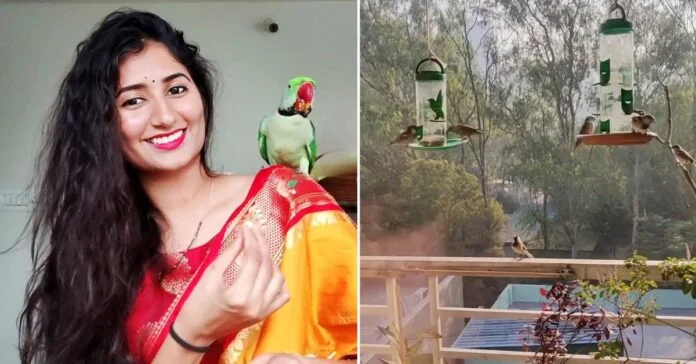
For most, a balcony is just an extension of their home—an outdoor space for morning tea or an occasional potted plant. But for Radhika Sonawane, it became a sanctuary for birds. In the heart of an urban jungle, she carved out a miniature ecosystem, earning herself the title of ‘The Bird Whisperer.’

From Isolation to Harmony with Nature

During the COVID-19 lockdown, while many struggled with isolation, Radhika found solace in an unexpected way—by connecting with nature. What started as a simple attempt to attract birds to her balcony quickly evolved into something extraordinary.

Initially, her efforts seemed futile—no birds ventured close, hesitant to trust the human presence. But Radhika, guided by her love for wildlife, refused to give up.

Creating a Heaven for Birds

Determined to provide a safe and welcoming space, she carefully curated her balcony with:

  • Lush greenery to mimic natural habitats
  • Bird feeders, stocked with seeds and grains
  • Birdbaths to provide fresh drinking water
  • Shelter areas to make them feel safe

Her patience paid off. First, a few sparrows fluttered in. Then, parrots, bulbuls, and even doves began visiting. Over time, these once-hesitant birds became regular guests, filling her mornings with a symphony of chirps and melodies.

A Bond Beyond Words

Today, Radhika shares an extraordinary connection with her feathered visitors. Some birds perch on her shoulders, while others eat straight from her hands—a rare display of trust from wild creatures.

“For them, my balcony isn’t just a place to stop by; it’s home,” she says.

Beyond Personal Joy: Inspiring a Movement

Radhika’s love for birds extends beyond her own home. She now conducts workshops to educate people on how to create bird-friendly spaces in urban areas.

With cities rapidly losing green cover, she emphasizes the need for small urban sanctuaries where birds can find rest and nourishment.

“Giving birds a place to rest is the least we can do,” she says. “Because birds belong in the sky, not cages.”

Her story is a reminder that small actions can create ripples of change—proving that even in a concrete jungle, nature can find its way back, if only we make room for it.

Bengaluru-Based Startup Ethereal X builds India’s First Reusable Rocket Engine

0

In a groundbreaking achievement for India’s space technology sector, Ethereal Exploration Guild, a Bengaluru-based company specializing in reusable launch vehicles, has unveiled the country’s first-ever reusable rocket engine’s Thrust Chamber Assembly (TCA), named the Pegasus TCA.

This innovation marks a significant leap in aerospace technology, as it powers the upper stage of their Razor Crest Mk-1 rocket, incorporating a fully indigenous propulsion system.

A Breakthrough in Propulsion Technology

For the first time in fifty years, an upper stage rocket engine will utilize an entirely new, domestically developed feed cycle—the Full Flow Segregated Cooling Cycle (FSCC). This advanced design improves efficiency and reusability, positioning Ethereal Exploration Guild as a formidable competitor in the global space industry.

According to the company, the test-ready, regeneratively cooled Pegasus TCA is capable of:

  • Generating 40kN of thrust
  • Achieving a specific impulse (Isp) of 293 seconds at sea level

If these performance metrics hold during testing, the Pegasus TCA will become India’s most efficient semi-cryogenic Thrust Chamber Assembly.

Key Milestones in Space Innovation

With the Pegasus TCA, Ethereal Exploration Guild has accomplished several pioneering feats:

  • World’s first RP-1/LOX engine TCA capable of operating on an expander cycle
  • India’s first reusable rocket engine TCA
  • India’s first bi-propellant-cooled engine TCA
  • India’s most powerful domestically developed semi-cryogenic TCA

These achievements solidify India’s growing expertise in next-generation space propulsion systems.

Global Recognition: Selected for the I2A Launchpad Program

Ethereal Exploration Guild has also earned a coveted spot in the India to America (I2A) Launchpad program, a strategic initiative fostering collaboration between Indian innovators and the US Department of Defense, Defense Innovation Unit (DIU), and other major space and defense stakeholders.

This selection is particularly significant as Ethereal Exploration Guild is the only launch vehicle company among the eight Indian startups chosen—a testament to their cutting-edge advancements.

A Rising Challenger to SpaceX?

Founded in 2022, Ethereal Exploration Guild is led by Manu J. Nair, a Mechanical Engineer and IIAS Scientist-Astronaut Graduate, alongside former ISRO scientist Shubhayu Sardar (COO) and aerospace engineer Prashant Sharma (CTO).

With a vision to disrupt the commercial launch market, the company aims to offer launches at significantly lower costs:

$350 to $2,000 per kilogram to space—challenging the industry benchmarks and undercutting major players like SpaceX.

The Future of Space Exploration in India

With their revolutionary propulsion technology, cost-effective launch solutions, and international recognition, Ethereal Exploration Guild is poised to redefine India’s role in the global space race.

As the demand for affordable, reusable launch vehicles grows, this Bengaluru-based startup is setting the stage for a new era in space exploration—one where India emerges as a leading force in sustainable and cost-efficient space travel.