Home Blog Page 37

World Earth Day 2026: “Our Power, Our Planet” — A Global Call to Protect Our Only Home

0

Every year on April 22, the world observes Earth Day, a global initiative dedicated to environmental protection and sustainability. What started as a national movement in the United States has evolved into a worldwide campaign, engaging over a billion people across more than 190 countries.

Understanding Earth Day: Meaning, History and Global Reach

Earth Day was first celebrated in 1970, spearheaded by U.S. Senator Gaylord Nelson. Disturbed by rising pollution levels and environmental neglect, he mobilized millions of Americans in what became a historic environmental “teach-in.” The first event saw around 20 million participants and laid the foundation for the modern environmental movement.

Over the decades, Earth Day expanded globally, becoming a unifying platform for environmental awareness and action. Today, it serves as a reminder that environmental protection is not confined by borders—it is a shared global responsibility.

From 1970 to Today: How a Movement Became a Worldwide Mission

Since its inception, Earth Day has played a significant role in shaping environmental policies and inspiring activism. It has contributed to landmark changes in environmental governance and continues to influence climate discussions worldwide. The day highlights urgent issues such as climate change, deforestation, biodiversity loss, and pollution, urging both individuals and governments to act.

Why Earth Day Matters More Than Ever in 2026

In today’s rapidly changing world, the importance of Earth Day has only intensified. Rising global temperatures, extreme weather events, and ecological degradation underline the need for immediate and sustained action. Earth Day acts as both a platform for awareness and a catalyst for solutions—encouraging simple actions like reducing waste, conserving energy, and adopting sustainable lifestyles.

Theme 2026: “Our Power, Our Planet”

The official theme for Earth Day 2026, announced by EARTHDAY.ORG, is “Our Power, Our Planet.”
This theme emphasizes a powerful idea: meaningful environmental change does not depend solely on governments or policies, but on the collective actions of people worldwide. It highlights how communities, individuals, and local systems play a crucial role in protecting the planet and driving sustainable progress.

Earth Day 2026 is not just a celebration—it is a reminder of responsibility. The message is clear: the power to protect the Earth lies with all of us. Whether through small daily actions or large-scale initiatives, collective effort can shape a healthier, more sustainable future for generations to come.


Satyendranath Tagore: The Pioneer of Indian Civil Services

0

In the long and complex history of India’s administrative system, one name stands out as a symbol of courage and change—Satyendranath Tagore. He was the first Indian to enter the prestigious Indian Civil Service (ICS), breaking racial barriers in a system that was once exclusively dominated by the British.

Born on June 1, 1842, in Calcutta (now Kolkata), Satyendranath belonged to the illustrious Tagore family, known for its contributions to literature, art, and social reform. He was the elder brother of Rabindranath Tagore, the Nobel Prize-winning poet. Raised in an intellectually vibrant environment, Satyendranath developed a strong academic foundation that would later help him achieve a historic milestone.

The mid-19th century marked the formal structuring of civil services in India under British rule, a system significantly shaped by Lord Cornwallis, often called the “Father of Civil Service in India.” However, this elite service was initially closed to Indians. The ICS examination was conducted in England, making it difficult for most Indians to compete due to distance, financial constraints, and systemic discrimination.

Against these odds, Satyendranath Tagore traveled to England and successfully cleared the ICS examination in 1863. He formally joined service in 1864, becoming the first Indian to do so. His achievement was not just personal—it marked a turning point in colonial India, demonstrating that Indians were equally capable of competing at the highest administrative levels.

During his career, Satyendranath served primarily in the Bombay Presidency (present-day parts of Maharashtra, Gujarat, and Karnataka). He held several important administrative positions and eventually served as a District Judge in Karnataka. His tenure, which lasted nearly three decades, was marked by dedication, integrity, and a commitment to justice.

Beyond administration, Satyendranath was also a scholar, linguist, and social reformer. He advocated for women’s education and played a role in promoting progressive ideas within Indian society. His work reflected a blend of administrative excellence and intellectual depth.

Satyendranath Tagore’s entry into the ICS opened the doors for many Indians who followed, gradually transforming the civil services into a more inclusive institution. Today, his legacy lives on in India’s modern civil services, including the Indian Administrative Service (IAS), which continues to shape governance in the country.

His life is a reminder that true change often begins with one individual daring to challenge the status quo—and succeeding.

Tim Cook to Step Down as Apple CEO After 15 Years, John Ternus Set to Take Charge

0

In a significant leadership transition, Tim Cook will step down as CEO of Apple on September 1, 2026, bringing to a close a remarkable 15-year tenure. He will move into the role of Executive Chairman, while Apple’s current hardware engineering head, John Ternus, is expected to take over as the new CEO. This shift marks the end of an era defined by stability, growth, and strategic evolution, and signals Apple’s renewed focus on future innovation, particularly in areas like artificial intelligence.

Tim Cook’s journey to the top is a story of discipline and operational excellence rather than flamboyant showmanship. Born in Alabama, he studied industrial engineering and later pursued an MBA from Duke University. Before joining Apple in 1998, Cook worked at IBM and Compaq , where he developed deep expertise in supply chain management. When he arrived at Apple, the company was still regaining its footing, and Cook played a crucial role in streamlining operations, cutting inefficiencies, and building one of the most effective supply chains in the world.

When Cook succeeded Steve Jobs in 2011, skepticism was widespread. Jobs was a visionary icon, and many questioned whether Cook could carry forward that legacy. Instead of imitating Jobs, Cook redefined leadership at Apple. He focused on consistency, long-term strategy, and expanding Apple’s ecosystem. Under his guidance, Apple strengthened its core products while significantly growing its services segment, including platforms like Apple Music and iCloud.

Cook’s tenure saw Apple reach historic financial milestones, becoming the first company to cross a trillion-dollar market valuation and continuing to grow beyond that. He also oversaw the success and expansion of products like the Apple Watch and the Mac lineup, with hardware innovation continuing alongside software and services growth. Notably, John Ternus—his successor—has played a key role in leading Apple’s hardware engineering efforts and revitalizing products like the Mac, contributing to renewed market momentum.

Beyond business metrics, Cook reshaped Apple’s identity through his emphasis on ethics and responsibility. He positioned user privacy as a core value, pushed for environmental sustainability with ambitious carbon neutrality goals, and advocated for diversity and inclusion. As one of the most prominent openly gay CEOs globally, Cook used his platform to promote equality and representation.

Tim Cook’s legacy lies not just in numbers, but in the stability and direction he provided during a critical phase in Apple’s history. As the company transitions to new leadership under John Ternus, it does so on the strong foundation Cook helped build—one that blends innovation with responsibility, and ambition with discipline.

Adi Shankaracharya Jayanti 2026: Celebrating the Philosopher Who Shaped India’s Spiritual Thought

0

Adi Shankaracharya Jayanti is one of the most significant spiritual observances in Hindu tradition, commemorating the birth of one of India’s greatest philosophers and reformers. In 2026, this auspicious day is being celebrated on April 21, marking his 1238th birth anniversary.

According to the Hindu Panchang, the festival falls on the Panchami Tithi (fifth day) of the Shukla Paksha in the month of Vaishakha. In 2026, this tithi begins early on April 21 and continues till April 22. The day is observed across India with prayers, spiritual discourses, and remembrance of his teachings.

Who Was Adi Shankaracharya?

Adi Shankaracharya was born in Kalady, Kerala, around 788 CE. He is regarded as a Jagadguru (world teacher) and one of the greatest spiritual minds in Indian history. Despite living a short life of just 32 years, he made profound contributions to Hindu philosophy and religious thought.

He is best known for reviving and systematising the philosophy of Advaita Vedanta, which teaches the non-dual nature of reality—that the individual soul (Atman) and the ultimate reality (Brahman) are one. His commentaries on sacred texts like the Upanishads, Bhagavad Gita, and Brahma Sutras made complex spiritual ideas accessible to common people.

Achievements and Contributions

One of his most remarkable achievements was establishing four major monasteries (mathas) in different parts of India—Sringeri, Dwarka, Puri, and Badrinath—to preserve and spread Vedic knowledge. These institutions continue to play a vital role in maintaining spiritual traditions even today.

He also travelled extensively across the country, engaging in philosophical debates and unifying diverse sects of Hinduism. His efforts helped revive Sanatan Dharma during a time when it faced challenges from various schools of thought.

Significance of the Day

Adi Shankaracharya Jayanti is not just a celebration of a birth anniversary but a reminder of timeless wisdom. Devotees observe the day by visiting temples, performing pujas, chanting Vedic hymns, and studying his teachings.

His philosophy continues to guide millions, emphasizing self-realisation, unity, and the pursuit of truth. In today’s fast-paced world, his teachings on detachment and inner awareness remain deeply relevant.

Conclusion

As India celebrates Adi Shankaracharya Jayanti, it is an opportunity to reflect on the life of a visionary who reshaped spiritual thought and strengthened cultural unity. His legacy endures not just in scriptures and institutions, but in the enduring quest for knowledge, truth, and self-realisation.

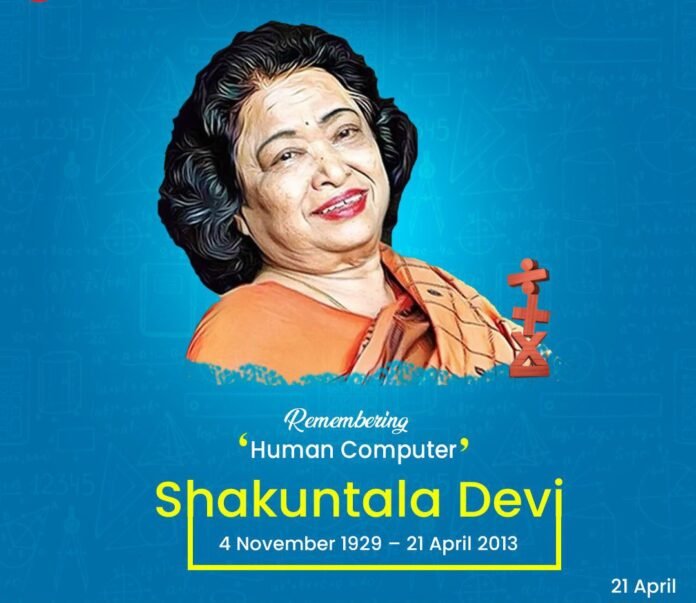
Remembering the “Human Computer”: The Enduring Legacy of Shakuntala Devi

0

On her death anniversary, we remember Shakuntala Devi —a name that continues to inspire awe in the world of mathematics. Fondly known as the “Human Computer,” she was not just a prodigy of numbers but a symbol of extraordinary mental ability and determination.

Born on November 4, 1929, in Bengaluru, Shakuntala Devi displayed an exceptional aptitude for numbers at a very young age. Without any formal training in mathematics, she amazed audiences with her ability to perform complex calculations mentally—often faster than a calculator. Her father, who worked in a circus, discovered her talent when she was just three years old, and soon she began touring with him, showcasing her skills across India and later the world.

What made Shakuntala Devi truly unique was not just her speed, but the accuracy and complexity of her calculations. In 1980, she earned a place in the Guinness World Records correctly multiplying two 13-digit numbers in just 28 seconds—an achievement that still astonishes mathematicians today. Her performances at prestigious institutions like Imperial College London and universities in the United States further cemented her global reputation.

Beyond her mathematical genius, Shakuntala Devi was also a prolific writer. She authored several books on mathematics, puzzles, and even astrology. One of her most remarkable contributions was her 1977 book The World of Homosexuals, which is considered one of the earliest studies on homosexuality in India—far ahead of its time and reflective of her progressive thinking.

Her life story is a testament to the power of natural talent combined with relentless passion. In a world increasingly reliant on machines, Shakuntala Devi proved that the human mind, when nurtured, can achieve extraordinary feats.

She passed away on April 21, 2013, but her legacy lives on—not just in record books, but in the inspiration she continues to provide to students, educators, and dreamers everywhere. As we mark her death anniversary, we celebrate not only a mathematical genius but a woman who broke barriers and redefined the limits of human potential.

When Writing Was Felt, Not Just Posted

0

There was a time when words took their time.

They were not rushed, not edited, not erased and rewritten in seconds. They lived quietly in the pages of diaries, in the folds of handwritten letters, in the margins of notebooks that carried pieces of people within them. Every word had weight. Every sentence had a story.

Then the world changed.

With the rise of technology, everything became faster—conversations, connections, even emotions. Social media gave us a voice that could travel across the world in an instant. We no longer had to wait days for a reply or search for the right paper to write on. Expression became easy, accessible, immediate.

And yet, somewhere in this ease, something began to slip away.

We started writing more, but saying less. Words became shorter, quicker, shaped to fit screens instead of souls. Feelings were reduced to captions, thoughts to fleeting posts, and emotions to something that could be scrolled past in seconds. We learned how to be seen, but slowly forgot how to be understood.

There was a time when people knew how to express themselves without filters—through long letters, through careful handwriting, through pages that held both clarity and confusion. Writing was not just communication; it was a release, a reflection, a quiet conversation with oneself.

Now, we often write to be noticed.

We choose words that sound right rather than ones that feel right. We shape our sentences for an audience, not for honesty. And in doing so, we lose something deeply human—the rawness of real expression.

Have you ever felt something so deeply that no message could explain it? A moment where your thoughts felt too heavy for a screen, too complex for a caption? In those moments, the absence of true writing is felt the most. Because some emotions do not need speed—they need space.

The pen understood that.

It paused when we paused. It slowed down when we needed to think. It never tried to impress—only to express. The pen could have never lied, but the fingers do.

Perhaps social media has not taken away our ability to write, but it has changed the way we choose to. It has taught us to communicate faster, but not always better. And as we continue to move forward in this digital world, maybe what we need is not less technology, but more truth within it.

Because in the end, writing was never just about words. It was about feeling them.

Written by Dishi Kothari

When Writing Was Felt, Not Just Posted

Apple Names John Ternus as New CEO: 5 Key Features You Should Know

0

Apple has announced a major leadership transition, naming insider John Ternus as its next Chief Executive Officer. Ternus will take over from Tim Cook on September 1, marking a pivotal moment for the iPhone maker as it navigates an era increasingly shaped by artificial intelligence and evolving consumer tech trends.

This leadership shift signals the end of a defining chapter under Cook and the beginning of a new phase where Apple must compete with rivals investing heavily in AI-driven innovation. Here are five standout features of Apple’s incoming CEO that define his leadership profile.

Longtime Apple Veteran with Deep Roots

John Ternus brings over two decades of experience at Apple. He joined the company’s product design team in 2001 and steadily climbed the ranks, becoming Vice President of Hardware Engineering in 2013.

In 2021, Ternus was elevated to Apple’s executive team as Senior Vice President of Hardware Engineering, working closely with Tim Cook. His long tenure gives him deep institutional knowledge and a strong understanding of Apple’s design philosophy and innovation culture.

Architect Behind Apple’s Core Hardware Success

Ternus has led engineering teams responsible for some of Apple’s most iconic and profitable products. These include the iPhone, iPad, Mac, Apple Watch, and AirPods.

His leadership has been central to maintaining Apple’s reputation for premium hardware quality while ensuring tight integration across its ecosystem—one of the company’s biggest competitive advantages.

Proven Track Record of Reviving Mac Growth

One of Ternus’s most notable achievements is helping revive Apple’s Mac lineup. Under his leadership, Macs have seen a resurgence in performance and market share, driven by innovations such as Apple’s custom silicon chips.

This success demonstrates his ability to execute long-term hardware strategies and adapt to changing market demands.

Driving Major iPhone Innovations

Ternus has also been at the forefront of major iPhone advancements. Most recently, he introduced the iPhone Air, described as the biggest redesign since 2017.

This highlights his focus on bold product evolution—an important trait as Apple faces increasing competition from AI-powered smartphones and emerging technologies.

Engineering Background with Strong Technical Foundation

Before joining Apple, Ternus worked as a mechanical engineer at Virtual Research Systems. He holds a degree in Mechanical Engineering from the University of Pennsylvania.

His technical expertise sets him apart as a hands-on leader who understands product development at a granular level—critical for a company where hardware innovation remains central to its identity.

What This Means for Apple’s Future

As John Ternus steps into the CEO role, he does so at a time when the tech industry is undergoing rapid transformation driven by AI. With competitors pushing boundaries in smart devices and automation, Apple’s ability to innovate will be closely watched.

Ternus’s strong hardware background, combined with his experience leading major product lines, positions him to guide Apple through this transition while preserving its legacy of design excellence.

Final Thoughts

The appointment of John Ternus as CEO marks both continuity and change for Apple. While he represents the company’s longstanding engineering culture, he also faces the challenge of steering Apple into an AI-first future.

His leadership will likely shape how Apple competes in the next decade—and whether it can maintain its dominance in the global consumer technology market.

National Civil Services Day 2026: Honouring the ‘Steel Frame of India’

0

Every year on April 21, India observes National Civil Services Day, a significant occasion dedicated to recognising the invaluable contribution of civil servants in nation-building. It is a day not only of appreciation but also of reflection, reminding administrators of their responsibility towards public service and good governance.

What is National Civil Services Day?

National Civil Services Day is celebrated across India to honour the work of officers engaged in various public services such as the IAS, IPS, and other administrative branches. These officials form the backbone of the country’s governance system, ensuring that policies are effectively implemented and citizens’ needs are addressed.

Why is it Celebrated on April 21?

The date holds deep historical significance. On April 21, 1947, Sardar Vallabhbhai Patel addressed the first batch of civil services probationers at Metcalfe House in Delhi. In his iconic speech, he referred to civil servants as the “steel frame of India”, emphasizing their crucial role in maintaining unity and stability in the country.

This moment laid the foundation for a strong, independent administrative system, and hence, April 21 was chosen to commemorate this legacy.

History of the Day

Although the historical roots go back to 1947, National Civil Services Day was officially celebrated for the first time in 2006. Since then, it has become an annual event where civil servants gather, reflect on their work, and are honoured for excellence in public administration.

One of the key highlights of the day is the Prime Minister’s Awards for Excellence in Public Administration, which recognises innovative and impactful work done by officers across the country.

History of Civil Services in India

The civil services system in India has a long history, evolving from ancient administrative practices to a modern bureaucratic structure. During British rule, the Indian Civil Service (ICS) was established, which later transformed into the present-day All India Services after independence.

Post-1947, leaders like Sardar Patel ensured that civil services remained strong, neutral, and committed to national unity. Today, institutions like the Union Public Service Commission (UPSC) ensure merit-based recruitment, maintaining the integrity of the system.

Significance of the Day

National Civil Services Day holds immense importance as it:
●Recognises the dedication and hard work of civil servants
●Encourages innovation and efficiency in governance
●Reinforces values like integrity, impartiality, and accountability
●Provides an opportunity for officers to recommit to public service

It also serves as a platform for sharing best practices and improving administrative systems across the country.

Conclusion

National Civil Services Day 2026 is more than just a ceremonial observance—it is a reminder of the vital role civil servants play in shaping India’s future. From implementing policies at the grassroots level to ensuring smooth governance, their work directly impacts millions of lives.

As India moves towards becoming a developed nation, the spirit of dedication and service envisioned by Sardar Vallabhbhai Patel continues to guide the country’s administrative framework.

Lithium in India: The Rising Power Behind Electric Vehicles and the Strategic Discovery in Jammu & Kashmir

0

For laymen, lithium is simply a type of metal. For science students, it is a chemical element placed in Group 1 of the periodic table alongside sodium and potassium. For professionals involved in mineral exploration, lithium is a rare yet highly valuable resource. Today, this element has become a global focal point, raising questions about its availability, usage, and strategic importance.

Over the past decade, a major shift in the global transport scenario has significantly increased lithium’s relevance. As fossil fuels continue to deplete, countries worldwide have moved toward electric vehicles (EVs). In recent years, nations including India have accelerated EV manufacturing. These vehicles depend on high-performance batteries—primarily lithium-based—bringing lithium into the spotlight.

Lithium Demand and Rapid Growth of EV Industry

The rapid growth of the EV industry has triggered an unprecedented surge in demand for lithium-ion batteries. Consequently, exploration efforts intensified to locate lithium-rich regions. Historically, major lithium reserves have been concentrated in four countries: Chile, China, Australia, and Bolivia. These nations dominate the global lithium market, forcing countries like India to rely heavily on imports. This dependency has raised concerns—any disruption in supply could severely impact the automobile and technology sectors.

Lithium for Electric Vehicles

Lithium is not only essential for electric vehicles but also widely used in rechargeable batteries for mobile phones, laptops, and digital cameras. Additionally, it plays a role in non-rechargeable batteries used in pacemakers, toys, and clocks, as well as in heat-resistant glass and ceramics.

Geologically, lithium occurs in various rock types in the form of minerals. The most important lithium-bearing minerals include lepidolite and spodumene. In India, these minerals have long been known to exist in small quantities, particularly in mica belts and other regions, though not at levels sufficient to support large-scale industry.

Recognising its strategic importance, the Government of India, along with state governments, initiated exploration projects for rare earth elements and lithium after 2014. These efforts have begun to yield promising results. Recently, the Geological Survey of India (GSI) announced the discovery of significant lithium deposits in the Reasi district of Jammu & Kashmir, near Salal village, north of the Vaishno Devi temple.

Lithium in India: The Rising Power Behind Electric Vehicles and the Strategic Discovery in Jammu & Kashmir

Explorations and Lithium Deposits in India

Preliminary surveys estimate these deposits at approximately 5.9 million tonnes. This discovery has been welcomed by both industry stakeholders and local communities. Mining and processing activities in the Salal region are expected to generate employment opportunities and contribute to regional economic development.

Exploration activities are also ongoing in Karnataka, Andhra Pradesh, Arunachal Pradesh, Chhattisgarh, and Jharkhand. In 2021, the Atomic Minerals Directorate (AMD) reported the presence of 1,600 tonnes of lithium-bearing resources in Karnataka.

A notable advantage of India’s newly discovered deposits lies in their lithium concentration. While global deposits typically contain around 220 ppm (parts per million), the Kashmir deposits reportedly contain approximately 500 ppm, making them comparatively richer.

Globally, lithium is often extracted from salt lakes, particularly in Chile’s desert regions. Similar efforts were made in Rajasthan’s salt lakes, but lithium concentrations there were found to be relatively low, around 20–30 ppm.

The Government of India has already initiated steps to begin lithium extraction in the Salal area. One key condition for companies participating in the project is the mandatory establishment of processing plants locally, ensuring additional employment and regional development.

Lithium Mining in Jammu and Kashmir

If successfully developed, lithium mining in Jammu & Kashmir could significantly reduce India’s dependence on imports and strengthen its position in the global lithium resource landscape. Current estimates suggest that India may rank among the top countries in lithium resources following this discovery.

However, from a geological perspective, caution is warranted. The current estimate of 5.9 million tonnes falls under the “inferred” category. Detailed exploration and further surveys are required to upgrade these resources to the “proved” category. It is also possible that more precise assessments could reduce the estimated reserves by 15–20%.

As a layman, this discovery is a matter of national pride and optimism. As a geologist, it represents a promising beginning—one that requires careful evaluation, scientific validation, and sustainable development.

(The writer is Rakesh Giri Goswami, Jodhpur, Rajasthan)

World Creativity and Innovation Day 2026: Celebrating Ideas That Shape the Future

0

Every year on April 21, the world observes World Creativity and Innovation Day, an international initiative led by the United Nations to highlight the power of ideas in transforming societies. In 2026, the day continues to emphasize how creativity and innovation are essential tools for solving global challenges and building a sustainable future.

What is World Creativity and Innovation Day?

World Creativity and Innovation Day is a global observance established by the United Nations General Assembly in 2017 to promote awareness about the importance of creativity in all aspects of human development.

It was first officially celebrated in 2018 and has since become a platform encouraging individuals, communities, and nations to think differently and act innovatively.

The day recognises that creativity is not limited to art—it also includes problem-solving, scientific thinking, entrepreneurship, and technological innovation.
Theme for 2026
The theme for 2026 continues the global call to action: “Step Out and Innovate.” This theme encourages people to move beyond ideas and take practical steps toward creating real-world solutions for global issues.
Why is it Important?
Creativity and innovation are crucial in addressing major global challenges such as climate change, poverty, inequality, and economic development. The United Nations highlights that innovative thinking can drive progress and help achieve the Sustainable Development Goals (SDGs).
The creative economy itself plays a significant role worldwide, contributing to employment, cultural exchange, and economic growth. It shows how ideas can translate into real impact.
History and Background
Although the day was formally recognised by the UN in 2017, its roots go back to earlier global efforts promoting creativity since the early 2000s. The observance was created to encourage people to use imagination and innovation as tools to improve everyday life and solve complex problems.
The choice of April 21 is symbolic, placed just before Earth Day, highlighting the role of creative solutions in building a sustainable planet.
How is it Celebrated?
Across the world, World Creativity and Innovation Day is marked through:

Workshops and seminars on innovation
Exhibitions and creative showcases
Educational programs and competitions
Digital campaigns promoting new ideas

Schools, universities, organisations, and governments actively participate by encouraging creative thinking and collaboration.
Conclusion
World Creativity and Innovation Day 2026 is not just about celebrating ideas—it is about turning those ideas into action. In a rapidly changing world, creativity is no longer optional; it is essential. Whether through technology, art, business, or social initiatives, innovation remains the key to building a better and more sustainable future.
The message is simple yet powerful: **every idea has the potential to change the world—if we dare to act on it.**