Home Blog Page 358

Whispers of the Past: 6 Breathtaking Indian Monuments That Time Almost Erased

0

India, a land of rich heritage and architectural marvels, is home to countless historical monuments. While some are globally renowned, others remain overshadowed and largely forgotten. These lesser-known sites, steeped in history and cultural significance, deserve recognition. Here are seven such hidden gems that tell fascinating tales of India’s past.


1. Maluti Temples, Jharkhand

Location: Maluti, Dumka district, Jharkhand

What Makes It Special?

The Maluti Temples complex comprises over 70 terracotta temples dating back to the 17th and 18th centuries. These temples feature intricate terracotta plaques depicting Hindu gods and mythological scenes, blending Bengal and Mithila architectural styles.

Why It’s Forgotten?

Located in the remote Dumka district, Maluti Temples suffer from poor accessibility and inadequate tourism infrastructure. Their historical and artistic value remains largely unrecognized.


2. Rabdentse Ruins, Sikkim

Location: Pelling, West Sikkim

What Makes It Special?

Rabdentse was the second capital of the Kingdom of Sikkim in the 17th century. The ruins of palaces, monasteries, and stupas offer a glimpse into Sikkim’s regal past. The site also provides breathtaking views of the Kanchenjunga mountain range.

Why It’s Forgotten?

The remote location, coupled with a lack of promotion and infrastructure, has kept Rabdentse in the shadows of more famous monasteries in Sikkim.


3. Kumbhalgarh Fort, Rajasthan

Location: Rajsamand district, Rajasthan

What Makes It Special?

Kumbhalgarh Fort boasts the world’s second-longest continuous wall, stretching 36 kilometers. A UNESCO World Heritage Site, the fort contains over 360 temples and grand palaces, showcasing the architectural brilliance of the Rajputs.

Why It’s Forgotten?

Despite its significance, Kumbhalgarh Fort remains overshadowed by Rajasthan’s more famous attractions like Amber Fort and Mehrangarh. Its remote location further limits its tourist appeal.


4. Unakoti, Tripura

Location: Unakoti, North Tripura

What Makes It Special?

Unakoti is an extraordinary site known for its rock-cut sculptures, including a massive 30-foot-tall head of Lord Shiva. According to legend, one crore (ten million) deities were to be carved here, but only one was left unfinished, giving the site its name.

Why It’s Forgotten?

Situated in the northeastern region of India, Unakoti remains largely unknown due to poor accessibility and historical political unrest in the area.


5. Bidar Fort, Karnataka

Location: Bidar, Karnataka

What Makes It Special?

Built in the 15th century, Bidar Fort exemplifies Deccan Sultanate military architecture. It features Persian-style arches, Turkish baths, mosques, and a unique water reservoir system.

Why It’s Forgotten?

Bidar Fort has been overshadowed by Karnataka’s more famous heritage sites like Mysore and Bijapur. Its off-the-beaten-path location and lack of promotion have kept it relatively unknown.


6. Chand Baori, Rajasthan

Location: Abhaneri, Rajasthan

What Makes It Special?

Chand Baori is one of India’s oldest and deepest stepwells, with 3,500 narrow steps arranged in a mesmerizing geometric pattern. Built in the 9th century, it served as a water reservoir and a refuge from the scorching heat.

Why It’s Forgotten?

Despite its architectural wonder, Chand Baori remains overlooked due to its remote location in Abhaneri and lack of large-scale tourism marketing.


Conclusion

India’s historical treasures extend far beyond its well-known monuments. These forgotten gems not only highlight the country’s architectural diversity but also reflect centuries of artistic, cultural, and religious evolution. Promoting and preserving these sites will ensure that their stories continue to be told for generations to come.

DoT and WhatsApp Launch ‘Scam Se Bachao’ Campaign to Combat Online Fraud

0

In a significant step towards enhancing digital safety, the Department of Telecommunications (DoT) in India has partnered with WhatsApp to launch the ‘Scam Se Bachao’ campaign. This initiative aims to educate citizens on identifying and reporting fraudulent communications, reinforcing India’s broader digital security framework as the nation advances in its digital transformation.

Objectives of the Campaign

The primary goal of this collaboration is to enhance digital safety and awareness among citizens. The DoT and WhatsApp will work together to provide resources and actionable information, empowering users to recognize and respond to potential scams. As digital fraud cases rise, this initiative plays a crucial role in protecting users from online threats.

Training and Awareness Initiatives

The campaign will include train-the-trainer workshops, targeting key personnel such as DoT officials, Sanchar Mitras, and Telecom Service Providers (TSPs). These workshops are designed to equip trainers with essential knowledge to educate the public effectively. By adopting a proactive approach, the initiative seeks to strengthen India’s response to cyber threats and fraudulent activities.

Strengthening the Sanchar Saathi Initiative

A key aspect of this collaboration is enhancing the Sanchar Saathi initiative, a citizen-centric program developed by the DoT. This initiative includes a dedicated portal and mobile application that allow users to:

  • Report suspected fraud calls and messages
  • Manage and verify their mobile connections
  • Block or trace lost mobile devices

By integrating WhatsApp’s outreach capabilities with Sanchar Saathi, the government aims to create a robust digital security ecosystem that safeguards users from cyber fraud.

Role of the Digital Intelligence Unit

The Digital Intelligence Unit (DIU), a division within the DoT, plays a pivotal role in this campaign. The DIU facilitates the exchange of intelligence between various stakeholders, including telecom operators, banks, and law enforcement agencies. This integrated approach helps in identifying and mitigating telecom-related fraud, ensuring a safer digital experience for users.

Multilingual Educational Resources for Wider Reach

Recognizing India’s linguistic diversity, WhatsApp will develop educational materials in multiple regional languages, including Hindi, Bengali, Marathi, Tamil, Telugu, Kannada, Malayalam, and Gujarati. This effort ensures that citizens across different states can access crucial online safety information in their preferred language, making the campaign more inclusive and effective.

Conclusion

With online fraud on the rise, the ‘Scam Se Bachao’ campaign represents a crucial step in India’s fight against digital scams. By leveraging WhatsApp’s extensive reach and the DoT’s regulatory expertise, this initiative is set to empower millions of citizens with the knowledge and tools needed to navigate the digital world safely. As India continues its digital transformation, initiatives like these will play a pivotal role in securing the country’s online ecosystem.

GRSE Successfully Completes Sea Trials for Advanced Naval Vessels

0

Garden Reach Shipbuilders and Engineers (GRSE) Ltd has successfully completed Contractor Sea Trials (CSTs) for two naval vessels, the Himgiri and Androth, marking a significant milestone in India’s naval shipbuilding efforts. The Himgiri is an Advanced Frigate under Project 17A, while the Androth is an Anti-Submarine Warfare Shallow Water Craft. These trials reinforce India’s growing expertise in indigenous warship development.

Importance of Contractor Sea Trials

CSTs play a critical role in evaluating a ship’s seaworthiness. During these trials, key performance aspects such as speed, manoeuvrability, and the functionality of onboard systems are rigorously assessed. Senior officials from GRSE and the Indian Navy closely monitored the trials to ensure the vessels met operational standards. The successful completion of CSTs indicates that both ships are on track for induction into the Navy.

Overview of the Vessels

The Himgiri is the first of three Advanced Frigates being built under Project 17A. This project aims to enhance India’s naval capabilities through modern, indigenously designed warships. The Androth, on the other hand, is the second of eight Anti-Submarine Warfare Shallow Water Crafts under construction at GRSE. Both vessels incorporate cutting-edge technology and enhanced stealth features, making them formidable additions to India’s maritime fleet.

Strategic Importance of Project 17A

Project 17A is a key initiative in India’s naval modernization program, designed to strengthen the country’s maritime defence. The ships are designed by the Directorate of Naval Design and are being constructed at GRSE and Mazagon Dock Shipbuilders Limited. Aligned with the Atmanirbhar Bharat vision, this project underscores India’s commitment to self-reliance in defence manufacturing.

Economic and Industrial Impact

The shipbuilding activities under Project 17A provide a significant boost to the Indian economy. Around 80% of the materials and equipment used in these ships are sourced from domestic vendors, supporting over 2,000 Indian firms and MSMEs. This initiative not only generates employment opportunities but also contributes to India’s post-COVID economic recovery by strengthening local industries.

Technological Advancements in Shipbuilding

The vessels under Project 17A integrate state-of-the-art technology, setting new benchmarks in India’s naval capabilities. Notably, these ships are the first gas turbine propulsion vessels built at GRSE. They also feature advanced weapon systems and enhanced stealth characteristics, ensuring superior operational performance. GRSE’s adoption of modular construction techniques further enhances efficiency and productivity in warship manufacturing.

Conclusion

The successful completion of sea trials for the Himgiri and Androth marks a significant step forward in India’s naval modernization. With a focus on indigenous design, economic growth, and technological advancements, Project 17A continues to reinforce India’s position as a key player in global maritime defence. These warships, once commissioned, will enhance the Navy’s operational readiness and contribute to safeguarding India’s maritime interests.

Air Pollution and Climate Change Challenge India’s Solar Energy Ambitions

0

India’s efforts to expand solar energy are facing hurdles due to air pollution and climate change, according to a recent study conducted by researchers at IIT Delhi. As the world’s fifth-largest solar power producer, India aims to generate 50% of its electricity from non-fossil sources by 2030. This ambitious target includes installing 500 GW of renewable energy capacity, with solar power accounting for one-fifth of the total. However, environmental factors threaten the efficiency of solar energy generation, potentially slowing progress toward these goals.

Climate Change and Its Impact on Solar Energy Efficiency

Climate change poses a significant challenge to solar energy production. The study highlights that solar photovoltaic energy is highly sensitive to weather conditions, with variations in atmospheric conditions affecting energy generation. Factors such as cloud cover and air pollution reduce the amount of solar radiation reaching solar panels, diminishing their efficiency and output.

Research Findings and Future Predictions

The IIT Delhi study analyzed data from 1985 to 2014 to forecast solar panel performance from 2041 to 2050. Researchers assessed global climate models using observations from NASA’s CERES project, considering two scenarios—one with moderate climate control efforts and another with weak climate action but strong air quality measures. The findings indicate that under moderate efforts, solar panel efficiency could decline by 2.3% by mid-century, leading to a loss of approximately 840 gigawatt-hours of electricity annually. This projected loss underscores the vulnerability of solar power to environmental changes.

Temperature and Its Role in Solar Panel Performance

Temperature plays a critical role in solar panel efficiency. The study found that rising ambient temperatures could increase solar cell temperatures by 2°C by mid-century. Since solar cells function optimally under cooler conditions, higher temperatures can negatively impact performance. The research suggests that solar radiation is the most influential factor affecting efficiency, followed by temperature and wind speed.

Regional Variations in Solar Potential

Despite the overall decline in efficiency, some regions in India, particularly parts of the Northeast and Kerala, are expected to experience increased solar power potential. This is attributed to a predicted decrease in cloud cover in these areas, which could allow more solar radiation to reach photovoltaic panels and enhance their output.

The Need for Urgent Action

The study underscores the importance of tackling climate change and improving air quality to protect and enhance India’s solar energy potential. Reducing greenhouse gas emissions and implementing effective air pollution control measures are crucial. Additionally, public participation in adopting sustainable practices, such as using electric vehicles, reducing carbon footprints, and promoting afforestation, can play a vital role in safeguarding the future of solar energy in India.

Conclusion

India’s ambitious solar energy goals are under threat due to climate change and air pollution. While advancements in technology and regional variations may offer some relief, immediate action is needed to mitigate environmental challenges. Strengthening climate policies, improving air quality, and investing in adaptive solar technologies will be essential in ensuring the continued growth and efficiency of solar power in India.

Government Advises Reduction of Cooking Oil in Mid-Day Meals Under PM-POSHAN Scheme

0

In a move to promote healthier eating habits among schoolchildren, the Union government has advised states to reduce cooking oil usage by 10% in mid-day meals served in government and aided schools. This directive falls under the Pradhan Mantri Poshan Shakti Nirman (PM-POSHAN) scheme, aiming to enhance the nutritional quality of meals provided to students.

Understanding the PM-POSHAN Scheme

The PM-POSHAN scheme is a flagship initiative of the Indian government designed to provide nutritious meals to children studying in government and aided schools. It primarily covers students from Bal-Vatika to class 8, ensuring they receive balanced, wholesome meals. In Karnataka, the scheme has been extended to include classes 9 and 10, benefiting approximately 54 lakh students. These meals incorporate fortified grains, pulses, and vegetables to meet essential dietary requirements.

Addressing Health Concerns

The advisory comes in response to the increasing prevalence of childhood obesity in India. According to The Lancet, the number of overweight children (aged 5-19) in India surged from 0.4 million in 1990 to 12.5 million in 2022. Excessive consumption of cooking oil has been linked to obesity and associated health risks, making this initiative a critical step towards healthier school meals. The goal is not only to regulate oil consumption but also to instill lifelong healthy eating habits in students.

Training and Awareness Initiatives

To ensure effective implementation, all cook-cum-helpers in schools will undergo training on reducing cooking oil usage while maintaining taste and nutritional value. Schools will also introduce special classes on low-oil diets, featuring guest lectures by nutrition experts. Additionally, interactive initiatives such as quiz competitions and essay-writing contests will be organized to engage students and raise awareness about healthy eating practices.

Encouraging Healthier Cooking Methods

As part of this initiative, schools are encouraged to adopt healthier cooking techniques such as grilling, steaming, and boiling instead of deep-frying. By minimizing the intake of unhealthy fats, students will be introduced to better dietary habits. Schools will also promote low-oil meal options in canteens and encourage students to try low-oil recipes at home.

Community Participation and Awareness Campaigns

Recognizing the importance of community involvement, the advisory recommends engaging parents and local communities in discussions about health and nutrition. Special meetings of the School Management Committee (SMC) will be conducted to emphasize the role of exercise and physical fitness. Further awareness campaigns, including seminars, workshops, and guest lectures, will be held to reinforce the importance of healthy eating habits.

Maintaining Nutritional Standards in Mid-Day Meals

The PM-POSHAN scheme ensures that mid-day meals adhere to strict nutritional guidelines. The meals include:

  • Fortified rice, wheat, or coarse grains, along with pulses and green leafy vegetables.
  • Use of Double Fortified Salt (DFS) and fortified edible oil (enriched with Vitamin A & D):
    • 5 gm per student for primary classes.
    • 7.5 gm per student for upper primary classes.
  • Integration of vegetables sourced from School Nutrition Gardens to enhance meal quality.

Conclusion

By reducing cooking oil in school meals, the government is taking a significant step towards fostering healthier dietary habits among children. With proper training, community engagement, and a focus on nutrition, this initiative under the PM-POSHAN scheme has the potential to create lasting positive changes in the health and well-being of millions of students across India.

India Expands Heat Action Plans to Combat Rising Temperatures

0

As India braces for another intense summer, the National Disaster Management Authority (NDMA) is set to implement an additional 300 Heat Action Plans (HAPs) across cities. These plans aim to address the growing challenge of rising temperatures, with heatwaves already arriving earlier this year and temperatures surpassing 40°C in several states. The India Meteorological Department (IMD) forecasts a further increase in temperatures in Northwest India, heightening concerns about public health and economic stability.

Understanding Heat Action Plans (HAPs)

Heat Action Plans (HAPs) serve as strategic frameworks developed by governments to mitigate the impact of extreme heat events. These plans outline standard operating procedures for cities and states, ensuring preparedness, response, and recovery from heat-related challenges. HAPs include emergency response activities, long-term preparedness strategies, and cooling interventions to protect vulnerable populations.

Expanding Implementation Across India

Currently, around 200 HAPs have been finalized in India. The NDMA is working to expand this number to 500, recognizing that many states still rely on basic advisory measures for heat prevention rather than comprehensive, actionable plans. The NDMA’s focus is on ensuring that these strategies are not merely theoretical but effectively implemented to reduce the dangers of extreme heat.

The Risks to Public Health and Infrastructure

Extreme heat poses significant risks to both public health and infrastructure. Improved weather forecasting has contributed to a decline in heatwave-related fatalities, yet the economic impact of heat stress remains severe. With approximately 85% of India’s workforce employed in the informal sector, industries such as agriculture and construction are particularly susceptible to heat-related challenges. Prolonged exposure to high temperatures can lead to productivity losses, increased health costs, and long-term economic strain.

A Global Perspective on Heat Stress

Globally, over 70% of the workforce is at risk from extreme heat, resulting in millions of injuries and fatalities each year. Climate change is expected to cost India approximately 2.8% of its GDP by 2050, affecting the living standards of nearly half of its population. By 2030, India could face significant job losses due to heat stress, with estimates suggesting that 34 million jobs may be at risk. Addressing these concerns requires immediate and sustained intervention.

Government Initiatives and Funding Efforts

Recognizing the urgent need for action, the Government of India has allocated $30 billion for disaster management from 2021 to 2026, with $6 billion specifically designated for mitigation efforts. These funds are aimed at strengthening resilience against climate-related challenges, including heat management and earthquake preparedness. Such investments are critical in safeguarding both human lives and economic stability as India navigates the challenges posed by climate change.

Conclusion

As extreme temperatures continue to challenge India’s public health, economy, and workforce, the expansion of Heat Action Plans represents a crucial step in mitigating heat-related risks. With proactive strategies and significant investments, India is working to enhance its resilience against the growing threat of climate-induced heat stress. However, the success of these efforts will depend on effective implementation, widespread awareness, and continued innovation in climate adaptation strategies.

The Spark of Life: How Water Sprays May Have Played a Role in Earth’s First Organic Compounds

0

For decades, scientists have sought to unravel the mystery of how life began on Earth. The Miller-Urey experiment, a classic study from 1952, suggested that lightning strikes on early Earth’s primordial soup could have generated the organic molecules essential for life. However, recent findings have reignited interest in alternative pathways, with new research proposing that crashing waterfalls and breaking waves—rather than lightning—may have been key players in the emergence of life.

The Miller-Urey Hypothesis: Lightning and Life

The Miller-Urey experiment, conducted by Stanley Miller and Harold Urey, is a cornerstone of abiogenesis theory. Their groundbreaking study simulated early Earth conditions by exposing a mixture of water, methane, ammonia, and hydrogen to electrical discharges. The result? The spontaneous formation of amino acids—the fundamental building blocks of life.

While the experiment was a landmark achievement, it has faced scrutiny over the years. Critics argue that lightning, while a powerful force, is sporadic and may not have been frequent enough to drive the consistent formation of organic molecules necessary for the emergence of life. This has led scientists to explore alternative energy sources that could have sparked these vital chemical reactions.

A New Contender: Water Sprays and Microlightning

A recent study published in Science Advances by researchers at Stanford University challenges the lightning-centric perspective. The research suggests that water sprays—such as those generated by waterfalls, ocean waves, and breaking droplets—could have played a crucial role in the formation of organic compounds, without the need for external electrical energy.

The key to this process lies in the concept of “microlightning.” When water droplets collide, they acquire opposite electrical charges. Larger droplets become positively charged, while smaller ones take on a negative charge. As these droplets come into close proximity, they generate tiny electrical discharges—microlightning—that can drive chemical reactions in much the same way as traditional lightning.

Microlightning and Organic Chemistry

Experiments conducted by the Stanford team revealed that spraying water into a gas mixture resulted in the formation of essential organic compounds, including hydrogen cyanide, glycine, and uracil. These molecules are significant because they are precursors to amino acids and nucleotides—the fundamental components of proteins and RNA, respectively.

This discovery suggests that water sprays could have provided a continuous, widespread mechanism for organic synthesis on early Earth. Unlike traditional lightning, which occurs sporadically, waterfalls and ocean waves would have been ever-present, creating a more stable and sustained environment for prebiotic chemistry to occur.

Implications for the Origins of Life

The implications of this study extend beyond Earth’s early history. If microlightning in water sprays could generate organic compounds here, similar mechanisms could be at play on other planets with liquid water. This raises intriguing possibilities for the search for life beyond Earth, particularly on ocean worlds such as Europa and Enceladus.

Ultimately, this research offers a fresh perspective on one of the greatest scientific mysteries: how life first arose on Earth. While the Miller-Urey experiment laid the foundation for our understanding of abiogenesis, the idea that water sprays could have played a pivotal role provides an exciting new avenue for exploration. Perhaps the true spark of life was not a dramatic bolt from the sky but rather the gentle, persistent dance of colliding water droplets.

As scientists continue to probe the origins of life, one thing remains clear: nature has an incredible ability to innovate, and life’s beginnings may have been sparked in ways we are only just beginning to understand.

They Spent 286 Days in Space, Completed 4,576 orbits around earth and made records of space walking. Welcome NASA astronauts Sunita Williams and Butch Wilmore to Earth…

0

NASA astronauts Butch Wilmore and Sunita Williams safely returned to Earth on Tuesday (March 18, 2025), concluding an unplanned 286-day stay aboard the International Space Station (ISS). Their SpaceX capsule splashed down in the Gulf of Mexico off the coast of Tallahassee, Florida, just hours after departing the ISS.

They Spent 286 Days in Space, Completed 4,576 orbits around earth and made records of space walking. Welcome NASA astronauts Sunita Williams and Butch Wilmore to Earth...

During their extended mission, the astronauts completed 4,576 orbits around Earth, covering approximately 121 million miles (195 million kilometers). While astronauts have spent longer periods in space, few have faced such uncertainty regarding their return. Over time, Wilmore and Williams transitioned from temporary visitors to full-time ISS crew members, contributing to critical experiments, equipment repairs, and spacewalks. Williams, who became ISS commander three months into the mission, set a record for the most spacewalking hours by a female astronaut—62 hours over nine excursions.

Originally scheduled for a short mission, Wilmore and Williams’ stay was extended indefinitely due to persistent technical failures with Boeing’s new Starliner crew capsule. Launched aboard Starliner on June 5, 2024, they were left stranded when the spacecraft was deemed unfit for reentry. NASA eventually arranged their return via SpaceX, though additional delays prolonged their time in orbit.

Their prolonged stay even took on a political dimension in January when former President Donald Trump urged SpaceX CEO Elon Musk to expedite their return.

Wilmore, 62, and Williams, 59, expressed gratitude for the experience but acknowledged the personal sacrifices involved. Wilmore missed much of his younger daughter’s senior year of high school, while Williams relied on internet calls to stay in touch with family.

Their return was met with widespread prayers and well-wishes. Twenty-one Hindu temples held ceremonies for Williams, whose Indian and Slovenian heritage has inspired many, while Wilmore, a Baptist elder from Houston, received prayers from his church congregation.

Following splashdown, SpaceX confirmed their safe return in a post on X: “Splashdown of Dragon confirmed – welcome back to Earth, Nick, Suni, Butch, and Aleks!”

Step Into Goa’s Hidden Carnival: Rare Glimpses of Shigmotsav Celebrations

0

Dangling from rotating poles, dancing to evade flaming cow dung cakes—if you thought Shigmotsav was just a colorful carnival, here’s a side you might not have seen before.

“Rice is cooked on people’s heads.” This is Varun Hegde’s favorite story to share about the Shisharanni ritual as he guides travelers into Goa’s villages every March, where the locals prepare for Shigmo—the vibrant harvest festival that heralds spring.

Varun pauses, waiting for the dramatic gasp that always follows his tale.

The True Spirit of Shigmotsav: Beyond the Grand Parades

For many, the essence of Shigmo lies in its grand city parades featuring dazzling floats and masquerades. But away from the main roads, deep within Goa’s villages, an ancient and deeply spiritual celebration unfolds—one rooted in mythology, devotion, and thrilling rituals.

Varun, a cultural explorer from Soul Travelling, specializes in uncovering Goa’s offbeat traditions. Alongside photographer Daniel Dsouza, he has witnessed firsthand the esoteric, spirited gatherings in the state’s hinterlands. This Shigmotsav, we step into their world to uncover Goa’s hidden traditions.

A Celebration of Homecoming and Mythology

March in Goa is a season of revelry. With the harvest complete, farmers put aside their ploughs, and the state transforms into a cultural spectacle. Streets brim with folk music, dance, and mythological reenactments, celebrating the return of brave soldiers and legends from Hindu mythology.

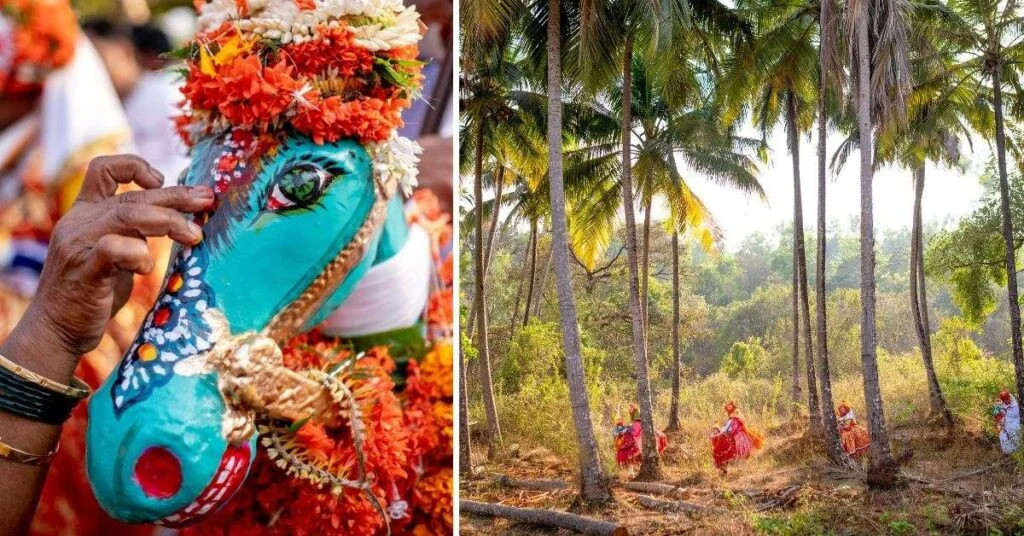
While ‘Vhadlo Shigmo’ dominates the cities with its elaborate parades, the lesser-known ‘Dhakto Shigmo’ in the villages embraces rituals steeped in folklore. The air reverberates with the beats of the ghumat, dhol, mhadle, and tashe (percussion instruments) as men invoke the Gods, offering gratitude for a bountiful harvest.

Step Into Goa’s Hidden Carnival: Rare Glimpses of Shigmotsav Celebrations

Legends That Shape the Festival

At the heart of Shigmo are rituals reenacting ancient lores—Holika’s fiery fate, Prahlad’s resilience against his father Hiranyakashyap, the tale of Kamadeva, and the victorious return of warriors. These stories are brought to life in village festivities, where faith and endurance take center stage.

The Thrilling Rituals of Shigmo

Faith is the foundation of Shigmo, evident in the many dramatic festivals that accompany it. Take ‘Chorotsav’ in Zarme village—known as the ‘festival of thieves.’ Villagers atone for their ancestors’ wrongdoings by enacting an age-old beheading ritual. “Participants are buried in the ground with only their heads exposed, reenacting the legend of young men who were once executed here,” Varun shares.

Then there’s ‘Gadde’ in Kudne village, where villagers dance around the Holi fire from midnight until sunrise. “No one can leave, and phones are strictly forbidden,” Varun explains. “It’s believed that those in a trance are lured into the forest by a devchar (spirit) holding a burning lamp.”

Firewalking and Daredevilry: Shigmotsav’s Daring Side

The ‘Lairai Zatra’ in Shirgao village is another test of devotion, dedicated to Goddess Shri Lairai. Here, devotees dance through blazing pyres, unharmed, driven by unwavering faith. “To witness or partake in such rituals, your beliefs must be rock solid. The villagers see it as an honor, not a challenge,” Varun says.

Similarly, the ‘Xeni Uzzo’ festival in Malcornem sees men scaling areca nut trees, hurling flaming sheni (cow dung) cakes at one another. Bare-chested, they dance amid the fire—a breathtaking display of courage and belief.

Shigmotsav’s Unique Traditions

Photographer Daniel Dsouza captures the sheer energy of these celebrations. “Each festival has its own character,” he notes. ‘Shidyotsav’ features men suspended from rotating poles, while ‘Karvalyo’ celebrates womanhood. ‘Viramel’ showcases martial arts in honor of warriors, and ‘Ghode Modni’ sees dancers wielding swords atop wooden horse effigies, paying tribute to Goa’s valorous past.

The Grandeur of Shigmotsav Awaits

As Shigmotsav sweeps through Goa, the state readies itself for a cultural transformation unlike any other. Whether through firewalking, spectral dances, or vibrant parades, the festival is a living testament to Goa’s enduring spirit and timeless traditions.

This year, step beyond the well-trodden tourist paths and witness the rare, thrilling, and deeply spiritual side of Goa’s grandest festival. Shigmotsav isn’t just a carnival—it’s a testament to faith, tradition, and the daring heart of Goa.

Inside India’s Cleanest Villages: What They’re Doing Differently

0

When you think of a clean and green place, what comes to mind? A high-tech city with modern waste management systems? A well-maintained urban park? Surprisingly, some of the cleanest and most sustainable places in India are not found in big cities but in its villages. These small communities have embraced a way of life that prioritizes cleanliness, sustainability, and harmony with nature.

From banning plastic to implementing eco-friendly farming, these villages have proved that transformation doesn’t require grand policies—it begins at home, with collective community efforts. Here’s how five remarkable villages are setting new benchmarks in cleanliness and environmental consciousness.

1. Mawlynnong, Meghalaya: Asia’s Cleanest Village

Tucked near the Meghalaya-Bangladesh border, Mawlynnong has earned the title of Asia’s cleanest village. But cleanliness here is not just a rule; it is a deeply ingrained way of life, backed by a remarkable literacy rate of 93.71%.

How They Did It:

  • Plastic-free mindset: Mawlynnong strictly enforces a plastic ban. Instead of allowing waste to accumulate, the villagers repurpose materials in creative, sustainable ways.
  • Daily cleaning habit: Every villager actively takes responsibility for keeping their surroundings spotless, sweeping their pathways regularly.
  • Sustainable construction: Houses and public spaces are built using local materials, reducing the village’s carbon footprint.
  • Improved sanitation: Public and private toilets have been installed throughout the village, ensuring hygiene and eliminating open defecation.
Inside India’s Cleanest Villages: What They’re Doing Differently

2. Baghuwar, Madhya Pradesh: A Self-Sustained Model of Cleanliness

Situated in Madhya Pradesh’s Narsinghpur district, Baghuwar is a shining example of a self-sustaining clean village. The villagers don’t just discuss cleanliness; they live it.

How They Achieved It:

  • Early adoption of sanitation: Baghuwar became open defecation-free (ODF) in 2007, years before the Swachh Bharat Abhiyan made it a national priority.
  • Community involvement: Every resident plays a role in keeping the village clean, from sweeping the streets to managing waste.
  • Water conservation: The village has invested in rainwater harvesting and water recycling, significantly improving groundwater levels and local climate conditions.

3. Sishunu, Nagaland: A Tobacco and Plastic-Free Haven

Sishunu in Nagaland is not just clean; it is also tobacco-free and plastic-free. This transformation was driven by community determination and funds from the Mahatma Gandhi National Rural Employment Guarantee Act (MGNREGA).

How They Achieved It:

  • Tobacco ban: A strict prohibition on tobacco sale and consumption is enforced across schools, offices, and public spaces, monitored by a dedicated Tobacco Control Committee.
  • Plastic waste management: The village council actively ensures minimal plastic usage, even repurposing plastic waste for road construction.
  • Strict anti-littering policies: Waste segregation is mandatory, and fines are imposed on those who fail to comply.
  • Sustainable farming: The village cultivates fruits like kiwi, bananas, oranges, and pomegranates using organic farming methods.

4. Thuruthikkara, Kerala: Kerala’s First Certified Green Village

Located in the Ernakulam district, Thuruthikkara has set the gold standard for sustainability, thanks to the Oorja Nirmala Haritha Gramam project.

How They Achieved It:

  • Community education: All 349 families in the village were educated on environmental issues and sustainability practices.
  • Advanced waste management: The village embraced a plastic-free, e-waste-free, and filament-free policy, supported by biogas plants, solar cookers, and LED lighting.
  • Institutional support: The transformation was driven by local organizations like the Haritha Keralam Mission and Energy Management Centre Kerala, providing the necessary technical expertise and resources.

5. Majuli, Assam: Living in Harmony with Nature

Majuli, a picturesque island in Assam’s Jorhat district, is not only breathtaking but also a leader in eco-friendly living.

How They Achieved It:

  • Bamboo architecture: Homes are built using bamboo, a renewable and sustainable material that minimizes environmental impact.
  • Community-driven cleanliness: Residents actively participate in cleaning efforts, ensuring their surroundings remain pristine.
  • Sustainable lifestyle: Following the indigenous philosophy of ‘Donyi Polo,’ which emphasizes the interconnection between humans and nature, Majuli’s residents practice responsible farming and resource management.
Inside India’s Cleanest Villages: What They’re Doing Differently

Lessons for India’s Urban Areas

These villages have demonstrated that sustainable living isn’t just about policies or government initiatives; it is about people making conscious choices every day. Their success stories serve as blueprints for cities and towns looking to build cleaner, greener environments. They did not wait for change—they became the change. When cleanliness and environmental care become a way of life, transformation follows.