Home Blog Page 332

India’s Borders Are Getting a Heartbeat: Phase Two of the Vibrant Villages Programme Begins

0

In the high-altitude silence of India’s borderlands — where rugged mountains meet political frontiers — a quiet transformation is brewing. These are not just edges of a map anymore. With the launch of Phase Two of the Vibrant Villages Programme (VVP), the Government of India is lighting the path toward a more connected, secure, and thriving frontier.

With a hefty ₹6,839 crore financial commitment and a long-term vision stretching till 2028–29, this phase aims to breathe life into the often-overlooked hamlets hugging India’s international boundaries.


From Isolation to Integration

In Phase One, the focus was sharp: develop villages along the China border. Now, in Phase Two, the initiative spreads its wings across 15 states and 2 Union Territories, reaching villages nestled within 10 kilometers of India’s international boundary — from the snow-laced ridges of Himachal Pradesh and Uttarakhand to the remote corners of the Northeast and beyond.

But this is not merely a development project. It’s a strategic and human-centered reimagining of India’s border policy.


Why It Matters: People as the First Line of Defense

These villages are not just geographic locations. They’re home to citizens who have lived for generations at the edge of India’s map, often with limited access to the kinds of infrastructure and opportunity found further inland.

The Vibrant Villages Programme flips that narrative. It sees border residents not as outliers, but as stakeholders in national security and engines of local development. By improving their quality of life — from better roads and power supply to mobile connectivity and education — the programme hopes to ensure that staying in these remote villages becomes a choice, not a compromise.

And yes, there’s a strategic undertone. A populated, thriving border is harder to infiltrate — both literally and ideologically. Prosperity becomes protection.


Building Bricks and Beyond: What’s Changing on the Ground

This phase brings with it a clear-eyed focus on infrastructure and inclusion:

  • Roads and Telecom: Linking once-isolated villages to the national grid, quite literally.
  • Power Supply: Reliable electricity is no longer a luxury — it’s a foundation.
  • SMART Classrooms: Education gets a tech upgrade, ensuring that even in the remotest corners, learning is modern and competitive.
  • Tourism Circuits: These regions are rich in cultural heritage and natural beauty. Promoting tourism isn’t just about economics; it’s about telling the stories of the land and its people.

A 100% Central Sector Scheme — With Local Soul

Funded entirely by the Union government, VVP-II will be monitored by a high-powered committee capable of tweaking rules for maximum impact. But despite its top-down funding structure, the soul of this programme is bottom-up.

Through fairs, festivals, and awareness camps, the government is aiming to rekindle the cultural spark in these regions. Local communities won’t just benefit from development — they’ll be the heart of it.

Regular visits by officials are expected to ensure that these efforts aren’t one-off headline grabbers but sustained partnerships with the people.


Empowering Hands, Enriching Lives

The Vibrant Villages Programme goes beyond bricks and broadband. It reaches into homes and fields, bringing with it initiatives for:

  • Skill Development & Entrepreneurship: So that people can build livelihoods where they live, rather than leaving in search of work.
  • Agricultural & Horticultural Cooperatives: To make farming more collaborative and profitable.
  • Housing, Health, and Sanitation: Because dignity begins with the basics.

The Vision: Thriving Borders, Steady Populations

There’s an overarching goal at play here: population stability in strategic areas. Too often, border villages face migration and decline. VVP wants to reverse that — making these places not just livable, but aspirational.

Imagine a young person choosing to stay in a border village because it offers opportunity, security, and pride. That’s the future VVP is aiming for.


A Blueprint Worth Watching

As the programme unfolds, its success won’t be measured only in kilometers of road or number of schools built. It will be seen in confidence restored, cultures revived, and communities rooted.

In the end, the Vibrant Villages Programme isn’t just about fixing what’s broken. It’s about building what’s possible — one village, one voice, one vision at a time.
‘If We Don’t Help Them, Who Will?’: This 22-YO Mobilised 600 Youth to Rescue Kashmir’s Homeless & Mentally Ill

0

The Boys Who Stayed: How Kashmir Youth Courage Is Rewriting the Story of the Forgotten

It started with a glimpse — a man on the roadside, torn clothes clinging to him, wild beard, no shoes, no shelter. Most people looked past. But a ten-year-old boy couldn’t.

That image stayed with Musadiq Bashir. He grew up, but the man’s loneliness followed him into adulthood like a silent question: What if that were me?

By 2022, Musadiq, then an engineering student in Pulwama, had seen too many like that man — people society had abandoned. They weren’t just poor. They were lost, mentally unwell, forgotten by their families and ignored by their communities.

Musadiq decided not to ignore them.


Turning Memory Into Mission

‘If We Don’t Help Them, Who Will?’: This 22-YO Mobilised 600 Youth to Rescue Kashmir’s Homeless & Mentally Ill

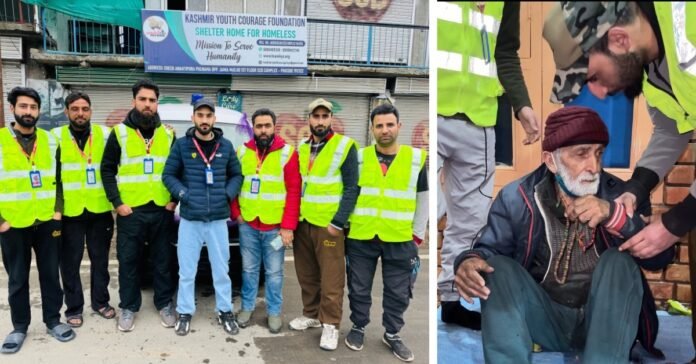
What began with quiet observation soon turned into quiet action. He and a few friends started walking the streets with food packets, blankets, and soap — small things, but offered with care. Slowly, those simple acts turned into something bigger: Kashmir Youth Courage (KYC).

KYC was never about grand gestures. It was about showing up. A group of just over 20 active members became the heart of the initiative. Today, KYC has grown into a volunteer network of 500 to 600 people across Kashmir, helping the invisible regain their place in the world.

In less than two years, they’ve assisted over 45 people — many of them mentally unwell, homeless, or abandoned by families. Some found their way back home. Others found something they hadn’t known in years: safety.


A Shelter with No Conditions

KYC operates from a humble rented space that doubles as a community centre and emergency shelter. At any time, 10 to 15 people live there, receiving not just meals and care, but something deeper — a renewed sense of worth.

Volunteers search the streets daily, not with orders or instructions, but with presence and patience. Many of those they help have been ignored, rejected, or mistreated for years. Building trust is the first step — and it often takes time.

The team approaches with calm and consistency, offering what’s needed most: clean clothes, a bath, a warm meal — and above all, someone willing to stay.


Stories That Stay

One of the toughest rescues involved a former businessman from Srinagar. A financial collapse left him mentally shattered. He walked away from his life and vanished into isolation. When KYC found him, he was volatile and withdrawn. The volunteers stayed — slowly earning his trust. One haircut, one clean shirt, one quiet moment at a time. Eventually, something changed.

Another story is that of Sameer — once abandoned by his family, now a committed KYC volunteer. His journey from suspicion to service is a testament to what happens when someone is seen, not dismissed.


Changing How a Community Sees the Forgotten

‘If We Don’t Help Them, Who Will?’: This 22-YO Mobilised 600 Youth to Rescue Kashmir’s Homeless & Mentally Ill

At first, KYC’s work confused many. Why help people who seemed beyond help? But over time, perceptions shifted. Shopkeepers began offering food. Strangers brought clothes. Students and professionals joined the mission. KYC wasn’t just changing lives — it was changing the community’s conscience.

Now, where there was once apathy, there’s awareness. Where there was once stigma, there’s solidarity.


Bigger Dreams, Limited Resources

Despite its impact, KYC runs solely on public support. There’s no corporate funding or government aid — just donations, volunteer hours, and shared humanity. Their rented shelter is small. Supplies are often scarce. But the spirit is strong.

Musadiq hopes the KYC model can be replicated elsewhere. He knows this isn’t just a Kashmir issue. Across India — across the world — people are living and dying unnoticed. The need is universal. The solution begins with noticing.


One Small Action at a Time

The message is simple: You don’t need a degree or a big bank account to help. A meal. A conversation. A warm blanket. Even noticing someone on the street is a start.

Because in a world that often looks away, the greatest act of courage is to stop — and care.


Support Kashmir Youth Courage

If you’d like to support their mission:

  • Account No: 1003010100000200
  • IFSC: JAKA0TOKUNA
  • UPI: JKBMERC00260553@jkb
  • Contact: +91 9622969690

This isn’t just a story about helping the homeless. It’s about reclaiming humanity — one forgotten soul at a time.

UN Resolution on Plastic Pollution and Human Rights

0

UN Human Rights Council Declares Healthy Oceans a Human Right in Landmark Plastic Pollution Resolution

In a groundbreaking move that cements the link between environmental degradation and human rights, the United Nations Human Rights Council (UNHRC) adopted a powerful new resolution on April 4, 2025, during its 58th session. The resolution boldly acknowledges the urgent need for a clean, healthy, and sustainable environment — and, for the first time, directly ties plastic pollution and ocean protection to the fundamental rights of individuals.

This historic decision signals a major shift in global environmental governance, as it calls on nations to adopt a human rights-based approach to tackling one of the planet’s most pressing ecological crises.


The Resolution in Context: A Wave of Change

The new resolution rides on the momentum of recent years, where the intersection of human dignity and environmental health has gained unprecedented international recognition.

  • In 2021, the UNHRC formally recognized the right to a healthy environment.
  • In 2022, the UN General Assembly reinforced this principle with its own resolution.
  • And now in 2025, the Council goes one step further — weaving the protection of the ocean biome, the fight against plastic pollution, and the defense of human rights into one cohesive call to action.

Human Rights, Plastic, and the Planet

At the core of the resolution is a powerful assertion: plastic pollution, climate change, and biodiversity loss are not just environmental issues — they are human rights issues.

The oceans, often romanticized as nature’s vast wilderness, are reframed here as a vital biome that underpins human life. The resolution stresses that protecting marine ecosystems isn’t only about saving whales or coral reefs — it’s about safeguarding human dignity, health, and survival, especially for communities that live closest to the shorelines.

This new stance was heavily informed by a December 2024 report by the UN Special Rapporteur on human rights and the environment, which emphasized how closely human well-being is tied to the health of our oceans — particularly for coastal and small island communities.


A Human Rights-Based Approach to Ocean Governance

This is where the resolution truly sets sail into new waters. It urges UN member states to embrace a governance model that centers around:

  • Participation of local communities
  • Protection of vulnerable groups
  • Inclusion, transparency, and accountability

This human rights-based approach isn’t just lip service. It means that environmental policies must be inclusive, must listen to those who are directly impacted, and must ensure that everyone — especially the most marginalized — has a seat at the table.

It also calls for coordinated, global action across the entire plastic lifecycle — from production and consumption to waste management and pollution cleanup.


Indigenous Knowledge: A Compass for Sustainability

One of the most vital — and long overdue — recognitions in this resolution is the role of Indigenous Peoples and local communities. Their traditional knowledge of sustainable resource use is now formally acknowledged as a key pillar in ocean governance.

This is a critical move. For too long, indigenous and community-based voices have been sidelined in global policy forums. The resolution now paves the way for their expertise to be integrated into environmental decision-making, ensuring policies are not only effective, but also equitable and culturally grounded.


Plastic Pollution in Focus

The resolution does not mince words about the devastating impact of plastic, particularly in marine environments. From choking marine life to disrupting food chains and affecting livelihoods, plastic waste is one of the most visible — and insidious — threats to both ecosystems and economies.

The Council emphasizes that the fight against plastic pollution must be global, cooperative, and centered around climate resilience and justice. It draws attention to the fact that the burden of this crisis is disproportionately borne by those least responsible — vulnerable communities in the Global South, coastal populations, and small island states.


What Comes Next?

With this resolution, the UNHRC has sent a clear message: environmental protection and human rights are inseparable. As nations negotiate legally binding global treaties on plastics and climate action, this resolution could serve as a moral compass and a strategic blueprint.

For activists, policy-makers, and communities alike, it opens the door for new advocacy tools, stronger legal frameworks, and a reinvigorated push toward environmental justice.


Final Word: A Sea Change in Perspective

The 2025 resolution may not eliminate plastic pollution overnight, but it does something just as important: it changes the narrative. The oceans are no longer seen merely as victims of human negligence — they are now recognized as a human rights frontier, and their protection is no longer optional. It is a global responsibility, and a moral imperative.

As the tides of international law shift, one thing is clear: a clean ocean is not just a dream — it’s a right.

How I Started a Farmstay With 2000 Alphonso Mango Trees

0

A Slice of Summer in Ratnagiri: Where Mangoes Rule and Nature Reigns

As the mercury climbed and the city air began to feel more like soup than atmosphere, our quest to bid a fitting farewell to a seemingly endless summer led us 30 kilometers off the Mumbai-Goa highway. What we found wasn’t just an escape — it was an experience.

Tucked between swaying paddy fields and orchards drenched in golden hues, Ganesh Agro Tourism in Ratnagiri is a 40-acre patch of paradise where mangoes aren’t just a fruit — they’re a way of life. This vibrant agro-tourism homestay, lovingly nurtured by Ganesh Ashok Ranade and his family, is a masterclass in organic farming, rural hospitality, and how to live in sync with the land.


From Commerce to Cultivation: Ganesh’s Homegrown Dream

How I Started a Farmstay With 2000 Alphonso Mango Trees

Ganesh didn’t start his career with soil under his nails. A commerce graduate, he was poised for a life in the corporate fast lane. But life had other plans — quieter, richer, and rooted in tradition. A rekindled passion for farming pulled him back to his family’s land and into the fold of his father’s legacy.

In 1978, Ganesh’s father had taken a gamble — planting 1,000 Alphonso mango saplings on what was then a harsh, rain-starved patch of land. Overcoming unreliable roads, power cuts, and parched soil, he turned it into a mango oasis. Decades later, Ganesh followed suit, planting another 1,000 trees. Today, the 2,000-strong orchard stands as a living monument to their shared perseverance.


Where the Trees Teach and Mangoes Star in Every Meal

How I Started a Farmstay With 2000 Alphonso Mango Trees

The homestay, which once served as the farm’s packing unit, now houses curious visitors eager to experience farm life up close. With five rustic rooms, including an authentic mud-walled room sans air conditioning, the space is both raw and refreshing — a perfect antidote to city fatigue.

Here, mangoes aren’t just consumed; they’re celebrated. From the tree to your plate, guests are immersed in every step of the mango’s journey. You can:

  • Learn to spot ripe mangoes
  • Climb the very trees they grow on
  • Pluck, ripen, and taste the fruits of your labor
  • Watch mangoes transformed into chutneys, pickles, panna, and the much-loved aamras

All while being treated to sumptuous, home-cooked Maharashtrian meals by Ganesh’s wife, Varada, where the mango (you guessed it) plays the starring role.


A Lesson in Sustainability and Soil

How I Started a Farmstay With 2000 Alphonso Mango Trees

But it’s not all sunshine and aamras. Ganesh is clear-eyed about the challenges of organic farming. Since 2002, he’s committed to chemical-free practices — crafting natural fertilizers from cow dung, warding off pests with neem-based sprays, and constantly tending to his orchard with a mix of tradition and innovation.

The inspiration to build a homestay came from an unexpected detour. While driving through Neral, Ganesh stumbled upon Saguna Baug, India’s first agro-tourism model spearheaded by food scientist-turned-farmer Chandrasekhar Bhadsavle. A tour of that lush space lit a spark. “That was all I needed,” says Ganesh. “It gave my vision a name.”


More Than Mangoes: A Rural Experience for All Seasons

Though summer is the obvious headliner, the farm doesn’t hibernate when the last mango falls. Monsoons bring a whole new learning curve — paddy cultivation, tractor rides, and mud-splashing adventures are on the menu. The rest of the year is dedicated to orchard maintenance, prepping the land for the next season’s bounty.

How I Started a Farmstay With 2000 Alphonso Mango Trees

And if mangoes ever need a break, there’s birdwatching, boating, tractor joyrides, and mango canning lessons to keep guests enchanted. Every activity is a brushstroke on the broader canvas of agro-tourism — a model that connects people to their food, their environment, and the people who tend to it.


A Market Favorite with a GI-Tagged Legacy

Ganesh’s mangoes don’t just charm tourists — they’re in high demand in Mumbai, Thane, Kolhapur, Sangli, Nashik, and Pune. And it’s no surprise. The Alphonso mango, named after Portuguese nobleman Afonso de Albuquerque, is known for its honeyed aroma, smooth pulp, and firm, golden skin. Thanks to Ratnagiri’s laterite-rich soil and coastal climate, Ganesh’s farm produces some of the finest Alphonsos around — GI-tag certified and full of character.

Though the family experimented with growing vegetables, the mango proved to be not just delicious but pragmatic. “Cows ate the vegetables,” Ganesh laughs. “And we couldn’t afford to hire watchmen. So mangoes it was.”


Where Passion Bears Fruit — Literally

How I Started a Farmstay With 2000 Alphonso Mango Trees

What started as a passion project has blossomed into a full-fledged agro-tourism experience. For Ganesh, this is more than just a livelihood — it’s a love letter to nature, legacy, and honest food. “I ventured into farming out of passion,” he says. “And it was the best decision of my life.”

So, if you’re looking to wrap up your summer with something sweet, tangy, and meaningful — Ganesh Agro Tourism in Ratnagiri is calling. And yes, there’s plenty of mangoes waiting.

To book your stay and bite into a summer well spent, reach out to Ganesh at 9422433676.

Kazakhstan’s Largest Rare Earth Deposit Discovered

0

In the windswept steppes of Central Asia, a discovery of global consequence is shaking up the world of high-tech resource politics. Kazakhstan, long known for its vast mineral wealth and strategic location, has unearthed what could become one of the largest rare earth metal deposits in the world—catapulting the country into a new era of strategic relevance.

Nestled in the Karaganda region, about 300 kilometres southeast of Astana, the Kuirektykol site has revealed nearly one million tons of rare earth metals (REMs). The announcement, made by Kazakhstan’s Ministry of Industry and Construction, has sent ripples through international markets, especially at a time when the global appetite for REMs is reaching an all-time high.


The Kuirektykol Jackpot: What’s in the Ground?

Early exploration indicates that the Irgiz and Dos zones within Kuirektykol hold particular promise. Rare earth element concentrations exceed 0.1%, with some samples boasting levels up to 0.25%—a significant benchmark in REM mining. The Irgiz area alone may contain around 800,000 tons of these high-demand materials.

Among the elements identified are cerium, lanthanum, neodymium, and yttrium—all indispensable for modern technologies. From the magnets in electric vehicles and wind turbines to critical components in smartphones, military equipment, and satellite systems, these metals form the quiet backbone of 21st-century innovation. The deposit features an average concentration of 700 grams per ton, a yield that could justify serious commercial interest if properly developed.


A Global Resource at a Global Crossroads

This discovery couldn’t come at a more pivotal moment. The global race to secure rare earth elements is intensifying, driven by the green energy transition and defence modernisation. Traditionally, countries like China, Russia, and the United States have dominated both supply and strategic policy in this domain. Now, Kazakhstan stands poised to reshape the map.

The country’s geographic positioning between Europe and Asia already offers a logistical edge. Add to that the newfound mineral wealth, and Kazakhstan’s role as a critical node in the rare earth supply chain becomes undeniable.


Development Hurdles and Global Collaboration

But Kazakhstan’s ambitions are tempered by a technological reality: it currently lacks the full industrial capacity to extract and refine these rare earth metals on its own. Recognising this, the government is actively seeking foreign investment and partnerships. Plans are underway to develop sophisticated extraction and processing infrastructure capable of handling the scale and complexity of REM production.

If successful, this could not only generate massive economic returns but also elevate Kazakhstan’s standing in the global green economy. Some geological models suggest the site’s total reserves could even surpass 20 million tons with deeper exploration—placing it among the world’s top rare earth repositories.


Strategic Leverage in a Shifting Geopolitical Landscape

Kazakhstan’s rare earth potential isn’t just a matter of economics—it’s a geopolitical asset. The announcement came just as the country hosted the first-ever EU-Central Asia summit, a timely intersection of opportunity and diplomacy. As the European Union pursues carbon neutrality by 2050, its dependency on stable sources of rare metals is growing.

The EU’s interest in non-Chinese sources of rare earths could lead to stronger strategic ties with Kazakhstan, offering both investment and political cooperation. For the EU, Kazakhstan represents a reliable, resource-rich partner in a region increasingly shaped by the strategic tensions of major powers.


Looking Ahead: A Nation on the Brink of Transformation

Kazakhstan has long been a mineral powerhouse, but this rare earth discovery at Kuirektykol opens a new frontier—one that blends energy policy, geopolitics, and technological evolution. With careful development and strategic partnerships, Kazakhstan could transition from a raw materials exporter to a central player in the global supply chain of next-gen technologies.

This isn’t just a mining story; it’s the emergence of a new chapter in global resource dynamics—with Kazakhstan turning the page.

The world is watching.

Double Your Harvest, Halve Your Water Use: Why Urban Farmers Love Aquaponics & How You Can Start

0

The Future of Farming: How Aquaponics is Revolutionising Our Backyards and Terraces

In a world where arable land is shrinking and water scarcity is tightening its grip, an eco-friendly revolution is quietly blooming—not in sprawling fields, but in compact city terraces and modest backyards. Meet aquaponics, a farming method that fuses hydroponics (growing plants in water) with aquaculture (raising fish), creating a symbiotic ecosystem where both plants and fish thrive using minimal resources. Think of it as nature’s closed-loop system—on steroids.

What is Aquaponics, Really?

Imagine this: fish are fed, they do their business (as fish do), and that nutrient-rich waste becomes food for plants. In return, the plants filter and clean the water, which is then cycled back to the fish tanks. No chemical fertilisers, no soil, minimal water usage—and maximum sustainability. It’s like having a farm and an aquarium that are best friends and business partners.

But aquaponics isn’t just about environmental brownie points; it’s also about smart economics. This highly organic approach can yield a dual income—harvest both fish and vegetables from the same system. It’s productive, pocket-friendly, and planet-conscious.


Getting Started: What Do You Need?

You don’t need acres of farmland or a tech degree to get started. According to Kerala-based farmer Vijayakumar Narayanan, you can set up a productive aquaponics unit in less than 900 sq ft. Ideally, split your space evenly—half for the fish pond, half for the plant beds. With this setup, you can raise up to two tonnes of fish.

Components to Include:

  • Fish tanks
  • NFT pipes (Nutrient Film Technique)
  • Water pumps
  • Bio-filters

Aquaponics expert Peter Singh from Delhi, who turned his setup into a green lung for battling air pollution, describes a basic unit of 2×6 feet, with a height of 6 feet. It uses just 250 litres of water, artificial lighting (about 200 watts), and can grow 180 leafy greens like lettuce, kale, and bok choy. One tank can comfortably sustain 10 freshwater fish (around 5kg total fish mass). Efficient, compact, and chic.


What Fish Should You Start With?

If you’re just dipping your toes in the water, go for hardy species like Tilapia, or ornamental fish such as goldfish and koi. These guys are low-maintenance and produce generous amounts of waste—ideal for feeding your plants. A 1,000-litre tank can host around 150 fish; for edible varieties, scale up to 3,000 litres.


Let’s Talk Substrate

Your plants still need something to anchor their roots. Skip the regular river sand—quartz silica sand is where it’s at. Rich in organics and excellent for filtration, it’s a game-changer. You’ll also need two pumps—one to aerate the pond and the other to send nutrient-rich water to your plant beds. Many of these components are available with government subsidies, so don’t forget to check with your local horticulture department.


How Much Does It Cost?

A starter system of 150 sq ft will set you back about Rs 60,000–65,000. According to Mamatha Kamireddy, a Bengaluru-based aquaponics trainer, this is more than enough to feed a family of five. If you’re going vertical on your terrace (think stacking shelves of veggies), the cost goes up to about Rs 800 per sq ft. Want to keep things horizontal? That brings the cost down to Rs 400 per sq ft.


Do You Even Need Fertilisers?

Not really. The beauty of aquaponics is that it’s self-fertilising. Fish waste is naturally rich in ammonia, which gets converted by beneficial bacteria into nitrates—excellent plant food.

Engineer-turned-urban-farmer Shashank Dubey from Vadodara has even upcycled old drums and cans to create thriving terrace systems. He adds iron nails, lime, and eggshells to supplement nutrients. Fancy, functional, and eco-friendly.


Mastering the Environment: pH and Temperature

Double Your Harvest, Halve Your Water Use: Why Urban Farmers Love Aquaponics & How You Can Start

You don’t need to be a scientist, but a little monitoring goes a long way.

  • pH levels should be tested and adjusted before introducing fish.
  • Leafy greens love 25–30°C, while strawberries do better around 18°C.
  • For lettuce, keep it cool—15°C is ideal.
  • Use urban clay pots to help regulate temperature.

Water You Waiting For?

If water conservation is your thing (and it should be), aquaponics is a no-brainer. The system recycles water continuously, with only minor loss through evaporation. You could save up to 80% more water compared to traditional farming.


Why Aquaponics is More Than Just a Trend

Aquaponics isn’t just another Pinterest-worthy urban farming fad. It’s a smart response to real-world crises—climate change, water shortage, food insecurity, and chemical-laden produce. With rising awareness and growing support from local governments and innovators, aquaponics is becoming an accessible lifestyle shift for urban dwellers and small farmers alike.

So whether you’re a sustainability enthusiast, a backyard gardener, or just someone who likes the idea of growing dinner while your fish do half the work—aquaponics might just be your calling.

Time to turn that terrace into a thriving food forest.

Widowed by Tigers, 500 Sundarbans Women Rebuilt Their Lives With 1 Woman’s Help & Fish Farming

0

Deep in the tangled green of the Sundarbans — where the rivers breathe mist and the trees have roots like claws — there are two things that rule: tigers and resilience. One kills. The other refuses to die.

This is a story not of tragedy, but of tenacity. Not just of wild beasts and whispered legends, but of women — bold, broken, rebuilding.

And at the center of it all? A woman from Mumbai with a dream and a shovel full of stubbornness.


The Honey That Costs Blood

Widowed by Tigers, 500 Sundarbans Women Rebuilt Their Lives With 1 Woman’s Help & Fish Farming

In most parts of the world, honey is a sweet treat.

In the Sundarbans, it’s a gamble with death.

Men here — the moulis — don’t just gather honey. They battle crocodile-infested waters, mangrove spikes, venomous snakes, and worst of all, the Royal Bengal Tiger. These majestic predators don’t just hunt deer. They hunt humans.

Step into this swampy wilderness, and the rules are clear: You take honey from the forest, the forest may take your life.

That’s not a saying. That’s a statistic.

Over 3,000 women in this region have lost their husbands to tiger attacks. They’re called bagh-bidhobas — tiger widows. It’s a title that comes with pain, stigma, and often, poverty.


“The Tiger or Hunger — What Would You Choose?”

Widowed by Tigers, 500 Sundarbans Women Rebuilt Their Lives With 1 Woman’s Help & Fish Farming

When philanthropist and restaurateur Neeti Goel first visited the Sundarbans in 2022, she came looking to understand. What she found was a brutal choice faced daily by the people here.

“Why do you keep going into the forest when you know it could kill you?” she asked a local honey gatherer.

His answer?
“If I don’t go, we don’t eat. Either the tiger kills us — or hunger does.”

Those words lit a fire in her that hasn’t gone out.


The Beast Beneath the Water

The tigers here aren’t like the ones you see in documentaries. These are swimmers, stalkers of the sea. With webbed paws and saltwater-soaked stripes, they cross rivers like roads. They hunt in silence and strike with precision.

One tiger was seen swimming across the delta faster than any human could manage. They aren’t just apex predators. They’re nightmares with fur.

And yet, the people stay.

Because behind every jungle venture is a hungry family, a child to clothe, a loan to repay.

But when a man doesn’t return by sunset, the village lights a candle and prepares for mourning.


From Widow to Warrior: Enter Neeti Goel

Widowed by Tigers, 500 Sundarbans Women Rebuilt Their Lives With 1 Woman’s Help & Fish Farming

Neeti didn’t come to hand out sympathy. She came to hand over shovels.

“I won’t spoon-feed you,” she told the widows. “But if you want to earn, I’ll show you how.”

And so, they started digging.

Literally.

In front of their homes, 100 women began to carve out fish ponds. With bamboo pipes and a crash course in aquaculture, they turned swampy patches into self-sustaining micro-businesses.

In just four months, the fish were thriving.

Today, those same fish are plated at five-star hotels. But more importantly, they’re feeding children. They’re paying for schoolbooks. They’re restoring dignity.


One Pond, One Phoenix

Take Souravi Mandal.

She lost her husband and son to a tiger. Then her daughter to a crocodile. It was as if the Sundarbans had swallowed her entire family.

But today? Souravi stands by the pond in front of her home with a quiet pride that roars louder than any beast. She earns ₹150 a day. She smiles again. She matters again.

And she’s just one of nearly 500 women Neeti has helped rise from the ashes.


From the Delta to the Dusty Heartland

Widowed by Tigers, 500 Sundarbans Women Rebuilt Their Lives With 1 Woman’s Help & Fish Farming

Neeti’s mission didn’t stop at the edge of the Sundarbans. Her battle for dignity rolled into Uttar Pradesh, Madhya Pradesh, and beyond.

  • In Mirzapur, where Naxalism kept girls from school, she gave them bicycles to pedal toward education.
  • For sex workers and domestic abuse survivors, she launched micro-businesses: papad stalls, vegetable carts, sewing units.
  • When Shabana’s husband sold her only rickshaw for booze, Neeti didn’t just buy her a new one — she bought her an e-rickshaw, turning her into a boss and a breadwinner.
Widowed by Tigers, 500 Sundarbans Women Rebuilt Their Lives With 1 Woman’s Help & Fish Farming

During the pandemic, when most were stuck indoors, Neeti co-led Khaanachahiye, delivering 80 lakh meals to migrants and the homeless.


A Quote to Remember

“Women don’t need to be empowered. They are empowered.
They just need opportunity.”
Neeti Goel

This belief isn’t a slogan for her. It’s a system. A way of doing things. It’s digging ponds instead of writing cheques. It’s rewriting tragedy into triumph — one woman, one story at a time.


The Final Word: Hope Has Webbed Feet Too

The Sundarbans is still dangerous. The tigers still swim. The forest still watches.

But now, there’s something else taking root here. Not just mangroves — but hope.

The kind that wears a widow’s sari, carries a bamboo pipe, and isn’t afraid of the dark anymore.


From fear to fish farms.
From prey to providers.
From loss to legacy.

The women of the Sundarbans aren’t just surviving anymore.

They’re rising.

The Talking Crow of Palghar: A Feathered Friend Who Found His Voice

0

Somewhere in the quiet village lanes of Palghar, Maharashtra, an unexpected celebrity is ruffling feathers—both literally and figuratively. He doesn’t wear sunglasses or post selfies, but he’s got a fan base, a viral video, and a voice that has social media hooked. Meet the talking crow who calls you out, chats with the locals, and casually asks, “What is your work?” like a nosy neighbor with wings.


A Crow with a Story—and a Vocabulary

The unlikely tale began when Mangalya Munke stumbled upon a tiny, injured crow—just 15 days old—lying helplessly beneath a tree. Rather than leave it to fate, Munke took the bird home, nursing it back to health. What started as an act of compassion soon turned into a full-blown family adoption. The crow, now a lively, chatty member of the Munke household, not only recovered but evolved into something of a feathery phenomenon.

The children fed it, played with it, and showered it with the kind of love usually reserved for the family dog. And the crow responded. Oh, did it respond.

According to a report by India Today, the crow didn’t just mimic sounds—it started speaking Marathi words like “Aai” (mother), “Baba” (father), and whole phrases like “What are you doing?” and “Why did you come home?” Better yet, it apparently knows how to greet—and grill—visitors, reportedly asking newcomers, “What is your work?” in classic small-town aunty fashion.


More Than Mimicry: A Bond Beyond Words

“It talks to us now. It calls us by name,” says Tanju Munke, Mangalya’s wife. “We didn’t teach it, it just picked it up.”

That might sound like a family exaggerating the pet’s party trick—but videos say otherwise. The crow, now a viral sensation, is seen perched comfortably on shoulders, hopping around the living room like a feathered roommate, and, yes, talking. Not chirping—talking.

What’s more, even though the crow spends the day flying off with its fellow birds, it always returns home before sunset. Every. Single. Day. The Munke household isn’t just its nest—it’s home.


Viral Wings and Social Media Stardom

As word spread, locals began flocking (pun intended) to the Munke house, phones ready, eager to witness the miracle bird in action. Some visitors even tried striking up conversations with the crow, hopeful it might say something back. Social media, of course, did what it does best—turn the crow into a sensation.

sted in the comments.


Crows: The Underrated Geniuses of the Bird World

As surprising as it might seem, science has long been aware of crow intelligence. Crows are known for their problem-solving skills, memory, emotional awareness, and even the ability to recognize human faces. But a crow that talks like a neighborhood uncle and returns home on time? That’s a plot twist no one saw coming.

This particular bird may not have a name (yet—can we suggest Kaw-lvin?), but it’s become a symbol of something bigger. It’s a reminder that kindness, connection, and a bit of curiosity can lead to the most unexpected bonds.


From Wings to Words: What This Story Really Tells Us

In a world constantly searching for viral trends and moments that “break the internet,” sometimes all it takes is a crow, a family, and a little compassion. The story of the Palghar talking crow isn’t just about a bird with a cool party trick—it’s about the kind of connection that transcends language, species, and expectation.

So the next time you hear a crow calling outside your window, maybe listen a little closer. Who knows? It might just ask you, “What is your work?”

Recent Discovery of Rajaraja Chola Inscription

0

High above the ancient plains of Madurai, nestled atop the rugged Somagiri hills of Melavalavu, history has whispered yet another of its long-buried secrets. Carved into stone, weathered by a thousand monsoons, an inscription has surfaced—one that draws a direct line to one of South India’s most illustrious emperors: Rajaraja Chola I.

This discovery has lit a spark among historians, archaeologists, and lovers of Tamil history. Not just because of the find itself—but because of what it tells us about an empire that once ruled the seas, sculpted stone into poetry, and transformed South India into a cultural powerhouse.


A Hilltop Inscription, A Pan-Regional Empire

The newly unearthed inscription, dated to around 1000 CE, mentions Viranarana Pallavarayan, a military commander under Rajaraja Chola I, and details a temple built by Malaiyappa Sambu. But this is more than a note on a stone—it is a geopolitical marker.

The location of the inscription—in Pandya territory—reinforces what historians long believed but rarely saw spelled out in such direct terms: that Rajaraja Chola’s influence had not only entered but firmly entrenched itself in the Pandya heartland. This was no fleeting conquest. It was a statement: “I am here, and I intend to stay.”


The Rise of a Titan: Rajaraja Chola I

Born to Parantaka Chola II, Rajaraja ascended the throne in 985 CE. But unlike rulers who are born into power, he had to earn it. Rajaraja was recognised early for his strategic mind and leadership, and when the crown did fall upon his head, he wore it with purpose.

And what a reign it was. In less than thirty years, Rajaraja Chola reshaped the map of southern India. He wasn’t merely a king—he was an empire builder.


The Sword and the Sceptre: Conquests and Consolidation

Rajaraja’s military brilliance is legendary. In 988 CE, he struck the Cheras with a crushing victory at Kandalur Salai. Soon after, he stormed the Pandya capital, Madurai, and stamped it with his name—Rajaraja Mandalam, marking the transformation of the region into a Chola province.

By 993 CE, his ambitions crossed the seas. Sri Lanka fell to his forces, with a new provincial capital established in its northern reaches. He didn’t stop there—his campaigns rolled into Karnataka, clashing with the Chalukyas, and expanding the empire deep into the Deccan.

But Rajaraja was more than a warrior. He understood that empires are built not just by the sword, but by the structure.


Rewriting Governance: From Lineage to Loyalty

Breaking from tradition, Rajaraja dismantled the hereditary power structures that had long dominated local governance. He introduced a system of appointed officials—loyal, trained, and accountable.

His empire was split into nine provinces, each allowed a degree of local autonomy. This was no chaotic decentralisation; it was a masterstroke of administrative balance. Villages held assemblies. Local decisions mattered. And yet, everything fed back into the heart of the empire, like tributaries flowing into a mighty river.


Temples as Testimony: The Cultural Pulse of an Empire

Rajaraja’s reign wasn’t just felt in battlefield victories or royal edicts—it was carved in stone, sung in verses, and painted in glorious murals. His magnum opus: the Brihadeshwara Temple in Thanjavur. Towering over the landscape even today, this UNESCO World Heritage site is more than a temple—it’s a statement of identity.

Dravidian architecture found its zenith here. The temple’s shadow never falls on the ground. Its walls whisper stories of Shiva, of kings, of celestial dancers, and of a golden age. Inside, we find murals that could rival Renaissance masters—centuries before the Renaissance even began.

Rajaraja didn’t stop at stone. He minted new coinage, a novel idea in South India at the time. His face appeared beside a seated goddess, a visual blend of divine right and sovereign power.


The Economic Web: Ports, Ships, and Spices

If war built the empire and art adorned it, trade fed it. The Chola economy was a beehive of mercantile activity. Spices, pearls, textiles, and precious stones flowed out of Indian ports toward West Asia and Southeast Asia. In return came gold, horses, and influence.

Mercantile guilds weren’t just business bodies—they were political forces, sometimes more powerful than local kings. They built temples, sponsored art, and even negotiated foreign deals.


So, What Does This Inscription Mean?

In many ways, it’s not just about the text. It’s about the echoes. A thousand years later, a piece of stone from a lonely hill tells us that Rajaraja’s vision was vast, deliberate, and enduring. It shows that his reach extended beyond maps—into culture, architecture, governance, and identity.

The Somagiri inscription is more than an archaeological find. It’s a bridge across time, a moment where the past reaches out and taps us on the shoulder, saying, “Remember me? I shaped your world.”

Unveiling the Secrets Beneath: How ChaSTE Took the Moon’s Temperature and Made History

0

On August 23, 2023, history echoed softly across the barren, silver plains of the Moon’s south pole as India’s Chandrayaan-3 mission etched its name into the annals of space exploration. But while the world cheered the Vikram lander’s triumphant touchdown, a lesser-known hero quietly got to work beneath the surface: the Chandra’s Surface Thermophysical Experiment—better known as ChaSTE.


Diving Into the Lunar Soil

Imagine this: a tiny probe, no larger than a soda can, plunges into alien soil on a world 384,400 km away. No fanfare. No dramatic music. Just pure science. ChaSTE’s mission? To uncover how the Moon handles heat—something critical not just for curiosity’s sake, but for the survival of future explorers.

Nestled within Vikram, ChaSTE deployed just a day after landing. Armed with ten ultra-sensitive Platinum Resistance Temperature Detectors (fancy speak for really precise thermometers), the probe began its slow descent—burrowing up to 140 mm deep into the regolith like a lunar mole on a mission. Each sensor, spaced like checkpoints along the probe, captured the temperature at a different depth, building the first-ever vertical thermal profile of the Moon’s south polar region.

But wait, there’s more—ChaSTE wasn’t just passively measuring temperature. A small ribbon heater near its tip heated the surrounding soil to actively test how well the regolith conducts heat. Think of it as toasting moon dust to see how fast it cools down.


What Did ChaSTE Discover?

Let’s talk numbers. During the scorching lunar day, surface temperatures climbed to a blistering 70°C—hotter than your average summer in Delhi. But dive just 80 mm down, and the mercury drops dramatically to a frigid -10°C. That’s a thermal cliff, not a gradient! These sharp contrasts tell scientists just how poorly the Moon’s surface conducts heat—like wrapping a lava rock in a cozy thermal blanket.

This steep thermal shift is more than just a neat science fact. It’s a clue—one that could point to regions where water ice, or other volatiles, might be hiding in the shadows. Areas with such steep gradients may help preserve precious resources, untouched for billions of years. And where there’s water, there’s potential for human habitats.


Engineering Marvel: Built for the Moon’s Extremes

ChaSTE’s design is a masterclass in subtle genius. Its sensors—RTD Pt-1000s—are prized for their accuracy and resilience in harsh environments. The probe itself is crafted from composite material that resists heating from within and maintains strength during penetration. Unlike past missions (looking at you, InSight and Philae), ChaSTE’s rotating mechanism and step-wise insertion proved both gentle and effective. No bounce. No jam. Just smooth lunar science.


Why This Matters More Than You Think

Previous lunar missions, including Apollo and Luna, focused mostly around the Moon’s equator—a region comparatively “tame.” Chandrayaan-3, by contrast, set its sights on the mysterious south pole. This region is cloaked in shadows, dotted with craters that never see sunlight, and may hold keys to sustaining long-term lunar presence.

ChaSTE’s data challenges existing thermal models that were mostly based on equatorial assumptions. It tells us that the poles are a different beast—unpredictable, volatile, and, therefore, valuable. For mission planners, this is gold. Understanding heat behavior helps in designing equipment that won’t fry or freeze, and structures that can keep astronauts safe during their extended stays.


The Bigger Picture: Beyond India, For Humanity

ChaSTE didn’t just work. It succeeded where other global missions had stumbled. ESA’s Philae struggled to anchor itself and failed to drill. NASA’s InSight probe, despite its sophisticated design, couldn’t bury itself into the Martian surface. ChaSTE, with its elegantly simple mechanism and India’s trademark ingenuity, nailed it.

It’s a proud moment, not just for India, but for the entire planetary science community. Chandrayaan-3 has proven that with careful design and a relentless pursuit of knowledge, even small instruments can yield seismic (or should we say thermic?) shifts in understanding.


What’s Next?

With one lunar day of continuous data—every single second for 14 Earth days—scientists now have a treasure trove of information. Future missions can build upon this foundation, targeting specific depths for resource extraction, planning habitats in thermally stable zones, and even setting the stage for human footsteps in these frosty shadows.

So the next time you look up at the Moon, spare a thought for the little probe that could. ChaSTE may be small, but in the cold silence of the Moon’s south pole, it spoke volumes.