Home Blog Page 330

Lotus-Leaf Lattes? The Latest Coffee Trend Is Beautiful, Bizarre — and Brewing Debate

0

Just when you thought coffee had reachJust when you thought coffee had reached peak creativity — with everything from charcoal lattes to espresso served in ice cream cones — a new twist is wafting in from the East. And no, it’s not another pumpkin-spiced gimmick.

Say hello to lotus leaf coffee. Yes, you read that right.

This unexpected trend is blossoming in China and taking the internet by storm — not for its complex brewing techniques or origin beans, but for the vessel in which it’s served: the majestic, waxy green expanse of a lotus leaf.


Coffee, But Make It Botanical

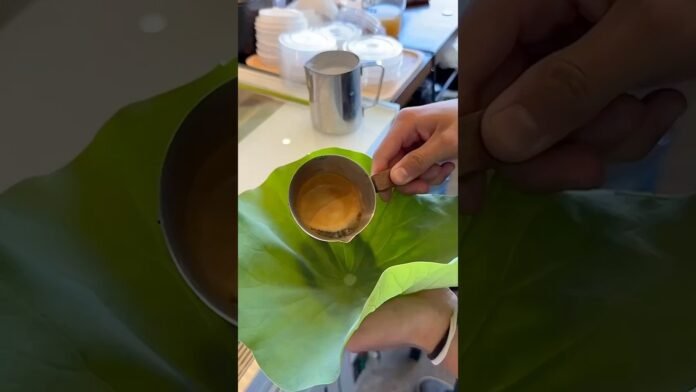
In a now-viral video, a barista gently pours warm coffee onto a lotus leaf, nestled delicately inside a glass frame. Instead of soaking in — as one might expect from any leafy surface — the coffee pools gracefully on top, refusing to be absorbed. Customers then sip the brew through a straw, pulling in a taste of nature with every draw.

Proponents claim this earthy presentation isn’t just a visual gimmick. According to them, the lotus leaf enhances the flavor of the coffee, infusing it with subtle botanical notes — although the science behind that is still, quite literally, up in the air.


The Science Behind the Spectacle

The lotus leaf is a natural marvel — renowned for what scientists call the “Lotus Effect.”

Its surface is superhydrophobic, meaning it’s incredibly water-repellent. Covered in microscopic bumps and waxy tubules, the leaf causes liquids to bead up and roll off effortlessly, collecting almost nothing along the way. It’s inspired innovations from self-cleaning paint to waterproof fabrics.

In the context of coffee, the brew glides across the leaf’s surface, reflecting light like liquid silk and possibly picking up trace aromas from the leaf.


Aesthetics vs. Practicality: The Internet Responds

As with all viral food trends, the online response has been polarising. While some viewers are enchanted by the harmony of natural design and beverage innovation, others see it as a step too far — an unnecessary and impractical reimagining of something that already works perfectly fine in a cup.

There’s admiration for the eco-conscious serving style, paired with curiosity about its taste. At the same time, skeptics question whether the novelty overshadows the actual coffee experience.


Cultural Curiosity or Culinary Gimmick?

Lotus leaf coffee invites a larger question: What makes a food trend meaningful?

Is it the flavor? The aesthetic? The sustainability? Or is it just a playful wink at our need to be constantly surprised — even by our morning caffeine?

There’s no doubt this leafy latte is a conversation starter. Whether it becomes the next matcha moment or floats quietly away on the trend tide remains to be seen.


Would You Try It?

Would you try coffee served on a lotus leaf? Is it a soulful sip of nature or just another short-lived internet stunt?

One thing’s clear — in the ever-shifting landscape of food and drink, creativity still has no limits, and your next cup of joe might just come with a leaf… and a lot of opinions.

A Doctor Explains Why Heart Attacks Are Rising Among Indians Under 40 And How to Stay Safe

0

The Silent Threat: Why More Young Indians Are Suffering Heart Attacks — And What You Can Do To Stay Safe

Until recently, heart attacks were mostly considered a health crisis of the elderly — something you’d worry about after 60, when the hair turns silver and the cholesterol levels creep up. But across India, that narrative is being turned on its head.

It’s becoming alarmingly common to hear of someone in their 30s or early 40s — seemingly fit, full of life, no major health complaints — suddenly experiencing a heart scare. Often, there are no loud warnings, just subtle signs that are easy to ignore, until it’s too late.

Hospitals across the country are sounding the alarm. Between 2020 and 2023, half of the patients who suffered heart attacks were under the age of 40. That’s right — half.

So, what’s happening to our hearts?


The Changing Face of Heart Disease

“Earlier, heart attacks were traditionally seen in people beyond 50 or 60,” says Dr Sudhakar Rao M, Consultant Cardiologist at Manipal Hospital, Bengaluru. “But in the last two decades, they’ve become common in young adults, especially those under 45.”

It’s a stark shift — and a scary one. The culprits? A tangled web of genetics, lifestyle choices, environmental changes, and our modern way of living that’s long on stress and short on movement.


Smoking: The Ticking Time Bomb

One of the biggest offenders? Smoking — both active and passive. Yes, even if you don’t smoke but are regularly around those who do, your heart is still at risk.

“People who smoke have three to four times higher chances of having a heart attack than non-smokers,” warns Dr Rao.

Here’s how it works: smoking narrows your blood vessels, making it easier for fat and cholesterol to stick to artery walls. Over time, this plaque buildup can block blood flow — triggering a heart attack.


The Triple Threat: Diabetes, Obesity, and Metabolic Syndrome

India is already known as the diabetes capital of the world — but now, this condition is cropping up in people as young as 30.

“When you have diabetes, your risk of heart disease doubles,” says Dr Rao. And if that wasn’t enough, add metabolic syndrome to the mix — a cocktail of high blood sugar, high cholesterol, high blood pressure, and high body weight.

This cluster of conditions acts like a silent saboteur, quietly increasing the risk of heart attacks while you go about your daily routine.

Dr Rao’s advice? “Keep your BMI below 24.5, and aim to reduce your body weight by 5% within three to six months. It can make a huge difference.”


It’s in the Blood: When Genetics Steps In

While many risk factors are controllable, some come down to the family tree.

If you have a parent or sibling who had heart disease before 50, and your LDL cholesterol (that’s the bad kind) is over 190, it could be a genetic condition like familial hypercholesterolemia.

“In such cases,” says Dr Rao, “you need aggressive management — sometimes with medication, sometimes with newer injectable treatments.”


The Symptoms You Might Miss

Here’s the tricky part — heart attack symptoms in young people can be subtle and misleading. Chest pain? Sure, but it might just feel like indigestion at first.

“If the pain lasts more than 10 minutes and comes with sweating, jaw pain, or left-hand pain, don’t ignore it,” warns Dr Rao.

Women, in particular, may not experience classic chest pain at all. Instead, they might feel:

  • Unexplained fatigue
  • Dizziness
  • Sweating
  • Shortness of breath
  • Jaw or arm discomfort

“50% of women don’t have chest pain during a heart attack,” Dr Rao points out — a reminder that we need to listen to our bodies carefully, especially when something feels ‘off.’


Prevention: The Real Power Move

Here’s the good news: while genetics may stack the deck, lifestyle and early monitoring can tip the odds in your favor.

Dr Rao’s golden rule? Start checking your vitals early — as early as 18.

  • Blood Pressure: Check it once a year; aim for below 130/80.
  • Cholesterol: Total cholesterol should be under 200; LDL should stay under 100.
  • Blood Sugar: Fasting sugar under 100; three-month average (HbA1c) under 5.7.

Think of it as a yearly oil change for your body — a small habit that can prevent a catastrophic breakdown.


Your Heart’s Daily To-Do List

Beyond check-ups, your daily habits are the real game-changers. Dr Rao recommends:

  • Walk it out: 10,000 steps a day helps keep your arteries clear and your heart strong.
  • Eat smart: Avoid red meat and embrace heart-friendly fats like those found in sunflower and olive oils.
  • Breathe easy: Make room for yoga or meditation — stress is a sneaky but serious heart hazard.

What About Those Sudden Gym Collapses?

Every now and then, headlines scream of someone collapsing at the gym — and while heart attacks are a possibility, they aren’t the only explanation.

“There are other causes, like hypertrophic cardiomyopathy or ventricular arrhythmias,” Dr Rao says.

That’s why, if you’re over 40 or have a family history of heart disease, diabetes, or high BP, it’s wise to get a heart check-up — ECGs, treadmill stress tests — before diving into high-intensity workouts.


The Takeaway: Don’t Wait for a Warning

The rise in heart disease among young Indians isn’t just a statistic — it’s a wake-up call. And it’s not just about avoiding death — it’s about protecting your quality of life, your energy, your ability to be present for the people and passions that matter.

The path to prevention is simple but powerful: know your numbers, move your body, manage your stress, and stay curious about your health.

Because the best kind of heart story? Is the one you never have to write.

How to Grow Oyster Mushrooms at Home: Tips from an Ernakulam Farmer Earning Rs 12 Lakh/Month

0

From Balcony to Bounty: How You Can Start Growing Mushrooms at Home — With Tips from a Farmer Earning Rs 12 Lakh a Month

Imagine waking up to the earthy aroma of mushrooms blooming just a few feet away from your kitchen — not in some distant forest, but in your own home. It may sound like a dreamy Pinterest fantasy, but for Jithu Thomas, a mushroom farmer from Ernakulam, it’s a full-blown reality. And with a bit of patience and the right know-how, he believes it could be yours too.

Now earning over Rs 12 lakh a month through mushroom cultivation, Jithu’s story started humbly — not in a big field or lab, but with a mother-son duo experimenting with mushroom seeds in a quiet corner of their home. What began as a passion project with his mother, Leena, has now grown into Leena’s Mushroom Farm — a thriving 1200-square-foot operation producing between 150 to 200 kg of mushrooms daily.

And what’s the magic mushroom that made it all happen? Not the trippy kind, thankfully — but the humble oyster mushroom, which Jithu swears by as the perfect starting point for beginners.

Whether you’re looking to grow your own food, start a side hustle, or just try something fun (and fungal), here’s a beginner’s guide from the man who turned spores into success.


Step 1: Choose Quality Seeds – Your Fungal Foundation

How to Grow Oyster Mushrooms at Home: Tips from an Ernakulam Farmer Earning Rs 12 Lakh/Month

Just like a good story starts with the right plot, your mushroom journey begins with the right spawn — that’s farmer-speak for mushroom seeds. Jithu emphasizes this as the most crucial step.

“You can either buy from experienced cultivators or order online,” he advises, “but make sure it’s from a trusted source.”

The reason? Your mushrooms are only as healthy as the seeds you plant. Inferior quality seeds can mean patchy growth, poor yields, or worse — no mushrooms at all.


Step 2: Start Small — Your Balcony is Big Enough

Think you need acres of land to be a mushroom farmer? Think again. Jithu recommends starting with a small space — even a corridor or balcony will do.

“You don’t need a fancy setup to begin. Use what you have and learn how the mushrooms respond,” he says.

The goal is to dip your toes (or spores) into the world of mushroom farming without being overwhelmed. Plus, starting small keeps your losses minimal if something goes wrong — and in farming, things will go wrong.


Step 3: Treat the First 6 Months Like an Internship

How to Grow Oyster Mushrooms at Home: Tips from an Ernakulam Farmer Earning Rs 12 Lakh/Month

Jithu’s advice for the first six months? Patience, learning, and observation.

“This period is for experimenting and getting used to the crop,” he explains. “Understand the conditions, notice the patterns, and find your rhythm.”

It’s a test phase — kind of like dating your mushrooms. You’re figuring out what works and what doesn’t before committing to something more serious.


Step 4: Respect the Crop’s Fragility — Mushrooms Are Sensitive Little Beings

How to Grow Oyster Mushrooms at Home: Tips from an Ernakulam Farmer Earning Rs 12 Lakh/Month

Yes, mushrooms grow fast — oyster mushrooms can be ready to harvest in just 3 to 5 weeks. But they’re also fussy.

“The crop is very sensitive. A slight change in temperature or an unnoticed pest can wipe out your entire batch,” Jithu warns.

That means you’ve got to monitor your setup — think of yourself as a mushroom babysitter. Keep the temperature and humidity stable, ensure proper hygiene, and act fast if you spot anything off.


Step 5: Stay Consistent — The Secret Ingredient

Consistency is what separates a casual experimenter from a full-fledged mushroom grower.

“You have to follow the process every day,” Jithu insists. “There’s no shortcut. Regular monitoring, cleaning, and adjusting are part of the job.”

Leena’s Mushroom Farm faced its share of challenges — floods, a global pandemic, fluctuating markets. But by sticking to a scientific approach and planning ahead, they didn’t just survive — they thrived.


Ready to Grow?

If you’ve ever thought mushroom farming was a mysterious, complicated venture, Jithu Thomas is here to bust that myth, one oyster mushroom at a time. His story — from sowing seeds with his mom to creating a successful enterprise — is a powerful reminder that with care, consistency, and a touch of curiosity, you can cultivate more than just a crop. You can grow a whole new way of life.

So next time you’re sipping coffee on your balcony, look around. That little corner could be the start of your very own mushroom journey.

And who knows? With a little patience and a sprinkle of spore magic, you might just turn your home into a mini mushroom empire.

Kicking Past Barriers: How a 20-YO Self-Taught Kickboxer Made It to the World Stage

0

“If everyone goes behind cricket, who will play other sports?”
This simple yet sharp question from Shraddha Rangharh, a 20-year-old kickboxer from Faridabad, cuts through the noise of India’s cricket-drenched sports culture. And she’s not just asking — she’s answering it with every medal, every kick, and every fight she wins.

Ranked World No. 5 in kickboxing, Shraddha is doing more than just representing India — she’s redefining what it means to rise against the odds.

No Coach. No Sponsors. No Problem.

Shraddha’s journey didn’t begin with cheering crowds or fancy gyms. It started in a conservative household in Haryana where even education for girls was seen as a luxury, not a right. “They believed letting me study was something they were giving me, not something I deserved,” she shares.

Kicking Past Barriers: How a 20-YO Self-Taught Kickboxer Made It to the World Stage

Sports? That was even more far-fetched.

Till sixth grade, Shraddha kept her love for sports bottled up — sneaking joy from kabaddi, cricket, and football when she could. But things began to change when she was 13, kicking a ball on the school ground, when a taekwondo coach noticed her powerful legwork and invited her to join.

That moment became her tipping point.

Martial Arts and a Spark of Destiny

Taekwondo became her first structured sport. She trained in silence, won her first gold at a CBSE national championship, and let that medal speak where words couldn’t. “That’s when I knew — I wasn’t just playing. I belonged in sports.”

At 14, Shraddha stumbled upon videos on YouTube — not dance trends or prank clips, but “tricking”, a blend of martial arts, acrobatics, and gymnastics. With no coach, no funds, and no family support, she taught herself — move by move, flip by flip — through the screen.

“I didn’t even have proper training gear. I’d earn Rs 100 during Navratri as a kanjak and save every penny for tournament registrations,” she recalls. Most teens were asking for birthday gifts; Shraddha was funding her dream with divine offerings and unmatched hustle.

Social Media: From Survival to Spotlight

Kicking Past Barriers: How a 20-YO Self-Taught Kickboxer Made It to the World Stage

In 2020, Shraddha turned to social media — not to chase fame, but to build a platform for underdog athletes like her. Her training videos, especially in musical and creative kickboxing forms, struck a chord. She wasn’t just kicking — she was synchronising her movements to music, blending power with poetry.

Her follower count exploded to 1.75 million. Soon, brands came calling, and collaborations helped fund her tournaments. That’s where Piyush Kumar from ART Talent Management discovered her. “We were looking for raw talent — and Shraddha was it,” he says.

With Piyush managing her online presence and deals, Shraddha could finally breathe — and focus on training, not surviving.

From National Glory to Global Goals

In 2023, Shraddha made her kickboxing debut at the National Championship and walked away with two gold medals. No surprises there. But 2024 is where the game got real: the WAKO World Cup and the Asian Kickboxing Championships were scheduled back-to-back — a whirlwind of preparation, travel, and pressure.

Her training? Relentless.
5 am to 10 am: cardio and technique.
1 pm to 3 pm: footwork.
Evening: gym or sparring.
And between all this? She’s still juggling college exams.

Shraddha doesn’t just train hard — she trains smart. “I visualise the venue. I play it in my head. I walk through the routine until it becomes muscle memory,” she explains.

In the World Cup, she snagged one gold and three silvers. The Asian Championship? Two golds, two silvers — in categories dominated by martial arts powerhouses like China, Thailand, and the Philippines.

“She hates silver,” laughs Piyush. “Gold is her peace.”

Shattering Stereotypes, One Kick at a Time

Kicking Past Barriers: How a 20-YO Self-Taught Kickboxer Made It to the World Stage

Shraddha’s fight isn’t just in the ring. “People told me I ‘run like a girl’ — like it’s an insult. And now, when I win, they say I ‘fight like a boy.’ Why can’t strength just be strength?” she asks.

She fights boys. She beats boys. She does it not to prove she’s better, but to prove she belongs — not in someone else’s shadow, but in a spotlight of her own.

What’s Next? A Golden Vision

Kicking Past Barriers: How a 20-YO Self-Taught Kickboxer Made It to the World Stage

With her eyes locked on the 2025 World Championship, Shraddha is leaving nothing to chance. “No Indian has won gold in that event. I want to be the first,” she declares, not as a dreamer, but as someone who’s already halfway there.

She’s eyeing new training with Italian coaches and seeking sponsors to keep up with the rising costs — ₹2 lakhs for a single international championship, plus additional fees per category. It’s a steep climb. But if anyone can scale that summit, it’s her.

And through all this, Shraddha hasn’t let go of her responsibilities. She’s pursuing a degree in arts, funding her younger sister’s college education, and supporting her family’s living expenses — all while chasing world dominance in kickboxing.


The Last Word:

Shraddha Rangharh isn’t just a martial artist. She’s a movement.
A one-woman army built on grit, grace, and ground-breaking kicks.
A small-town girl with big-league ambition.
A story that doesn’t just deserve to be told — it demands to be heard.

So the next time someone says, “It’s just a girl,”
remember this: She kicks harder than your excuses.

Biogas, Manure, Tiles: This Industry Has Cracked the ‘Zero-Waste’ Code

0

India generates a staggering 62 million tonnes of waste every year. That’s enough to fill nearly 24,000 Olympic-sized swimming pools. Most of this ends up in ever-expanding landfills, choking our cities and weighing down our green ambitions. But amid this rising tide of waste, one company is quietly proving that trash doesn’t have to be the end of the line — it can be a powerful new beginning.

Enter Merino Industries, one of the world’s largest manufacturers of decorative laminates, and now, a trailblazer in circular manufacturing. In a time when industries are caught balancing the tightrope between profitability and sustainability, Merino has found a way to do both — by turning waste into wealth.

Biogas, Manure, Tiles: This Industry Has Cracked the ‘Zero-Waste’ Code

Beyond Clean Floors and Fancy Panels

At first glance, you might associate Merino with stylish interiors and glossy finishes. But behind those elegant surfaces is a remarkable story of resourcefulness and reinvention. Led by CMD Mr. Prakash Lohia, the company has built a waste management system that’s as robust as it is visionary — one that could become a blueprint for other industries navigating the sustainability challenge.

“The model’s genius,” Mr. Lohia explains, “lies in tracking every fragment of waste and assigning it purpose.” This isn’t just cleanup — it’s a holistic transformation rooted in the UN’s Sustainable Development Goals (SDGs) and powered by innovation.

Biogas, Manure, Tiles: This Industry Has Cracked the ‘Zero-Waste’ Code

The Six Pillars of the Merino Waste Model

Let’s dive into the core of Merino’s strategy — six distinct ways the company is not just disposing of waste, but creating value from it:

1. From Potato Peels to Power and Protein

At Merino’s Potato Flakes Plant (PFP), the humble potato peel gets a second life — not in the trash, but as animal fodder. Meanwhile, wastewater from processing undergoes anaerobic decomposition at their Effluent Treatment Plant (ETP), producing biogas that fuels cooking — a seamless blend of sustainability and utility.

2. Biogenic Fuels for Energy Independence

Sawdust, rice husk, and other organic residues are harnessed as biogenic fuels, generating clean energy. These renewable sources help partially power Merino’s plants, reducing reliance on fossil fuels while cutting down operational costs.

3. From Factory Floor to Footpath

Combustible waste like laminate scraps and panel offcuts don’t head to the dumpster — they’re fed into Merino’s industrial furnaces. The resulting ash? Turned into bricks and tiles, now forming pathways across Merino’s factory campuses. Waste becomes infrastructure. Literally.

4. Fertilising the Future

Step into the lush green expanse of Merino’s Hapur complex, and you’ll see the impact of their waste-to-soil strategy. Slurry, a by-product from the biogas plant, is processed into 215 metric tonnes of organic manure each year. This nutrient-rich fertiliser keeps Merino’s campuses thriving — a small but striking example of closed-loop ecology.

5. Smart Sorting, Safer Disposal

Waste is meticulously classified into categories — hazardous, non-hazardous, recyclable, non-recyclable, organic, non-organic, liquid, solid. This detailed taxonomy enables safe disposal, especially of hazardous materials, which are sent exclusively to authorised recyclers. It’s not just eco-friendly — it’s responsible industrial citizenship.

6. A Culture of Consciousness

At the heart of this strategy lies something deeper than systems and sorting — a mindset. “We draw inspiration from ancient Indian wisdom,” says Mr. Lohia, “which teaches respect for resources and mindful consumption.” It’s a cultural lens that reframes waste not as an inevitable burden, but as an opportunity.

Waste as Wealth, Process as Philosophy

Biogas, Manure, Tiles: This Industry Has Cracked the ‘Zero-Waste’ Code

Merino’s model is more than just a sustainability checklist — it’s a powerful reminder that efficiency and environmental ethics can go hand-in-hand. By embedding waste management into the DNA of its operations, Merino is doing more than reducing landfill loads. It’s setting a precedent — showing how Indian industries can scale up without scaling down the planet.

As India stares down a growing waste crisis, Merino Industries offers a rare glimmer of optimism. Their approach proves that sustainability doesn’t have to be expensive, complicated, or at odds with growth — it can be the engine that drives it.

And in a world desperately seeking solutions, that may just be Merino’s most beautiful product yet.

You’d Never Guess This Modern Home Was Once a Shipping Container

0

Imagine this: your next home goes up in just a few weeks. It’s sleek, sustainable, solar-powered — and crafted from an old shipping container that once traversed oceans.

Sounds like science fiction? In Bengaluru, it’s already happening.

At the edge of the city’s bustling innovation belt, a small but ambitious startup called The Habitainer is quietly challenging everything we thought we knew about housing. Their bold experiment: transforming decommissioned shipping containers into beautiful, functional homes — the kind you’d actually want to live in.

And no, they don’t look like something plucked from a shipyard.

From Cargo to Casa

Their latest creation is a solar-powered duplex — yes, a duplex — made entirely from reused shipping containers. But don’t let the rugged origins fool you. Step inside, and you’ll find yourself in a light-filled space with wide-open rooms, floor-to-ceiling windows, and a design so modern, it belongs in a glossy architecture magazine, not a scrapyard catalogue.

Gone is the industrial chill that usually accompanies container homes. In its place: a minimalist aesthetic that feels warm, intentional, and, frankly, a little luxurious.

But what really sets The Habitainer’s homes apart isn’t what you can see — it’s what’s cleverly hidden: solar panels integrated into the design, greywater recycling systems, and upcycled materials that quietly shrink the home’s environmental footprint.

Fast Homes for a Fast World

In a world where traditional construction often stretches into months or years — racking up delays, costs, and emissions — The Habitainer’s homes are refreshingly efficient. Built off-site, they can be assembled in a matter of weeks, like a very grown-up Lego set.

Over the past four years, this Bengaluru-based team has completed more than 200 projects across India. No two homes are the same — from compact studios for solo dwellers to spacious family homes, every unit is tailored to the person living inside it.

This isn’t cookie-cutter design. It’s customized, considered, and deeply contextual.

Sustainability with Substance

Container homes are not a brand-new concept — they’ve made appearances in Europe, the U.S., and even disaster relief zones. But what The Habitainer is doing feels different. It’s not just about novelty; it’s about necessity.

India’s cities are growing fast. Land is limited, resources are stretched, and construction often comes at a steep environmental cost. Against that backdrop, The Habitainer’s model offers something both practical and visionary: a housing solution that’s faster to build, lighter on the planet, and fundamentally more adaptable.

It’s a design that respects the limits of our time, while still reaching for beauty.

The Bigger Picture

Let’s be honest — container homes won’t solve every problem in India’s housing puzzle. But in a landscape dominated by concrete jungles and skyrocketing costs, they offer a refreshing alternative. A whisper of what’s possible when innovation meets empathy.

It’s not about making do with less. It’s about doing more with what we already have — transforming overlooked materials into meaningful spaces that serve real people.

Would You Live in a Box?

Once upon a time, the idea of living in a shipping container might’ve sounded absurd — cramped, cold, temporary. But with designs like these, that narrative is changing.

Would you live in one?

Maybe the question we should be asking is: Why wouldn’t you?

Because if a home can be built quickly, powered sustainably, and tailored to your needs — all while reducing your impact on the planet — then maybe the future of housing doesn’t lie in building up.

Maybe it lies in thinking inside the box.

An Institution that could Marry Modern Science with Indian Intellect

0

In the simmering heat of the 1890s, as India toiled under colonial rule, one man’s dream glimmered with the promise of transformation—Jamsetji Nusserwanji Tata, a successful industrialist, was dreaming big, and he was dreaming ahead. But this wasn’t just about steel or mills. It was about minds. About building a world-class university in India—an institution that would serve as a beacon for scientific research and national progress.

An Institution that could Marry Modern Science with Indian Intellect

A Spiritual Spark: When Tata Met Vivekananda

Legend has it that the idea found divine reinforcement on a sea voyage from Japan to the U.S. in 1893. Tata found himself in the company of a young monk—Swami Vivekananda. Their discussion was anything but ordinary. As waves crashed against the hull, the conversation flowed through philosophy, science, and India’s dire need for both.

Tata asked the monk what could best serve India. Vivekananda’s answer? “Science and education.” He stressed that a scientific temperament, rooted in Indian values and empowered with modern tools, could change the destiny of the country.

This meeting left an indelible mark on Tata. He returned not just with new business ideas, but with a mission to build an institution that could marry modern science with Indian intellect. Thus, the seeds of what would become the Indian Institute of Science (IISc) were sown.

An Institution that could Marry Modern Science with Indian Intellect

An Idea Needs Land—and Allies

But an idea, no matter how visionary, needs ground to stand on—quite literally. Tata poured his personal wealth into this dream. The princely state of Mysore rose to the occasion. The Regent Queen Maharani Kempananjammani Vani Vilasa Sannidhana, ruling on behalf of her young son Krishnaraja Wadiyar, gifted 371 acres and 16 guntas of land in Bangalore, plus financial assistance for the institute’s founding and sustenance.

Even the British colonial government, not known for spontaneous generosity, pitched in. But Jamsetji wouldn’t live to see his dream take physical shape—he passed away in 1904. Still, the embers of his vision were glowing too bright to fade.

Birth of a Scientific Giant

On 27 May 1909, following a resolution by the Government of India, the Indian Institute of Science was born. The English chemist Morris Travers was appointed as its first director, and the Institute opened its doors to 24 students in 1911.

The humble beginnings featured just two departments—General and Applied Chemistry, and Electrical Technology. Yet even then, the Institute was wired for impact. Under the urging of Sir M Visvesvaraya, Dewan of Mysore and Council member, early research focused on solving India’s practical problems. This led to the establishment of six industrial ventures within five years, including the now-iconic soap and sandalwood oil factories in Bangalore and Mysore.

An Institution that could Marry Modern Science with Indian Intellect

Scientific Titans Walk These Halls

By the 1930s, the Physics department was being helmed by none other than Sir C.V. Raman, India’s first Nobel Laureate in the sciences. He went on to become IISc’s first Indian Director in 1933. Under his leadership, the Institute’s reputation soared.

An Institution that could Marry Modern Science with Indian Intellect

Over the decades, a constellation of brilliant minds walked IISc’s hallowed halls—Homi J. Bhabha, Vikram Sarabhai, Kamala Sohonie, C.N.R. Rao, and many others. Together, they shaped India’s future—from nuclear power to nutrition science, from satellite launches to materials research.

War Effort and Wartime Innovation

During World War II, IISc took a break from pure academia to do some heavy lifting—literally. It helped in training military personnel, manufacturing war materials, and collaborating with Hindustan Aircraft Limited (now HAL) to maintain Allied planes. It was science in service of survival.

An Institution that could Marry Modern Science with Indian Intellect

This wartime period also triggered an engineering boom. New departments were added, including Aeronautical Engineering, Metallurgy, and Mechanical Engineering.

The Dhawan Era: Rocket Fuel for Research

Fast forward to the 1960s through the early 80s, and the Institute was under the transformative leadership of Satish Dhawan, an aerospace genius who also chaired ISRO. IISc exploded into new disciplines: materials science, automation, molecular biophysics, and theoretical studies. It wasn’t just about research anymore—it was about relevance.

His brainchild, ASTRA (Application of Science and Technology to Rural Areas), embodied this ethos. Today, it lives on as the Centre for Sustainable Technologies.

The New Millennium: A New Chapter

In the 21st century, IISc broke new ground—literally. It launched its undergraduate programme, expanded into brain research, nanoscience, hypersonics, and more. The Institute also established a massive 1,500-acre campus in Challakere, Chitradurga district, Karnataka, broadening its scientific footprint.

It also became a hub for start-ups and innovation, blending academia with industry in a powerful synergy.

A Global Scientific Landmark

Over the years, IISc has played host to a who’s who of global thinkers: Gandhi, Queen Elizabeth, Ho Chi Minh, Nikita Khrushchev, James Watson, and prime ministers from Nehru to Modi. It’s not just an Indian institution—it’s a global scientific lighthouse.

An Institution that could Marry Modern Science with Indian Intellect

A Legacy Forged in Faith and Fire

From the spiritual spark of a monk’s wisdom to the steel resolve of an industrialist, IISc’s origin is a beautiful paradox—science born from faith. Swami Vivekananda once said, “Education is the manifestation of perfection already in man.” At IISc, that perfection is still unfolding.

More than a century later, the Institute remains a living tribute to those who dared to dream beyond their time—proving that true progress lies not just in discovery, but in determination, diversity, and the courage to imagine.

Bringing Back the Dire Wolf: The ‘Magic’ Behind a Bold Scientific Revival

0

Colossal Biosciences—the genetic engineering company best known for its mission to revive the woolly mammoth—has achieved another groundbreaking feat: the return of the extinct dire wolf.

The Dallas-based biotech firm announced Monday the successful birth of three dire wolf puppies, marking a major milestone in demonstrating the viability of its cutting-edge “de-extinction technologies.” The breakthrough showcases the potential for reviving other long-lost species.

According to Colossal CEO and co-founder Ben Lamm, this marks the first time a de-extincted animal has been successfully brought back to life.

“Our team extracted DNA from a 13,000-year-old tooth and a 72,000-year-old skull to create healthy dire wolf puppies,” Lamm said in a press release. “It was once said, ‘any sufficiently advanced technology is indistinguishable from magic.’ Today, we’re proud to reveal some of that ‘magic’ and its potential to transform conservation as we know it.”

Extended Heatwaves: Sustainable Solutions with Mud Houses and Green Building Innovations

0

By Anjali Solanki

As climate change intensifies, extended heatwaves are becoming a global challenge, impacting health, agriculture, and energy systems. With rising temperatures straining urban infrastructure, sustainable solutions are critical to mitigate the effects of prolonged heat and build resilient communities.

Understanding Extended Heatwaves

Extended heatwaves are prolonged periods of excessively high temperatures, often exacerbated by climate change, urbanisation, and deforestation. According to recent studies, heatwaves are becoming more frequent and severe, with urban heat islands amplifying temperatures in cities. The consequences include heat-related illnesses, strained power grids due to increased cooling demands, and reduced agricultural yields.

The Need for Sustainable Solutions
Conventional cooling methods, like air conditioning, contribute to greenhouse gas emissions and overburden energy systems. Sustainable alternatives not only reduce environmental impact but also offer long-term resilience against extreme heat. By integrating traditional wisdom, such as mud house construction, with modern green building innovations, communities can adapt to rising temperatures while minimizing their carbon footprint.

Mud Houses: A Time-Tested Solution for Heatwave Resilience

Mud houses, also known as adobe or earthen homes, are an ancient architectural practice that offers natural insulation against extreme heat. Made from locally sourced materials like clay, sand, and straw, mud houses maintain cool indoor temperatures even during scorching summers. Their thick walls absorb heat during the day and release it slowly at night.

Solar Shading: External shades, pergolas, or trees block direct sunlight, lowering indoor temperatures.

Renewable Energy Integration: Solar panels and geothermal systems power cooling needs sustainably, reducing strain on grids during heatwaves.
Green buildings not only mitigate heat but also align with global sustainability goals, such as reducing carbon emissions and promoting circular economies.

Maximum Impact

Integrating mud houses with green building innovations creates a hybrid model that leverages the best of both worlds. For instance, a mud house with a green roof and solar-powered ventilation combines traditional insulation with modern efficiency. Adding native plants for shading and rainwater harvesting systems further enhances sustainability, making these homes self-sufficient and climate-resilient.

Case Study: India’s Mud House Revival
In Rajasthan, India, architects are blending mud house designs with green building principles to create heatwave-resistant homes. These structures use locally sourced mud, incorporate passive cooling, and feature rooftop gardens. Such projects demonstrate how traditional knowledge can meet modern needs, offering scalable solutions for urban and rural areas alike.

Urban Greenery: Planting trees and creating green corridors reduce urban heat island effects.

Water Conservation: Rainwater harvesting and greywater recycling support sustainable landscaping during dry spells.

Community Awareness: Educating residents about heatwave preparedness, such as hydration and energy conservation, fosters resilience.

Challenges and Future Directions

While mud houses and green buildings offer promising solutions, challenges like scalability, regulatory barriers, and public perception must be addressed. Governments and organizations can incentivize sustainable construction through subsidies, training programs, and policy reforms. Additionally, raising awareness about the long-term benefits of eco-friendly architecture can shift consumer preferences toward sustainable living.

Extended heatwaves demand innovative

sustainable solutions that balance environmental responsibility with human comfort. Mud houses, with their natural cooling properties, and green building techniques, such as passive design and renewable energy, offer practical ways to adapt to rising temperatures. By embracing these approaches, communities can build a future that is resilient, affordable, and in harmony with the planet. Whether through reviving traditional mud architecture or scaling modern green innovations, the path to heatwave resilience starts with sustainable choices today

Now, Democratise Your Wellness Monitoring with Britannia NutriChoice’ NutriPlus App

0

Britannia NutriChoice—one of India’s leading biscuit brands—extended its commitment to simplifying everyday wellness with the launch of NutriPlus, a mobile app that is on a mission to democratise wellness tracking in India by making it simpler, more accessible, and entirely smartphone-driven.

Designed in partnership with Aktivo Labs, this evidence-based app is available by simply scanning a pack of Britannia NutriChoice, making what is typically complex technology available in an intuitive, easy-to-access form. In just one year, NutriPlus has seen good organic adoption, with over 1.5 lakh user sign-ins—demonstrating the growing demand for everyday wellness solutions.

NutriPlus provides a single, evidence-based Nutri+ Score, helping users monitor key lifestyle indicators such as steps, sleep quality, fibre intake, and water intake. Over the past year*, the average Nutri+ Score has increased from 60 to 62, signalling an improvement in overall wellness. Users have shown a steady improvement in their routines, with daily steps increasing by 10%, exercise time rising by 16% and sleep duration improving from 6 hours 46 minutes to 7 hours 08 minutes, These consistent enhancements highlight the app’s effectiveness in encouraging small but meaningful everyday changes.

Archana Balaraman, General Manager, Marketing, Britannia said, “NutriPlus has made wellness tracking simpler for everyone. By removing the need for wearables or complex tracking systems, we’ve enabled more people to take small, meaningful steps in their daily routines. As we continue evolving NutriPlus, Britannia NutriChoice remains committed to helping individuals embrace better wellness habits with ease.”

About Britannia NutriChoice

Britannia NutriChoice has always supported consumers in making small, simple choices that contribute to a better lifestyle. With NutriPlus, this philosophy extends beyond food, delivering technology-enabled wellness tracking that empowers individuals to adopt sustainable routines and everyday improvements. The app now also offers a customized diet chart feature, giving users personalised diet plans based on their goals—making NutriPlus a complete companion for simplified, holistic wellness tracking. As engagement continues to grow, NutriPlus remains focused on making wellness insights more accessible and actionable for all.

Britannia

Britannia is a 100+ year old Company and is a market leader in the Bakery category in India with an annual revenue of Rs 150 Billion. The company is into 2 large snacking categories-Bakery & Dairy, with trusted & iconic brands such as Good Day, Marie Gold, Milk Bikis & NutriChoice. Britannia products are available in over 80 countries. The Company manufactures its products in nearly 100 factories, which are made available in over 6 Million outlets to eventually reach over 180 Million households in the country. The Company’s vision is to be a responsible global, total foods company, and delight consumers with delicious, and wholesome snacks and beverages throughout the day.