Home Blog Page 296

IBM’s Deep Blue Defeats World Chess Champion Garry Kasparov in 1997

0

On May 11, 1997, IBM’s Deep Blue achieved what many thought impossible: it defeated reigning world chess champion Garry Kasparov in a six-game rematch, winning 3.5–2.5. This event wasn’t just a triumph on the 64 squares—it represented a watershed moment in the history of artificial intelligence and computational power.

The Road to the Rematch

IBM first challenged Kasparov in 1996, when an earlier version of Deep Blue lost 4–2. Though defeated, Deep Blue won the first game, proving that a machine could outplay a human grandmaster at least once. Spurred by this breakthrough, IBM engineers and computer scientists upgraded the system—boosting processing speed, expanding opening libraries, and improving evaluation algorithms—to create “Deeper Blue.”

The Six Critical Games

  1. Game 1 (May 3, 1997): A hard-fought draw, setting an even tone for the match.
  2. Game 2 (May 4, 1997): Deep Blue’s historic first win against Kasparov in a full-length game.
  3. Game 3 (May 6, 1997): Kasparov bounced back with a victory, narrowing the score.
  4. Game 4 (May 7, 1997): Another draw as both sides tested each other’s resilience.
  5. Game 5 (May 9, 1997): Deep Blue capitalized on a tactical error by Kasparov to secure its second win.
  6. Game 6 (May 11, 1997): After a tense battle, Deep Blue drew, clinching the match 3.5–2.5.

Why This Match Mattered

  • Proof of Concept for AI: Demonstrated that specialized hardware paired with optimized algorithms could rival—and surpass—human strategic thinking.
  • Advances in Parallel Processing: Deep Blue’s 30-node cluster, each with multiple processors, performed up to 200 million chess positions per second.
  • Opening Book and Heuristics: By integrating an extensive opening database and sophisticated evaluation functions, Deep Blue showcased how data-driven approaches enhance decision-making.

The Broader Impact on Artificial Intelligence

Deep Blue’s victory resonated far beyond chess. It spurred investment in machine learning, data analytics, and expert systems across industries:

  • Healthcare: AI-driven diagnostic tools now analyze medical images and patient data with unprecedented accuracy.
  • Finance: Algorithmic trading and risk assessment leverage similar evaluation models to optimize portfolios.
  • Autonomous Systems: The principles behind Deep Blue’s processing paved the way for self-driving cars and robotics.

Reflections and Controversies

Kasparov questioned some of Deep Blue’s moves—arguing that the machine made “creative” plays beyond its programming. While IBM insisted all moves were computed by Deep Blue’s original code, debates about AI transparency and machine “intuition” began in earnest, foreshadowing modern discussions on explainable AI.

Legacy of the 1997 Match

Two decades later, the Deep Blue–Kasparov match remains a landmark:

  • Educational Inspiration: Chess programs and online platforms now teach tactics and strategy to millions of learners.
  • AI Ethics and Governance: The match ignited conversations about responsibility, control, and the future relationship between humans and intelligent machines.
  • Continued Innovation: From Watson on Jeopardy! to today’s large language models, each milestone builds on the foundations laid in 1997.

A Trip to Haridwar from Jaipur: Bask In The Beauty of Pretty Hills and Mighty Himalayas Surroundings Scenic Locations…

0

By Apoorva Dabral

This is a travelogue which I have written while taking a tour from Jaipur to Haridwar via road. Opening the door of the car, enduring a 6 hour drive from Delhi through the moonlit night across the vast fields of Western UP carpeting the landscape and kissing the horizon in its calm darkness, I greeted the first rays of the morning. With the Himalayan mountains faintly visible, being illuminated by the sun, blooming into their transient beauty, the air was cold, calm and dense, the perfect start to the pilgrimage.

As I stepped out into the wide parking amid winters, scenic surroundings engulfed me and I happily drowned in its sheer bliss, for before me flowed the Ganga, the flood banks of which were separated by an iron grid. Nevertheless, I stood there, embracing the immense calmness, yet the vigour of the mighty river. Even after being diverted by the barrage, which was faintly visible as a speck in the morning horizon, the natural path of the river was reduced to stones and some primitive vegetation. 

A Trip to Haridwar from Jaipur: Bask In The Beauty of Pretty Hills and Mighty Himalayas Surroundings Scenic Locations...

The nectar of the Himalayas flowed with pure serenity, the sound of its lapping waves being heard from where I stood, calm and intense. Here I stood on my destination, for which I had yearned for months. The holy soil of Haridwar felt like a home I never knew I had.

After refreshing myself, I grabbed all my stuff and as if in a peaceful frenzy, started walking towards Har Ki Pauri. 

As my feet, as if having a soul of their own, guided me through the bustling lanes of the city with vigorous energy, with the warm sunlight of an early spring morning touching my cheeks through the leaf silts of the leaves and the tarpaulin sheets of the stalls, the walk was not only the walk of the body, but was the journey of the soul. The old road, which, like most roads in the town were the harsh dwelling of many in the city of faith, felt like a heavenly path to liberation. 

A Trip to Haridwar from Jaipur: Bask In The Beauty of Pretty Hills and Mighty Himalayas Surroundings Scenic Locations...

Observing closely, it is as if I was witnessing life in the limited view of my eye. From small, excited children running around, with their young fathers and mothers struggling to hold them, to the old, wrinkled and heavily bearded “Sadhus” who roamed the streets. From the sons who held the ashes of their father’s, walking solemnly towards the ghat to the newly born infants, yet to gain consciousness of the world who were brought here to purify them in the holy waters of the Ganga. Haridwar indeed represents its name. The path to the divine. 

Riches,poverty, gloom, laughter all flowed on the same road, alike, towards the ghat of Har Ki Pauri.

As I stood on the first step of the ghat, with the cold and calm waters of the Ganga slowly lapping on my feet, I once again looked at the rising sun, the warm rays of which had pierced the horizon and engulfed me in a warm blanket. 

The faint sound of the temple bells, which were almost constantly being rung by people who were here not for a materialistic purpose, but with a sense of duty and detachment, which enhanced the melodious sound of the bells. This is perhaps what devotion is, I thought, to dedicate oneself entirely to the divine, to not seek anything besides him, to only yearn him in a world where yearning has become the new devil.

The mighty ganga flowed before me, with it’s cold waves being as cold as the melted ice from the Himalayan peaks. As I stepped deeper into the cold waters which a constant shiver down my spine as the cold flow of the water softly pushed against my back and shoulders. At last I reached the sandbank, the deepest point of the ghat.

A Trip to Haridwar from Jaipur: Bask In The Beauty of Pretty Hills and Mighty Himalayas Surroundings Scenic Locations...

 Looking at the sun, I offered obeisance to him, followed by Ganga herself, and the Devi- Devatas. I calmed the thoughts of the mind, which were as rigorous as the river herself, for a moment, my conscience was the calmest it could ever be, and at that very moment, I took a deep dip, engulfing myself entirely in the pure waters of the Ganga

As I stepped out onto the ghat, I had felt as if it was a rebirth of me, not only did the Ganga washed my body, but it washed away my conscience and soul. I took a deep breath and stole one last look at the heavenly ghat, with the river flowing below carrying with her, floral offerings made by people for a better future, as well as the ashes of the dead being immersed at a distant corner. As I stood there, a sense of ethereal calm appeared in me. I smiled at the beauty of the town, and now had the answer to the yearn I possessed for months. While the physical being lived in a distant land, Haridwar will always be the home of the soul.

Har Har Gange!

Bob Marley, the Legendary Reggae Musician, Whose Indelible Legacy Inspires Millions…

0

Bob Marley passed away on May 11, 1981. The world mourned the loss of this legendary musician , the Jamaican-born musician whose soulful rhythms and powerful lyrics transcended borders. At just 36 years old, Marley succumbed to melanoma, leaving behind an indelible legacy that continues to inspire millions worldwide.

The Final Days of a Reggae Pioneer

Bob Marley’s battle with acral lentiginous melanoma began in 1977, when a suspicious spot was found under his toe’s nail. Despite mounting health challenges, Marley remained dedicated to his craft—touring relentlessly and recording groundbreaking albums. His final performance took place on September 23, 1980, in Pittsburgh, Pennsylvania. By spring 1981, his health had dramatically declined, and he passed away in Miami, Florida, surrounded by family and close friends.

A Life Woven with Music and Message

From his early days with The Wailers to his solo superstardom, Marley infused reggae with potent themes of love, resistance, and unity. Albums like Catch a Fire (1973) and Exodus (1977) featured anthems—“Stir It Up,” “One Love,” and “Redemption Song”—that voiced the struggles and hopes of oppressed communities. Even after his passing, these tracks became rallying cries for social justice and peace.

“Emancipate yourselves from mental slavery; none but ourselves can free our minds.”
— Bob Marley, Redemption Song

Why May 11, 1981, Still Resonates

Each year on May 11, fans worldwide observe Bob Marley Day, paying tribute through concerts, art exhibits, and charitable events. Marley’s influence stretches from Kingston’s streets to stadiums in Tokyo, uniting generations across cultures. His message of “One Love” remains a timeless call for solidarity.

  • Cultural Impact: Marley popularized reggae on a global scale, inspiring artists from rock to hip-hop.
  • Political Voice: He used music to critique apartheid in South Africa and champion pan-Africanism.
  • Spiritual Resonance: Rooted in Rastafarian faith, his songs embrace themes of spirituality and resistance.

Preserving the Legend

Bob Marley’s family and the Bob Marley Foundation continue to safeguard his heritage. The Bob Marley Museum in Kingston offers a glimpse into his life, housing personal artifacts, recording equipment, and original manuscripts. Through educational programs and philanthropy, the foundation promotes peace and community development in Jamaica and beyond.

Lessons from Marley’s Journey

  1. Art as Activism: Marley demonstrated that music can be a powerful tool for social change.
  2. Global Unity: His art transcended language barriers, proving that shared human experiences connect us all.
  3. Enduring Inspiration: Even decades after his death, new generations discover and reinterpret his messages of hope.

Conclusion

On May 11, 1981, the world bid farewell to Bob Marley, but his spirit lives on in every beat of reggae music and every call for justice. As we remember him, let us carry forward his vision: a world united by love, empowered by music, and driven toward freedom.

The Uprising of 1857 in Rajasthan: A Forgotten Chapter of India’s First War of Independence

0

It is a deeply thought-provoking question: how could a spice-trading company, the East India Company, enter a vast and culturally rich land like India and ultimately dominate it? The British came to India under the guise of trade and established the East India Company. Over time, using a combination of diplomacy, deceit, and military power, the British began to occupy various regions across the country. The turning point came with the Battle of Plassey in 1757, where the East India Company defeated Siraj-ud-Daulah and began asserting direct control over Indian territories.

At the time, many regions in India were under the control of the Mughal Empire and local kings. Rajputana (present-day Rajasthan), with its famed wealth and valor, attracted British interest. Governor-General Sir Charles Metcalfe initiated a series of treaties with the princely states of Rajputana. These agreements required the local rulers to pay khiraj (tax) to the British in exchange for protection, with a promise of non-interference in internal matters.

However, these treaties gradually weakened the economic condition of the rulers while strengthening British control. The East India Company imposed additional taxes, beyond the agreed khiraj, and began to interfere in regional governance. Cottage industries were destroyed, the production of salt and opium was banned, and arbitrary taxes were levied. When taxes were unpaid, the British confiscated land and property, ended royal succession rights, and even began to alter cultural and religious traditions. Christian missionaries were deployed to convert locals, sometimes through incentives like tax exemptions. This intrusion into personal and societal spheres created widespread resentment.

The Spark of Revolution in Nasirabad

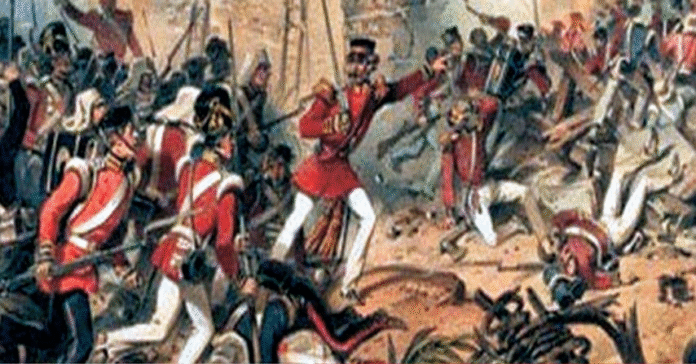
This growing discontent erupted into revolution. On 28 May 1857, the spark of rebellion ignited in Rajasthan at Nasirabad. Revolutionaries seized the artillery and killed Major Spottiswoode and Colonel Newbury. Churches and official bungalows were set on fire, and the British treasury was looted. The rebels set their sights on Delhi to seek leadership from Mughal emperor Bahadur Shah Zafar.

The rebellion soon spread. When the news reached Neemuch, Colonel Abbott tried to enforce loyalty by making Hindu soldiers swear on the Bhagavad Gita and Muslim soldiers on the Qur’an. But soldier Mohammad Ali Baig of Awadh questioned this loyalty, highlighting British betrayal in his homeland. On 3 June 1857, Hindu and Muslim soldiers jointly rebelled, looted the Neemuch cantonment, and set out for Delhi via Deoli, Tonk, and Agra.

Rebellion Spreads Across Rajputana

In Erinpura, the Jodhpur Legion, stationed at Sirohi, revolted on 21 August 1857. On 23 August, leaders like Moti Khan, Sheetal Prasad, and Tilak Ram raised the slogan “Chalo Delhi, Maro Firangi” (Let’s go to Delhi, kill the foreigners). The revolutionaries looted the Erinpura station and reached Pali, where they joined forces with Thakur Kushal Singh Champawat of Auwa village. With support from local Thakurs, Kushal Singh raised an army of 6,000 men.

On 8 September, his forces defeated the royal army of Jodhpur at the Battle of Bithora. Chief commander Onad Singh was killed, and Captain Heathcote fled. Another victory followed at Chelawas on 18 September. Revolutionaries, led by Thakur Shivnath Singh of Asop, aimed for Delhi but were halted and defeated at the Battle of Narnaul.

On 20 January 1858, the British, under Brigadier Holmes, launched an assault on Auwa. Local villagers fiercely resisted for three days. On 24 January, the British captured the Auwa fort through the betrayal of its keeper. In retaliation, they plundered the village, destroyed temples, and exploded the fort using gunpowder. They looted the idol of Sugali Mata—the goddess of revolution—along with cannons and gunpowder.

Kota’s Fierce Revolt

Kota witnessed the most violent and organized uprising. On 15 October, Lala Jaydayal and Risaldar Mehrab Khan led the revolution, setting fire to the Residency and killing Major Burton, his two sons, and several British officers. The revolutionaries paraded Burton’s head through the city. The Maharao of Kota was confined in the fort, and efforts to suppress the revolt failed. British control was reestablished on 30 March 1858 under General Roberts. Jaydayal was betrayed and arrested, Mehrab Khan was executed, and Jaydayal was blown from a cannon at the spot where Burton was killed.

People’s Support and Widespread Resistance

Elsewhere, Gurjar leaders like Devi Singh and Bhawani Shankar of Dholpur raised 3,000 soldiers, later joined by 5,000 from Gwalior and Indore. In Tonk, women played an active role in the uprising, the only such instance in Rajasthan. The Nawab’s attempts to suppress the rebellion failed.

The revolt wasn’t limited to soldiers—civilians, monks, and local leaders also played vital roles. Sikar’s Dungar Ji and Jawahar Ji repeatedly looted British cantonments. Dungar Ji was betrayed by his brother-in-law but later rescued through the bravery of Lotia Jat, Karna Meena, Sawanta Meena, and Jawahar Ji. Sadhus and sanyasis inspired people through street plays, puppetry, and oral storytelling. They spread messages of Swadharma (self-duty), Swadeshi (indigenous), Swaraj (self-rule), and Swabhasha (native language).

Despite their defeat, the people’s spirit was not crushed. The British committed horrific atrocities—mass killings, destruction of villages, and severe punishments to even women and children.

Aftermath and Legacy

Although the 1857 rebellion failed militarily, it ignited a spark of nationalism. Modern education spread, leading to the rise of a middle class that would later drive India’s freedom struggle. Revolutionary ideals were kept alive by non-violent leaders like Arjun Lal Sethi, Kesari Singh Barhat, and Mahatma Gandhi, and revolutionaries like Bhagat Singh, Rajguru, Chandrashekhar Azad, Subhash Chandra Bose, and Veer Savarkar.

Even though this first war of independence in Rajasthan was brutally suppressed, its legacy inspired future generations. It laid the foundation for a more organized and widespread national movement.

Operation ‘Sindoor’ and Its 8,000-Year-Old Connection to Hanumangarh, Rajasthan

0

The name ‘Sindoor’, traditionally a sacred symbol of marriage for Indian women, has now gained a modern connotation—Operation Sindoor, India’s strategic military mission to eliminate terrorists. But few know that this symbolic pinch of red powder has an 8,000-year-old legacy, with deep roots in Rajasthan’s Hanumangarh district, particularly in the ancient Harappan site of Kalibangan.

Sindoor in Ancient Civilization: A Link to the Indus Valley

Archaeological excavations in Kalibangan village, located in the Pilibanga tehsil of Hanumangarh, have revealed various artifacts linked to women’s adornment. Among these, traces of sindoor (vermilion) on ancient figurines and in containers provide compelling evidence that the cosmetic tradition dates back to the Indus Valley Civilization (circa 3300–2500 BCE).

These findings, along with discoveries in Rakhigarhi—the largest Harappan site in neighboring Haryana—highlight the deep cultural roots of sindoor in Indian heritage. Items like bangles, bracelets, rings, forehead bindis, sindoor containers (sindoor dani), and mirrors made from clay, stone, copper, and faience have been unearthed during excavations.

Historical Significance of Sindoor

A study published in the journal Nature suggests the Indus Valley Civilization is nearly 8,000 years old, making it one of the world’s oldest urban cultures. Evidence of women using makeup and adornments, including sindoor, indicates a rich tradition of feminine expression and social symbolism that predates written history.

The Kalibangan Museum now showcases many of these ancient artifacts, preserving the memory of a civilization where sindoor wasn’t just a cosmetic but a cultural emblem.

How Was Sindoor Made in Ancient Times?

Archaeologists, intrigued by the presence of sindoor on ancient statues and in containers, explored its composition. Research revealed that early sindoor was made using natural ingredients like turmeric, alum, and lime, showcasing the ingenuity of ancient chemistry.

Sindoor to Operation Sindoor: From Symbolism to Strategy

While sindoor remains a revered part of Indian marital customs, today its name represents India’s resolute stand against terrorism. Operation Sindoor, named after this powerful symbol of life and continuity, is eliminating threats to national security—linking ancient heritage with modern valor.

Conclusion

From the sacred rituals of the Indus Valley to modern military operations, the journey of sindoor is a remarkable blend of heritage and heroism. Hanumangarh’s ancient connection to this symbol underscores how deeply India’s cultural and strategic identity is intertwined

India-Pakistan Escalation: What Is the ‘Ladder of Conflict’ and How Close Are We to War?

0

In the past 17 days, tensions between India and Pakistan have sharply escalated, climbing four rungs on what experts call the ‘escalation ladder’. It all began with the Pahalgam terrorist attack on April 22, followed by Indian airstrikes on May 7 targeting terrorist camps inside Pakistan. In retaliation, Pakistan launched missile and drone attacks on Indian military bases.

This article breaks down where both nations stand in the ongoing conflict, what the escalation ladder is, and what could happen next.

What Is an Escalation Ladder?

The ‘escalation ladder’ is a theoretical framework used in defense and international relations to understand how conflicts progress between two nations. It starts with diplomatic tensions or minor skirmishes and can escalate to full-scale war.

Coined by American military strategist Herman Kahn in his 1965 book “On Escalation: Metaphors and Scenarios”, the concept originally described 44 rungs of conflict. However, modern experts typically simplify it into seven key stages, ranging from diplomatic protests to nuclear war.

Where Are India and Pakistan on This Ladder Now?

Currently, India and Pakistan are on the 4th step of this escalation ladder. Here’s a look at how the situation has intensified over the past two weeks:

Step 1: Initial Spark – Terrorist Attack

On April 22, terrorists attacked Indian forces in Pahalgam. Indian Foreign Secretary Vikram Misri confirmed that Pakistan-backed groups were responsible.

Step 2: Diplomatic and Strategic Responses

On April 23, India took five major actions:

  • Reduction in Pakistani diplomatic presence
  • Suspension of the Indus Water Treaty
  • Closure of the Attari-Wagah border
  • Economic sanctions
  • International diplomatic outreach

Pakistan mirrored some of these moves.

Step 3: Military Posturing

Following the Pahalgam incident:

  • Pakistan increased troop deployment along the border
  • Leaders issued nuclear threats
  • Both nations conducted missile tests and military exercises

Step 4: Kinetic Military Actions

  • On May 7, India carried out airstrikes on nine terrorist camps in PoK and Pakistan.
  • On May 8, Pakistan attempted missile and drone strikes on 15 Indian military bases, which were intercepted by India’s S-400 air defense system.
  • In retaliation, India destroyed segments of Pakistan’s air defense system.
  • Aerial engagements occurred between fighter jets on the night of May 8.

Has War Officially Begun Between India and Pakistan?

Not yet—but we are in a ‘war-like situation’, say military experts.

  • Retired Lt. Gen. Rameshwar Roy: “Wars aren’t always declared. Each nation’s reaction determines the next move in the conflict.”
  • Retired Air Vice Marshal Om Prakash Tiwari: “Right now, this is not a full-scale war, but a dangerous stage of escalation.”
  • Retired Lt. Gen. Sanjay Kulkarni: “India hasn’t initiated war, but Pakistan’s repeated aggression can be seen as acts of war.”

When Is It Considered a Full-Fledged War?

According to the Oxford Dictionary, war is a conflict between two parties involving organized, often prolonged combat.

Carl von Clausewitz, a noted military theorist, defined war as:

“An act of violence intended to compel our opponent to fulfill our will.”

A full-fledged war involves:

  • Use of Army, Air Force, and Navy simultaneously
  • Large-scale attacks across multiple fronts
  • Bombardment of cities and critical infrastructure

In comparison, India’s Kargil conflict in 1999 was considered a limited war, focused solely on regaining strategic positions.

Difference Between a War and a Military Operation

AspectWarMilitary Operation
ScaleNationwide or regional, involving all forcesTargeted, focused missions
PurposeTerritorial gain, political changeNational security, retaliation
CasualtiesIncludes civilians and militaryAimed to minimize collateral damage
Example1999 Kargil WarOperation Sindoor (fictional example for this context)

Operations are typically precise and strategic, while war leads to widespread destruction and civilian displacement.

What Could Happen Next?

If military actions continue and escalate to the 5th step, we may see:

  • Mobilization of full armed forces
  • Air and naval blockades
  • Attacks on strategic infrastructure
  • Possible international intervention to de-escalate

Given the nuclear capabilities of both India and Pakistan, escalation control is critical. Any further step could result in massive humanitarian and geopolitical consequences.

Conclusion

The current India-Pakistan standoff has reached a dangerous inflection point. While both nations have avoided a formal declaration of war, actions on the ground suggest an active military engagement phase. The global community watches closely, hoping diplomacy will prevail before the escalation ladder is climbed further

Rabindranath Tagore: Know More on This First Non-European to win the Nobel Prize in Literature…

0

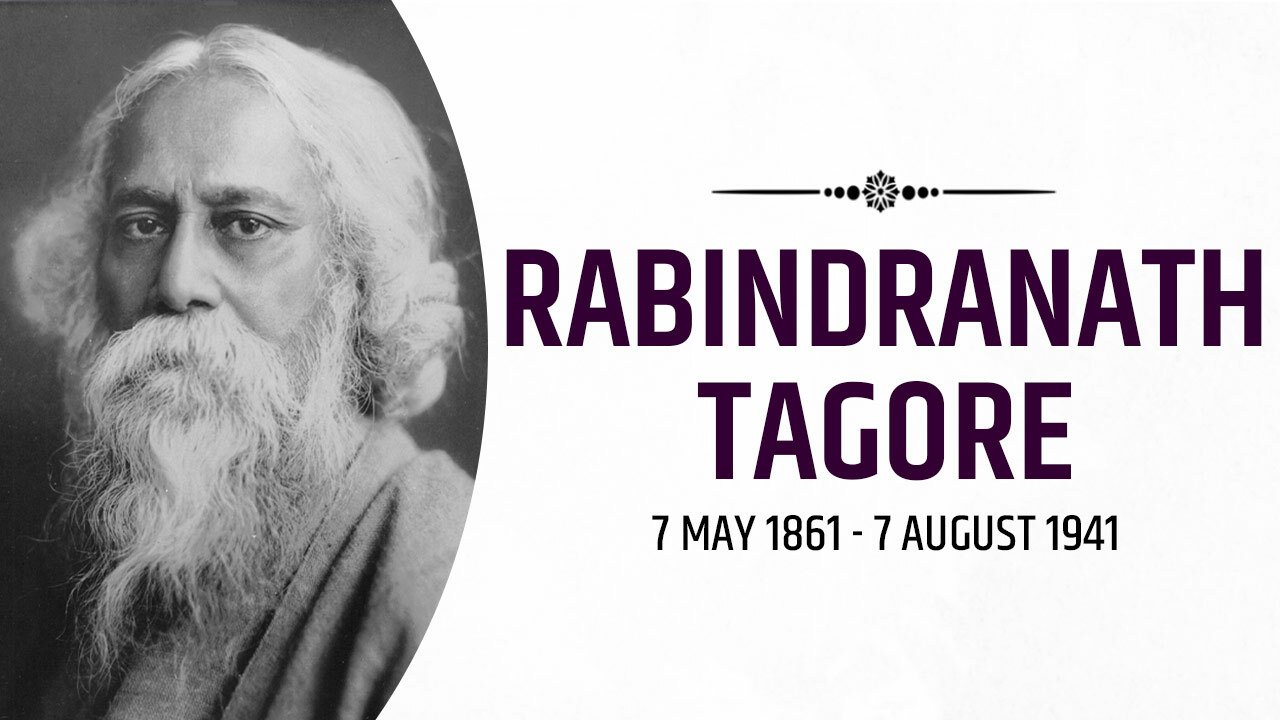
We commemorate the 164th birth anniversary of Rabindranath Tagore, a towering figure in Indian literature, culture, and history. Celebrated as Rabindranath Tagore Jayanti, this day honors the life and legacy of the polymath who reshaped Bengali literature, Indian arts, and the nation’s cultural identity. As the first non-European to win the Nobel Prize in Literature in 1913, Tagore’s contributions extend beyond India, leaving an indelible mark on the global stage. This article explores his remarkable life, his contributions to the nation, and his enduring legacy.

Early Life and Background

Born on May 7, 1861, in Kolkata (then Calcutta) to a prominent Bengali Brahmin family, Rabindranath Tagore was the youngest of thirteen children. His father, Debendranath Tagore, was a leader of the Brahmo Samaj, a reformist Hindu movement, which deeply influenced Tagore’s spiritual and philosophical outlook. Raised in a culturally rich environment, Tagore was exposed to literature, music, and art from an early age. He began writing poetry at eight and published his first collection by sixteen, showcasing his prodigious talent.

Tagore’s education was unconventional. Disenchanted with formal schooling, he was largely tutored at home, which allowed him to explore diverse subjects, including literature, science, and Western philosophy. His travels to England in 1878 further broadened his worldview, blending Eastern and Western intellectual traditions in his works.

Literary Contributions

Tagore’s literary oeuvre is vast and multifaceted, encompassing poetry, novels, short stories, plays, essays, and songs. Writing primarily in Bengali, he also translated many of his works into English, gaining international acclaim. His most celebrated work, Gitanjali , a collection of spiritual poems, earned him the Nobel Prize in 1913. The Nobel citation praised his “profoundly sensitive, fresh, and beautiful verse,” which resonated with universal themes of love, nature, and divinity.

Tagore’s novels, such as Gora and Ghare-Baire (The Home and the World), explored complex social issues like nationalism, identity, and gender roles. His short stories, including Kabuliwala and The Postmaster, captured the human condition with empathy and nuance. His plays, like Chitrangada and Raja, blended myth and modernity, influencing Indian theater profoundly.

Tagore also composed over 2,000 songs, known as Rabindra Sangeet, which remain an integral part of Bengali culture. These songs, ranging from devotional to patriotic themes, are celebrated for their lyrical beauty and emotional depth. Additionally, he was a gifted painter, creating over 2,000 artworks in his later years, which reflected his experimental and introspective spirit.

Contributions to the Nation

Tagore’s contributions to India’s cultural and intellectual landscape are unparalleled. His works instilled a sense of pride in Indian heritage during the colonial era, fostering a cultural renaissance. As a staunch advocate of Indian nationalism, he initially supported the Swadeshi movement but later distanced himself from militant nationalism, emphasizing universal humanism over narrow patriotism.

Tagore’s most enduring national contribution is Jana Gana Mana, India’s national anthem. Written in 1911, it was adopted by the Constituent Assembly in 1950, symbolizing India’s unity in diversity. Similarly, his song Amar Sonar Bangla became the national anthem of Bangladesh, reflecting his deep connection to Bengali identity.

In 1901, Tagore founded Visva-Bharati University in Santiniketan, West Bengal, envisioning a holistic educational institution that blended Indian and global traditions. Initially a school, it grew into a university in 1921, attracting scholars and artists worldwide. Santiniketan remains a testament to Tagore’s progressive vision of education, emphasizing creativity, environmental consciousness, and cultural exchange.

Tagore was also a social reformer. He criticized caste discrimination, championed women’s rights, and promoted rural development through initiatives like the Sriniketan project, which focused on agricultural and cooperative reforms. His essays and lectures addressed pressing issues like communal harmony and environmental conservation, making him a visionary far ahead of his time.

Global Impact and Philosophy

Tagore’s philosophy of universalism and humanism transcended national boundaries. His extensive travels to Europe, the Americas, Asia, and the Middle East facilitated cross-cultural dialogues. He engaged with luminaries like Albert Einstein, W.B. Yeats, and Mahatma Gandhi, enriching global intellectual discourse. His lectures, compiled in works like Sadhana and Nationalism, emphasized the unity of humanity and cautioned against the dangers of aggressive nationalism.

Tagore’s rejection of British knighthood in 1919, in protest against the Jallianwala Bagh massacre, underscored his commitment to justice and moral integrity. This act resonated globally, amplifying his stature as a voice of conscience.

Legacy and Contemporary Relevance

Rabindranath Tagore passed away on August 7, 1941, but his legacy endures. His works continue to inspire artists, writers, and thinkers worldwide. In India, Tagore Jayanti is celebrated with cultural programs, recitations of his poetry, and performances of Rabindra Sangeet, particularly in West Bengal. Visva-Bharati University remains a hub of learning and creativity, preserving his vision.

Tagore’s emphasis on universal values, environmental stewardship, and cultural harmony is strikingly relevant today. In an era of polarization and ecological crises, his call for unity and respect for nature offers timeless wisdom. His literary and artistic contributions continue to bridge cultural divides, reminding us of the power of creativity to uplift humanity.

Rabindranath Tagore was not just a poet, writer, or composer but a cultural icon who shaped India’s soul and touched the world with his genius. On Rabindranath Tagore Jayanti 2025, let us celebrate his life by revisiting his works, embracing his ideals, and striving for a world where love, creativity, and humanity prevail. As Tagore himself wrote in Gitanjali, “Where the mind is without fear and the head is held high… into that heaven of freedom, my Father, let my country awake.” His words continue to guide us toward a brighter, more inclusive future.


Palaeofires: Ancient Wildfires in India Reveal Crucial Insights into Earth’s Geological and Climate History

0

Palaeofires have a huge role to play in maintaining geological records. Recent scientific discoveries have illuminated the role of palaeofires—ancient wildfires preserved in the geological record—in shaping Earth’s environmental and climatic history. Groundbreaking evidence of such fires, dating back to the Permian Period approximately 250 million years ago, has been uncovered in the Godavari Basin of India. These findings offer vital information about prehistoric vegetation, climate evolution, and the formation of coal deposits over geological time.

Palaeofires serve as critical indicators of ancient ecosystems and atmospheric conditions. These wildfire events, captured in sedimentary layers, have left lasting imprints on landscapes and vegetation patterns. By influencing the transformation and accumulation of plant material, they have played a major role in coal formation and carbon cycling.

To analyse these fire events, researchers employed an array of advanced techniques. Palynofacies analysis helped categorize organic particles found in sedimentary rocks, while tools like Raman Spectroscopy, Rock-Eval Pyrolysis, and FTIR Spectroscopy enabled a detailed examination of microscopic organic matter and fossil charcoal. These methods allowed scientists to distinguish between different forms of charcoal and other organic materials with a high degree of precision.

The study identified three primary types of organic particles: Translucent Organic Matter (TrOM), which includes pollen and plant debris; Palaeofire Charcoal (PAL-CH), which serves as direct evidence of vegetation burning; and Oxidised Charcoal (OX-CH), which likely represents charcoal that was reworked or transported after initial burning. This classification has significantly advanced the understanding of wildfire impacts in the geologic past.

One of the study’s major breakthroughs was the ability to differentiate between in situ (originating at the location) and ex situ (transported) charcoal. This distinction resolves a long-standing geological debate about the origin of charcoal found in coal-bearing formations. Stratigraphic patterns revealed that fire residues were more thoroughly preserved during regressive phases (sea-level decline), while transgressive phases (sea-level rise) saw increased oxidation of these materials.

The research also linked high atmospheric oxygen levels during the Permian Period to an increase in wildfire frequency and intensity. This indicates that Earth’s prehistoric environment may have been far more fire-prone than previously believed. Data from the Raniganj Coalfield suggest a relationship between palaeomires (ancient peatlands) and seasonal drought-induced fires, offering a window into past fire regimes and their environmental effects.

These findings have significant implications for modern climate studies. Understanding how ancient wildfires contributed to carbon cycling can enhance present-day strategies for carbon sequestration and climate change mitigation. This research also provides essential tools for palaeoclimate reconstruction, helping scientists develop more accurate models of Earth’s climatic past.

Looking forward, further investigations are necessary to explore the deeper relationship between palaeofires and long-term climate change. Ongoing research into geological archives will continue to shed light on how fire shaped the evolution of Earth’s environment, offering insights that may inform contemporary environmental and energy policies.

Persian Gulf Named As Arabian Gulf: Know its Geopolitical, Cultural, and Economic Implications

0

In a significant geopolitical move, the United States government has officially decided to refer to the Persian Gulf as the Arabian Gulf or Gulf of Arabia. This renaming aligns with the preferences of several Arab Gulf nations and is seen as an effort to strengthen diplomatic ties with key allies in the Middle East. The announcement was strategically timed with President Donald Trump’s visit to the region, emphasizing a renewed focus on bolstering U.S.–Arab alliances.

What is the Persian Gulf?

The Persian Gulf is a shallow marginal sea that forms a critical part of the Indian Ocean. It lies between the Arabian Peninsula and southwestern Iran, and is bordered by:

  • Iran to the north, northeast, and east
  • Oman and the United Arab Emirates to the southeast and south
  • Saudi Arabia, Bahrain, and Qatar to the southwest and west
  • Kuwait and Iraq to the northwest

The Strait of Hormuz connects the Persian Gulf to the Gulf of Oman, which leads into the Arabian Sea. Major rivers like the Tigris, Euphrates, and Karun contribute fresh water to the gulf.

Historical Background: Persian Gulf vs Arabian Gulf

The term “Persian Gulf” has been used in global maps and documents since at least the 18th century and is deeply tied to Iran’s historical and cultural heritage. However, Arab states such as Saudi Arabia, the UAE, and Qatar have long advocated for the name “Arabian Gulf”. The naming dispute reflects the region’s complex geopolitical tensions, with Iran fiercely opposing any alternative terminology.

Geopolitical Impact of the Name Change

The U.S. renaming decision is widely seen as a diplomatic signal favoring Arab nations and their interests. It comes amid growing tensions between Iran and its regional rivals. This shift in terminology aligns the U.S. more closely with the Gulf Cooperation Council (GCC) states and may further strain relations with Tehran, which considers the name “Persian Gulf” a matter of national pride and sovereignty.

Strategic and Economic Importance of the Gulf

The Persian/Arabian Gulf is not only a geographic landmark but also a strategic economic corridor. Key features include:

  • Hosting one of the world’s busiest oil shipping routes
  • Containing vast reserves of oil and natural gas
  • Impacting global oil prices due to regional instability
  • Serving as a hub for maritime trade and military operations

The Strait of Hormuz, through which a significant portion of the world’s petroleum passes, underscores the global energy security relevance of this region.

International Naming Standards and Variations

While the U.S. military and some Western countries have adopted the term Arabian Gulf, international bodies like the International Hydrographic Organization (IHO) still officially recognize Persian Gulf. The inconsistency in naming across maps, media, and government publications continues to fuel debate and diplomatic sensitivities.

Cultural Sensitivities and National Identity

The naming of the gulf is as much about cultural identity as it is about geography. For Iranians, the name “Persian Gulf” is a powerful symbol of ancient civilization and national heritage. Conversely, Arab nations see “Arabian Gulf” as a term that reflects their modern political influence and territorial sovereignty.

Conclusion: A Name with Global Implications

The U.S. decision to adopt the term Arabian Gulf marks a strategic geopolitical alignment with Arab Gulf allies and adds a new dimension to the already sensitive Iran–Arab relations. As the world closely watches the evolving dynamics of the Middle East, the naming of this critical waterway continues to be a symbol of power, identity, and international diplomacy.

Maharana Pratap Jayanti: Honoring the Lion of Mewar

0

“Na chhoda maidan kabhi veeron ne, na jhuka singhapan kabhi Mewari ranbankuron ne.”
In the land where valor flows like blood in the veins of its warriors, one name shines brighter than the rest Maharana Pratap. A symbol of unyielding courage, undying patriotism, and fierce resistance, Maharana Pratap was not just a king; he was the embodiment of Veer Ras, the heroic spirit that refuses to kneel even before the mightiest of empires. On Maharana Pratap Jayanti, we bow not in submission, but in reverence to a warrior who lived and died by the sword, for honor, dharma, and the motherland.

A Legacy of Valor

Born on May 9, 1540, in the fortress of Kumbhalgarh, Maharana Pratap Singh of Mewar was destined to defy empires. Unlike many of his contemporaries, who chose diplomacy or submission to the Mughal Empire, Pratap chose resistance. Even when offered wealth and high status, he refused to bow before Akbar, stating that freedom was worth more than a thousand kingdoms.

The Battle of Haldighati: Where Legends Were Forged

The most iconic chapter of Maharana Pratap’s life came in 1576 at the Battle of Haldighati. Outnumbered and outgunned, Pratap led a small but fiercely loyal army against the vast Mughal forces. Though the battle was inconclusive, Pratap’s defiance sent a clear message Mewar would not be conquered by force or flattery. His loyal steed, Chetak, wounded but unrelenting, carried him to safety, becoming a legend in his own right.

A Life of Sacrifice and Struggle

Maharana Pratap spent years in exile, living in forests, facing hunger, and enduring countless hardships. Yet, his will remained unbroken. He reclaimed much of his lost territory later in life, proving that perseverance, even in the darkest times, leads to triumph. He ruled not with greed but with integrity, refusing to exploit even his enemies’ families or civilians.

Inspiration Across Centuries

Maharana Pratap’s legacy continues to inspire generations. His life is not merely history it is a guiding flame for those who believe in standing up for justice, honor, and freedom, no matter the odds. From textbooks to folk songs, his story lives on as a celebration of resistance against tyranny.

A Tribute to True Courage

On this Maharana Pratap Jayanti, let us not merely commemorate a date but awaken the warrior spirit within. Let his life remind us that real heroes are forged not in comfort, but in the fire of struggle and sacrifice. In a world that often bends before power, Maharana Pratap stands tall unbending, unbroken, and forever immortal in the heart of Bharat.

“Ran mein jinki talwar se bijli bhi sharmaaye,
Un Maharana ko Mewar sadaa vandan chadhaaye.”