Home Blog Page 247

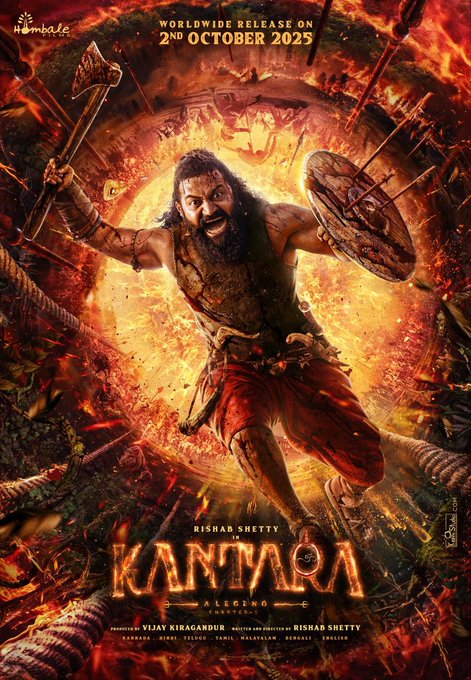
The skies crackled. The earth trembled. And on October 2, 2025, a new legend begins—Kantara: Chapter 1…

0

Rishab Shetty returns not as a man, but as a myth incarnate. The poster alone feels like a divine premonition—he floats mid-air, brandishing a battle axe kissed by fire, a shield etched in ancestral fury. His eyes? Ablaze with the power of a thousand spirits. This isn’t just cinema. This is a spiritual storm that will consume screens and souls alike.

The Roar of the Wild Returns

Forget subtlety. Fans have unleashed their madness in full form.

  • “I’m ready to surrender my sanity to this saga!”
  • “This is not a teaser. It’s divine possession on a poster.”
  • “If Kantara was a temple, Chapter 1 is its deity.”

From memes to murals, reels to rituals, the frenzy is unlike anything cinema has seen. 500 fighters, 25-acre sets, and chants that feel older than time itself—Kantara: Chapter 1 is shaping into the mythological megaton fans prayed for.

Why This Chapter Could Shake Indian Cinema

  • Ancient deities awaken during the Kadamba reign Cinematography that feels like gods whispering through shadows Music that reverberates through your chest like temple bells With Amazon Prime Video securing the digital rights, this legend is set to roar across continents.

When Gods Gleamed in Gold: A Dazzling Night on the Wheels of Divinity

0

On Sunday, Lord Jagannath, along with his brother Balabhadra and sister Subhadra, was adorned in Suna Besha (golden attire) atop their chariots. As part of this sacred tradition, the deities were embellished with approximately 208 kilograms of gold ornaments. This ritual forms a grand segment of the Rath Yatra festival. According to the Shri Jagannath Temple Administration (SJTA), devotees were allowed to witness this dazzling spectacle from 6:30 PM to 11:00 PM. Temple sources confirm that the divine trio wore around 30 types of ornaments, crafted from gold, silver, diamonds, and other precious metals

As twilight draped the coastal town in a silken hush, the sacred boulevard of Grand Road lit up with celestial grandeur. In a spectacle that fused devotion with royal opulence, Lord Jagannath, Lord Balabhadra, and Devi Subhadra emerged cloaked in shimmering glory—each seated upon their colossal chariots, transformed into moving thrones of gold.

When Gods Gleamed in Gold: A Dazzling Night on the Wheels of Divinity

The occasion? The legendary Suna Besha, where the deities don a radiant ensemble of 208 kilograms of pure gold, silver, diamonds, and dazzling jewels. But this wasn’t just ornamentation—it was a cultural crescendo, echoing centuries of faith and tradition. As the Rath Yatra procession paused, the trio was adorned with over 30 unique ornaments, from majestic crowns and layered necklaces to armlets sculpted with intricate mythology. Each piece not only sparkled—it told stories of divine protection, cosmic energy, and eternal grace.

By evening, the Grand Road had become a sanctuary of awe and emotion. Thousands of devotees, eyes moist with reverence, stood in silence from 6:30 PM till 11 PM, absorbing the magnanimous darshan that only happens once a year. Pilgrims described the sight as “a glimpse into Vaikuntha itself,” while temple priests whispered ancient mantras in harmony with the glittering divine gaze. The gold may glitter, but in Puri that night, it was faith that truly shone.

San Fermín Unleashed: Spain’s Wildest Week of Faith, Fireworks & Fearless Runners

0

Every July, the city of Pamplona in northern Spain erupts into a whirlwind of tradition, adrenaline, and celebration. The San Fermín Festival, held from July 6 to 14, is one of the world’s most iconic cultural events—where devotion to a saint meets daring bull runs and nonstop revelry.

A History Etched in Faith and Folklore

  • The festival honors Saint Fermín, Pamplona’s first bishop and patron saint, believed to have been martyred in the 3rd century. Originally celebrated on September 25, the feast was moved to July 7 in 1591 to coincide with summer fairs and better weather. Over centuries, secular cattle fairs merged with religious processions, giving birth to the modern San Fermín spectacle. The festival gained global fame thanks to Ernest Hemingway’s 1926 novel The Sun Also Rises, which romanticized the bull runs and bohemian spirit.

Purpose and Spirit

  • The festival is a tribute to Saint Fermín’s courage and sacrifice, blending Catholic devotion with Basque and Spanish traditions. It’s also a celebration of community, bravery, and cultural pride, where locals and tourists unite in a shared ritual of risk and joy.

How It’s Celebrated Today

  • The festival kicks off with the Chupinazo, a firework launched from Pamplona’s City Hall on July 6, igniting nine days of festivities.
  • Each morning from July 7 to 14, the Encierro (Running of the Bulls) sees thousands sprint ahead of six charging bulls through cobbled streets. Afternoons feature bullfights, while evenings bring folk dances, concerts, giant puppet parades, and fireworks. Participants wear white outfits with red neckerchiefs, symbolizing purity and martyrdom.
San Fermín Unleashed: Spain’s Wildest Week of Faith, Fireworks & Fearless Runners

Massive Global Appeal

  • In 2025, the festival is expected to draw over 1.7 million attendees from around the world.
  • More than 25,000 people packed Pamplona’s square for this year’s Chupinazo alone.
  • The event is covered by 140 media outlets from 13 countries, highlighting its international allure.

A Festival with a Voice

  • This year’s opening ceremony included a powerful message of solidarity with Palestine, showing that San Fermín is not just about tradition—it’s also a platform for global awareness.
San Fermín Unleashed: Spain’s Wildest Week of Faith, Fireworks & Fearless Runners

MS Dhoni: The Cricket Legend Who’s Also the Best Friend Everyone Deserves

0

Mahendra Singh Dhoni has always been celebrated for his calm demeanor and grounded presence, both on and off the field. While his leadership made fans swoon and opponents wary, it is his humility and unwavering loyalty to those close to him that truly define the man behind the cricketing icon. In a world that often chases the spotlight, Dhoni continues to cherish simplicity and deep personal bonds — as a cricketer, and more importantly, as a friend.

MS Dhoni Surprises His Childhood Friend in Ranchi

On June 22, 2025, a heartwarming moment unfolded in Dhoni’s hometown of Ranchi. A video surfaced on social media showing the former India captain quietly attending the birthday celebration of his childhood friend, Surendra. Dressed in a simple black t-shirt and trousers, Dhoni stood unnoticed at the back of the room, smiling gently as Surendra cut his birthday cake. The modesty of the moment reflected Dhoni’s essence — a man who values relationships over recognition.

Standing by Friends in Times of Need

Dhoni’s loyalty to his friends is not new. In 2013, when childhood friend and former Ranji player Santosh Lal was diagnosed with cancer, Dhoni didn’t hesitate to step in. Lal, known as the inventor of the helicopter shot, was airlifted to Delhi for treatment, thanks to Dhoni’s efforts. The Jharkhand State Cricket Association also pitched in, donating ₹1 lakh and raising additional funds for Lal’s family.

Dhoni’s support included:

  • Medical evacuation: He arranged for Lal’s emergency transfer to Delhi.
  • Financial help: Along with JSCA’s contribution, friends and members collected ₹39,500.
  • Media recognition: The story highlighted Dhoni’s unwavering bond and compassion, garnering nationwide attention.

Paramjit Singh: The Friend Who Believed First

Another pillar in Dhoni’s journey is Paramjit Singh, owner of Prime Sports in Ranchi. A former cricketer and one of Dhoni’s closest friends, Paramjit played a vital role during Dhoni’s early days. He believed in Dhoni’s talent and went to extraordinary lengths to support him — even traveling to Jalandhar for six months to secure a bat sponsorship that helped launch Dhoni’s professional career.

Despite their deep friendship, Paramjit revealed in an interview with Dainik Jagran that he never visited a stadium to watch Dhoni play for India. Instead, he preferred the comfort of his small television set at his store in Ranchi, silently cheering for his friend from afar. Today, his shop is a mini-museum of memories, proudly displaying a bat signed by Dhoni and the entire Indian team — a testament to a friendship built on belief, not glory.


In every chapter of his life, Mahendra Singh Dhoni has remained more than a cricketing legend — he has been a devoted friend. Whether it’s quietly attending a birthday party, supporting a friend through a health crisis, or helping someone who once believed in him, Dhoni proves that being a good human is the greatest form of greatness.

Sharat Kelkar Becomes Highest Paid TV Actor. Know Who He Is and Where He Comes From…

0

Actor Sharad Kelkar is set to make a comeback in television after working on superhit Bollywood films like PK, Ramleela, and Tanhaji. As per media rports, the actor has charged Rs 3.5 lakh per day for the television show, Tum se Tum Tak. With this high amount, Sharad Kelkar has become the highest-paid actor in the television industry, surpassing Kapil Sharma, Hina Khan, Dilip Joshi and others’ earnings.

Kelkar was born and raised in Gwalior, Madhya Pradesh. His father served as a PWD engineer in the Madhya Pradesh Government. He holds an MBA degree from the Prestige Institute of Management, Gwalior, and also studied at the Laxmibai National Institute of Physical Education, Gwalior.

On 3 June 2005, he married his co-star Keerti Gaekwad Kelkar. The couple has a daughter named Kesha. Sharad and Keerti also participated in the dance reality show Nach Baliye 2.

Career

Sharad Kelkar made his television debut in 2004 with the show Aakrosh on Doordarshan, where he played the role of Inspector Sachin Kulkarni.

His wife, Keerti Gaekwad Kelkar, is also a television actress and is known for her role as Chandni / Devika in Saat Phere – Saloni Ka Safar. The couple appeared together on Nach Baliye 2 in 2006.

India’s First Ever Win at Edgbaston is Just Wow. See How Harbhajan, Yuvraj, Shikhar Dhawan React on Social Media…

0

India secured their first-ever win at Edgbaston, defeating England by 336 runs in the second Test to level the Anderson-Tendulkar Trophy series 1-1. With this win, India became the first Asian team to win a test at Edgbaston.

The team roared back into the series with a commanding 336-run victory over England at Edgbaston, levelling the five-match contest at 1-1.

Captain Shubman Gill led from the front with a historic performance, earning the Player of the Match award for his stunning contributions with the bat. Gill scored a monumental 269 in the first innings and followed it up with a blistering 161 in the second, becoming the first player in Test history to record scores of 250 and 150 in the same match.

Speaking after the match, Gill lauded the team’s collective effort, highlighting the character they showed in bouncing back after the defeat in the first Test.

Purple Revolution in Kashmir’s Largest Lavender Farm in Sirhama: Tourists Flock to See Bumper Harvest

0

By Kamran Raashid Bhat


Kashmir’s largest lavender farm in Sirhama has witnessed a bumper harvest this year, yielding an impressive 60 quintals of aromatic crop.

Purple Revolution in Kashmir’s Largest Lavender Farm in Sirhama: Tourists Flock to See Bumper Harvest

The vibrant lavender bloom has become a scenic spectacle, drawing nature lovers, photographers, and tourists in large numbers. Locals, too, are reaping the benefits through enhanced income opportunities, farm-based employment, and small-scale processing ventures.

Officials associated with the Aroma Mission said the initiative is aimed at promoting aromatic plant cultivation across Jammu and Kashmir. Lavender, known for its high oil yield and market value, is particularly well-suited to the region’s temperate climate.

The success story of Sirhama’s lavender farm is being hailed as a model for sustainable agriculture and rural development in Kashmir.

These lavender fields have quickly become a favorite spot for both tourists and residents. “People come here with their families and friends to relax, take photos, and even shoot reels and videos.

Dalai Lama’ B’Day: US Sends Warm Wishes As a Huge Crowd Gathers in Dharamshala; See How Social Media Reacts on Geopolitics and Politics…

0

It’s Dalai Lama’s 90th birthday tomorrow and there has been a huge crowd gathering in Dharamshala to extend wishes to their dear Lama. Meanwhile there is politics and geopolitics running far and wide. Firstly US sent birthday wishes to Lama, secondly Union minister Kiren Rijiju met Lama and then there were many celebrations being organised in Dharamshala. Let’s get a sneak peak via social media ..

Dalai Lama Marks 90th Birthday with Global Call for Compassion and Inner Peace

0

On the occasion of his 90th birthday, Tibetan spiritual leader His Holiness the 14th Dalai Lama issued a heartfelt message to well-wishers around the world, urging people to embrace compassion, warm-heartedness, and altruism as guiding principles for a better future.

In a statement shared from his residence in Dharamshala, the Dalai Lama acknowledged the various celebrations being held in his honor, especially within Tibetan communities. “I particularly appreciate the fact that many of you are using the occasion to engage in initiatives that highlight the importance of compassion, warm-heartedness, and altruism,” he said.

Despite his global stature, the Dalai Lama humbly reminded followers, “I am just a simple Buddhist monk; I don’t normally engage in birthday celebrations.” However, he took the opportunity to share reflections on the values that have defined his life and teachings.

“While it is important to work for material development, it is vital to focus on achieving peace of mind through cultivating a good heart and by being compassionate—not just toward near and dear ones, but toward everyone,” he stated. “Through this, you will contribute to making the world a better place.”

Reaffirming his lifelong commitments, the Nobel Peace laureate said he would continue to focus on promoting human values, interfaith harmony, and preserving ancient Indian wisdom and Tibetan culture, both of which emphasize peace of mind and emotional well-being.

Drawing strength from the teachings of the Buddha and Indian masters such as Shantideva, the Dalai Lama concluded his message by sharing a verse that encapsulates his guiding aspiration:

“As long as space endures,
As long as sentient beings remain,
Until then, may I too remain
To dispel the miseries of the world.”

The Dalai Lama ended his message with gratitude and blessings: “Thank you for using the opportunity of my birthday to cultivate peace of mind and compassion. Tashi Delek and with prayers.”

Made in China vs. Make in India: What Global Manufacturing Shifts Reveal

0

The recent recall of Chinese engineers from Foxconn’s iPhone factories in India highlights rising tensions in global manufacturing realignments. As Apple ramps up production in India, aligning with the Indian government’s Make in India initiative, the global spotlight also returns to China’s long-running industrial strategy — Made in China 2025. While this policy now receives little public mention from Chinese officials, it continues to shape global manufacturing in profound ways. Understanding its goals, successes, and shortcomings offers valuable lessons for India’s manufacturing ambitions.

Made in China 2025: A Blueprint for Industrial Dominance

Launched in 2015, Made in China 2025 is a strategic plan aimed at upgrading China’s manufacturing capabilities from low-cost mass production to high-tech, innovation-driven industries. It targets ten priority sectors, including electric vehicles, artificial intelligence, aerospace, biotechnology, new materials, and high-speed rail systems. The policy promotes self-reliance, technological leadership, and integration of green energy in manufacturing.

Global Concerns and China’s Strategic Silence

Although Made in China 2025 has delivered significant results, it has also drawn global scrutiny. Western countries have criticized the policy as protectionist, arguing that China’s generous state support — including subsidies, low-interest loans, and tax incentives — gives domestic firms an unfair advantage. Foreign companies operating in China often face strict conditions, such as forced technology transfers. To reduce international backlash and avoid trade disputes, Chinese authorities have since downplayed public references to the policy, even as its core objectives continue.

What Has Made in China 2025 Achieved?

Despite controversy, the policy has driven considerable progress. China now leads global production in sectors like lithium-ion batteries, solar panels, and electric vehicles. Its high-speed rail technology is among the most advanced in the world. Innovations in robotics, smart sensors, and industrial automation have helped narrow the gap with global leaders. The initiative has also fueled significant growth in R&D investment, workforce upskilling, and domestic supply chain integration.

However, gaps remain — particularly in semiconductor manufacturing and commercial aircraft development, where China continues to rely heavily on foreign technology.

Challenges and Takeaways for India

While China’s strategy boosted manufacturing, it left the services sector relatively underdeveloped. India, in contrast, boasts a strong services economy but still lags in manufacturing scale, precision, and technology. The Make in India initiative, launched in 2014, seeks to bridge this gap by attracting foreign investment and building a robust industrial base.

Yet India faces persistent challenges: infrastructure limitations, skill shortages, complex regulations, and fragmented supply chains. To succeed, India must invest deeply in R&D, modernize logistics, and foster an ecosystem of innovation—lessons that can be drawn from China’s integrated approach. At the same time, India must balance growth in both services and manufacturing to ensure sustainable development.

Apple and the Manufacturing Pivot

Apple’s decision to expand iPhone production in India reflects a broader global push to diversify supply chains away from China. It’s a milestone for Make in India. However, the recent recall of Chinese engineers from Foxconn’s Indian operations reveals the operational and cultural complexities involved in such transitions — from managing technology transfer to building a skilled local workforce.

For India to emerge as a true global manufacturing hub, addressing these challenges is critical. Transparent policymaking, streamlined procedures, and workforce development will be key to attracting and retaining major global players in the long term.