

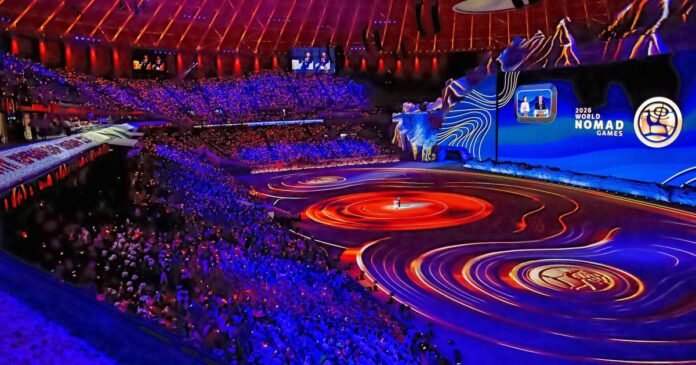
Kyrgyzstan has opened the sixth edition of the World Nomad Games, transforming the country into a global stage for the sports, traditions and cultural heritage of nomadic communities. The spectacular opening ceremony was held at Bishkek Arena on August 31, bringing together athletes and delegations from 104 countries. More than 3,000 athletes participated in the opening parade, making this the largest edition of the Games so far.
The World Nomad Games, often described as the “Olympics of the nomadic world,” were first organised in Kyrgyzstan in 2014. The event was created to preserve, revive and promote traditional sports and cultural practices associated with nomadic peoples. Over the years, it has evolved from a regional cultural sporting event into an international platform that brings together participants from different continents and cultures.
The 2026 edition is being held from August 31 to September 6, with the opening ceremony in Bishkek and the main competitions taking place around the Issyk-Kul region. The Games feature 43 disciplines, covering traditional wrestling, horseback sports, archery, strength competitions and traditional intellectual games. Events include horseback archery, traditional archery, horse racing, tug of war, various national wrestling styles, and traditional board games such as Toguz Korgool and Mangala.
The opening ceremony showcased the richness of nomadic culture through large-scale performances, music, dance and visual storytelling. Athletes from more than 100 countries marched in the stadium, while the artistic programme celebrated the history and traditions of the peoples of the Eurasian steppe. The spectacular setting, combined with elaborate cultural performances, gave the ceremony an atmosphere that went beyond a conventional sporting event.
The Games also attracted considerable international attention because they coincided with the Shanghai Cooperation Organisation summit in Bishkek. Several world leaders attending the summit were present at the opening ceremony, including Indian Prime Minister Narendra Modi, Russian President Vladimir Putin and other heads of state. Their presence highlighted the growing international significance of an event that combines sport, culture and diplomacy.
At the heart of the Games are equestrian traditions that have played an important role in the lives of nomadic communities for centuries. Horse racing, horseback archery and other horse-based competitions demonstrate skills that were historically connected with travel, hunting, warfare and survival across the vast Central Asian steppes. Wrestling and strength-based competitions similarly reflect traditions in which physical ability, endurance and courage were highly valued.
However, the World Nomad Games are not limited to sporting competition. Their larger objective is to create a meeting place for ethnoculture, traditional knowledge and international dialogue. Alongside the sporting programme, the 2026 Games include cultural festivals, exhibitions, academic discussions and programmes highlighting traditional crafts, music, folklore and ways of life.
The participation of countries from across the world also demonstrates how traditional culture can become a bridge between societies. While the Games have their roots in Central Asian nomadic traditions, this year’s participants include countries from Europe, Asia, Africa, Oceania and the Americas. Several countries are participating for the first time, further expanding the international character of the event.
For Kyrgyzstan, the Games carry particular cultural and national significance. The country has positioned the event as a way of sharing its nomadic heritage with a global audience while promoting cultural preservation and international cooperation. The dramatic landscapes around Lake Issyk-Kul and the Tian Shan mountains further add to the distinctive character of the Games, placing ancient sporting traditions against one of Central Asia’s most spectacular natural settings.
The sixth World Nomad Games therefore represent much more than a competition for medals. They are an effort to keep traditional knowledge and cultural practices alive in a rapidly changing world. By bringing thousands of athletes and cultural representatives together, Kyrgyzstan is showing how traditions that once belonged to the nomadic communities of the steppe can find a place on the modern international stage. As the competitions continue through September 6, the Games are once again turning the spirit of nomadic culture into a truly global celebration.