

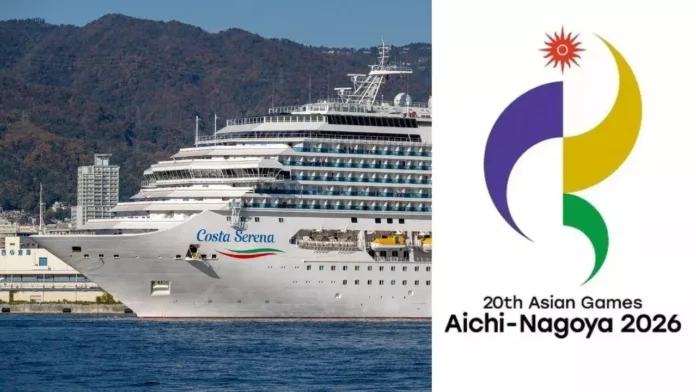
The 20th Asian Games, scheduled to be held in Japan from September 19 to October 4, 2026, will introduce an unusual concept for athlete accommodation. Instead of constructing a conventional Athletes’ Village, organisers in Aichi-Nagoya have chosen to use a large cruise liner, Costa Serena, as a floating residence for thousands of athletes and officials. The ship will be docked at Kinjo Pier in Nagoya and is expected to arrive on September 15, four days before the opening ceremony.
The decision is primarily aimed at providing accommodation without undertaking the cost and time involved in constructing a permanent athletes’ village. The organisers had earlier planned accommodation for around 15,000 athletes and officials, but registrations eventually crossed 17,000, creating additional logistical pressure. The Olympic Council of Asia and the organising committee have subsequently confirmed that accommodation arrangements have been secured for all participants registered within the permitted entry period.
The Costa Serena will accommodate approximately 4,000 to 5,000 people during the Games. According to the original accommodation plan, athletes from around 20 sports, particularly those whose competition venues are close to Nagoya Port, will stay aboard the ship. These include archery, basketball 3×3, cycling, gymnastics, handball, judo, kabaddi, rowing, rugby, tennis, weightlifting, wrestling and wushu.
The cruise liner is equipped with facilities that make it suitable for functioning as a temporary hotel. Reports indicate that it has hundreds of cabins, multiple swimming pools, restaurants and other recreational facilities. During the Asian Games, however, the vessel will remain docked rather than operating as a conventional cruise ship. It will essentially function as a “hotel ship”, providing accommodation and services to athletes throughout the competition period.
The cruise ship is only one part of Japan’s unconventional accommodation strategy. Around 2,400 participants were originally planned to stay in temporary Asian Games Villas, made from container-style units at Garden Pier. These facilities, along with the cruise ship, will form the Athletes’ Plaza. A shuttle service will connect the two locations, with the journey between the piers expected to take around 15 minutes. Other athletes and officials will be accommodated in hotels across Nagoya and other cities where competitions are being held.
The arrangement has attracted attention because it offers a very different experience from the traditional Athletes’ Village seen at major sporting events. Supporters of the concept believe the floating village will provide athletes with an opportunity to interact with competitors from different sports while staying in an unusual setting. Organisers have also presented the idea as an innovative use of existing infrastructure rather than constructing buildings that may have limited use after the Games.
At the same time, the plan comes with logistical challenges. The Asian Games will take place during Japan’s typhoon season, raising questions about the practicality of housing thousands of athletes on a ship. Organisers have maintained that contingency arrangements are being prepared and that weather forecasts will allow sufficient time for necessary decisions.
The unusual accommodation plan reflects the broader approach adopted by the Aichi-Nagoya Asian Games. Rather than concentrating all participants in one purpose-built village, Japan is using a combination of cruise-ship accommodation, temporary structures and existing hotels across different locations. With more than 17,000 athletes and officials registered, this decentralised model is also helping organisers manage the unexpected increase in participation.
The Costa Serena will therefore become one of the most distinctive features of the 2026 Asian Games. As thousands of athletes arrive in Japan to compete across dozens of sports, some will have the unusual experience of returning from competition not to a traditional athletes’ village, but to a floating one anchored in Nagoya Port. The experiment could offer a new model for hosting large sporting events while reducing the need for costly permanent infrastructure.