

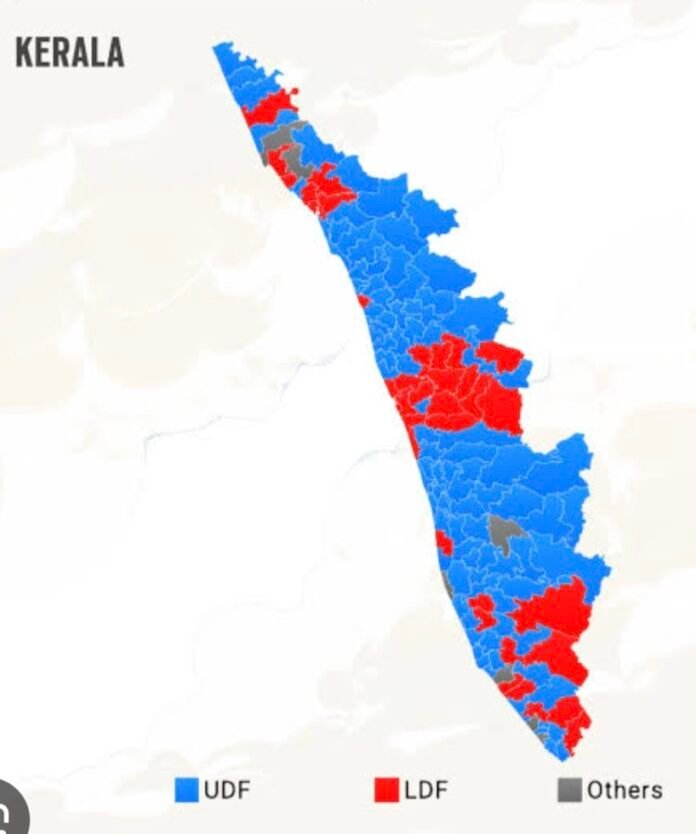
The 2026 Assembly elections in Kerala have delivered a clear and historic verdict, with the United Democratic Front (UDF) returning to power after a decade, defeating the Left Democratic Front (LDF) led by Chief Minister Pinarayi Vijayan.
The results, declared on May 4, 2026, mark a major political shift in the state and carry significant national implications.
Final Results: Accurate Seat Tally
The Kerala Assembly has 140 seats, with 71 needed for a majority.
According to final results and authoritative tallies:
●UDF: 102 seats (clear majority)
●LDF: 35 seats
●Others (including BJP): 3 seats
These numbers confirm a landslide victory for the UDF, well above the majority mark.
Within the UDF:
●Indian National Congress won 63 seats
●Indian Union Muslim League also delivered strong gains
Within the LDF:
●Communist Party of India (Marxist) saw a major decline
End of a Decade of Left Rule
The defeat of the LDF brings an end to 10 years of continuous governance (2016–2026) under Pinarayi Vijayan.
The LDF had made history earlier by breaking Kerala’s tradition of alternating governments, but in 2026, voters have reverted to that pattern decisively. The scale of defeat—dropping from around 99 seats earlier to just 35—makes it one of the LDF’s worst performances.
A Historic Political Momen
This election is historically significant beyond Kerala:
●It marks the end of the last Left-led state government in India
●For the first time in decades, no Communist party is in power in any Indian state
This gives the result a national ideological dimension, not just a state-level shift.
Why the UDF Won So Big
The UDF’s sweeping victory is rooted in multiple factors.
There was strong anti-incumbency after two consecutive terms of the LDF government. Issues related to governance, corruption allegations, and public dissatisfaction played a role. At the same time, the UDF ran a well-coordinated campaign, presenting a unified front and a strong alternative vision.
The alliance also benefited from social coalition consolidation, including support from minority communities and urban voters. Its campaign promises and messaging resonated across regions.
LDF’s Decline: What Went Wrong
The LDF’s campaign, heavily centred around Pinarayi Vijayan’s leadership, did not translate into electoral gains. Analysts note that the government failed to read early signals of public dissatisfaction, which had surfaced in previous local elections.
Despite highlighting achievements in infrastructure and welfare, the LDF could not overcome the broader mood for change.
BJP’s Limited but Notable Presence
The Bharatiya Janata Party (BJP) remained a minor player in terms of seats but managed to win around 1–3 seats, marking a small but notable presence in the Assembly.
While far from a major breakthrough, this indicates a gradual expansion of its base in a state traditionally resistant to the party.
Voter Participation and Election Context
The election saw a high voter turnout of around 78–79%, reflecting strong democratic participation across the state.
The contest remained largely bipolar between UDF and LDF, with regional and local dynamics shaping outcomes in several constituencies.
Conclusion: A Decisive Shift
The 2026 Kerala Assembly election is a clear mandate for change. With 102 seats, the UDF has not just won—it has delivered one of the most decisive victories in the state’s recent history.
For Kerala, this signals a new phase of governance under the Congress-led alliance. For national politics, it marks the end of Left rule at the state level—a development with long-term implications.