

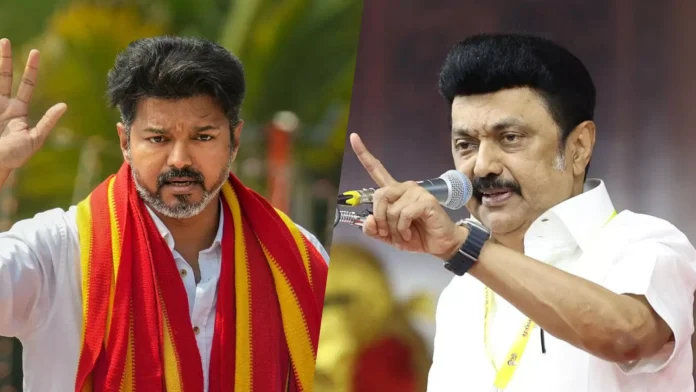
Tamil Nadu’s 2026 Assembly elections have not only reshaped the state’s political arithmetic but also brought renewed focus to an ongoing ideological debate—the place of Sanatan Dharma in public discourse and politics. With actor-turned-politician Vijay emerging as a central figure and his party, Tamilaga Vettri Kazhagam(TVK), making a powerful electoral debut, many observers see this as a shift in both political tone and voter expectations.
The Sanatan Controversy and Political Context
The debate around Sanatan Dharma intensified in recent years following remarks by leaders of the ruling Dravida Munnetra Kazhagam(DMK), including statements by Udhaynidhi Stalin that sparked national controversy. Critics argued that such remarks hurt religious sentiments, while supporters defended them as part of the Dravidian movement’s long-standing critique of caste hierarchies and social inequalities.
Under Chief Minister M.K. Stalin, the DMK government maintained that its ideological stance was rooted in rationalism and social justice. However, the Sanatan issue became a flashpoint in political debates, especially as opposition parties framed it as an attack on tradition and faith.
Governance Under the DMK
Since coming to power in 2021, the DMK government focused on welfare schemes, social justice policies, and infrastructure development. Initiatives in education, healthcare, and public distribution systems were widely discussed, and the administration retained a strong support base in several regions.
At the same time, critics pointed to concerns around law and order, political rhetoric, and governance delivery. The Sanatan controversy added to a broader narrative among some sections of voters that cultural sensitivities were not being adequately respected. It is important to note, however, that there is no official evidence of any state policy targeting Sanatan Dharma itself—the debate remained largely political and ideological rather than administrative.
Vijay’s Entry and His Position
Into this charged atmosphere stepped . While he did not centre his campaign solely on religious issues, his messaging struck a different tone—emphasising unity, governance, and respect for people’s beliefs without aggressive ideological confrontation.
Rather than direct confrontation, Vijay’s “reply” to the DMK’s narrative came through his political positioning. He avoided polarising language, focused on corruption, youth empowerment, and clean governance, and appealed to a broad voter base that included both urban youth and traditional voters.
Election Result and Changing Voter Mood
The strong performance of TVK in the 2026 elections indicates a significant shift. While final government formation dynamics depend on confirmed numbers, TVK’s emergence as a major force suggests that voters were open to an alternative beyond the traditional DMK–AIADMK divide.
For many analysts, this shift reflects:
●A desire for less confrontational politics
●Fatigue with established party narratives
●A growing youth-driven demand for governance-focused leadership
Will Vijay Change the Narrative?
If Vijay transitions from electoral success to governance, his biggest challenge will be to balance cultural sensitivity with administrative effectiveness. His campaign suggests an attempt to move away from ideological extremes and towards a more inclusive political language.
However, expectations are high. Voters will look for tangible outcomes in employment, development, and transparency—beyond symbolism or rhetoric.
Conclusion
The 2026 Tamil Nadu election is not just about who wins power—it reflects a deeper shift in public sentiment. The Sanatan debate highlighted ideological divides, but Vijay’s rise suggests that voters may be seeking a more balanced, less polarised approach to politics.
As Tamil Nadu enters a new political phase, the real test will lie not in rhetoric, but in governance—where promises meet performance, and where a new leadership must prove its ability to deliver for all sections of society.